Reflective Supervision in ABA: A Plain-English Guide
Reflective supervision in ABA is relationship-based, curious, and collaborative. Learn how it builds clinical reasoning and helps reduce provider burnout.
Key takeaway
Reflective supervision in ABA is a relationship-based, curious, and collaborative way to supervise that builds a clinician's thinking, not just their paperwork. Instead of checking boxes, the supervisor and supervisee slow down together.

Foundations of Reflective Supervision in Behavior Analysis
Experts who cover this
4 recordings on openceu cover reflective supervision.
- Featured talk1 Supervision CEU
Foundations of Reflective Supervision in Behavior Analysis
B. Kuereine GrayThe Behaviorist Bookclub
The core topic of the talk: reflective supervision is defined as a relationship-based, curiosity-driven model of supervision focused on clinical growth and…
- 1 Supervision CEU
Reflective Supervision and Client Outcomes
B. Kuereine GrayThe Behaviorist Bookclub
Defines reflective supervision as relationship-based, curiosity-driven, collaborative supervision centered on clinical reasoning and emotional awareness…
- 1 Supervision CEU
Reflective Supervision and Provider Outcomes in ABA
B. Kuereine GrayThe Behaviorist Bookclub
B. Kuereine Gray frames reflective supervision as relationship-based, curiosity-driven, and collaborative, focused on clinical reasoning and emotional…
- 1 Supervision CEU
So You Think You Can Lead, Ten Self Reflection Questions for Leaders in ABA
Sean YocumHickory Learning Group
Cited via Sellers et al. (2016) as a practice where supervisors self-monitor their own behavior and openly admit mistakes to strengthen the…



On this page · 11 sections▾
Reflective supervision in ABA is a relationship-based, curious, and collaborative way to supervise that builds a clinician's thinking, not just their paperwork. Instead of checking boxes, the supervisor and supervisee slow down together. They look at why decisions were made and how the work feels.
This model is still rare in behavior analysis. Most supervision in the field leans toward hours, deadlines, and task lists. Reflective supervision adds something different. It treats the supervisor relationship as a tool for growth, much like the bond between a therapist and a client.
What makes supervision "reflective"#
B. Kuereine Gray is a BCBA and an infant, early childhood, and family mental health specialist. She has worked in disabilities since 1997. In her talk series, she gives a simple definition. Reflective supervision is relationship-based, curiosity-driven, and collaborative. It focuses on two things: clinical reasoning and emotional awareness. Clinical reasoning means how a clinician thinks through a case and picks a next step. Emotional awareness means noticing your own feelings and how they shape your choices.
It is curiosity driven. It's collaborative and it focuses on clinical reasoning and emotional awareness.
From the talk — B. Kuereine Gray
Gray also explains that this model does not stand alone. She says reflective supervision requires reflective practice, reflective teaching, and clinical supervision. In other words, the supervisor has to practice reflection, not just ask for it. Gray notes she did coursework and received a lot of supervision herself. That was just to apply for emerging status as a reflective supervisor. So the approach is a trained skill, not a casual style.
Rapport comes first, just like with clients#
Gray starts with something every behavior analyst already knows. Rapport is one of the first things needed before a client will take on hard therapy demands. Rapport means a trusting, comfortable bond between two people. Clients need it before they can push through difficult goals.
Gray argues the same rule should apply inside supervision. If rapport matters for learners, it should matter for supervisees too. A supervisor and supervisee need an established relationship before deep growth can happen.
It is collaborative in nature.
From the talk — B. Kuereine Gray
She draws a clear line here. Collaboration does not mean one person giving orders. Gray says that "this is your direction, do your direction" style has its place. But a list of tasks to complete does not grow a professional. It gets work done. It does not build a better clinician. That difference sits at the center of the whole model.
Curiosity instead of a to-do list#
The second pillar is curiosity. A curious supervisor asks questions before giving answers. The goal is to help the supervisee see their own thinking.
In her talk on Reflective Supervision and Client Outcomes, Gray sums up what the model is not. It is not asking, "Did you get your hours?" It is not asking, "Are your treatment plans done this specific way?" Those questions belong to administrative supervision. Administrative supervision is the side of the job that tracks rules, hours, and documents.
Reflective supervision being relationship. chip-based, curiosity-driven, collaborative, and then focused on clinical.
From the talk — B. Kuereine Gray
Instead, Gray says the focus is clinical growth and understanding the process. Time goes toward reviewing and reflecting on why we make the decisions we make. The payoff, in her words, is stronger clinicians and practitioners. A supervisor who asks what a clinician noticed and felt, rather than handing over a fix, opens a door that a checklist keeps shut.
Reflection before reaction#
Gray uses a short phrase across her series: "reflection before reaction." It names a habit the model tries to build. When a session goes badly, the natural pull is to react fast, jumping to a fix or a judgment before understanding what actually happened.
Reflection before reaction asks for a pause instead. The supervisee and supervisor first look at what happened. They ask what the clinician felt, what they saw, and what they assumed. Only then do they decide what to do next.
reflection before reaction
From the talk — B. Kuereine Gray
This pause connects back to emotional awareness. Strong feelings can quietly steer clinical choices. A supervisor who makes room for those feelings helps the supervisee notice them. Once a feeling is named, it is easier to set aside and think clearly. Gray frames this as a skill teams can practice. She encourages simple reflective supervision protocols so the habit becomes routine, not rare.
Providers need the same support as clients#
In part two of her series, Gray turns to the providers themselves. She points out a gap in how the field works. Behavior analysts carefully identify support factors for clients, patients, students, and learners. But the field rarely does the same for its own providers.
Gray argues that a science of behavior should apply to everyone in the system. Providers need a support framework just like the people they serve. Without that support, both the person and the organization are less likely to succeed. She even shares that she often feels like she is "on my own island" as a provider.
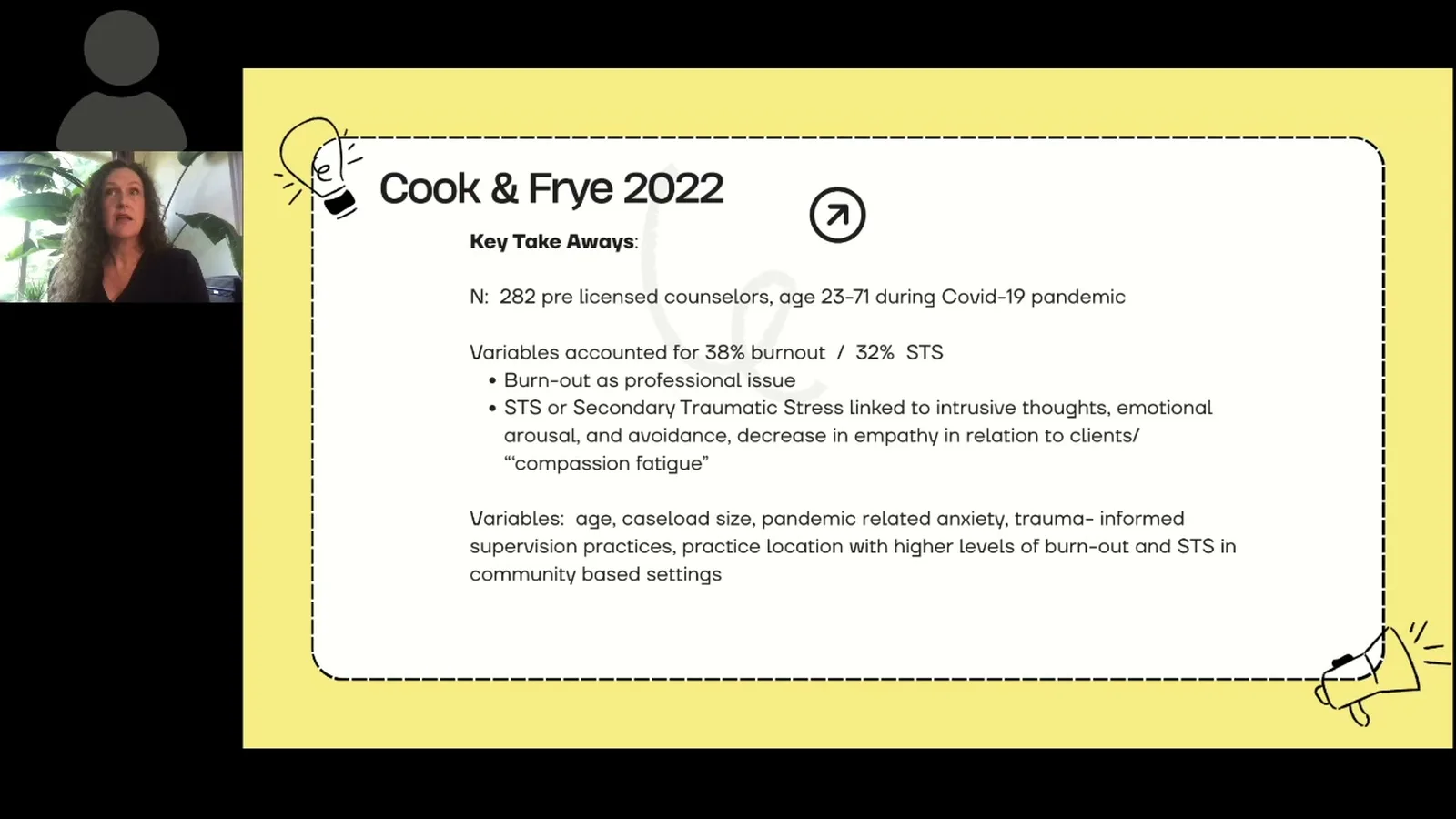
discuss reflective supervision to reduce burnout and improve decision-making.
From the talk — B. Kuereine Gray
Burnout is deep, lasting exhaustion from work that wears down energy and care. Gray calls reducing it one of the key needs in the field right now. Her case is that reflective supervision gives providers a place to process hard work. That space can protect their well-being and sharpen their choices at the same time.
How it connects to better clinical decisions#
Gray links reflective supervision to concrete clinical skills, not just feelings. In her provider outcomes talk, she reports that this kind of supervision has been tied to several gains.
It has been shown to improve clinical reasoning, risk assessment, ethical judgments, and treatment. planning.
From the talk — B. Kuereine Gray
Risk assessment means spotting what could go wrong for a client and planning for it. Ethical judgment means making the right call when rules or values pull in different directions. Treatment planning is choosing goals and methods for a client. Gray adds that reflective supervision is associated with effectiveness in care. Her question to the audience is direct: why wouldn't we use more effective supervision?
In the client outcomes talk, she ties the model to treatment fidelity and case conceptualization. Treatment fidelity means running a plan the way it was written. Case conceptualization means how a clinician makes sense of a client's whole situation. Gray applies reflective supervision to case reviews and team case discussions. The idea is that how a provider functions shapes how the client does.
Owning mistakes as a leader#
Sean Yocum comes at reflective supervision from the leadership side. His talk offers self-reflection questions for leaders in ABA. He points to Sellers et al. (2016) as highlighting reflective supervision as a recommended practice.
It's a recommended practice where leaders must self monitor their own behavior and admit mistakes to improve the supervisor-supervisee relationship.
From the talk — Sean Yocum
Self-monitoring means tracking your own behavior the way you would track a client's. Yocum gives a clear example of a weak apology: "I'm sorry if you felt bad because of the new scheduling policy." He calls that a cop out. A real apology owns the decision and names the extra work it caused.
Yocum says this kind of ownership teaches the team that mistakes are normal. It builds trust and what he calls psychological safety. Psychological safety means people feel safe to speak up and admit errors. He adds that it can cut turnover, because people follow leaders who admit when they are wrong. He is firm that apologizing does not shrink a leader's authority.
How the two views fit together#
Gray and Yocum do not clash on this topic. They stress different parts of the same idea. Gray builds out the full model: rapport, curiosity, collaboration, and a focus on reasoning and emotion. Yocum zooms in on one behavior inside that model. A leader watches their own actions and owns their errors.
Both speakers put the relationship at the center. Gray says supervisors need rapport with supervisees, just as clinicians need it with clients. Yocum says honest apologies build trust "brick by painful, honest brick." Both see supervision as more than giving directions.
Both also tie the model to staff outcomes. Gray points to reduced burnout and better decisions. Yocum points to psychological safety and less turnover. A supervisor could use Gray's framework as the structure. Yocum's advice on self-monitoring and apology then becomes one daily habit within it. Read together, the two talks give a big-picture model and a practical starting point.
Why so few ABA providers use it#
If reflective supervision helps, why is it so rare in ABA? Gray cites a 2022 report from the Office of Planning, Research and Evaluation. That report found reflective supervision is practiced by only a small group of providers.
reflective supervision is really only being practiced. In a very small. population of. providers
From the talk — B. Kuereine Gray
Most of those providers work in early intervention and mental health. Gray lists home visiting, infant and early intervention, child welfare, and social work. It is not being practiced on a broader scale. That is true even though research suggests it could help across mental health practitioners.
Gray also admits there are some setbacks in applying the model to ABA. Behavior analysis has a strong focus on hours, data, and documentation. A model built on emotion and open questions can feel unfamiliar at first. Part of her goal is to show that reflection fits the science, rather than fighting it.
What the research says#
The research named in these talks comes mostly from fields next to ABA. Gray cites a 2022 report from the Office of Planning, Research and Evaluation. It found reflective supervision used mostly in early intervention, home visiting, child welfare, and social work.
Gray also describes a 2019 social work review that looked at 256 studies. It asked what helps supervision work, what hinders it, and in what settings it works. She uses it to show the field has plenty of theory about good supervision.
Within behavior analysis, Yocum points to Sellers et al. (2016). He reports it highlights reflective supervision as a recommended practice. In his summary, leaders self-monitor and admit mistakes to strengthen the supervisory bond.
Gray reports that reflective supervision has been linked to better clinical reasoning and risk assessment. She also names gains in ethical judgment and treatment planning. Still, most of this evidence comes from outside ABA, so direct ABA studies remain a clear gap.
FAQ#
What is the difference between reflective supervision and administrative supervision? Administrative supervision tracks hours, paperwork, and whether tasks are done. Reflective supervision looks at why a clinician made their choices and how the work felt. Gray says it focuses on clinical reasoning and emotional awareness.
Can reflective supervision help with burnout in ABA? Gray frames reducing burnout as a main goal of the model. She argues providers need a support framework, just like clients do. Reflective supervision gives them a regular place to process hard work.
What does a reflective supervisor actually do? They build rapport, ask curious questions, and collaborate instead of only giving directions. Yocum adds that they self-monitor their own behavior. They also openly admit their mistakes to build trust with the team.
Turn this topic into a CEU
You just studied this. Now get credit for it.
Watch Foundations of Reflective Supervision in Behavior Analysis with B. Kuereine Gray and earn 1 free BCBA CEU. Detailed certificate, delivered the moment you finish.