The Five-Part Supervision Framework
A plain-language guide to the five-part supervision framework for behavior analysts. Build relationships, structure, observation, feedback, and reflection.
Key takeaway
The five-part supervision framework is a simple way to run supervision on purpose. It treats supervision as a system with clear steps, not a list of boxes you check at the last minute.
Building a Supervision System That Actually Works
Experts who cover this
The recording behind this guide covers five-part supervision framework.
- Featured talk1 Supervision CEU
Building a Supervision System That Actually Works
Lauren DonovanThe Behaviorist Bookclub
Lauren Donovan presents a five-step framework for running supervision as an intentional system rather than reactive check-boxing: building relationships…
On this page · 8 sections▾
The five-part supervision framework is a simple way to run supervision on purpose. It treats supervision as a system with clear steps, not a list of boxes you check at the last minute. The five parts are building relationships, creating structure, observing performance, teaching and giving feedback, and reflecting on progress.
This matters because supervision shapes the next wave of clinicians. A trainee is a person earning supervised hours toward certification. When supervision is rushed or random, that person learns bad habits. When it follows a clear system, the trainee grows and the clients get better care. The framework gives you a repeatable plan you can trust week after week.
Start with relationships#
Every part of good supervision rests on trust. A trainee who feels safe will ask real questions and admit mistakes. A trainee who feels judged will hide problems until they grow large. So the first step is to build a real working relationship.
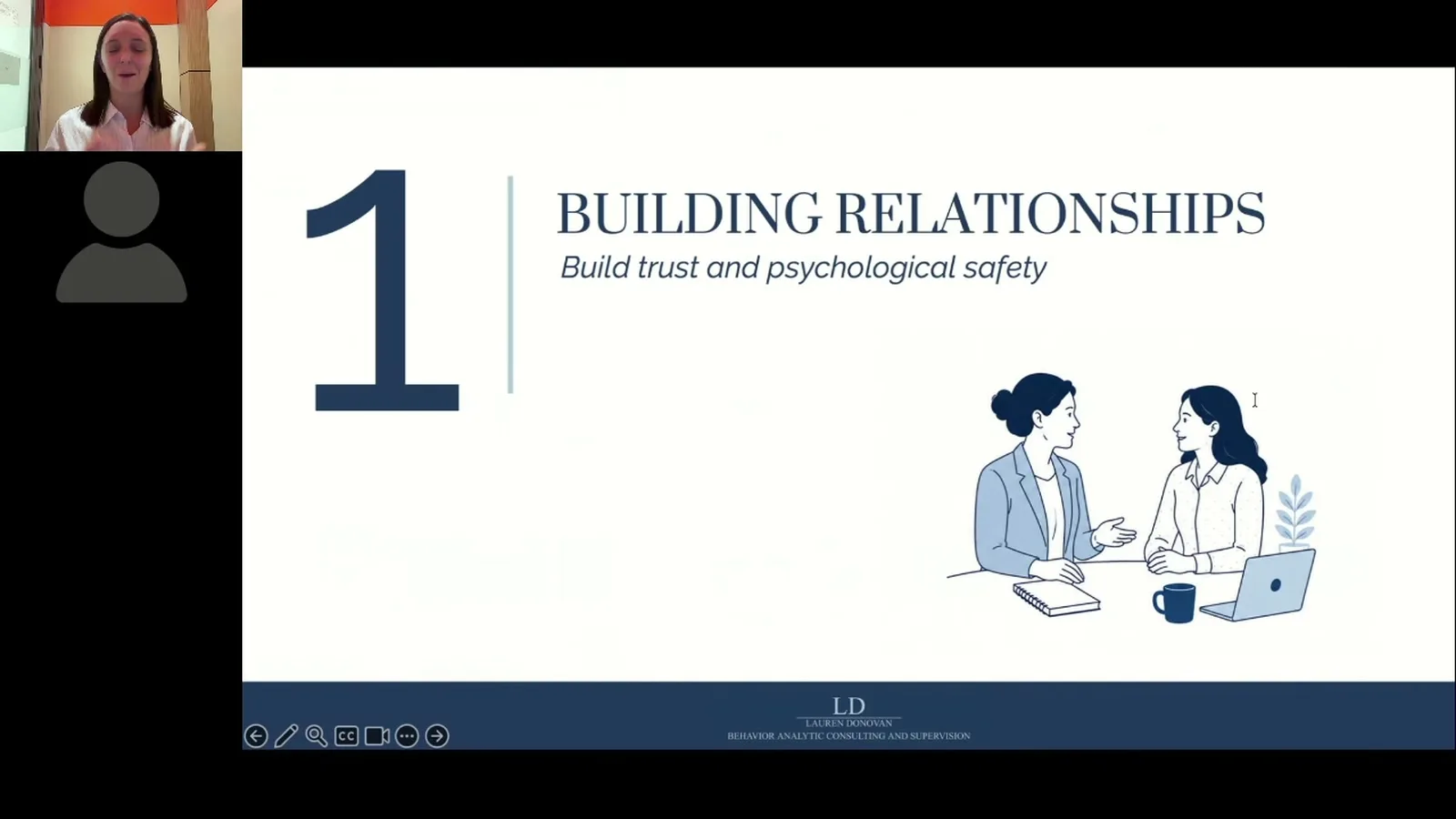
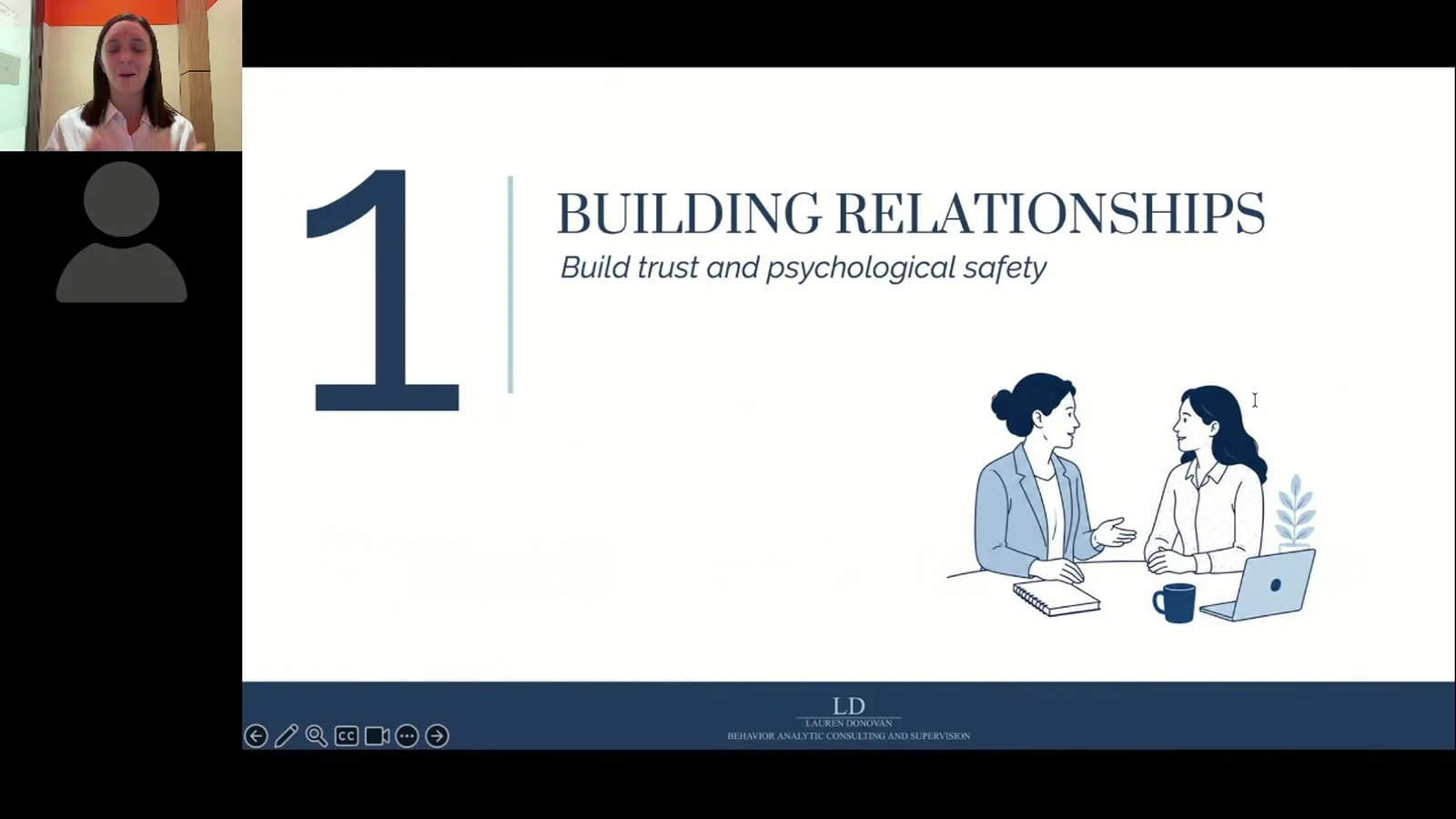
Number one, building relationships, right? Everything starts with relationships. From the talk — Lauren Donovan
This does not mean you become close friends. It means you show up, you listen, and you make it safe to learn. You learn what the trainee wants from their career. You share what you expect. That shared ground makes every later step easier.
Create clear structure#
Once trust is in place, the system needs a shape. Structure is the schedule, the goals, and the written plan that hold supervision together. Without it, meetings drift and hours pass with little learning.
Good structure sets a regular meeting time and a clear agenda. It names the skills the trainee will build and by when. Researchers have pushed for this kind of planning for years. Garza and colleagues (2017) argued that supervision should run as one complete, planned system. They built tools so supervisors could set tasks, goals, and feedback in one clear process.
Structure also helps when life gets messy. During the COVID-19 pandemic, many clinics closed or moved online. Ninci and colleagues (2021) showed how a written fieldwork plan kept training on track through those shocks. A fieldwork plan maps out the hands-on client hours a trainee must log. Their template let supervisors adjust the plan without losing the goals. A clear structure bends instead of breaking.
Observe performance directly#
You cannot coach what you have not seen. The third part is watching the trainee work with real clients. This is where you learn what they can do and where they still struggle.
Observing performance. Build this up as something good. From the talk — Lauren Donovan
That framing matters. Many trainees dread being watched. They think observation is a test they can fail. A good supervisor flips that fear. You explain that watching is how you help the trainee grow. You praise what goes well before you fix what does not. Over time the trainee starts to want the eyes on their work.
Observation also keeps your feedback honest. When you see the session yourself, your notes come from what you actually watched happen. That makes the next step land with more weight.
Teach and give feedback#
 Advertisement
Watching only helps if you turn it into teaching. The fourth part is showing the trainee how to improve and telling them how they did. In the talk, Lauren Donovan names this step teaching and providing feedback. Feedback is the engine that moves skills forward.
Strong feedback is specific and kind. You name one or two things to keep doing. You name one or two things to change. Then you show the change instead of just describing it. Many supervisors use behavioral skills training here, a teach-then-practice method. You explain the skill, model it, let the trainee try, and coach them as they go.
This teaching pays off at scale. Hartley and Dubuque (2023) described an organization-wide training model with heavy hands-on teaching. In their program, 88% of trainees passed the certification exam on their first try. That rate beat many university programs by a wide margin. Clear teaching, repeated often, changes outcomes.
Reflect and evaluate progress#
The last part closes the loop. Donovan calls it reflecting and evaluating progress. You step back and ask how far the trainee has come. Reflection turns single sessions into a story of growth.
Set aside time to look at the whole picture. Compare where the trainee started to where they are now. Check the goals from your structure step. Some are met, and you can celebrate them. Some are not, and they become the focus for next month. This review also tells you if your own supervision is working. If a skill is stuck, maybe the teaching needs a new approach.
Reflection is also where values live. The late Ronnie Detrich built supervision systems that were rigorous but supportive (Twyman et al., 2024). He demanded strong practice and cared for the people doing it. That balance is the goal. You hold a high bar and you help people reach it.
Why the parts work as one system#
The power is in the order and the loop. Relationships make observation feel safe. Structure gives observation something to measure. Observation feeds honest feedback. Feedback moves skills. Reflection checks the whole thing and starts the next round. Skip a part and the others get weaker.
You do not need to be perfect at all five on day one. Pick the weakest part in your current supervision and start there. Build it into a habit, then strengthen the next part. A system grows one piece at a time.
What the research says#
Several peer-reviewed sources back this systems view of supervision.
Garza, K. L., McGee, H. M., Schenk, Y. A., & Wiskirchen, R. R. (2017). Some Tools for Carrying Out a Proposed Process for Supervising Experience Hours for Aspiring Board Certified Behavior Analysts. Behavior Analysis in Practice, 11(1), 62-70. This paper argues that scattered good practices are not enough. It lays out a full process with tools for tasks, goals, and feedback.
Ninci, J., Čolić, M., Hogan, A., Taylor, G., Bristol, R., & Burris, J. (2021). Maintaining Effective Supervision Systems for Trainees Pursuing a Behavior Analyst Certification Board Certification During the COVID-19 Pandemic. Behavior Analysis in Practice, 14(4), 1047-1057. This article shows how a written, personalized fieldwork plan kept supervision working through site closures and a move to online care.
Hartley, B., & Dubuque, M. (2023). The Apprentice Model 2.0: Enhancement of the Apprentice Model. Behavior Analysis in Practice, 16(4), 993-1005. This study reports strong exam pass rates from a structured, organization-led supervision model with hands-on teaching.
Frequently asked questions#
What are the five parts of the supervision framework?
The five parts are building relationships, creating structure, observing performance, teaching and giving feedback, and reflecting on progress. They run as a loop. Each part sets up the next, and the last one starts the cycle again.
How is a supervision system different from normal supervision?
Normal supervision often reacts to whatever comes up that week. A system plans the work in advance with set goals, set meetings, and a clear order of steps. That plan makes the training steady and easier to repeat across many trainees.
Where should a new supervisor start?
Start with relationships and structure. Trust makes a trainee open up, and structure gives your time a shape. Once those two feel solid, add regular observation, then build your feedback and reflection habits from there.
 Advertisement
Turn this topic into a CEU
You just studied this. Now get credit for it.
Watch Building a Supervision System That Actually Works with Lauren Donovan and earn 1 free BCBA CEU. Detailed certificate, delivered the moment you finish.