Teaching WH-Questions Isn’t Enough: Building True Conditional Discrimination
Presented by Dana Pettus
This presentation challenges the assumption that teaching WH-questions in isolation produces flexible verbal repertoires. Drawing on the work of Dr. Francesca degli Espinosa, participants will examine how autoclitic frames and the scaffolding of skills can be used to systematically establish robust discriminated responding across verbal forms and to prevent faulty stimulus control before it becomes entrenched.
Cancel any time. Cert delivered to your inbox the moment you pass the quiz.
Learner ratings
from 247 learners
98% would recommend this CEU to other professionals in their field (204 responses)
“Great information with visual supports”
— Michelle A.“na”
— Stephanie T.
About this CEU
Many behaviour analysts can establish correct responding to individual WH-questions. However, when programs stall at more complex discriminations—such as discriminating features from functions questions, or adjectives from class relations—the issue is rarely the learner’s ability. The breakdown often reflects faulty stimulus control resulting from programming that uses a train and hope method of teaching question discrimination.
Abstract
This presentation challenges the assumption that teaching WH-questions in isolation produces flexible verbal repertoires. Drawing on the work of Dr. Francesca degli Espinosa, participants will examine how autoclitic frames and the scaffolding of skills can be used to systematically establish robust discriminated responding across verbal forms and to prevent faulty stimulus control before it becomes entrenched.
Credits
1 CEU · 60 min
From the talk
What was covered
Hundreds of mastered WH-questions still fall apart when mixed. Autoclitic frames (sentence starters that cue the right answer) build true conditional discrimination (an answer controlled by more than one cue).
- Test WH-question answering in mixed arrays, not isolated drills. Isolated drills hide faulty stimulus control (the wrong cue controlling the answer).
- Treat most classroom labeling as an interverbal tact (a label controlled by both the question and the object). It is not controlled by the object alone.
- Before starting autoclitic frames, confirm 100 to 200 fluent tacts (mastered labels). The learner also needs at least a two-word echoic (repeating two words back).
- Run the three steps in order: echoic training with no objects, autoclitic tacting with no discrimination, then mixed discrimination trials.
- When a learner errors, prompt with the frame first. Save the full verbal answer for later in the prompt hierarchy (the order of help you give, least to most).
- Set mastery criteria (the rule for when a skill counts as learned) around discrimination. A target is not done until the learner holds it in discrimination with everything mastered before it.
Why 200 Mastered Tacts Still Fall Apart in Mixed Questions
You know this learner. They have more than 200 tacts (labels for things they see). They name colors, shapes, actions, and functions. Drill one question type in a row and the data look great. Then you mix the questions and the whole thing comes apart.
Dana Pettus has watched this since she entered the field in 2013. She was running programs from the ABLLS and the VB-MAPP. Learners picked up skill after skill. Then they hit a wall at harder discriminations (telling two question types apart). The skills were there. Putting them together was not.
The common read is that the learner is not ready for it yet. Dana's read is different. The breakdown is faulty stimulus control (the wrong cue controls the answer). The child is answering the picture, not the question. Later she moved to a practice built on the verbal behavior work of Dr. degli Espinosa. Learners there reached the advanced curriculum much faster. They had a solid base, so complex skills came almost free.
But as soon as you put it together, it falls apart.
From the talk — Dana Pettus
Tact vs. Interverbal Tact: What Is Really Controlling the Answer
Start with the definition most of us learned. A tact is a nonverbal SD (something the learner sees or hears). It evokes a response. Then it gets a generalized reinforcer (a reward that works in many settings). Now think about your own day. Pure tacts are rare.
Almost all teaching-table labeling is an interverbal tact (a label controlled by question plus object). 'What color is it' and the car both have to be present. Neither cue does the job alone.
Two terms make this precise. Convergent control (many cues, one answer) is when several cues combine to control one response. Divergent control (one cue, many answers) is when a single cue evokes many responses. 'What color' can evoke blue, yellow, or red. A green ball can evoke ball, round, small, or green. The word green comes out only when both cues converge.
This is why teaching a WH-question as a plain tact is risky. You hold up the card. You ask 'what is it.' The learner says car. You score it correct. You still do not know whether the question did any work at all.
When was the last time you walked into a room?
From the talk — Dana Pettus
A Ten-Minute Probe for Faulty Stimulus Control
The test is cheap and you can run it today. Put out an array of mastered pictures. Hold up one and ask one or two mastered questions about it. Ask both questions about at least one picture. Move at a normal pace and go down the line.
Start with a two or three element discrimination. Object versus color works well: what is it, what color, what color, what is it. Action pictures give you three: who is it, what is he doing, where are they. The next step up is many questions about one object. Same car, six questions. What is it. What sound does it make. What color. What does it have. What do you do with a car. What is a car. After that, move to scenes. Ask about the agent, the action, the location, and prepositions (small words like in and on).
Four error patterns tell you what you need to know. The learner names the item no matter what you ask. The learner starts naming before you even ask the question. The learner gives a compound answer, saying 'mommy drinking' for both 'who is it' and 'what is she doing.' Or the learner guesses, scrolling through answers and shifting to whatever was reinforced last. Any of these means the question is not pulling its weight.
when you do it back to back in this kind of way you'll see everything is just the item name.
From the talk — Dana Pettus
The Gap in the ABLLS and VB-MAPP Teaching Sequences
Typical development gives us a benchmark. Discriminating several questions about the same object usually appears around 2.5 to 3 years old. It grows from there as vocabulary and knowledge grow. Research shows autistic children make steady errors on these conditional discrimination questions (answers that depend on the question asked). A bigger vocabulary alone does not fix it.
Now look at how our assessments sequence the work. The ABLLS labeling section teaches tacts of objects, actions, features, functions, and classes. Nothing in that sequence checks interverbal tacts or question discrimination. The interverbal section teaches what, where, who, and when answers, again with no discrimination test built in. A real test of discriminating questions about items and activities does not arrive until late in the sequence.
The VB-MAPP tacting sequence has the same shape. Fifty generalized tacts. Then noun and verb combinations. You teach 'mommy drinking' as one chunk. You never check that mommy answers 'who' and drinking answers 'what is she doing.' The check on color, shape, and function discrimination lands at a later tact milestone. By then, the learner has often built faulty stimulus control from earlier teaching. The discrimination was never explicitly taught or tested.
Autoclitic Frames: The Three-Step Teaching Sequence
An autoclitic frame is a verbal frame with a fixed part and a variable part. 'In the' is the fixed part and it points to a location. Kitchen fits. Moo does not. 'She is' is fixed, and running, drinking, or dancing fill the slot. The fixed part pulls for a whole class of answers, because of a long history of hearing it that way.
Dr. degli Espinosa built a teaching procedure on that fact. You ask a tight, structured question. The learner answers with a frame that shares sound with your question. 'What color' gets 'color blue.' 'What number' gets 'number four.' The question evokes the frame. The frame narrows the field to one class of answers. The picture then picks the member of that class.
Check the prerequisites first. The learner needs roughly 100 to 200 fluent tacts. They need solid labels for colors, animals, numbers, and letters. They also need at least a two-word echoic (repeating two words back). Pick the first discrimination from an area of strength. Number versus color, letter versus color, and shape versus color are good starting points. Item versus color is often the hardest one, so do not default to it.
The sequence has three steps. Step one is echoic training with no objects in sight. You want the frame tied to the words, not to a picture. You say 'say color purple' and the learner repeats it. Four colors and four numbers are plenty. Step two is autoclitic tacting. Show an array of four, ask only one question type, and let them practice 'number two, number three' with the frame. Step three is the discrimination. Prime with a few echoics, put out four colored numbers, and alternate the two questions down the line. Ask both questions about one of them.
Teachers often balk at the grammar here. 'Color green' is not a sentence. In Dana's experience, learners use the frame only as long as they need it, then drop it.
they'll use the frame when they need it.
From the talk — Dana Pettus
What the Research on Autoclitic Frames Shows
Dr. degli Espinosa published a study in 2020 that described and evaluated this procedure. Two children with autism learned to tact under multiple control (answers driven by more than one cue). She taught 'what is it' against 'what color.' Both learners discriminated the questions with taught stimuli and with untaught stimuli. One learner then answered a number versus color discrimination that had never been taught. That is a strong first sign of generalization (the skill spreading to new, untaught examples).
In 2021, Milishkovic and colleagues ran an extension and replication with three more participants. They used the same procedure on shape versus number and item versus color. It worked again. They noted that item versus color was harder for two or three of the participants than shape versus number. Their explanation was the long reinforcement history (how often labeling has been rewarded before) for labeling items. Dana reports the same pattern in her own caseloads. That is why she avoids item versus color as a first target.
Also in 2021, Dr. degli Espinosa compared teaching with and without the frames procedure. All four children eventually showed generalized interverbal tacting. Two of them only got there in the frames condition. Two got there without it.
However, for all of them, it was a more efficient way.
From the talk — Dana Pettus
Prompting and Fixing the Three Error Patterns
Prompt least to most, and make the frame your first prompt. If the learner errors on 'what color,' you say 'color' and stop. That cues them to produce the frame and to prompt themselves toward a color answer. Only go to a full verbal prompt ('color blue') if the frame prompt fails. Enough differential reinforcement (rewarding only the correct answer) will eventually teach correct answers without any of this. That is not the skill being built here.
Three error types call for three different fixes. First, tact errors: the learner names the wrong color or number. That means the basic tact training was not strong enough to hold up in discrimination. Pause the program and build fluency. Second, wrong frames: the learner says 'number yellow' or pairs the wrong frame with the question. Go back to step two, autoclitic tacting, and add echoic priming before sessions.
Third, the learner produces a clean frame but is still not listening to the question. You ask 'what color' and get 'number four.' Use a textual prompt (a printed word card) here. Make one card reading color and one reading number. Give the SD with no target stimuli visible. Immediately prompt the learner to select the card and say the frame. Then present the stimuli so they complete the answer: 'color blue.' Keep the cards in the same position every time, because the card is a support and not another discrimination.
If your learner does not read, swap the words for pictures. A card covered in colors means say color. A card covered in numbers means say number. You will need a little pretraining, but it works. Fade the prompt in steps. Move from cards to a point at the same spot on the table. Then just ask the question before the stimuli appear. Many learners have a click moment partway through this, and the discrimination starts generalizing on its own.
we're trying to teach the more generalized skill of being able to prompt yourself.
From the talk — Dana Pettus
Layering Skills: From Colors to Features, Functions, and Classes
Change your mastery criteria and much of this takes care of itself. A target is not mastered until the learner holds it in discrimination with targets mastered earlier. Animal sounds are not done when the learner can say moo. They are done only when the learner can answer several questions about the same animal in one run: 'what does it say,' 'what is it,' and 'what color.' That means interspersing mastered questions into every current program.
Think of skills as layers, not as a checklist. When you add classes, you are not teaching classes alone. You are teaching classes mixed with colors, items, sounds, and parts. The frames scale with the skill. It's a car. Color blue. Shape circle. Number four. Letter B. A cow says moo. A pig says oink. A car is a vehicle. A car has wheels. You kick a ball. You eat with a fork. One note from Dr. degli Espinosa's approach: treat animals as objects. Say 'it's a dog,' not 'animal dog.' Class relations (grouping items by category) come later.
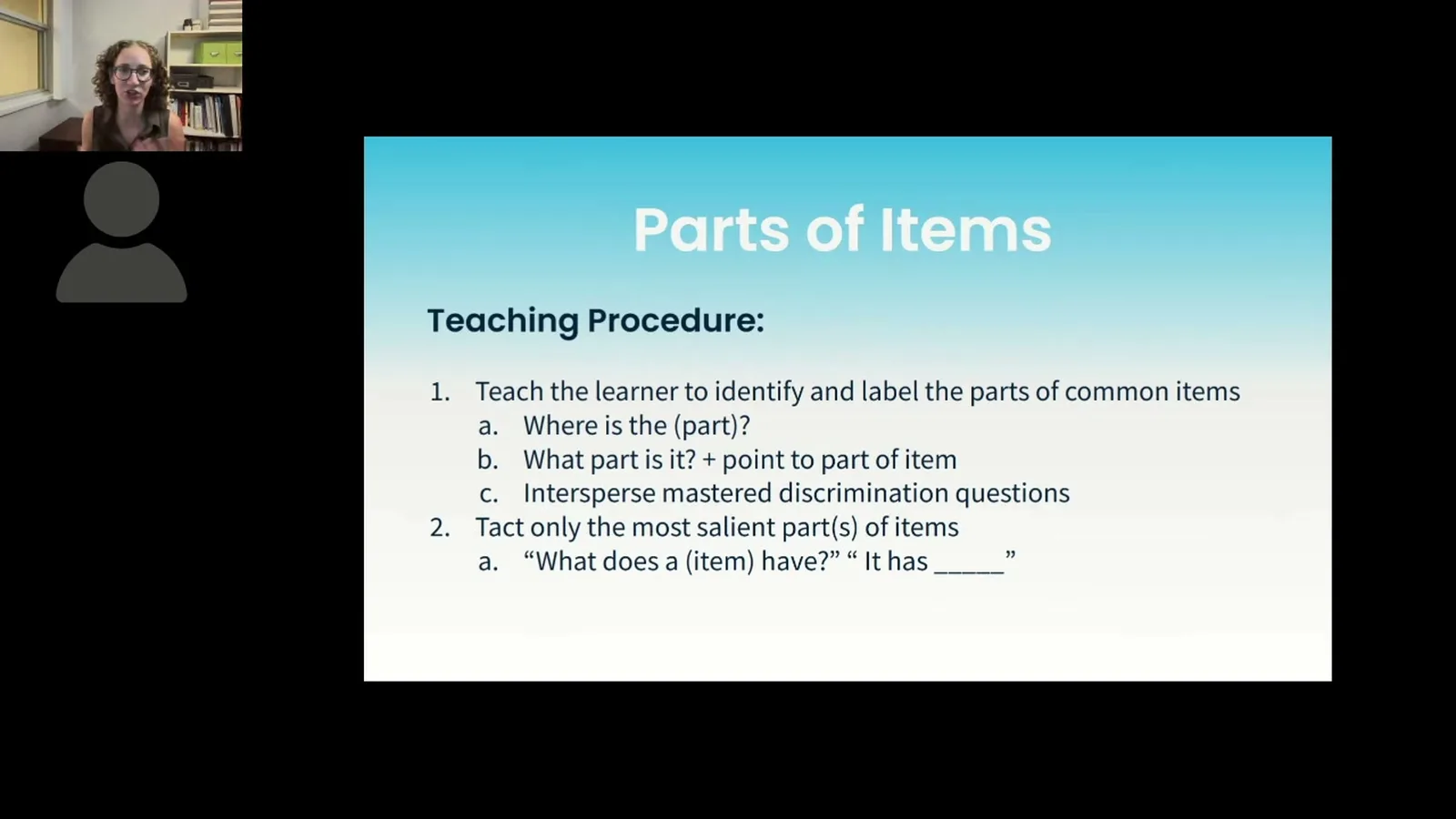
Order matters inside the harder skills too. For parts of objects, teach labeling the whole item before teaching its parts. A learner who answers 'wheels' to 'what is it' is not wrong. The answer is just under the wrong stimulus control. Dana uses 'what part' to keep that clean. Scenes come next: who is it, what are they doing, where are they. Then layer on two-component questions like 'what color is his shirt,' and after that features and functions.
Two practical limits are worth knowing. Wait on this procedure if the learner only produces one-word responses, and build the two-word echoic first. For an AAC user (someone who uses a device to communicate), a folder labeled colors that speaks its name can act a bit like a frame. Sign language works with the procedure as well.
It's not quite the same procedure because it's visual versus auditory
From the talk — Dana Pettus
Common questions
What is an autoclitic frame in ABA?▾
It is a verbal frame with a fixed part and a variable part. Think 'in the' plus kitchen, or 'she is' plus running. The fixed part has a long history of being completed by one class of words. That history makes it pull for that class. In teaching, the frame is matched to the question: 'what color' gets 'color blue.' That gives the learner a self-prompt that narrows the answer before the picture even matters.
How do I know if my learner's WH-question answering is under faulty stimulus control?▾
Run a fast mixed probe with mastered stimuli only. Put out an array and hold up a picture. Ask one or two mastered questions about it, alternating question types down the line. Watch for four signs. The learner names the item no matter what you ask. The learner answers before you finish. The learner gives compound answers, or guesses and scrolls. Any of these means the question is not controlling the response. A learner who is perfect in blocked drills and falls apart here has the skills but not the discrimination.
Isn't 'color green' bad grammar? Will the learner get stuck saying it?▾
It is awkward, and that is accepted on purpose. Dana and Dr. degli Espinosa have both found that learners use the frame only while they need it to discriminate. Once the discrimination is solid, most drop the frame on their own. If a learner keeps it, you can reinforce responses without the frame for a short period.
Which discrimination should I teach first with this procedure?▾
Pick from your learner's area of strength. Number versus color, letter versus color, and shape versus color are common first targets. Item versus color tends to be harder. Labeling items has such a long reinforcement history that doing something else with the item takes more work. That difficulty showed up in the 2021 replication and in Dana's own clinical practice.
Do I need to run the echoic training step if my learner already discriminates some questions?▾
Not always. The full echoic and autoclitic tacting steps are for establishing the first basic question discrimination. Once a learner has that initial discrimination, you can move into more complex skills. That includes classes, parts, features, and functions, without rebuilding the whole sequence. You still intersperse mastered questions and keep mastery criteria tied to discrimination.
About the speaker
Dana Pettus is a Board Certified Behavior Analyst working in Toronto, Ontario. She has worked in ABA since 2013, mostly with children and teens with autism. Her clients have also included those with dual diagnoses and developmental and intellectual disabilities. Her background is in clinical practice rather than research, with a focus on early intervention and language training. She now works with older clients as well.
This summary was generated from the recording’s transcript. Quotes are taken word for word from the talk.
What you'll learn
- 11. Discriminate between correct WH responding under limited stimulus control and responding under true conditional and multiply controlled stimulus control. 2. Analyze learner errors to identify competing, restricted, or faulty stimulus control within tact and WH-question programs. 3. Design cumulative instructional sequences to establish discriminated responding across WH forms, adjectives, features, functions, and class relations. 4. Revise existing verbal behaviour programs to strengthen stimulus control, promote maintenance, and reduce rote responding.
Concepts in this CEU
Course materials
Related talks
Talks that cover the same concepts
Getting the Right Answer Isn’t Enough: Establishing Speaker–Listener Repertoires for Complex Learning
The Behaviorist Bookclub

It’s Complicated: Teaching Relationship Safety That Reflects Real Life
The Behaviorist Bookclub

Rad N Bad: Dosage by Tradition: What the Research Actually Says About ABA Hours, and the Contingencies Behind Them
Hickory Learning Group

When the Foundations Are Right: Unlocking Advanced Verbal Repertoires
The Behaviorist Bookclub
Shaping Behavior Change when ADHD is in the Picture
The Behaviorist Bookclub

The Interdisciplinary Case Conference
The Mindful Learner LLC
More from The Behaviorist Bookclub
Real World” BCBAs, the “Behavior Crisis”, and Pathological Demand Avoidance
The Behaviorist Bookclub
Collaboration and Building Rapport: Starting a Strong Foundation With Caregivers and Stakeholders in the Home
The Behaviorist Bookclub
Harm Reduction Within ABA Practice
The Behaviorist Bookclub
OpenCEU is supported by advertising from third-party sponsors. Sponsors are clearly labeled, have no influence over course content, instructors, or CEU decisions, and never appear on certificates. The BACB does not sponsor, approve, or endorse OpenCEU sponsors or their products.