Interoception Teaching for People With IDD: A BCBA Starter Guide
Learn how to teach interoception to people with IDD so they can read internal body cues. Practical strategies from a BCBA-led CEU.
Key takeaway
The body has sensory systems that pull in information from the outside world, and a quieter set that reports what is happening inside the skin.
What Does Your Body Know? Teaching Individuals with IDD to Recognize Internal Warning Signs`
Free learning path on this topic
PDA and Demand Avoidance
B. Kuereine Gray's three PDA talks plus Clelia Sigaud on the logic of anxiety. What PDA is and isn't, how to collaborate with caregivers, how to handle complex profiles and replacement behaviors, and why demand-avoidant learners respond the way they do.
On this page · 10 sections▾
The body has sensory systems that pull in information from the outside world, and a quieter set that reports what is happening inside the skin. Interoception is one of those inside senses, and many learners with intellectual and developmental disabilities (IDD) need direct teaching to use it well.
What interoception is and why it matters for IDD#
Most BCBAs grew up on the five outside senses: sight, sound, smell, taste, and touch. Those report what is happening around the learner. Interoception is different. It reports what is happening inside the chest, the gut, the throat, and the muscles. A racing heart, a tight stomach, heavy eyes, a clenched jaw. All of that is interoceptive data.
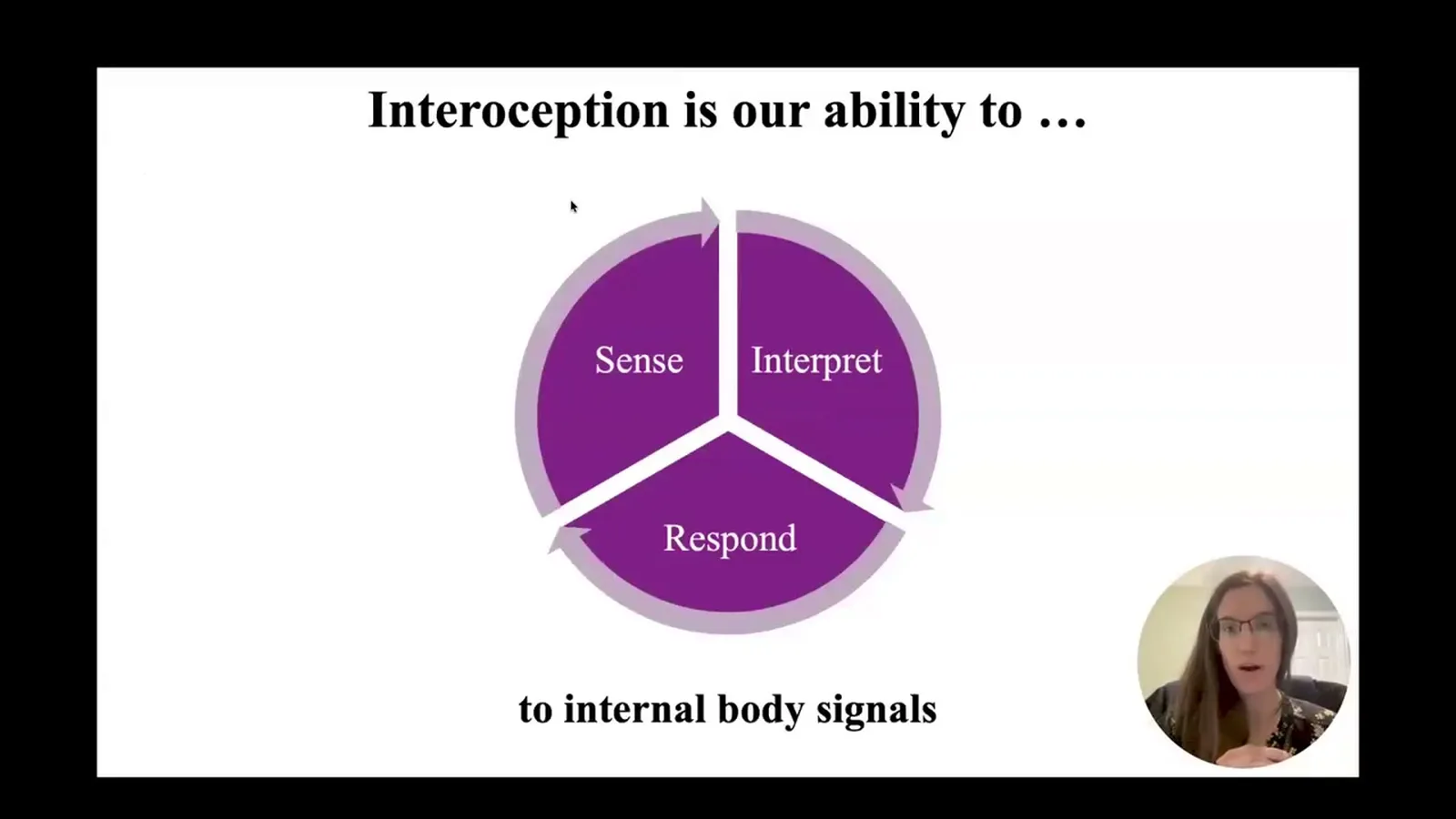
interoception is our body's ability to sense, interpret, and respond to our internal body signals From the talk — Tricia Lund
For people with IDD, this matters in two big ways. First, internal cues are the earliest warning system the body has. They fire long before a problem is loud enough to label with words. Second, the same system that reads hunger and fatigue also reads fear, threat, and the gut-level sense that something is off. If a learner cannot read that channel, a lot of the safety rules we teach show up too late to help.
Sensing, interpreting, responding: the three-part loop#
Interoception is not one skill. It is a small chain.
- Sensing. Notice the signal. Stomach is clenching. Heart is faster. Shoulders are rising.
- Interpreting. Give the signal a name. Hungry. Tired. Nervous. Something here feels wrong.
- Responding. Take action that fits. Eat. Rest. Get space. Tell a trusted adult.
When a learner only has step three (the response) but not step one and two, safety lessons stall out. The body is shouting, but the learner has no way to act on the message until the situation is already overt. Building interoception means slowing down and teaching each link.
Why many learners with IDD miss internal cues#
A learner can struggle with interoception for a lot of reasons that have nothing to do with effort. Lund flags four that BCBAs see all the time.
individuals that are neurodivergent, individuals that have a history of trauma...may struggle with interoceptive awareness From the talk — Tricia Lund
- Neurodivergence. Many autistic and IDD learners process internal signals differently. Cues may be muted, scrambled, or only register when they are extreme.
- Trauma history. A nervous system that has been overwhelmed often turns down the volume on internal cues. That is a protective move, not a deficit.
- Compliance-heavy histories. Years of "sit still, finish your work, ignore that feeling" can teach a learner that internal signals are noise to push past.
- Medication effects. Drugs that act on the nervous system can blur sensing and interpretation. That is worth knowing before you assume a learner is ignoring you.
None of this is a reason to skip interoception work. It is a reason to start earlier, go slower, and stack supports.
How to build body discrimination before safety rules#
A lot of safety programming jumps straight to the script: say no, go away, tell someone you trust. Those scripts assume the learner has already noticed that something is wrong. For many learners with IDD, that is a leap.
The fix is to teach body discrimination first. Before the rule, the learner needs the cue. That means slow, repeated practice naming what is happening inside.
- Ask "what does your body feel like right now?" during calm moments, not just hard ones.
- Pair body check-ins with naturally occurring antecedents: greeting a new person, walking into a noisy room, sitting next to a stranger on the bus.
- Reinforce the report, even when the report is "I don't know." That answer still counts as noticing.
Once a learner can reliably tact internal states, the safety rule has something real to hook onto. Now "tell a trusted adult" is triggered by a felt signal, not a memorized script.
Body maps, body scans, and visual scales that work#
Interoception is invisible by definition, so the teaching tools need to make it visible. A few that travel well between ABA, OT, and SLP sessions:
- Body maps. A simple outline of a body where the learner colors or points to where they feel something. Tight chest gets a color. Wobbly legs get another.
- Body scans. A short routine: check your head, your chest, your stomach, your hands, your feet. Name what each part feels like. Two minutes, twice a day.
- 0 to 5 tension scales. A felt-board or printed visual that lets the learner rate how activated they feel without needing the language for it.
- Visual thermometers. A vertical scale that grows from calm to busy to too much. Concrete. Easy to point to.
- ABC logs with an interoceptive column. Add a fourth column to the standard antecedent, behavior, consequence chart for body sensation. Patterns jump out fast.
These tools work because they give the learner and the team a shared vocabulary for something that used to be private.
Embedding interoception into daily living#
Interoception cannot live only in the safety-skills binder. If a learner only practices body awareness during one weekly lesson, the skill stays brittle. The more useful move is to fold it into routines that already happen.
- Toileting. Add a body check before the prompt. "What is your stomach telling you?"
- Mealtime. Pair the start of the meal with a hunger rating, and the end with a fullness rating.
- Hygiene. Tooth brushing, showering, and dressing all offer natural touchpoints for sensing.
- Movement. Before and after a walk, a stretch, or a workout, name how the body feels.
- Transitions. Use the moment between activities to scan and report.
These embedded reps are how the skill generalizes. They also matter for the pause, scan, decide chain that Lund's co-presenter described, where a learner interrupts automatic responding, scans the body, and chooses what to do next.
your body doesn't just track hunger. It tracks danger too From the talk — Tricia Lund
Every routine where a learner practices reading the channel for hunger or fatigue is also practice for reading it for fear and threat. That is the whole point.
When to bring in OTs, SLPs, and caregivers#
Interoception is bigger than any one discipline. BCBAs can do a lot, but the work gets stronger when other people are in the room.
- Occupational therapists. OTs bring deep training in sensory processing and body-based curricula. They are the right partner for body-mapping work and structured interoceptive programs.
- Speech-language pathologists. SLPs help learners build the language or AAC vocabulary to tact internal states. Without that, a learner can feel the cue but not share it.
- Teachers and school staff. They see learners across a longer day and catch shifts that a short ABA session might miss.
- Caregivers and direct support staff. They are usually the first to notice the breathing change, the posture shift, the quiet move toward a trusted adult. Coach them to name what they see in real time.
- Interoception clinicians. If you can find a clinician trained in a structured interoception curriculum, loop them in. They can give the team a shared framework and pace the work for learners who need slower exposure.
A coordinated team turns interoception from a private lesson into a real repertoire that travels with the learner across home, school, and community. The goal is for the language to match across settings. If the school team uses a 0 to 5 scale and the home team uses a thermometer, the learner has to translate every time. Pick one set of tools as a team and stick with it.
What this changes about safety programming#
Behavior skills training is not going away, and it should not. The point of building interoception is not to replace "no, go, tell" or good touch and bad touch curricula. It is to give those scripts a real trigger.
A learner who can feel the early signal can act on it before the situation is overt. A learner who cannot feel that signal is stuck waiting for the situation to become extreme enough to match the rule. That gap is where grooming lives.
For BCBAs writing safety goals, that means two things. First, screen for interoceptive awareness before you write a rule-based safety goal. If the learner cannot reliably tact internal states, add prerequisite goals that build that repertoire. Second, write goals that reinforce reporting discomfort, not just compliance. "I don't like that," "I need space," and "something feels weird" are man's worth shaping. They are also the earliest forms of self-advocacy a learner can use under pressure.
FAQ#
What is interoception in simple terms? Interoception is the sense your body uses to read what is happening inside you. It tells you when you are hungry, tired, nervous, hot, or in pain. It is the inside version of your other senses.
Why do people with IDD struggle with interoception? Several reasons stack up. Neurodivergent brains often process internal signals differently. A history of trauma can quiet the system. Years of compliance-focused teaching can teach a learner to ignore body cues. Some medications also blunt the signal.
Can interoception actually be taught? Yes. It is a learned repertoire, not a fixed trait. Learners build it through repeated practice noticing, naming, and acting on internal signals. Body maps, body scans, and visual scales make the work concrete enough to teach with ABA tools you already use.
What tools help teach body awareness? Body maps, body scans, 0 to 5 tension scales, visual thermometers, and ABC logs with an interoceptive column. Pair these with structured programs like MABT or assessments like the MAIA-2 when you have an OT or interoception clinician on the team.
How long does it take to build interoceptive awareness? Plan in months, not weeks. Early gains show up as a learner using new body words and pointing to where they feel things. Trustworthy self-advocacy on safety takes longer, because the learner has to notice, interpret, and act under pressure. Steady daily reps move it faster than long weekly lessons.
Bring this into your practice#
Interoception teaching is not a side quest. It is the foundation under every safety lesson, every self-advocacy goal, and every emotional regulation plan you write. If your learners cannot read the channel, your scripts arrive late.
Watch the full talk for the case examples, the behavioral indicators Carolyn Wilkinson breaks down, and the program list you can bring to your interdisciplinary team.
Turn this topic into a CEU
You just studied this. Now get credit for it.
Watch What Does Your Body Know? Teaching Individuals with IDD to Recognize Internal Warning Signs` with Tricia Lund and earn 1 free BCBA CEU. Detailed certificate, delivered the moment you finish.
Keep going with a free learning path
PDA and Demand Avoidance
B. Kuereine Gray's three PDA talks plus Clelia Sigaud on the logic of anxiety. What PDA is and isn't, how to collaborate with caregivers, how to handle complex profiles and replacement behaviors, and why demand-avoidant learners respond the way they do.