It’s Complicated: Teaching Relationship Safety That Reflects Real Life
Presented by Patricia "Tricia" Lund, BCBA, CSE, LBA & Carolyn Broner, Ph.D., M.S. Ed., BCBA

In this session, Patricia Lund, BCBA, and Carolyn Broner, BCBA, examine why traditional rule-based safety programs fall short for individuals with autism and intellectual and developmental disabilities, and what a developmentally grounded, relationship-based alternative looks like across the lifespan. Broner opens with early childhood, reviewing the shared content model behind most child safety curricula (body ownership, touch and secret discrimination, refusal, disclosure) and the evidence base, including a Cochrane review of 24 trials. She identifies core limitations: prevention burden placed on the child, the assumption that danger is recognizable, binary safe/unsafe sorting, rules taught without developmental prerequisites, and no demonstrated abuse prevention. She then presents a Notice-Interpret-Respond framework built on teachable interoception, a spectrum-based model of felt safety, emotional safety language for private events, flexible response repertoires (pause, scan, decide), and the BCBA's role across universal, family, and child-directed tiers. Lund extends the discussion to teens and adults, arguing that sex education is abuse prevention: it builds disclosure language, models of healthy relationships, decision-making skills, and sexual self-esteem. She reviews relevant BACB ethics codes, walks through the SSKAAT-R and the free TALK-SC assessments, and covers consent procedures, guardian review, private settings, trauma effects on results, the knowledge-versus-behavior distinction, and using scores to program goals rather than restrict relationships.
Register free & watch nowCancel any time. Cert delivered to your inbox the moment you pass the quiz.
Learner ratings
from 69 learners
100% would recommend this CEU to other professionals in their field (26 responses)
“Looking foreword for more training”
— Prianka R.“This presentation helped me to understand how relationship safety is the foundation for successful Applied Behavior Analysis. It transforms therapy sessions from forced compliance into meaningful, collaborative connections.”
— Cristina G.“GOOD”
— Kelvin O.
About this CEU
In this session, Patricia Lund, BCBA, and Carolyn Broner, BCBA, examine why traditional rule-based safety programs fall short for individuals with autism and intellectual and developmental disabilities, and what a developmentally grounded, relationship-based alternative looks like across the lifespan. Broner opens with early childhood, reviewing the shared content model behind most child safety curricula (body ownership, touch and secret discrimination, refusal, disclosure) and the evidence base, including a Cochrane review of 24 trials. She identifies core limitations: prevention burden placed on the child, the assumption that danger is recognizable, binary safe/unsafe sorting, rules taught without developmental prerequisites, and no demonstrated abuse prevention. She then presents a Notice-Interpret-Respond framework built on teachable interoception, a spectrum-based model of felt safety, emotional safety language for private events, flexible response repertoires (pause, scan, decide), and the BCBA's role across universal, family, and child-directed tiers. Lund extends the discussion to teens and adults, arguing that sex education is abuse prevention: it builds disclosure language, models of healthy relationships, decision-making skills, and sexual self-esteem. She reviews relevant BACB ethics codes, walks through the SSKAAT-R and the free TALK-SC assessments, and covers consent procedures, guardian review, private settings, trauma effects on results, the knowledge-versus-behavior distinction, and using scores to program goals rather than restrict relationships.
From the talk
What was covered
Rule-based safety programs fall short for autistic and IDD learners. This session builds a relationship-based model instead, from childhood to adulthood.
- Check that a learner can notice and name a body signal before you teach a safety rule. Rules without that base fail under stress.
- Drop safe versus unsafe for a spectrum. Teach phrases like I feel unsure so a learner can report the gray moments.
- Teach a response menu instead of one script: pause, scan, decide, then move away, ask a question, or get help.
- Treat sex education as abuse prevention. Build sexual self-esteem as a protective factor (something that lowers risk) rather than an extra topic.
- Use the TALK-SC to map knowledge gaps and write goals. Never use a low score to restrict someone's relationships.
- Program for generalization (using a skill outside of training) and train caregivers. A skill shown in session is not a skill used in a real relationship.
Why Safe Versus Unsafe Rules Break Down in Real Relationships
Most child safety programs ask a learner to sort the world into two bins. Safe or unsafe. Good touch or bad touch. Then they add a short script: say no, get away, tell someone. Those lessons are well meant. They do teach real ideas. This session opened by naming what they miss.
Harm rarely looks like stranger danger. It grows inside a bond the person already has. It shows up as slow boundary pushing. It shows up as mixed signals and power gaps. None of that fits a two-bin rule. When the other person is someone the child loves, there is no clean slot to drop the moment into.
For people with autism or IDD (lifelong thinking and learning differences), the gap gets wider. Body awareness may still be forming. So may words for feelings. So may the skill of reading context. Self-advocacy (speaking up for your own needs) is often thin. The rule gets taught. The skills that make the rule usable do not.
Traditional safety programs are built around simple rules.
From the talk — Patricia "Tricia" Lund, BCBA, CSE, LBA & Carolyn Broner, Ph.D., M.S. Ed., BCBA
What the Research on Child Safety Curricula Actually Shows
The evidence base here is real, and Broner walked through it. A Cochrane review (a rigorous summary of many trials) looked at 24 trials with more than 5,800 children. It found 15 different safety programs. Most taught body safety rules, touch and secret sorting, refusal, and who to tell. A later meta-analysis (a study combining many earlier studies) looked at 29 studies. It found gains in knowledge, safety skills, and attitudes over control groups.
Look closely and the content is nearly the same from program to program. Different names. Different ages. Same core themes: body ownership, touch, secrets, refusal, disclosure. The field has settled on one shared content model. That is not a scandal by itself. It does mean the field has asked a narrow set of questions.
The teaching methods match too. Stories, videos, games, and puppets carry the concepts. Role play and rehearsal give practice. That is discrete trial teaching and behavior skills training (teach, model, practice, give feedback) aimed at safety content. The logic works fine for teaching a rule. The open problem is generalization.
Despite measurable gains in knowledge, these programs have not been shown to actually prevent abuse.
From the talk — Patricia "Tricia" Lund, BCBA, CSE, LBA & Carolyn Broner, Ph.D., M.S. Ed., BCBA
Five Limitations, and the Structural Gap Underneath Them
The session grouped the problems into five limitations. Prevention falls on the child. Danger is assumed to be easy to spot. Events get sorted into safe or unsafe. Rules are taught before the growth skills that support them. And no program has been shown to stop abuse.
The fourth one matters most to us. It is not a curriculum gap. It is a sequencing problem. We teach the top of the stack before the base is there. Programs also ask children to trust their feelings. They never teach them to notice those feelings first. They describe what unsafe looks like with no picture of healthy to compare it against.
Two outside gaps sit beside those. Power and grooming (slow trust building before harm) are rarely taught head on. Yet those are the exact conditions where most abuse happens. Help seeking is the other gap. It usually stops at telling a trusted adult. That step only works if the adult is there, believes the child, and acts.
The result is knowledge without protection. A child can pass a test and still freeze in the moment. Binary words can even add confusion about bodies. And the whole load lands on the least powerful person in the room.
Children need a broader map, not a single scripted step.
From the talk — Patricia "Tricia" Lund, BCBA, CSE, LBA & Carolyn Broner, Ph.D., M.S. Ed., BCBA
Readiness Is Built: The Skills That Have to Come First
Safety rules can raise knowledge without raising readiness. Readiness rests on a few basics. Feeling words. Emotional awareness. Body based self-knowledge. These are not extras that sit next to safety content. They are what makes safety content work at all.
Broner laid the skills out by age. Infancy brings attachment and co-regulation (an adult helps the child calm down). Toddlers add autonomy, boundaries, and first feeling words. Preschool ties that to body autonomy. That is where formal safety lessons usually start. School age adds peers and problem solving. The teen years shift to healthy versus unhealthy bonds and choices made alone.
The order matters because each layer holds up the next. A child with shaky self-regulation cannot reach their feeling words under stress. Without feeling words, perspective taking (guessing what someone else thinks) is hard. Without perspective taking, a murky relationship moment is nearly impossible to sort out. No rule fixes that.
Readiness isn't a given. It's built.
From the talk — Patricia "Tricia" Lund, BCBA, CSE, LBA & Carolyn Broner, Ph.D., M.S. Ed., BCBA
Notice, Interpret, Respond: Teaching the Body as Data
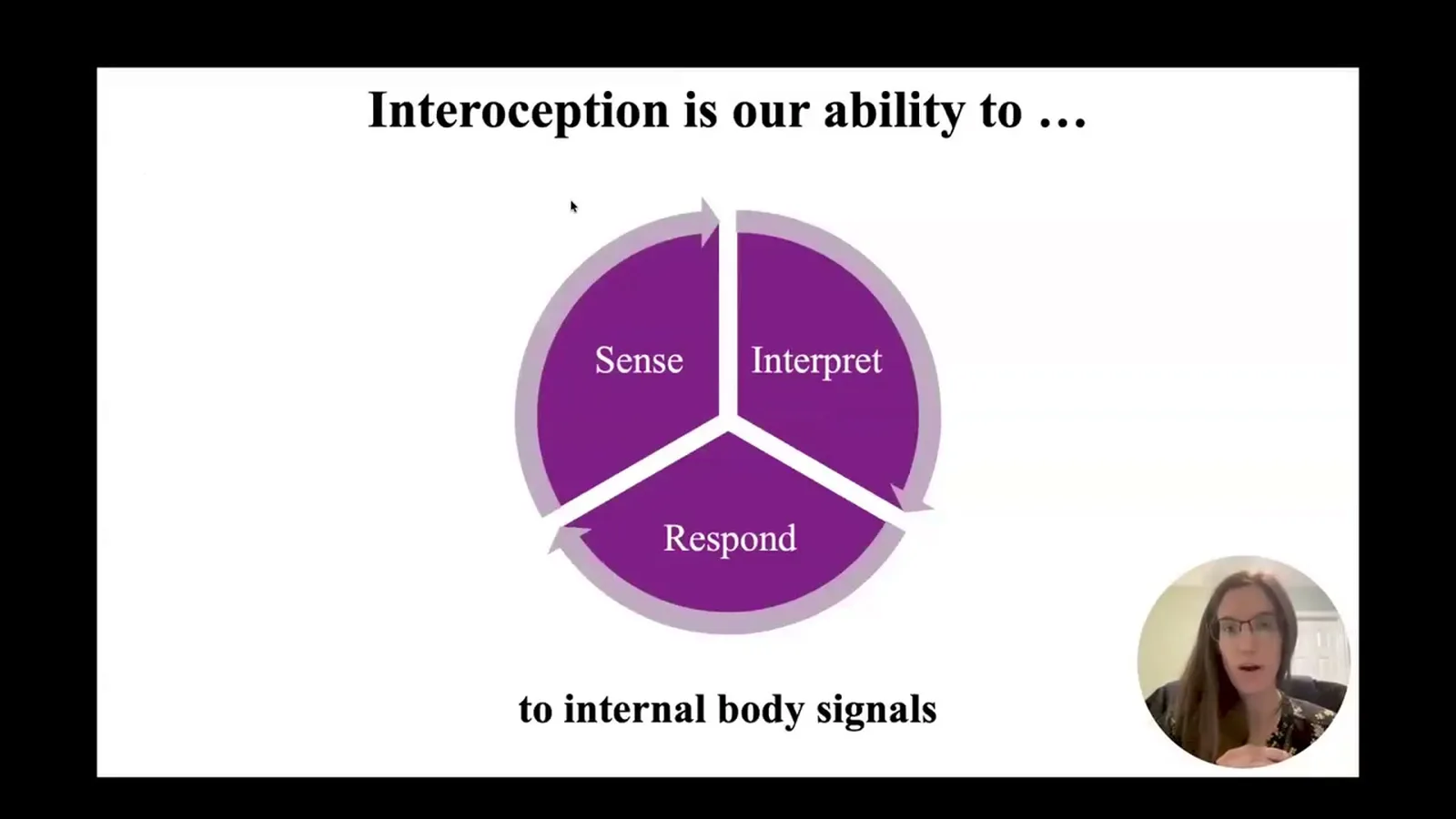
The alternative has three steps in a fixed order. Notice means catching a signal inside the body. Interpret means giving that signal meaning in context. Respond means picking a safe action. Skip ahead to the response step and nothing holds it up.
Notice rests on interoception (sensing signals inside your body). Many learners do not tune in on their own. They may feel fear or unease with no words for it. The session treats this as a skill you can teach, not a fixed trait. A tight stomach. A busy heart. Stiff muscles. A change in breathing. Those are learnable data points.
Interpret needs room for gray. Not every uneasy feeling means danger. Not every familiar person is safe. So felt safety gets taught as a spectrum. Happy and energized. Calm and okay. Unsure, or something feels weird. Scared or unsafe. That middle band is the most useful part. It is early news, before anything has a name.
Language is what makes the spectrum usable. I feel unsure. Something feels different. My body is telling me something. Those phrases give a child words for private events (feelings only that person can sense). They open a talk with a trusted adult, and that talk is often where protection starts. Binary words work against that. If the only options are safe and unsafe, the middle gets harder to report.
Children can't interpret what they haven't noticed.
From the talk — Patricia "Tricia" Lund, BCBA, CSE, LBA & Carolyn Broner, Ph.D., M.S. Ed., BCBA
Response Menus and the BCBA Role Across Three Tiers
One scripted no is not a response repertoire. The session laid out a menu instead. Pause, and do not answer right away. Move away and make space. Ask a question to slow things down. Go get a trusted adult. Say that something feels wrong. Say no, wait, or check first.
For young children the menu packs down to three words: pause, scan, decide. Pause and notice what is happening. Scan: what is my body telling me? What is going on around me? Do I need help? Then decide on one simple action. These are practiced routines, not adult judgment calls.
The work also spreads across three tiers. Universal work builds core skills and settings that support talking and feelings. Family work trains caregivers to reinforce those skills in daily routines. Child directed work is the teaching itself: body safety, social and emotional learning, role play, decision practice.
The BCBA cuts across all three. Assess whether the prerequisite skills are there. Adapt teaching to how the person communicates. Teach help seeking, refusal, context reading, and self-advocacy. Support caregivers and the rest of the team. Then program for generalization, because a skill shown in session is not a skill used in a real relationship.
So the BCBA's role is not simply teaching safety skills.
From the talk — Patricia "Tricia" Lund, BCBA, CSE, LBA & Carolyn Broner, Ph.D., M.S. Ed., BCBA
Sex Education Is Abuse Prevention for Teens and Adults
Lund picked the thread up at adolescence with one core claim. Sex education is not a topic beside abuse prevention. It is abuse prevention. It works through four routes. It gives people words to disclose. It shows what a healthy relationship looks like. It builds decision making. And it builds sexual self-esteem.
That last route is easy to miss. Someone taught that their sexuality is dirty or wrong sits at higher risk, not lower. Shame makes disclosure less likely. It also makes mistreatment easier to accept. The person does not feel entitled to anything better. A healthy view of one's own sexuality is a protective factor.
Lund walked through the ethics codes that apply. Code 1.05 keeps you inside your scope of competence. Code 1.06 says keep that competence current. Code 1.07 asks you to check your own bias. That matters a lot here, with many sexual and gender identities in play. If bias would dent your work, do not take the case yet. Code 3.01 puts the client's interest first, which gets sticky when guardians are involved. And you are still a mandated reporter (required by law to report abuse).
BCBAs can teach this. ABA is a framework, not a diagnosis. Reinforcement is still reinforcement. Task analysis is still task analysis. Lund uses discrimination training, shaping, chaining, and differential reinforcement (rewarding one response, not another) for consent and boundary respecting behavior. She also runs function based assessments aimed at sexual behavior. She uses ACT (therapy built on acceptance and values) for values based work. Get supervision or consultation your first time through.
So sex education is not separate from abuse prevention. It is abuse prevention.
From the talk — Patricia "Tricia" Lund, BCBA, CSE, LBA & Carolyn Broner, Ph.D., M.S. Ed., BCBA
Assessing Sociosexual Knowledge: SCAT-R, TALK-SC, and What Scores Mean
Start with an assessment, then program for what is missing. Lund named two tools. The SCAT-R is the Sociosexual Knowledge and Attitudes Assessment Tool, Revised. It is the longer of the two. It looks at anatomy, intimacy and relationships, reproduction, hygiene, sexual behavior, safety, and illegal sexual behavior. It uses pictures, which helps clients with limited spoken language. A new version is coming, so Lund suggested waiting for it before you start using this one.
The TALK-SC is the Tool for the Assessment of Levels of Knowledge, Sexuality, and Consent. It has five sections: public versus private, sexuality, pregnancy and choice, sexually transmitted infections, and against the law. You read each question word for word. Each answer gets a 0, 1, or 2, with written criteria for partial and full credit. A caregiver interview comes with it. It was developed by David Hingsberger and co-authors, and his wider work is worth reading.
The procedure carries as much weight as the score. Review the materials with the guardian first. Show the words, the pictures, and the stimuli you will use, and get that on a consent form. Run it in a private space, but not the client's bedroom. Two assessors is best. If that is not possible, keep staff within sight. Get the client's own consent before you start, since the referral usually came from someone else. Remind them they can skip, pause, or stop.
Watch body language the whole way through. Clients with long compliance histories often will not ask for a break. If you cannot finish, mark it incomplete and come back another day. Read the score with care too. These tools measure knowledge, not behavior. A strong score next to public problem behavior means it is not a knowledge gap. Go look at what keeps the behavior going instead. Trauma can split knowing from doing. Culture and faith shape answers as well. And a low score is never a reason to block someone from dating.
It's a roadmap and it tells us where we can step in and help the person build the skills that they need in order to have a relationship that is safe and meaningful to them.
From the talk — Patricia "Tricia" Lund, BCBA, CSE, LBA & Carolyn Broner, Ph.D., M.S. Ed., BCBA
Common questions
Why isn't good touch, bad touch enough for clients with autism or IDD?▾
It asks the learner to sort a moment into two bins under stress. Real harm often comes from a trusted person through slow boundary pushing. It does not land cleanly in either bin. It also skips the skills that make sorting possible, like noticing body signals and naming feelings. The session argued for a spectrum and a response menu instead.
Can a BCBA teach sex education?▾
Yes, within scope and with supervision or consultation. ABA is a framework, not a diagnosis specific method. Discrimination training, shaping, chaining, task analysis, and differential reinforcement all transfer to consent and boundary skills. Ethics codes 1.05, 1.06, 1.07, and 3.01 apply directly, including checking your own bias. You are also a mandated reporter if a disclosure comes up.
What does the TALK-SC assess?▾
It covers five areas: public versus private places, topics, body parts, and behaviors. It also covers sexuality, pregnancy and choice, sexually transmitted infections, and sexual acts that are against the law. Questions are read word for word and scored 0, 1, or 2 with written criteria. It also comes with a caregiver interview. It works as a pre and post measure around relationship and sexuality teaching.
Does a low score on a sociosexual assessment mean someone cannot have a relationship?▾
No. Lund was direct that a low score is not grounds to restrict dating. She has seen staff use it that way. The tool alone does not decide capacity to consent, and she would not lean on it for legal proceedings. Treat the score as a roadmap for which skills to teach next.
What do I do when a client knows the safety rules but does not use them?▾
Treat it as something other than a knowledge gap. If someone can name public and private correctly but still undresses in public, that gap is not about knowledge. Go back to the environment and find what is keeping the behavior going. Trauma history can also pull behavior away from knowledge, so gather that context too.
About the speaker
Patricia Lund is a licensed special education teacher and a board certified behavior analyst in Texas. She is a certified sexuality educator through ASECT (the American Association of Sexuality Educators, Counselors, and Therapists). She is also a certified trauma professional and is completing coursework in thanatology (the study of death and dying). Most of her current work is with teens and adults in Medicaid waiver programs, group homes, and residential settings. She also has a sister with autism. Carolyn Broner is the owner and founder of Applied Behavioral Approaches in Suwannee, Georgia. She has close to 30 years of experience across education and behavior analysis, including K-12, post-secondary, and clinical settings. Her training spans special education and educational and organizational leadership.
This summary was generated from the recording’s transcript. Quotes are taken word for word from the talk.
What you'll learn
- 1Learning Objectives
- 2By the end of this CEU, participants will be able to:
- 3Identify at least two limitations of existing relationship safety frameworks, including the Circles program, as they apply to individuals with IDD.
- 4Explain why a binary safe/unsafe categorization of relationships may be insufficient for abuse prevention in individuals with IDD.
- 5Describe the key components of a relationship-based approach to safety skills training that reflects the actual perpetrator population.
Concepts in this CEU
Related talks
Talks that cover the same concepts
What Does Your Body Know? Teaching Individuals with IDD to Recognize Internal Warning Signs`
The Behaviorist Bookclub

The Interdisciplinary Case Conference
The Mindful Learner LLC
Teaching WH-Questions Isn’t Enough: Building True Conditional Discrimination
The Behaviorist Bookclub
An Examination of Abuse Prevention
The Behaviorist Bookclub
Child Development Deep Dive: Early Childhood (2-5 year olds)
The Behaviorist Bookclub
When the Foundations Are Right: Unlocking Advanced Verbal Repertoires
The Behaviorist Bookclub
More from The Behaviorist Bookclub
Supervising Beyond Technical Skills: Professionalism, Communication, and Clinical Judgment
The Behaviorist Bookclub
Reflective Supervision and Client Outcomes
The Behaviorist Bookclub
Empowering Autonomy and Self-Management in ADHD Learners
The Behaviorist Bookclub
OpenCEU is supported by advertising from third-party sponsors. Sponsors are clearly labeled, have no influence over course content, instructors, or CEU decisions, and never appear on certificates. The BACB does not sponsor, approve, or endorse OpenCEU sponsors or their products.