Motivating Operations in ABA: Why Value Changes
Motivating operations change how much a reward is worth right now. See how BCBAs read them, use choice, and build real motivation.
Key takeaway
Motivating operations are things that change how much a reward is worth right now. A snack is worth a lot when you are hungry. The same snack means little right after a big meal.
What Does Your Body Know? Teaching Individuals with IDD to Recognize Internal Warning Signs`
Free learning path on this topic
Verbal Behavior: Beyond WH-Questions
Dana Pettus's three-part series on building generative verbal behavior. Why WH-question programs stall, how to establish speaker-listener repertoires, and how to scaffold advanced verbal skills like recall and simple inference. Three hours, three CEUs.
Experts who cover this
6 recordings on openceu cover motivating operations.
- Featured talk1 CEU
What Does Your Body Know? Teaching Individuals with IDD to Recognize Internal Warning Signs`
Tricia LundThe Behaviorist Bookclub
Carolyn ties shifts in verbal behavior, like increased manding for escape or reassurance-seeking, to changes in motivating operations, arguing these observable…
- 1 CEU
Shaping Behavior Change when ADHD is in the Picture
Nicole StewartThe Behaviorist Bookclub
Repeated exposure to the same materials/SDs was explained as functioning as an abolishing operation for ADHD brains, creating habituation and reduced…
- 1 CEU
The Interdisciplinary Case Conference
Michelle VencesThe Mindful Learner LLC
Michelle describes training behavior technicians to check antecedent variables like sleep, hunger, and attention deprivation before sessions, and to…
- 3.50 Ethics CEUs
Analyzing Assent and Taking Data
Matt HarringtonThe Behaviorist Bookclub
Explains research showing that adding reinforcer choice acts as a motivating operation that raises reinforcer value and instructional efficiency, which is his…
- 1 Ethics CEU
Cultural Considerations Across Teams, Systems & Practice
Makenzie SandlerThe Behaviorist Bookclub
Frames a mismatch between an organization's reward system and what employees actually value as an MO problem, meaning the "reinforcer" offered may not…
- 1 Supervision CEU
Dunder Mifflin’s Guide to Training and Onboarding: Lessons from The Office
Mellanie PageThe Behaviorist Bookclub
Named as one of the high-impact skills to prioritize in RBT training, alongside reinforcement delivery and pairing, because it ripples into overall treatment…



On this page · 8 sections▾
Motivating operations are things that change how much a reward is worth right now. A snack is worth a lot when you are hungry. The same snack means little right after a big meal. That shift in value is a motivating operation, or MO.
MOs matter to BCBAs, RBTs, teachers, and parents. They explain why the same reward works one hour and flops the next. They also shape how likely a behavior is to happen. When you learn to read MOs, you can teach at the right moment.
What motivating operations are#
Brian Middleton gives a clean, plain definition. MOs are events in the setting that change two things. They change how much a consequence matters. They also change how likely a behavior is to occur.
MOs are environmental events or conditions that impact the significance of consequences and influence the probability of behaviors occurring. From the talk — Brian Middleton
This is why MOs sit at the heart of good teaching. A reward only works if it is valued in the moment. MOs tell you when that value is high or low. Timing your teaching to high value makes it far more effective.
MOs live in emotions too#
Brian pushes teams to widen what they track. Many people take ABC data, which records what comes before and after a behavior. He says emotions belong in that data as an MO. A tired or upset child brings a different value to the same reward.
if you're taking ABC data and you're not including MOs as a part of that, you should start doing that as soon as possible because MOs can include emotions, emotional states that increases or decreases the probability of behavior occurring. From the talk — Brian Middleton
This view treats feelings as real, usable data. You do not ignore a child's mood. You log it and use it to understand behavior. An MO column can explain a hard day that looks random.
Reading MO shifts as warning signs#
Carolyn shows how MOs show up in what people say and do. A change in verbal behavior can signal a change in motivation. More asking to escape, or more reassurance seeking, is a clue. It may mean the value of safety or escape just went up.
these observable changes may signal a shift in motivating operations, indicating that the value of escape, safety, or proximity to trusted individuals has increased. From the talk — Carolyn
This helps teams catch stress early. You watch for the shift before a big escalation. When escape suddenly looks valuable, something changed. Reading that MO gives you a chance to respond with care.
Choice can build motivation#
 Advertisement
Matt Harrington points to a powerful MO you can add on purpose. Giving a learner a choice raises the value of the reward. Research shows choice itself works as a motivating operation. It also makes the whole session run better.
the addition of reinforcer choice can actually act as a motivational operation that increases the value of that reinforcer and instructional efficiency From the talk — Matt Harrington
This is a strong case for building in assent, a learner showing they are okay to go on. When a child gets to choose, the reward means more. Even a favorite item gains value when choice is present. You can see this idea in action in Analyzing Assent and Taking Data.
Do not shrink the world to force a mand#
Kaelynn Partlow warns against a common reflex. Some teams take away a loved item to force a request. The idea is to raise motivation for that item. But this shrinks a world that may already be small.
We cannot reasonably hope to expand someone's motivation by shrinking down their worlds, which are already far too small. From the talk — Kaelynn Partlow
There is a kinder path to build motivation. You add new reinforcing activities instead of removing old ones. A bigger world creates more natural chances to teach. This respects the person while still building skills, a theme in The Ethics of Socially Significant Goal Selection - Applied 2023.
MOs at work, not just in therapy#
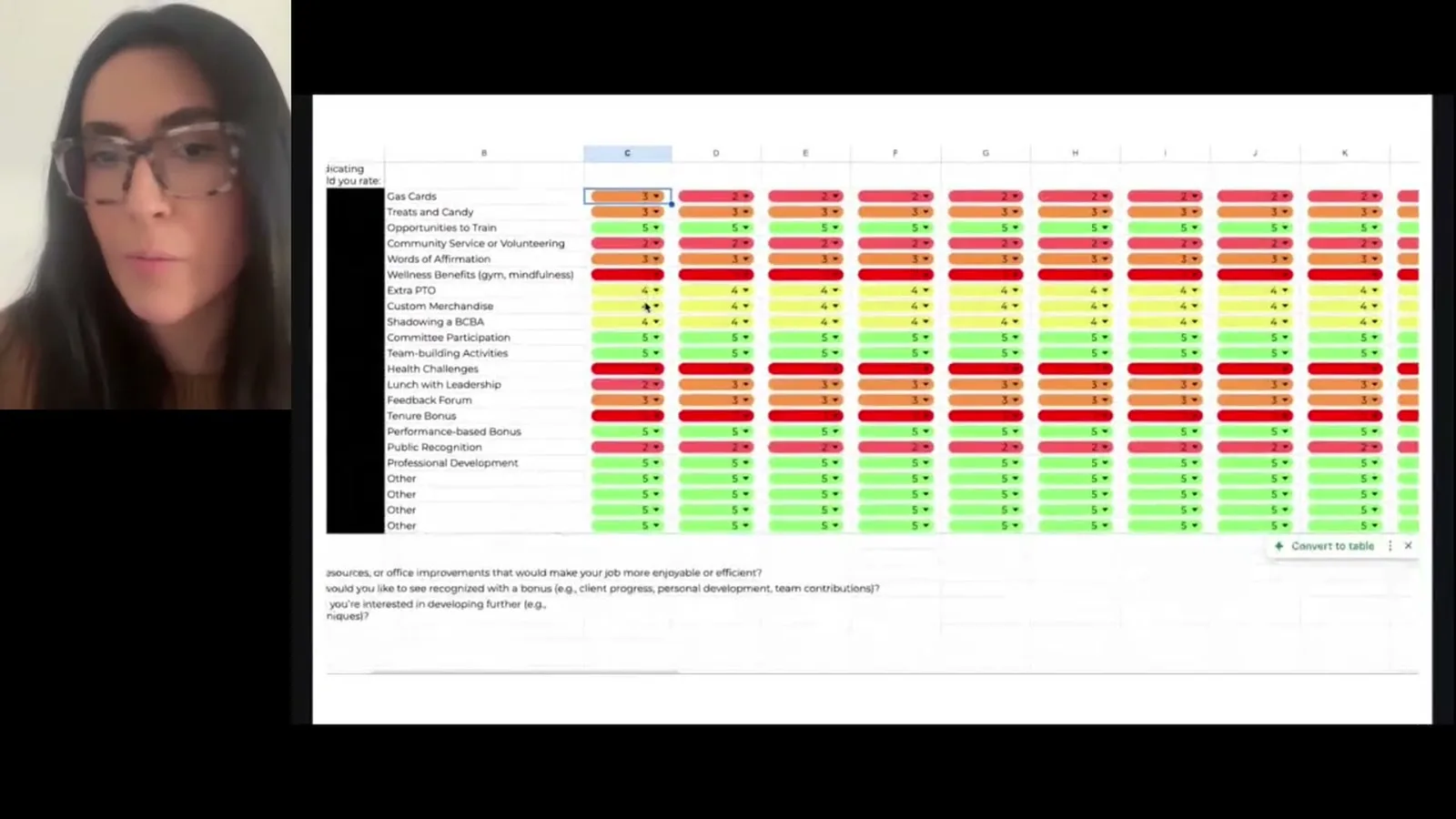
MOs are not only for clients. Makenzie Sandler applies them to staff and workplaces. A reward system only works if staff actually value the reward. If the metrics and the reward do not line up, motivation drops.
This is the same MO idea in a new setting. A bonus means nothing if it holds no value for that person. Leaders have to check that their rewards truly reinforce. Otherwise the wanted behavior will not grow.
What the research says#
The MO concept has sharpened how the field analyzes behavior. It gives a frame for events that change how well a reward or punisher works. Researchers note it improved precision, though the concept still has real limits. Used well, it helps clarify when removing a stimulus will act as negative reinforcement (Edwards, T. L., & Poling, A. (2020). Motivating Operations and Negative Reinforcement. Perspectives on Behavior Science, 43(4), 761-778).
MOs also do not act alone. They work alongside signals that tell us a reward is available. One paper argues MOs and those signals are distinct but interact closely (Poling, A., Lotfizadeh, A. D., & Edwards, T. L. (2019). Motivating Operations and Discriminative Stimuli: Distinguishable but Interactive Variables. Behavior Analysis in Practice, 13(2), 502-508). Value and availability both shape what a person does.
MOs can even be built on purpose to teach language. In one study, researchers set up conditions that made a missing item valuable. Two children with autism then learned to ask for known and unknown items (Jessel, J. & Ingvarsson, E. T. (2022). Teaching two children with autism to mand for known and unknown items using contrived motivating operations. Behavioral Interventions, 37(1), 139-152). This shows MOs are a tool you can design, not just observe.
FAQ#
What is a motivating operation in simple terms? It is anything that changes how much a reward is worth right now. Hunger makes food valuable, and a full stomach makes it worthless. MOs also change how likely a behavior is to happen. They set the stage for teaching to work or fail.
What is the difference between an MO and a reinforcer? A reinforcer is a reward that makes a behavior grow. An MO changes how strong that reward is at the moment. The same reinforcer can be powerful or weak depending on the MO. So the MO sets the value, and the reinforcer does the shaping.
How do BCBAs use motivating operations? They time teaching for moments when a reward is valued. They read shifts in behavior as clues that value changed. They also add choice to raise a reward's value on purpose. Good MO use makes sessions smoother and more effective.
 Advertisement
Turn this topic into a CEU
You just studied this. Now get credit for it.
Watch What Does Your Body Know? Teaching Individuals with IDD to Recognize Internal Warning Signs` with Tricia Lund and earn 1 free BCBA CEU. Detailed certificate, delivered the moment you finish.
Keep going with a free learning path
Verbal Behavior: Beyond WH-Questions
Dana Pettus's three-part series on building generative verbal behavior. Why WH-question programs stall, how to establish speaker-listener repertoires, and how to scaffold advanced verbal skills like recall and simple inference. Three hours, three CEUs.