Emotional Regulation in Autism: The Interoception Foundation
Emotional regulation in autism starts with interoception. Learn the pause, scan, decide chain and how to teach it, from a BCBA-led CEU.
Key takeaway
A Board Certified Behavior Analyst (BCBA) who teaches a learner to pause, scan, and decide gives that learner a tool that travels into every hallway, bathroom, and bus ride, and the simple 0 to 5 tension scales that come with it turn daily living routines like toileting, snack, and transitions into the practice ground where real regulation gets built.
What Does Your Body Know? Teaching Individuals with IDD to Recognize Internal Warning Signs`
Free learning path on this topic
PDA and Demand Avoidance
B. Kuereine Gray's three PDA talks plus Clelia Sigaud on the logic of anxiety. What PDA is and isn't, how to collaborate with caregivers, how to handle complex profiles and replacement behaviors, and why demand-avoidant learners respond the way they do.
On this page · 9 sections▾
A Board Certified Behavior Analyst (BCBA) who teaches a learner to pause, scan, and decide gives that learner a tool that travels into every hallway, bathroom, and bus ride, and the simple 0 to 5 tension scales that come with it turn daily living routines like toileting, snack, and transitions into the practice ground where real regulation gets built. That is the shift this talk pushes for. Stop waiting for a meltdown to teach coping. Start with the inside of the body, in the small moments, and the rest of the safety plan has somewhere to land.
Why emotional regulation needs interoception first#
Most regulation plans skip a step. They teach the coping skill, the break card, the deep breath, the visual schedule. Then they wait for the learner to use the tool when they need it. The tool sits unused, and the team writes it off as non-compliance.
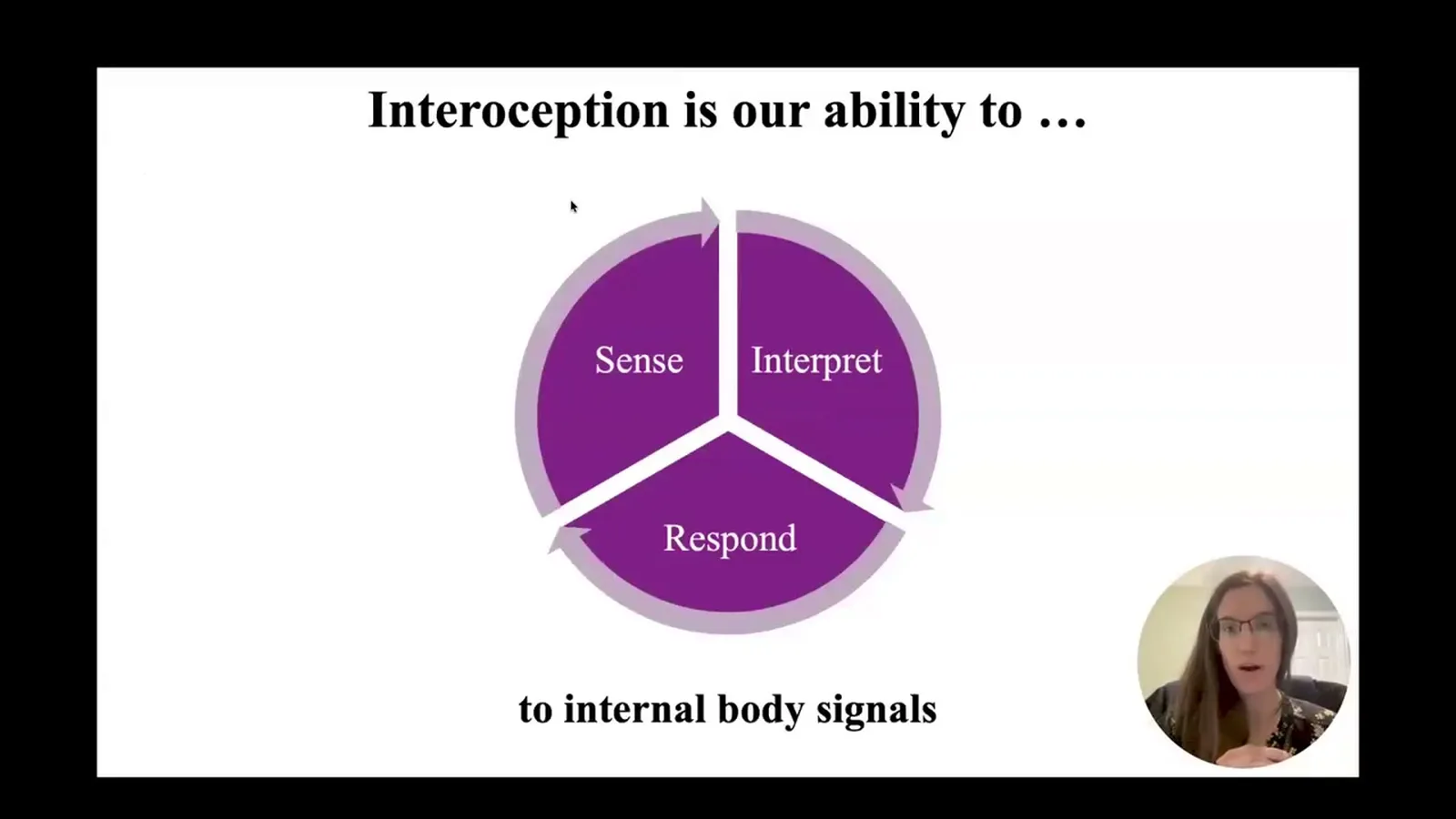
The step that gets skipped is interoception. Interoception is the body's ability to sense what is happening inside the skin, things like a racing heart, a tight chest, a clenched stomach, a hot face. A learner who cannot feel those signals cannot use a coping tool, because the cue to use the tool has not arrived yet. The first sign that something is wrong is the meltdown itself, and by then the breath card is too late.
For autistic learners and many learners with intellectual and developmental disabilities, those internal signals are quieter or harder to read. That is not a defect. It is a teaching target. If a Board Certified Behavior Analyst (BCBA) wants emotional regulation to stick, the first repertoire to build is body noticing, not coping. Coping is the second skill. The first skill is sensing.
This is also why a behavior intervention plan that lists only outward responses runs out of room. The plan has to reach inside.
The pause, scan, decide chain explained#
The center of this approach is a three-step response chain. It gives the team a script to teach and the learner a small, repeatable behavior.
Step one is pause. The learner stops the automatic response. That alone is a real skill for a learner whose first reaction to discomfort is to bolt, hit, or shut down. Pause buys two or three seconds.
Step two is scan. The learner checks the body. Heart, breath, muscles, stomach, the urge to move. The team teaches a short list of places to look. The scan does not have to be fancy. It has to be repeatable.
Step three is decide. The learner picks a response that fits the signal. Move away. Move closer. Ask a question. Request space. Get a drink of water. Find a trusted adult. The decision is shaped by what the body is saying, not by a rule on a poster.
Teach a pause, scan, decide response chain, which consists of pause, stop, and interrupt automatic responding. From the talk, Tricia Lund
This chain matters because it works in any setting. A rule like "raise your hand to ask for a break" only fires in the classroom. The pause, scan, decide chain fires in the cafeteria, at home, on a job site, and at a community event. It is the same three steps every time.
Tension scales and body thermometers that work#
Once a learner can pause and scan, the team needs a way for that scan to come back with information. That is where 0 to 5 tension scales and body thermometers come in.
A 0 to 5 tension scale is a simple visual. Zero is calm. Five is overwhelmed. The middle numbers describe the body, not the mood. Two might be a slightly tight jaw. Three might be a fast heart and shallow breath. The scale gives the learner words and pictures for the parts of the body that usually go un-named.
0 to 5 tension scales, which helps the learner rate how activated, tense, uncomfortable, unsafe their body feels. From the talk, Tricia Lund
A body thermometer works the same way, with a visual that climbs from cool to hot as activation rises. Some learners take to a thermometer faster than a number scale because the image lines up with how the body actually feels.
A few things make these tools land. Pair them with real moments, not worksheets. Rate the body before a transition, after recess, during a tooth-brushing routine, on the way to the dentist. Reinforce the tact, meaning the act of correctly labeling the internal state, even when the rating is low. The point is not to get a high number. The point is to get an honest one.
Reframing stims as regulation attempts#
A lot of ABA history treats repetitive behavior as something to extinguish. The talk pushes back, hard. Many of those behaviors are not problem behavior. They are the learner trying to take care of themselves.
Some learners attempt to regulate internal arousal through repetitive or soothing, self-soothing behaviors. From the talk, Tricia Lund
That reframe changes the data sheet. Instead of a behavior to reduce, a rocking pattern, a hand flap, or a hum becomes a precursor to read. It tells the team that arousal is climbing. The right move is not blocking. The right move is offering a regulation option, a quiet space, a movement break, deep pressure, a preferred song, and watching to see if the learner picks it up.
This is also a relationship move. A learner whose self-soothing has been blocked in the past learns to hide. A learner whose self-soothing has been respected learns to trust the team enough to share a body signal out loud. That trust is the soil that pause, scan, decide grows in.
The clinical question shifts from "how do we reduce this stim" to "what is the body asking for, and what can we offer that gets there with less wear and tear."
Reinforcing "I need space" instead of tolerance#
A lot of ABA programming has historically reinforced tolerance. The learner gets through the demand without aggression and earns a token. That works, until it does not, and the team is left wondering why the learner shut down at 11 a.m. on a Tuesday.
The interoceptive approach reinforces something different. It reinforces honest reports of discomfort. "I need space." "I do not like this." "My chest is tight." "Can we slow down." Those are the mands the team wants to see more of.
A few practical moves. Stop scoring a calm body during a hard demand as the gold standard. Start scoring an early, accurate report. Honor the report. If the learner says they need space at a two on the scale, give space at a two on the scale. The token economy can still exist. It just has to pay for early communication, not silent endurance.
This is also how the team builds self-advocacy. A learner who has been paid for reporting discomfort at low levels will report discomfort at higher levels, including in situations the team never trained for. That is the long game.
Sample session structure for ABA teams#
Here is one way a team can lay out a 60 minute session that puts interoception at the center, without rebuilding the whole program from scratch.
Open with a 2 minute body scan. Use the 0 to 5 scale. Record the number. Do not coach toward a low number. Just record.
Run the first skill block as you normally would, for 15 to 20 minutes. Keep a column on the data sheet for body signals you see, like flushed skin, fast breath, shoulders rising, or proximity seeking.
Pause for a check-in. Ask the learner to rate the body again. If the number went up, run the pause, scan, decide chain together. Choose a regulation response. Movement, water, a quiet corner, a preferred item. Score the chain, not just the outcome.
Run the second skill block. Same data column for body signals.
Close with a third scan and a brief tact practice. "Where did you feel that today." Reinforce the report, not the reading.
This structure does not slow the session down. It catches the early signals that used to derail the last 15 minutes and turn them into a teaching opportunity.
Caregiver coaching scripts you can copy#
Parents and direct support staff are often the first to see a body signal. They need scripts that are short enough to use in the kitchen at 7 a.m.
Script one, the body check. "Show me a number from 0 to 5. Where do you feel it." Use it before any transition that has been hard in the past.
Script two, the offer. "Your shoulders are up. Do you want a hug, a stretch, or a quiet minute." Give three concrete options. Let the learner pick.
Script three, the honor. "Thank you for telling me. Let us take that minute." Then actually take the minute. The honor is the reinforcer.
Script four, the repair. When a caregiver misses a signal and the day goes sideways, the repair script matters. "I missed it earlier. Your body was telling me, and I went too fast. Let us try again." Modeling repair teaches the learner that body signals are worth sending, even when the first send did not land.
If our goal is to move beyond compliance and towards self-advocacy, learners can't simply memorize what to say. From the talk, Tricia Lund
That last line is the test. If the family can run those four scripts in a normal week, the regulation work is no longer trapped in the session room. It lives in the house.
Frequently asked questions#
How does interoception connect to emotional regulation?
Interoception is the sensing step. Emotional regulation is the response step. A learner who cannot feel a rising heart rate, a tight stomach, or a hot face cannot pick the right coping tool, because the cue to use the tool has not arrived. Teaching body noticing first gives every other regulation tool a place to plug in.
What is the pause, scan, decide chain?
It is a three-step response chain. Pause stops the automatic reaction. Scan checks the body for signals like heart rate, breath, muscle tension, and the urge to move. Decide picks an adaptive response, like moving away, moving closer, asking for space, or seeking support. The chain travels across settings because it does not rely on outside rules.
How do you use a 0 to 5 tension scale?
Treat it as a tact, not a quiz. Ask for a rating during real moments, before a transition, after recess, during a haircut. Reinforce honest answers at every level, not just low ones. Use the rating to choose what comes next, like a movement break at a 3 or a quiet corner at a 4. Over time the learner uses the scale without a prompt.
Are stims always something to reduce?
No. Many repetitive behaviors are the learner's first attempt to regulate internal arousal. The clinical move is to read them as a signal, not a target. If a learner starts rocking or humming, the team can offer a regulation option and watch what helps. Blocking the behavior without offering a replacement usually pushes the arousal somewhere harder to reach.
How do I teach parents to support body awareness?
Give them short scripts that fit a real day. A body check before a transition. An offer with three concrete options. An honor that includes actually pausing for a minute. A repair when a signal gets missed. Coach the scripts in a parent session, then watch a real routine, like getting ready for bed, and give feedback in the moment.
Watch the full talk#
Tricia Lund walks through the science of interoception, the public accompaniments of private events, and the specific teaching moves that build emotional regulation from the inside out. If the regulation plan in front of you keeps stalling, this is the talk to watch before the next plan meeting.
Turn this topic into a CEU
You just studied this. Now get credit for it.
Watch What Does Your Body Know? Teaching Individuals with IDD to Recognize Internal Warning Signs` with Tricia Lund and earn 1 free BCBA CEU. Detailed certificate, delivered the moment you finish.
Keep going with a free learning path
PDA and Demand Avoidance
B. Kuereine Gray's three PDA talks plus Clelia Sigaud on the logic of anxiety. What PDA is and isn't, how to collaborate with caregivers, how to handle complex profiles and replacement behaviors, and why demand-avoidant learners respond the way they do.