High-Masking PDA: Why Verbal, Social Kids Get Missed
High-masking PDA: how precocious language, role play, and surface sociability hide the profile and what to look for instead, from a BCBA-led CEU.
Key takeaway
High-masking PDA looks like a chatty, articulate kid who plays pretend well and runs the play scene from the inside. They talk early. They direct the other kids.
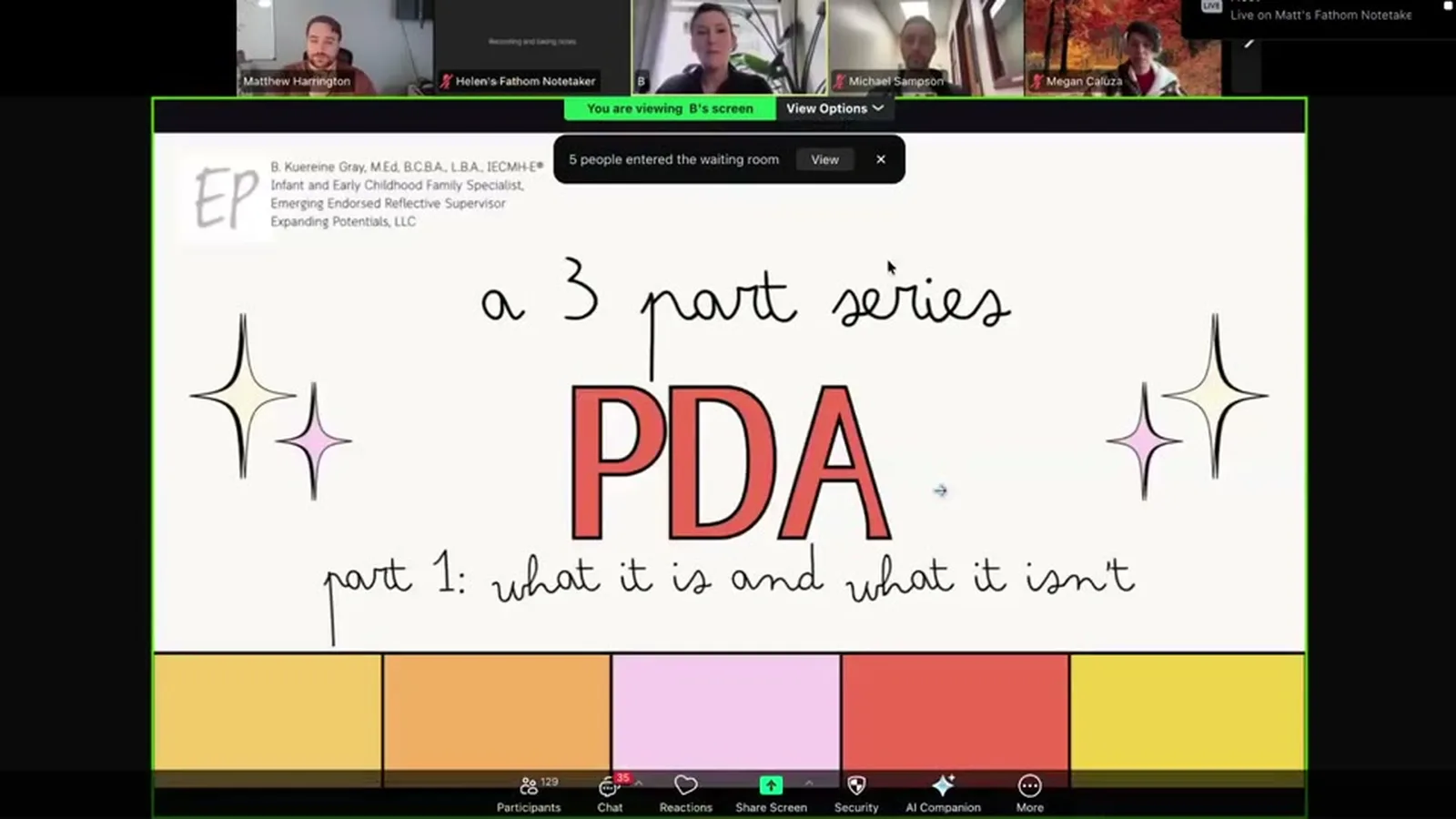
PDA: What it is and What it isn't
On this page · 8 sections▾
High-masking PDA looks like a chatty, articulate kid who plays pretend well and runs the play scene from the inside. They talk early. They direct the other kids. They mimic smiles and nods. The signs are there. They just sit under a layer of verbal skill that fools most evaluators.
What "high masking" looks like in a PDA kid#
A high-masking child with a PDA profile blends in on first look. They make eye contact. They join group play. They use big words for their age. They notice when adults smile, and they smile back. None of that rules out the profile. It hides it.
The mask is built from copied behavior. The child watches what other kids do. They store the pattern. They run it back. To a teacher or evaluator, that looks like social skill. But the child is not feeling the cue. They are matching it.
This is the kid who scores low on a checklist and high on parent stress. The parent says something is off. The school says they seem fine. Both are right.
They are likely high masking. They may have language in social skittles that will mask underlying deficits so that other people might not notice some of their deficits or think that those deficits don't exist and some of them may be missed as not having an autism diagnosis. From the talk — B. Kuereine Gray
The four signals that make adults underestimate them#
Four surface traits do the heavy lifting on the mask. Spot all four together and you have a strong reason to look closer.
Signal 1: Precocious language. The child talks earlier than peers. They use adult phrasing. They ask questions that sound mature. Adults read this as bright. They stop scanning for other signs.
Signal 2: Surface sociability. The child seems to want friends. They greet people. They join groups. Underneath, the social play is thin. They lead more than they share. They struggle when the script changes.
Signal 3: Role play and pretend. They pretend with dolls, action figures, kitchen sets. Older evaluators were trained to rule out autism the moment they saw pretend play. That rule is wrong here.
Signal 4: Mimicked nonverbal cues. They nod when others nod. They laugh when others laugh. The timing is close. The understanding is not.
A lot of them may have high language abilities, they may be precociously verbal, they may appear very social. This is the linchpin for me. From the talk — B. Kuereine Gray
When language and pretend show up together, evaluators relax. That is the moment the profile slips past them.
Why role play and pretend don't rule out PDA (or autism)#
Role play is the trap. A lot of training in the field still treats pretend play as proof of typical development. That logic does not hold for PDA-profile kids.
These kids often love pretend. But the play has a shape. It repeats. They run the same scene over and over. They cast the other kids. They tell the adult where to sit and what to say. They are not co-creating. They are directing.
Watch for who is in charge. Watch for what happens when another child changes the plot. A child without the profile rolls with the change. A child with the profile shuts down, escalates, or quits the game.
Individuals in this profile typically have no problem with role play and pretend, which can make it difficult if we're also suspecting autism spectrum disorders. From the talk — B. Kuereine Gray
If the evaluator only sees the first ten minutes of play, they will see the mask. They will not see the script. They will write a clean report.
What masking costs the kid#
Letting the mask stand has a price. The child does not get the right services. They get partial services or no services. Progress stalls. Adults blame the child or the parent.
Inside the child, the cost shows up later. Anxiety builds. Sleep gets worse. Some kids start picking skin. Some pull out eyelashes or eyebrows. Some shut down at home after holding the mask all day at school.
There is also pressure from adults to soften the picture. Parents do not want their child labeled. Clinicians do not want a hard conversation. So the report says "high functioning." The plan goes light. The kid keeps slipping.
It's tempting to make PDA less stigmatizing to parents and play up on like oh look they have so much language or they play so nicely but when we do this and we don't discuss it openly with transparency it can result in loss of access to services. From the talk — B. Kuereine Gray
Naming what you see is the kinder option. It opens doors that "she's fine" closes.
What to put in your clinical notes when you suspect masking#
If you think masking is in play, write it down with specifics. Vague notes do not move evaluators. Concrete patterns do.
Document the gap between surface and depth. Note that the child uses adult words but does not catch sarcasm or simple jokes. Note that the child joins play but always directs it. Note that the child mimics a smile within one second of the adult smiling.
Track the precursors before a meltdown. The child may go quiet. They may say "I don't have the right pencil." They may dissociate for a few seconds. These small signals come before the big behavior. Most adults miss them because they look normal.
Track which demands trigger the freeze. Familiar tasks the child can do are the key marker. A child resisting a brand-new task is normal. A child resisting brushing teeth they know how to brush is the pattern. Write the demand, the time of day, the response, and what happened next.
Track the day-to-day variability. The same intervention may work Tuesday and fail Thursday. Note both days. Note what was different. The threshold model says demands stack across a day. By 2 pm the child may be at the edge before you start your session.
Note any high comorbidity signs. ADHD plus autism in the same kid often shows up in this profile. Anxiety responses are common. None of these change your scope of practice. They sharpen the referral question.
There is that ability to mask that I can blend in. I understand some of those nonverbal social cues that other people do like nodding smiling when other people smile laughing when other people laugh. From the talk — B. Kuereine Gray
When to push for a re-evaluation#
Push for a re-eval when the data stops adding up. A clean autism rule-out does not close the question if the child keeps showing these patterns.
Push when interventions work some days and fail others. That pattern is itself diagnostic. Token boards and visual schedules are built for a different profile. If they fail in a child with strong language, that is a signal, not a failure of the tool.
Push when the parent describes a different child at home. Many of these kids hold the mask at school and crash at home. Ask the parent for video. A short clip of the homecoming meltdown can change an evaluator's mind faster than any report.
Push when the surface stays calm but the child loses skills. Sudden drops in eating, sleeping, or toileting in a verbal kid are worth a fresh look. The profile can hide behind language until language itself starts to fray.
When you refer, name the question. Say you want screening for a PDA profile inside autism. Suggest the EDA-8 or the diagnostic interview for social and communication disorders. Stay in your scope. The evaluator does the diagnosis. You frame the question well enough that they look in the right place.
Frequently asked questions#
If a kid plays pretend well, does that rule out autism plus a PDA profile?
No. Pretend play does not rule out autism. It does not rule out PDA. Kids with this profile often love role play. Watch how they play. If they direct every scene, repeat the same plot, and struggle when peers change the script, the play itself is part of the picture.
How do I tell a parent their "high-functioning" kid is actually masking?
Lead with what you see, not what you think. Describe the pattern. "She runs the play scene. She mimics smiles. She shuts down when the plan changes. The other kids do not show this pattern." Then say what you want to do. "I want to refer for a screening that looks at this profile. It may help us match the intervention." Avoid the word "fine." Avoid promising a clean answer. Parents read both as cover.
Do girls mask PDA more than boys, like with autism?
The clinical pattern in autism is that girls often mask more and get diagnosed later. The PDA literature is younger and the data is thinner. Anecdotally, the same trend shows up. Treat sex as a reason to look harder, not as a reason to look away from boys. Verbal boys with the profile get missed too.
Watch the full session#
Want the full clinical context, including how this links to escalation, comorbidity, and assessment tools? Watch the recording. It is one CEU, one hour, and the examples make the pattern stick.
Turn this topic into a CEU
You just studied this. Now get credit for it.
Watch PDA: What it is and What it isn't with B. Kuereine Gray and earn 1 free BCBA CEU. Detailed certificate, delivered the moment you finish.