SBT Modifications for PDA Learners: Clap, FCR, and Fawn Response
Concrete SBT modifications for PDA learners. Fade the clap, build multi-topography FCRs, and pause when the fawn response shows up.
Key takeaway
The first SBT modification for a PDA learner is fading the clap. Skill-Based Treatment, or SBT, usually starts with a loud clap. That clap signals that a request is coming.
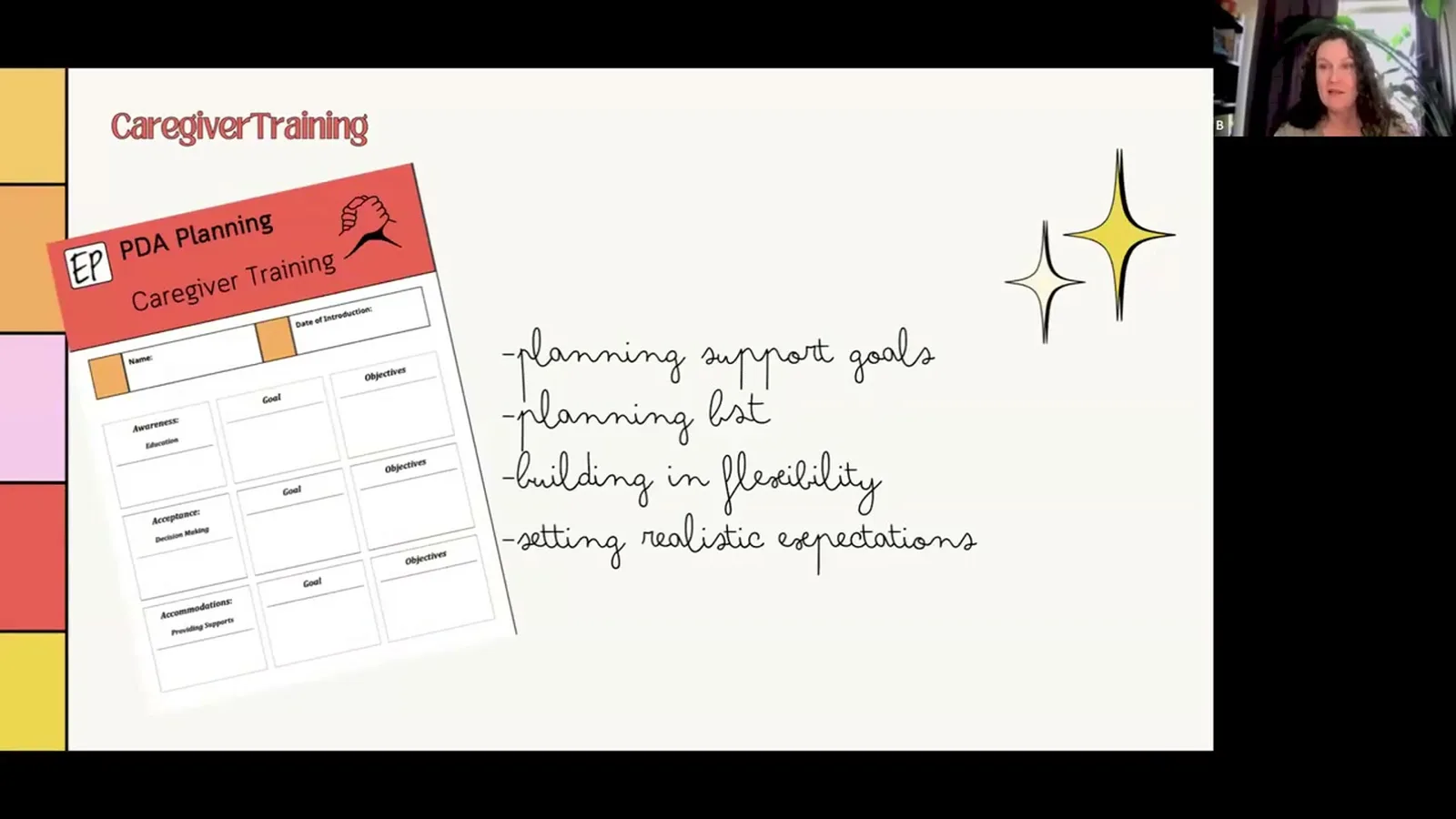
PDA Caregivers, Complex Profiles, Replacement Behaviors, and Being Trauma Informed
On this page · 8 sections▾
The first SBT modification for a PDA learner is fading the clap. Skill-Based Treatment, or SBT, usually starts with a loud clap. That clap signals that a request is coming. For a learner with a Pathological Demand Avoidance profile, or PDA, the clap can spike anxiety. The sound alone can shut the session down.
This page covers three changes you can make inside SBT this week. Fade the clap. Pause when the fawn response shows up. Rehearse decline as a real target response. Each change comes from a real session with a real learner.
Why standard SBT can stall with a PDA learner#
SBT is built on fast cycles. You present a small demand. The learner asks for a break. You honor the break. Then you go again. The Practical Functional Assessment, or PFA, tells you what to put in those cycles. Both come from FTF Consulting. Both work very well for many learners.
A PDA learner can stall on the very first step. The trigger is not the demand itself. The trigger is the loss of control. The clap, the script, and the timing all signal a loss of control. The learner reads that signal before you finish setting up.
You will see one of two patterns. The learner explodes. Or the learner gives in too fast. Both patterns are signals to change the procedure. Neither pattern means the learner failed SBT.
Fading the clap: when to drop it, when to keep it#
The clap was the cue that the practice trial was starting. FTF Consulting has moved away from it for many learners. The case of O shows why this matters. O is 14. O is blind, deaf, and has trisomy 13. For O, a strong cue is still needed. The clap stays.
For a learner with a PDA profile, the clap can be the trigger. Bea names this clearly in the recording.
So excited that FTF has discussed that they are fading out the clap. For individuals who do have PDA presentations, it's important to note that that can actually be something that will trigger an anxiety response. From the talk — B. Kuerine Gray
You have two choices when fading the clap. Replace it with a softer cue. Or drop the cue and start the trial inside play. A soft cue can be a hand on a shared toy. A play start can be sliding a piece into a puzzle the learner is already touching. Both let the demand come without the warning sound.
Test one change at a time. Run three to five sessions. Watch the rate of Happy, Relaxed, Engaged signals, or HRE. If HRE holds steady or goes up, keep the change. If HRE drops, the cue was doing work you missed.
Reading the fawn response as a stop signal#
The fawn response is when a learner gives in fast to stop the demand. It looks like cooperation. It is not. The learner is masking. The cost shows up later in the day.
Bea pauses SBT when she sees this. She is direct about why.
The next time we put SBT on hold for that individual is that we were experiencing increased fawning response. So instead of engaging in an FCR, it was just 'okay, I'm going to do what you asked.' From the talk — B. Kuerine Gray
Here is what fawning looks like in session. The learner agrees right away. The learner has tears on their face. The learner stops asking for breaks. The learner stops asking for a different way. You start to see more behavior after session, not less.
When you see fawning, put SBT on hold. Do not push for one more trial. Go back to pairing. Build a few days of low-demand time. Then bring SBT back with a smaller step.
The data point you are tracking is not the Functional Communication Response, or FCR. The data point is whether the FCR was a choice. A scripted yes from a fawning learner is not a skill. It is a warning.
Multi-topography FCRs inside SBT#
A single FCR can also become a trigger. SBT often trains one phrase. The phrase might be "my way, my play." For a PDA learner, that one phrase becomes one more rule. One more rule means one more loss of control.
The fix is to build a small set of FCRs that all do the same job. The learner can pick. The learner can mix. The clinician counts any of them.
Three or four works well as a starting set:
- "My way, my play"
- "I'm not ready"
- "Can we do it different"
- A non-vocal version, like a card or a sign
You count any one of these as a correct FCR. The point is the function, not the form. If the learner says "I'm not ready," and you push for "my way, my play," you have set a new demand. You have stopped doing SBT.
This change holds true outside the SBT room. If a parent only counts one phrase, the family runs the same trap. Caregiver training has to cover the full set.
Rehearsing "I'm not ready" as a target response#
Most SBT teaches the learner to ask for what they want. PDA SBT also teaches the learner to decline. Decline is the target. Decline is the skill.
Bea names the rule the team practiced with the learner.
It is okay to decline. It is okay to advocate at the onset of any demand presentation. From the talk — B. Kuerine Gray
You can run decline practice inside the normal SBT loop. Set up a small demand. Wait. If the learner says "I'm not ready," honor it on the spot. Then move on. Sometimes the demand is real. Sometimes it is practice. The learner never knows which. That keeps the decline skill live.
Track two things over time. Did the learner decline at least once a session. Did the learner accept at least one demand without prompting. Both should rise together. If only one rises, the balance is off.
This is the part most teams skip. Decline feels like a setback to staff. It is not. A learner who can decline can also choose to engage. That choice is the goal.
Rotating co-regulation strategies inside the SBT loop#
SBT drops requirements very fast. That speed is a feature, not a bug. You can use that speed to test co-regulation strategies in a safer way. Bea makes the case for using SBT this way.
In SBT, because you're dropping requirements so fast, you can try things out in a safer way, right? You can rotate through seven different co-regulation methods. From the talk — B. Kuerine Gray
Pick seven co-regulation strategies to test. Examples include shared deep breaths, a walk together, a fidget swap, a quiet hum, a hand on the shoulder, a shared count to ten, and a "let's both pause" move. Rotate one per session. Watch which one shifts the learner from escalated to HRE.
The key move is modeling without a demand. You take the break first. You name what you are doing. You let the learner join. You never tell the learner to copy you. The choice has to stay theirs.
Once you know which two or three strategies work, those become your go-to set. Train the parents on the same set. Train the school team on the same set. The learner gets the same response in every room. That stable response builds trust, and trust is what makes the next SBT trial work.
Frequently asked questions#
Do I still run a synthesized contingency analysis with a PDA learner?
Yes, but slower. The synthesized contingency analysis is the PFA step that finds what the behavior is doing. You still need that answer. You just take more sessions to get it. Use shorter trials. Stop the moment you see fawning. Keep the analysis going across days, not one session.
What if the learner only complies when they're fawning?
Treat the compliance as a red flag, not a win. Pause SBT. Go back to pairing for several days. Look for a smaller starting demand. The learner is telling you that the current step is too big. A smaller step that builds a real FCR will beat a bigger step that builds a fake one.
Can I run SBT in school for a PDA student?
You can. School makes it harder, but not impossible. Start with one adult who has the most time with the student. Train that person first. Often this is the paraprofessional. Build small wins. Then bring in the teacher. Then the special ed director. You build buy-in one level at a time. The IEP meeting is the last step, not the first.
What to do this week#
Pick one change. Run it for one week. Track Happy, Relaxed, Engaged signals each session.
If you are starting with the clap, test a soft cue or a play start. If you are starting with the fawn response, write down what fawning looks like for your learner. Share that list with every staff member. If you are starting with multi-topography FCRs, write the three or four forms on a card. Tape it to the staff binder.
Then watch the recording for the parts you skipped. Bea walks through the cases of S, O, Y, C, and F in full. Each case shows a different mix of these changes. Your learner will fit one of those mixes more than the others. The full talk gives you the language to tell parents what you are doing and why.
Turn this topic into a CEU
You just studied this. Now get credit for it.
Watch PDA Caregivers, Complex Profiles, Replacement Behaviors, and Being Trauma Informed with B. Kuerine Gray and earn 1.5 free BCBA CEUs. Detailed certificate, delivered the moment you finish.