Co-Regulation for PDA Learners: Modeling Without Making a Demand
How to model co-regulation for a PDA learner without turning it into another demand, plus when self-regulation is the wrong goal, from a BCBA-led CEU.
Key takeaway
Co-regulation is modeling your own regulated state out loud so the learner can borrow it, and it has to come before self-regulation can be taught.
PDA Caregivers, Complex Profiles, Replacement Behaviors, and Being Trauma Informed
On this page · 8 sections▾
Co-regulation is modeling your own regulated state out loud so the learner can borrow it, and it has to come before self-regulation can be taught. For a learner with a PDA profile (pathological demand avoidance, a nervous-system response pattern where any felt demand can spike anxiety), this order is not a nice-to-have. If you skip it and write a self-regulation goal first, you are asking the child to use a skill they have no foundation for, and the request itself becomes the next demand that sets them off. The fix is small in size and big in effect. You stop telling the learner to calm down. You narrate your own state, do the calming thing yourself, and wait for them to step into it with you.
Why "take a breath" is a demand to a PDA learner#
A BCBA (Board Certified Behavior Analyst, the clinician who designs the plan) is trained to deliver a clear instruction and reinforce the response. With most learners that works. With a PDA learner it can backfire on the first word. The cue itself is the trigger.
When you present an SD for regulation, you are essentially presenting another demand that can increase escalation. From the talk — B. Kuerine Gray
"SD" here means discriminative stimulus, the cue that signals a specific response. "Take a breath." "Use your strategy." "Let's do our breathing." Each one is a clean request to a regulated nervous system and a felt threat to a dysregulated PDA nervous system. The body reads it as a loss of autonomy, and the response class (the whole family of behaviors aimed at the same outcome, from a flat no to property destruction) gets louder, not quieter.
This is the part that trips up well-meaning teams. The plan looks right on paper. The team is fluent. The data still gets worse. The issue is not the strategy. It is that the strategy is being handed to the learner as a directive.
Modeling co-regulation: narrate your own state, not theirs#
The move is to make yourself the example. You do the calming. You say what is happening in your own body. You do not coach theirs. The learner watches, the learner mirrors, and now they are doing the regulation skill without ever being told to.
Here is how the talk frames it with a learner Y (a five-year-old with autism and ADHD, precocious language, and explosive escalation that came out of nowhere). Y is escalating. The volume is climbing. Property destruction is close.
I think I need a break. So you, you can take a break right there, but I, I need to take a break to myself because I'm a little overwhelmed. From the talk — B. Kuerine Gray
Notice the build. The clinician owns the break. The learner is told they can stay where they are. Then the clinician keeps narrating: my body feels like it is going fast, my breathing is fast, I am talking louder than usual, I might pick up a fidget, I might pace. Every line labels an internal event so it has a name. Every line is about the adult.
The clinician then picks up the fidget. Walks the room. Says one open line: "Sometimes it is good to have a buddy to help you calm down. You can do it with me if you want." That is the only thing offered to the learner, and it is offered as a choice, not a step.
The instant the learner attends to it, even a single step toward the adult, the strategy is working. That is the initiation. That is the data point. You do not stop and praise it as a target behavior. You keep being the example.
The reinforcement language switch ("this is helping me" vs. "good job")#
The reinforcement step is where most teams reintroduce the demand by accident. "Good job breathing." "I love how you are doing your strategy." Both are clean reinforcers in most plans. Both can shut a PDA learner down because both put the learner's behavior on display and ask, implicitly, for more of it.
The minute there's that initiation, you can reinforce that behavior. And it's not reinforcement of "oh, I like you're doing this" because again, that could potentially be considered a demand. From the talk — B. Kuerine Gray
The switch is to keep talking about yourself. "My body is starting to feel slower." "I feel so much better with you doing this with me." "Thank you for doing this with me. It is really helping." Each line takes the spotlight off the learner. Each line still pairs the moment with warmth and a sense that something worked. The reinforcement is real. It just does not arrive as an evaluation of them.
After a few rounds, you can ask one neutral question. "Is your body starting to feel slower?" If they say yes, great. If they say "I hated this," even better, because now you have data, and you can ask, "Oh, what do you like to calm down? I will do it with you now." You stay in the co-regulation. You just rotate the method.
Tolerance of co-regulation as the actual first goal#
The IEP (individualized education program, the legal document driving school services) tends to ask for self-regulation goals. Parent intake forms ask for self-regulation goals. A new clinician inherits five of them. None of those goals will move for a PDA learner who does not yet tolerate co-regulation, because the prerequisite skill has not been built.
We spend a lot of time on treatment goals, focusing on self-regulation, self-regulation, self-regulation. However, if you don't have a strong foundation of co-regulation, you have to engage in co-regulation. From the talk — B. Kuerine Gray
The first goal is not "the learner will use a regulation strategy in three out of four opportunities." The first goal is whether they tolerate the adult co-regulating near them at all. After that, whether they accept it (eye contact, body orientation, an utterance back). After that, whether they initiate it (move toward the adult, request the buddy, name the feeling first). Self-regulation comes after those three are stable, not before.
This reframe also gives the BCBA language for a goal-writing meeting. When a teacher asks why the plan does not have a self-regulation target, the answer is that the learner has not yet shown stable tolerance of co-regulation, and a self-regulation target would skip the foundation. That is a clean, defensible position. It also matches what the data will show.
Goal-writing: co-regulation before self-regulation#
Practical sequencing for a goal bank that respects the prerequisite:
- Tolerates an adult co-regulating in close proximity during a low to medium dysregulation moment, without escalation, for a target duration.
- Accepts a co-regulation offer presented as a choice (attends to the model, mirrors one element).
- Initiates co-regulation by moving toward the adult or naming a body cue during a dysregulation moment.
- Selects a preferred co-regulation method from two or more options that the team has rotated through.
- Uses one of those methods independently after the adult begins modeling, with the adult fading their narration.
Each step is measurable. Each step builds on the one before. Self-regulation language only enters the plan after step five is stable across people and settings.
Reading subtle initiation and treating it as the FCR#
The FCR (functional communication response, the replacement behavior the team taught to access the same reinforcer as the problem behavior) does not have to be the exact sentence the plan wrote down. With a PDA learner, holding out for the scripted response is itself a demand.
If the plan says the FCR is "my way, my play," and the learner says "I am not ready," that is an FCR. If the learner steps toward the adult who is modeling co-regulation, that is an FCR. If they pick up the fidget the adult put down, that is an FCR. Counting these as the response means the reinforcer can land in real time, and the learner gets a clean pairing of communication and access.
The takeaway for the team is to widen the threshold. Several FCRs, all serving the same function, all reinforced. The plan stays evidence-based. The learner gets to vary the response, which is the whole point of the program.
Frequently asked questions#
Is co-regulation an evidence-based ABA goal?
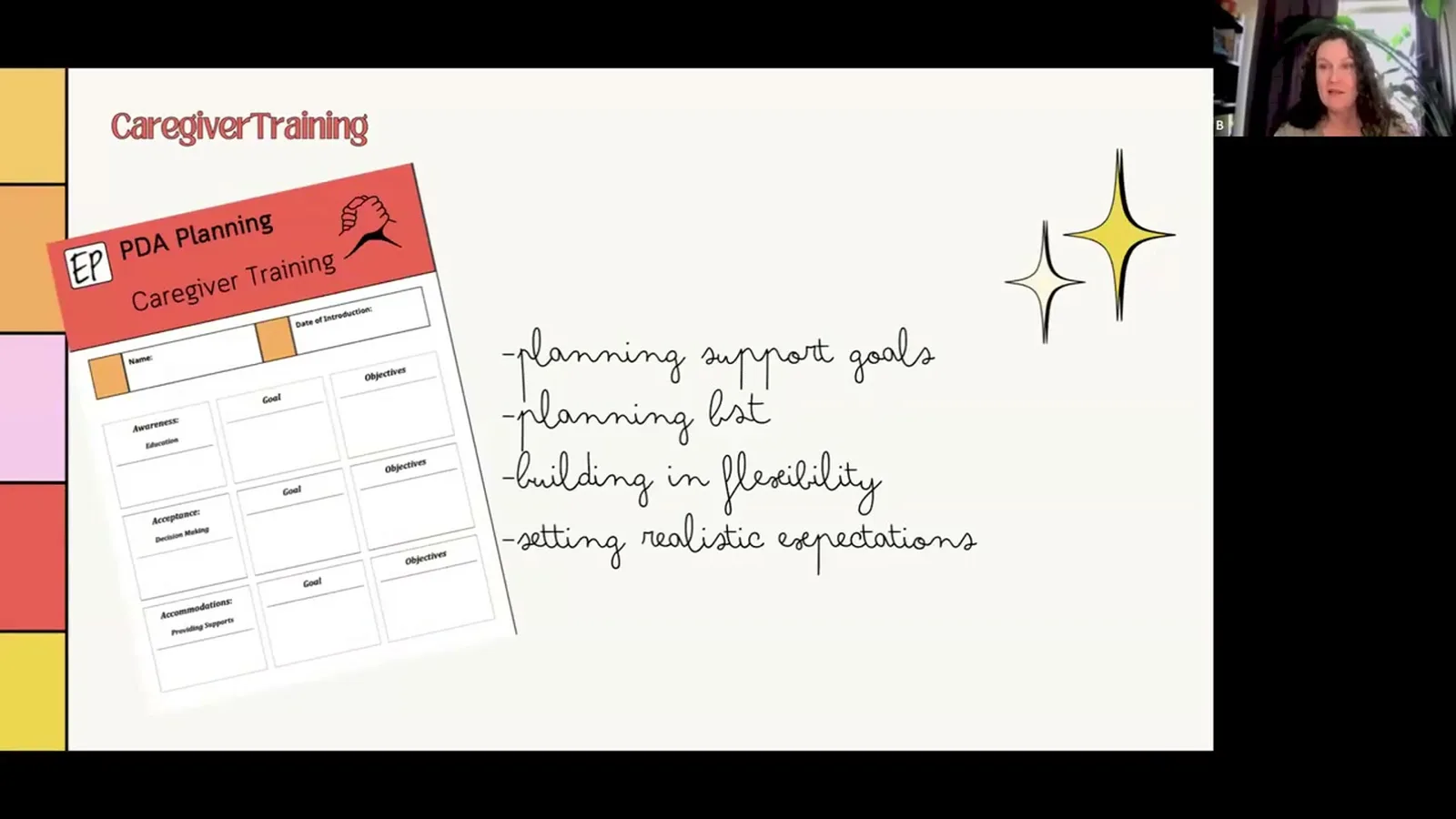
Co-regulation is a procedural variation built on operant principles already in the field: modeling, prompting, shaping, reinforcement of a target response, and stimulus control. The PDA-specific Carlozzi caregiver study from October 2025 is the first peer-reviewed PDA study in the US and reported a large effect on caregiver strain when training emphasized awareness, acceptance, accommodations, affirmation, and advocacy. Goal language like "tolerates co-regulation" or "initiates co-regulation" describes a measurable response and reinforcement contingency, which is what the BACB (Behavior Analyst Certification Board) wants to see.
What age is too old to target co-regulation instead of self-regulation?
There is no age cutoff. In the talk, the case examples ranged from a three-year-old to a 26-year-old, and co-regulation was a caregiver focus across the older cases (an 18-year-old with autism, ADHD, epilepsy, and a 26-year-old with Down syndrome, autism, and OCD). What matters is whether the learner has demonstrated stable tolerance, acceptance, and initiation of co-regulation. If those are not stable, self-regulation is not the next step yet, regardless of age.
How do I get a paraprofessional to model co-regulation believably?
Train the narration with BST (behavior skills training, the four-step coaching loop of instruction, modeling, rehearsal, feedback). Give them three short scripts they own, in their own voice. Let them practice the scripts on you while you play the learner. Reinforce specific lines that landed, not "good job." Then watch one real session, give one piece of feedback, and rotate. The paraprofessional does not need to be theatrical. They need to be calm, specific about their own body, and willing to be the one taking the break.
Want the full hour with the case examples#
The CEU walks through five learners (ages three to 26), the SBT modifications that worked, the fawn response, and the verbatim co-regulation script in context. Watch the talk to hear how B. Kuerine Gray sequences it in real time, and where she pauses the program when the standard procedure starts hurting the learner.
Turn this topic into a CEU
You just studied this. Now get credit for it.
Watch PDA Caregivers, Complex Profiles, Replacement Behaviors, and Being Trauma Informed with B. Kuerine Gray and earn 1.5 free BCBA CEUs. Detailed certificate, delivered the moment you finish.