Anxiety as a Private Event in ABA: The Wave Shape That Matters
Anxiety is a private event with a wave shape, and where you reinforce on that wave decides the whole outcome. Here is how it works, from a BCBA-led CEU.
Key takeaway
Anxiety is a private event with a wave shape, and the spot on that wave where reinforcement lands is the whole intervention. Picture a kid sitting in the car at school drop off.
Hey, Chillax Man! Understanding the Logic of Anxiety
On this page · 8 sections▾
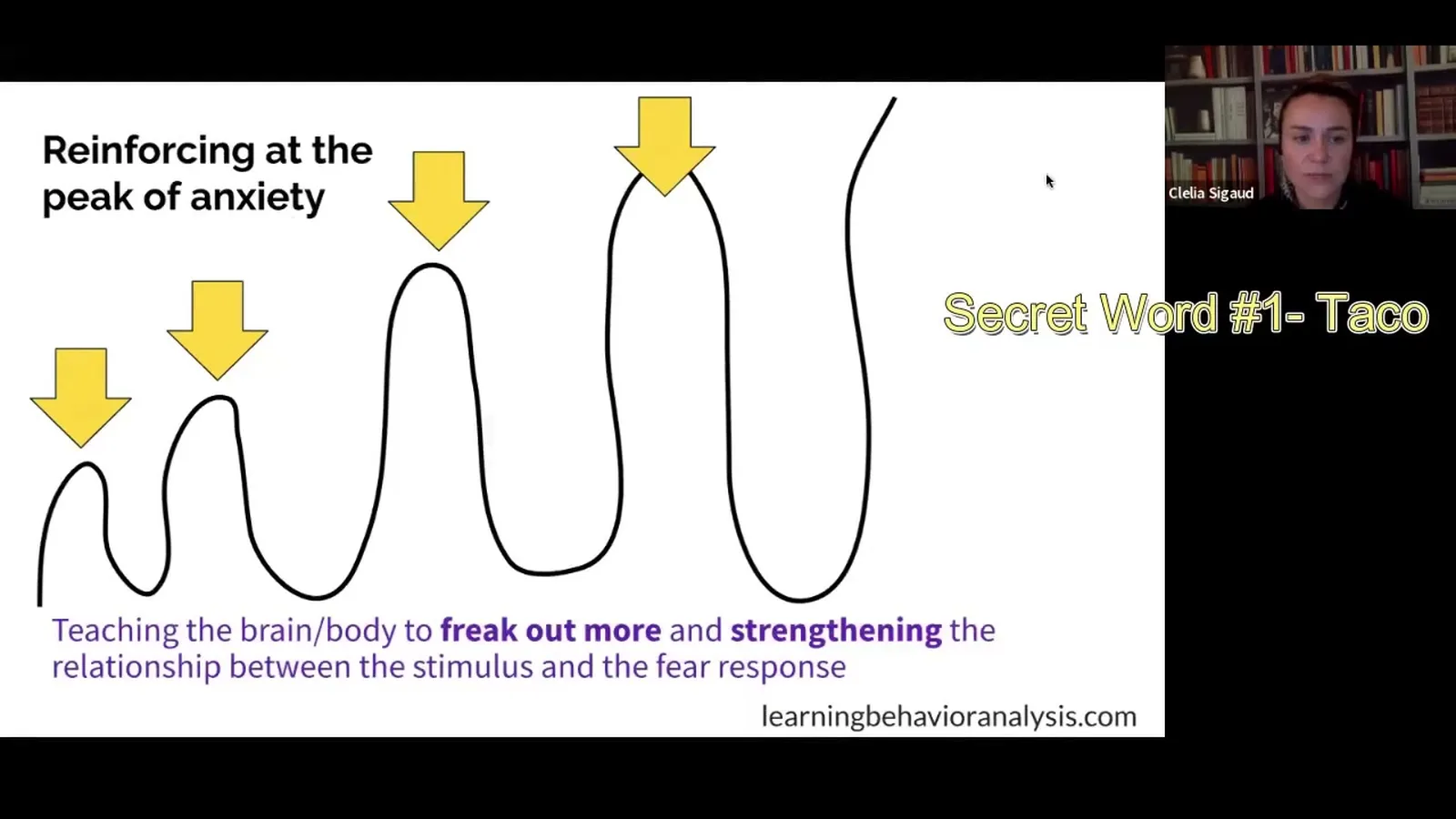
Anxiety is a private event with a wave shape, and the spot on that wave where reinforcement lands is the whole intervention. Picture a kid sitting in the car at school drop off. He is calm. Then his parents start in with "come on, go to school, you got this," and his anxiety climbs. It climbs higher. It hits the peak. He has a behavior. He goes home. The wave came down because he escaped at the top, and his brain just learned that the way out of school is to push the feeling all the way to the ceiling. A Board Certified Behavior Analyst (BCBA) cannot see anxiety the way you can see a tantrum on a floor, but the contingency is doing its job either way. This page walks through the wave, where reinforcement lands on it, and why that single idea is the spine that every other piece of anxiety work hangs from.
What private event means in plain English#
A private event is something happening inside a person that only they can feel. Anxiety is the classic example. So are nausea, a racing heart, the dread that creeps in when you check your phone, the relief that washes through you when a hard email gets answered. You cannot point at it. You cannot tape it. You cannot put it on a clipboard and tally it.
That used to make behavior analysts squirm. If you cannot see it, how can you work with it? But Skinner was clear that private events are still behavior. They are still under the control of contingencies. The skin of the person is not a magic line that turns off the laws of learning. A heart pounding in a chest follows the same rules as a hand reaching for a doorknob. We just have less access to it.
For a BCBA, that means two things. One, you have to listen carefully to what the kid or the parent tells you, because their report is your data. Two, you have to read the public behavior that travels with the private event. The kid does not have to label "I am anxious." The kid drags his feet. He chews his shirt. He asks the same question seven times. Those are your handles.
Why anxiety has a wave shape and cannot stay at the peak#
Anxiety is not a flat line and it is not a cliff. It is a wave. It rises, it peaks, it falls. The body cannot hold the peak forever, and that is by design.
We know that the aversive physiological arousal associated with fear cannot go on at the same intensity forever. If it could do that, it would defeat its evolutionary purpose because the point of it is to be so noticeable and aversive that it essentially, it doesn't force, but it highly, highly incentivizes immediate action. From the talk — Dr. Clelia Sigaud
That is the whole reason the wave exists. Fear is a signal. Signals that scream forever stop being signals. The body burns through the chemicals, the heart slows, the wave comes down whether you do anything or not.
This is good news for treatment. If you can hold a kid in the situation long enough, the wave will fall on its own. The body does not need an escape to come back to baseline. It will get there. The trick is what we, the people standing next to the wave, decide to do with that information.
Reinforcing at the peak: how natural life makes anxiety worse#
Here is where the whole intervention lives or dies. Reinforcement does not care about your intent. It lands where it lands.
Here we're reinforcing at the peak of anxiety. This is teaching the brain and the body to freak out more and strengthen the relationship between the stimulus and the fear response. From the talk — Dr. Clelia Sigaud
When the kid escapes at the peak, you have just told his nervous system a very clear story. The story is: school is dangerous, your panic was the only thing big enough to get you out, your panic worked, panic harder next time. He did not write that lesson on purpose. Nobody did. The contingency wrote it.
This is the default setting of regular life. Parents are kind. Teachers are tired. The path of least resistance is to give the kid a break when he is melting down, because the meltdown is loud and the break is quiet. So a kid with no clinical support tends to drift toward higher and higher peaks, because that is what works.
Reinforcing at the bottom: where intervention actually lives#
The opposite move is to make sure the escape, or the praise, or the access to the preferred thing, lands when the wave is low. Not when the kid is screaming. Not when the kid is hyperventilating. When the kid is in the room, doing the hard thing, and the body has settled even a little.
That is the entire job. Not "expose the kid and hope." It is sequence the contingency so the reinforcer lands at a bottom, not a peak. Every time you do that, you weaken the link between the trigger and the fear. Every time the natural environment lands a reinforcer at the peak, you strengthen it.
This is also why "just push through it" advice from the internet is so dangerous for anxious kids. The advice assumes the wave will eventually fall on its own and the kid will learn it is fine. That can happen. It can also catastrophically backfire if the kid bolts at minute nine and the bolt becomes the reinforced moment.
What this looks like in M's morning at school#
Sigaud walked through a case in the talk that draws the wave in real life.
He'd be sitting in his car and then his parents would start prompting, come on, go to school, go to school, go to school. You got this. His anxiety would peak, peak, peak, peak. And then suddenly he would have a behavior and he would get out of school. From the talk — Dr. Clelia Sigaud
Read that pattern carefully. The parents are loving. They are trying. The prompts are well meant. And the prompts are the climb up the wave. The behavior at the top is the only thing big enough to break the prompt chain, so it gets selected for. The kid is not manipulative. The contingency is just working.
The intervention rewrite is not "stop prompting." It is sequence the morning so that calm in the car gets the good thing, partial entry gets the good thing, and the peak does not. You move the reinforcer down the wave. The car line stops being a climb and starts being a place where being okay pays off.
Why this changes how you write a BIP#
If you skip the wave and just write a Behavior Intervention Plan (BIP) the old way, you end up with goals like "decrease escape behaviors by 50 percent." Fine on paper. Useless on a Monday morning, because it tells nobody where the reinforcement is supposed to land.
A BIP built on the wave reads differently. It tells the team exactly which moment on the wave gets the reinforcer. It tells them what counts as a bottom for this kid this week. It tells them which prompts feed the climb and which do not. It treats parents and aides as people who are about to shape something powerful, and gives them a clear rule about when to deliver it.
That is also why anxiety BIPs that "work in clinic but not at home" usually fail in the same place. The clinic team is shaping at the bottom. The home team, with no plan, is reinforcing at the peak. Same kid. Two completely different learning histories. The wave does not care which room you are in.
The trap of arbitrary reinforcers for private events#
The last trap is thinking reinforcement for an anxious kid looks like a sticker chart.
We're not saying that reinforcers are going to look the same as perhaps what you might be more likely to think about when you hear the term reinforcer. So given that that's the case, what's the logic of anxiety disorder intervention? From the talk — Dr. Clelia Sigaud
For a kid whose private event is fear, the most powerful reinforcer in the room is usually relief. Not candy. Not a token. Relief. The drop from the peak of the wave to a baseline. So when you are picking your contingency, you are not choosing between "edibles or tokens." You are choosing the moment you let the relief arrive. If the relief arrives at the peak, you bought a bigger wave. If the relief arrives at the bottom, you bought a smaller one.
This is also why the "arbitrary reinforcer" approach falls apart in anxiety cases. A sticker for "being brave" lands whenever the adult notices. Often that is at the worst possible moment. The naturally available reinforcer, escape and relief, is doing the real teaching in the background. Your job is to get your hands on the natural one, not stack arbitrary ones on top of it.
Frequently asked questions#
How can a BCBA reinforce something they cannot see?
You read the public behavior that rides along with the private event. A kid who is at the bottom of his wave looks different from a kid who is at the peak. His breathing is slower. His shoulders drop. He answers a question with a full sentence instead of one word. Those visible signs are your timing cues. You do not have to see the anxiety to deliver reinforcement at the right point on its wave. You just have to read the body that is carrying it.
Is the wave shape the same for panic and generalized anxiety?
The shape is the same in the sense that arousal rises, peaks, and falls. The time scale is different. A panic wave can crest in minutes. A generalized anxiety wave can hum at a low simmer for hours and only spike around specific triggers. Both follow the rule about where reinforcement lands. With panic you have less time to plan your delivery, so the prep work on antecedents and on the team has to be tighter.
Does this mean we should never let an anxious kid escape?
No. Escape is part of life and part of treatment. The question is timing. Escape at the peak teaches the wave to grow. Escape at a partial bottom, after some exposure and some success, teaches the wave to shrink. A good plan uses escape on purpose, at a specific point on the wave, and never lets it land at the top by accident.
This page is the conceptual spine. Once the wave is clear, the rest of the work has a place to sit. If you have not seen this idea drawn out by a BCBA who is also a clinical psychologist, the original talk is the best 90 minutes you can spend on anxiety this month.
Turn this topic into a CEU
You just studied this. Now get credit for it.
Watch Hey, Chillax Man! Understanding the Logic of Anxiety with Dr. Clelia Sigaud & Matt Harrington and earn 1.5 free BCBA CEUs. Detailed certificate, delivered the moment you finish.