Trauma-Informed ABA for PDA Profiles: What Changes in Session
How to run trauma-informed sessions for PDA learners: mitigate harm, reduce anxiety, increase autonomy, and check your own triggers, from a BCBA-led CEU.
Key takeaway
Trauma-informed ABA for a PDA profile (Pathological Demand Avoidance, an autism profile) means three things in one session. You work to lower the learner's anxiety, you protect their sense of autonomy, and you check your own behavior as the clinician.
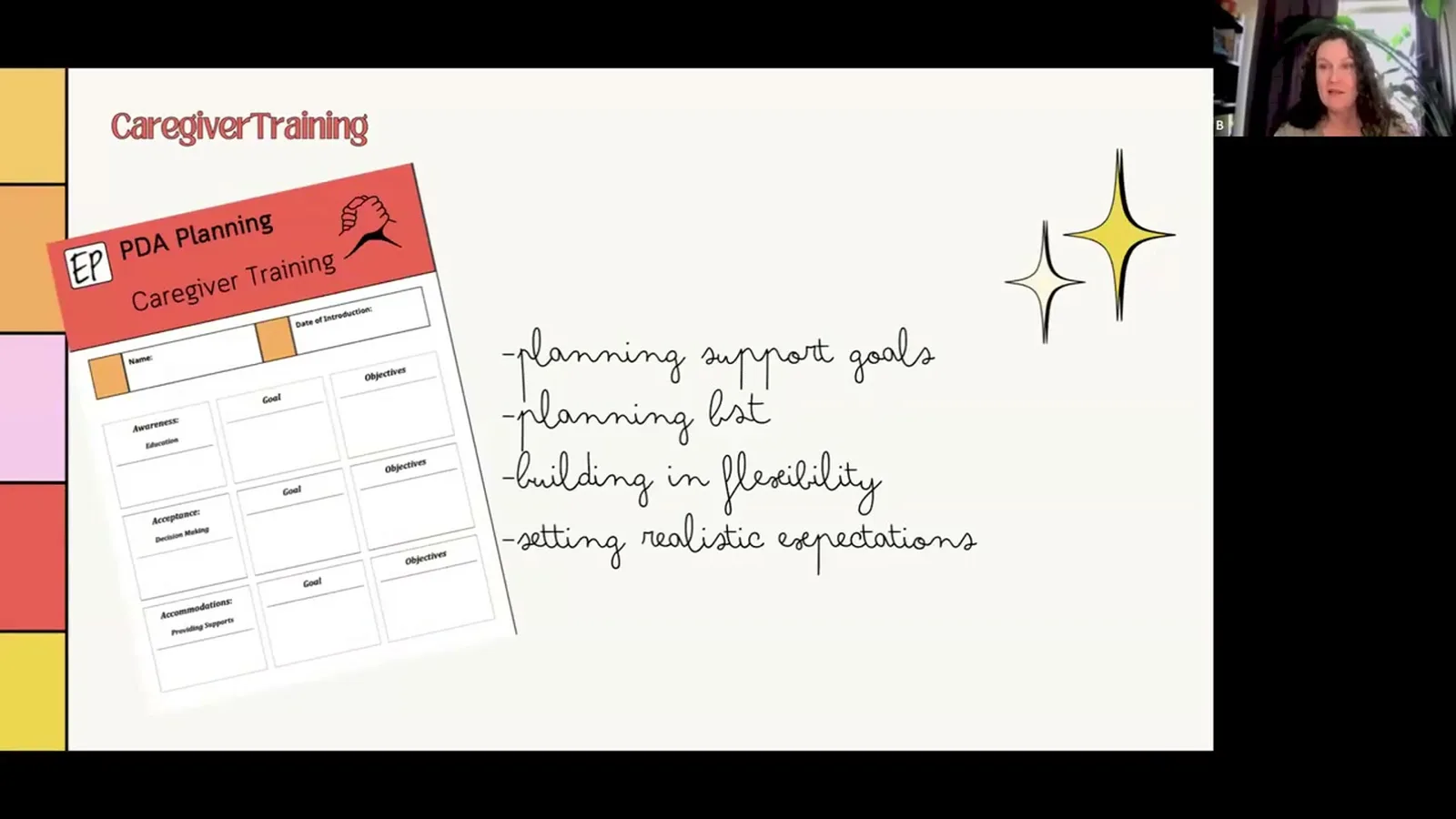
PDA Caregivers, Complex Profiles, Replacement Behaviors, and Being Trauma Informed
On this page · 7 sections▾
Trauma-informed ABA for a PDA profile (Pathological Demand Avoidance, an autism profile) means three things in one session. You work to lower the learner's anxiety, you protect their sense of autonomy, and you check your own behavior as the clinician. That third part is the one most teams skip. This page walks through what changes when you bring a trauma-informed lens to a session with a PDA learner, and what does not. The clinical work is still ABA. The questions you ask yourself mid-session are different.
What "trauma-informed" actually means in a PDA session#
Trauma-informed care is not a procedure you add to a session. It is a frame you put around every procedure you already run. For a PDA learner, the frame starts with one assumption. A loss of control feels unsafe to this nervous system. A demand can land as a threat even when nothing about the demand looks scary from the outside. Your job is to read the request from the learner's side first.
That is different from "be nice" or "be soft." A trauma-informed BCBA still runs SBT (Skill-Based Treatment, a teaching format from PFA, the Practical Functional Assessment). They still teach an FCR (Functional Communication Response, the words or signs a learner uses to ask for a break). They still take data. What changes is the first question they ask when behavior shows up. They stop asking "what behavior do I block." They start asking what the learner just lost.
Is this a perception of a loss of autonomy, and a response to that perception?From the talk — B. Kuerine Gray
That question reframes the whole session. If the answer is yes, the next move is not a consequence. The next move is to give some control back. Sometimes that is a choice between two tasks. Sometimes it is co-regulation. Sometimes it is dropping the demand for a minute and just sitting with the learner. The procedure does not change. The order and the framing do.
Three live questions to ask yourself mid-session#
A trauma-informed session is hard to run from a written plan alone. The learner moves fast, and the right response shifts with their state. Gray gives three short questions to hold in your head while you work. Read them as a checklist you run every few minutes.
Am I decreasing anxiety. Am I increasing autonomy. Am I providing supports so we can get there together. If the answer to any one of those is no, you change what you are doing. You do not wait for the data sheet to tell you at the end of the week. You change it now.
Am I decreasing anxiety? Am I increasing autonomy? Am I providing supports so that we can get to where we need together?From the talk — B. Kuerine Gray
These three questions also help with the part of PDA work that throws new clinicians. The goal is not to remove the demand. The goal is to get to the same outcome through a path the learner can tolerate. You may need to subtly shape your way there. You may need to change how you present it. You may need to add accommodations. The destination is the same. The path is theirs to help pick.
Mitigating harm vs. just being nice#
There is a soft version of "trauma-informed" that floats around in our field. It treats the term as a synonym for warm tone and gentle words. That is not what mitigating harm means. Mitigating harm means you watch for the ways your standard procedures can hurt this specific learner, and you change those procedures before they cause damage.
The clap fade from SBT is a clean example. The clap was a loud audible cue that paired with the start of the cab chain (the cooperative behavior chain). For most learners, it worked. For some PDA learners, the clap itself was an anxiety trigger. It paired the safe SBT window with a startle response. The harm was not in the protocol. The harm was in running an unmodified protocol on a learner whose nervous system read it as a threat.
Fawning is the other example to watch for. A PDA learner with a fawn response will not push back. They will give in and push through, sometimes with tears running down their face. The data sheet says they complied. The session looks successful. Inside, the learner is building a stronger link between this room, this person, and being unsafe. A trauma-informed BCBA spots fawning the way they spot aggression. Both are behavior. Both tell you the demand was too much.
When you spot fawning, the modification is the same as the modification for refusal. You teach the learner that "I am not ready" is a real answer. You rehearse it when the stakes are low. You honor it when they use it. You build flexibility in the FCR so the learner is not picking one rigid script and you are not waiting for one rigid response.
The clinician trigger check: power struggles, tone shifts, body language#
The piece that makes trauma-informed care different from generic compassionate care is the clinician-side accountability. You are part of the antecedent. Your tone, your body, your face, and your history all land on the learner before any procedure starts. If you do not track your own state, your plan is missing a variable.
PDA work pulls on clinician triggers more than most cases. The behaviors can read as disrespect. The words can read as personal. The refusal can read as something we were trained, sometimes in our own childhoods, to push back on. None of those reads belong in session. But they show up anyway, because we are people.
What are our triggers or setting events for our own maladaptive responses? I've seen providers over the years who may not be aware, get into power struggles.From the talk — B. Kuerine Gray
The check is small and fast. Did my tone just shift. Did I lean in when I should have leaned back. Did my face tighten. Am I holding the demand because the learner needs the skill, or because I do not want to be the adult who gave in. If any answer is the second one, you step back. The learner can feel it whether you name it or not.
Reflective supervision as a PDA safeguard#
The trigger check is hard to do alone. You cannot watch your own face while you watch the learner's face. That is why reflective supervision matters more for PDA cases than for most other work. A reflective supervisor is not there to catch protocol drift. They are there to give you a place to notice your own pattern.
A good reflective supervision setup for a PDA case has three pieces. A short, regular check-in that is not tied to billing. A specific question about your own state during the last session. And a plan for what you will try differently next time. The plan can be small. "I will sit on the floor for the first five minutes." "I will drop the third demand if their breathing speeds up." Small is fine. Small is what changes a pattern.
We are responsible for being in control of our own histories and being able to change our own patterns of behavior to mitigate harm.From the talk — B. Kuerine Gray
That responsibility is the part that makes this clinical work, not just kindness. You can be kind and still cause harm. You can be warm and still get pulled into a power struggle. The work is to know your own setting events, plan for them, and ask another clinician to help you check yourself.
Trends over time, not within a single week#
The last piece of a trauma-informed PDA frame is how you read your own data. PDA learners have big day-to-day swings. Sleep, school, family stress, and inside-the-body cues all change how the day runs. If you grade your plan on one week of graphs, you will yank a working program off the board because of a hard Tuesday.
Look at trends over months. A trauma-informed plan should show a slow, consistent upward line in the things you actually care about. More flexibility. More appropriate refusal. More use of the FCR. More tolerance of co-regulation. Fewer fawn responses. Fewer big escalations. The week-to-week noise is real. It is also the wrong unit of measurement for this work.
When the trend is not moving, the question is rarely "is the protocol right." The question is usually about the three live questions from earlier. Where in the session is anxiety still climbing. Where is autonomy still missing. Where is the support thin or pulled away too fast. Those answers usually live in the parts of the session no one is logging.
Frequently asked questions#
Is trauma-informed care the same as gentle parenting in ABA?
No. Trauma-informed care is a clinical frame for how procedures get run. Gentle parenting is a parenting style with its own values. They overlap in tone, but the work is different. A trauma-informed BCBA still runs SBT, still teaches FCRs, still takes data, and still has clinical targets. What changes is that they treat loss of control as a possible source of behavior, and they modify their own actions to mitigate harm. Gentle parenting does not require an FBA (Functional Behavior Assessment, the BCBA's behavior workup) or a treatment plan. Trauma-informed ABA does.
How do I document a trauma-informed modification on a treatment plan?
Write it as a procedural modification with a clear rationale and a measurable target. For the clap fade, you might write: "Cab chain initiation will use a verbal cue instead of an audible clap. Rationale: client's anxiety response to startle stimuli, observed across three sessions. Target: client engages in cab chain without pre-task escape attempts in 80 percent of opportunities across two weeks." The modification belongs in the procedural section. The rationale belongs in the clinical reasoning section. The data plan belongs in the measurement section. That structure holds up under audit and tells the next clinician why the change exists.
What if my BCBA supervisor pushes back on dropping the clap?
Bring the assent data. A supervisor's pushback is usually about fidelity, not about cruelty. If you can show that the standard protocol was producing pre-session avoidance, fawning, or a drop in HRE (Happy, Relaxed, and Engaged baseline), you have the case. Pair that with the FTF Consulting update on fading the clap and the trauma-informed rationale on this page. If the supervisor still pushes back, ask them to sit in on one session and watch the learner's body before the clap and after. That observation usually moves the conversation faster than another email.
Watch the full talk: PDA Caregivers, Complex Profiles, Replacement Behaviors, and Being Trauma Informed with B. Kuerine Gray. The 76-minute recording walks through five real cases (S, O, Y, C, and F), shows where each procedure was modified through a PDA lens, and goes deeper on the reflective supervision frame.
Turn this topic into a CEU
You just studied this. Now get credit for it.
Watch PDA Caregivers, Complex Profiles, Replacement Behaviors, and Being Trauma Informed with B. Kuerine Gray and earn 1.5 free BCBA CEUs. Detailed certificate, delivered the moment you finish.