The One-Page ABA Summary That Other Providers Actually Read
Stop sending pediatricians a 60-page behavior plan. The one-page care collab summary template, from a BCBA-led CEU.
Key takeaway
Here is how to write a one-page ABA summary another provider will actually read: put the client's name at the top, then primary goals when you started, then current goals, then one to three behavior graphs, then one to three skill acquisition graphs, and stop.
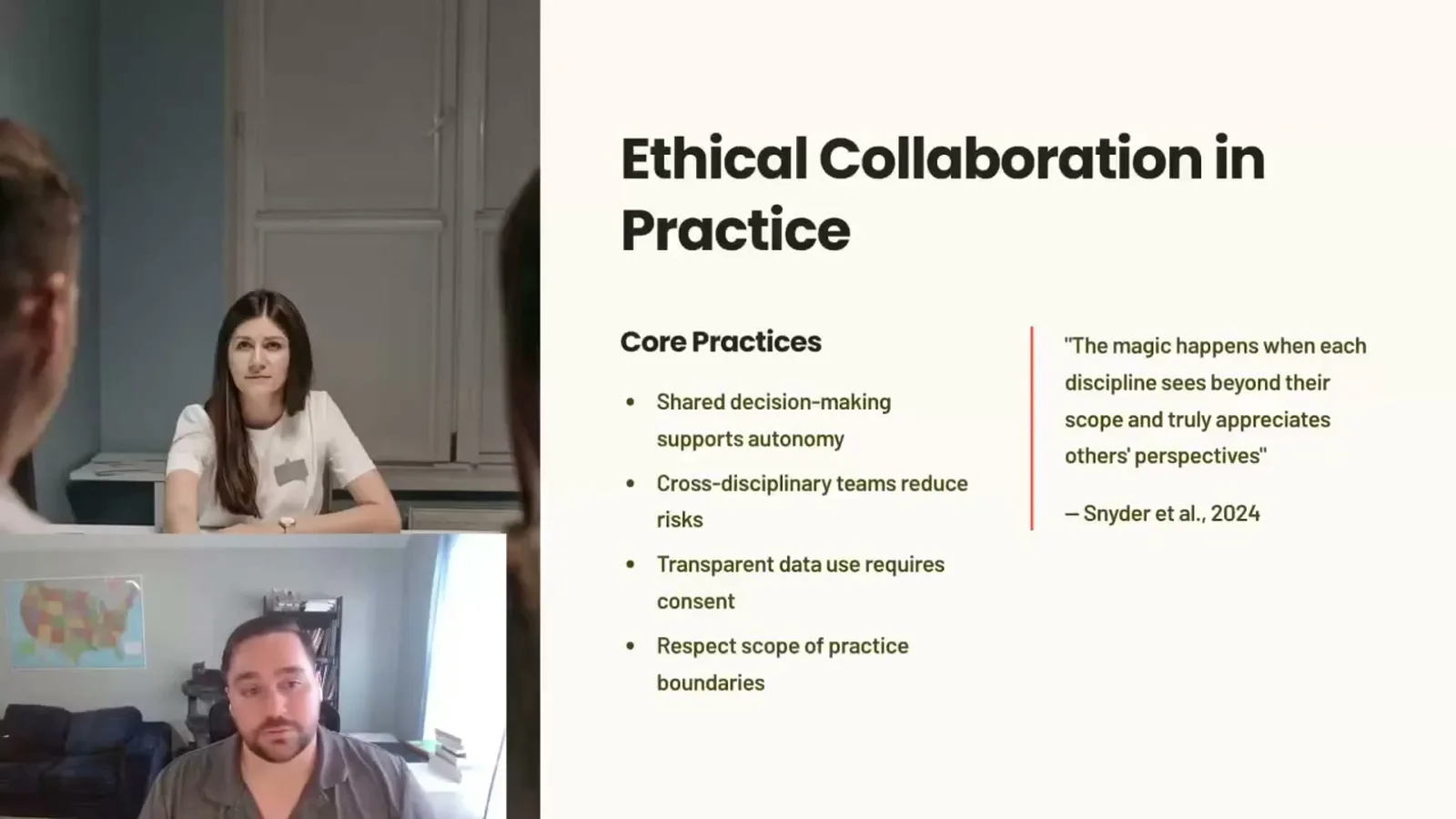
New Year, New Care Collab Goals
On this page · 9 sections▾
Here is how to write a one-page ABA summary another provider will actually read: put the client's name at the top, then primary goals when you started, then current goals, then one to three behavior graphs, then one to three skill acquisition graphs, and stop. That is the whole template. Matt Harrington built it after watching a pediatrician miss a real medication issue because the mom said the afternoons were "up and down." The pediatrician heard "fine." The data said the opposite. They pulled up the graphs, saw the pattern, changed the medication, and the behavior dropped. A one-pager would have caught that on the first visit. A 60-page behavior plan would have stayed in the shredder.
If you are a BCBA (Board Certified Behavior Analyst), or you work next to one as an SLP (Speech-Language Pathologist) or OT (Occupational Therapist), this page is for you. The rule is the same no matter who is on the other side of the email.
Why one page (and what happens to the 60-page version)#
Other providers do not have time for your full behavior plan. They have 30-minute slots. They have charts to write. They have other kids to see. When you walk into a pediatrician's office with 60 pages, you are asking them to do homework for free. They will not do it.
A one-pager is always going to be a full behavior plan. Please do not walk into a pediatrician care collaboration with a 60-page document. They will never read it. They'll thank you and they'll put it in the trash. Well, the shredder, rather. In general, for all our care coordination, we want it to be a one-pager. From the talk — Matt Harrington
A one-pager forces you to pick what matters. That is the whole point. If you cannot fit it on one page, you have not decided what the visit is really about. The other provider will read one page in 90 seconds and walk away with a decision they can act on. That is worth more than a thousand pages they never open.
The seven things Matt puts on every summary#
Here is the exact list from the CEU. Put these on the page in this order. Nothing else.
Highlights, name of client, primary goals when they started, current goals, one, two, three behavior graph, one, two, three skill acquisition graphs. Things that make a real impact one way or the other. From the talk — Matt Harrington
So the seven blocks are:
- Highlights. Two or three lines at the top. What changed since last time. What you need from this meeting.
- Name of client. First name, age, date of birth. Date of the summary.
- Primary goals when they started. The original three or four goals from intake. So the other provider can see the arc.
- Current goals. What you are working on now. Three to five max.
- One to three behavior graphs. Pick the behaviors that drive the conversation today. Not all of them.
- One to three skill acquisition graphs. Same rule. Pick the skills that matter for this visit.
- The closing question. One line at the bottom. "What data would be helpful for our next visit?" That is it.
That is the whole page. If you have a logo, a clinic name, and a date footer, you are done.
How to pick which 3 graphs to include#
This is the part most BCBAs get wrong. You do not pick the graphs that look best. You pick the graphs that match the question the other provider is going to ask.
For a pediatrician, that is almost always sleep, eating, tantrums, or aggression. Pick the graph that maps to a medical lever they can pull. If the kid is on a sleep medication, sleep is the graph. If you are tracking GI flare-ups, GI is the graph. If nothing on your data maps to anything the pediatrician can do, you are bringing the wrong page.
For an SLP, pick a language graph. Manding rate. AAC use across settings. Echoics. Something that overlaps with what the SLP is already tracking, so you can compare notes.
For an OT, pick the behavior that has a sensory hypothesis. Tolerating transitions. Time on task. Self-regulation. Show the graph and ask if their sensory diet is moving the line.
For a psychiatrist, sleep and mood. Always. And fidelity to medication if you are tracking it.
You are not picking your favorite data. You are picking their lever.
The "up and down afternoons" problem. Why narrative loses to graphs#
This is the story that proves why the one-pager wins. Read it once and you will never go back to narrative summaries.
The mom said, oh, it's been up and down, but, you know, it's not awful, but it's definitely not great. And the pediatrician interpreted that as, okay, well, things are going fine. But then we looked at the data and we saw a completely different story in the afternoon. From the talk — Matt Harrington
"Up and down" sounds like a 6 out of 10. The graph showed a 2. The mom was not lying. She was just exhausted and using the words a tired parent uses. The pediatrician heard the words and made a decision. With the graph in front of him, he made a different decision, and the kid got better.
This is the whole case for the one-pager. Parents and providers translate the same data into different stories. A graph translates the same way for everyone. When you put the graph on the page, you take the translation out of the conversation.
Tailoring the one-pager per partner: pediatrician vs. SLP vs. psychiatrist#
Same seven blocks. Different graphs and different closing question. Here is the swap.
Pediatrician one-pager. Graphs: sleep, GI events, tantrum frequency. Highlights: anything that points to a medical contributor. Closing question: "Are there medical rule-outs you want me to track between now and our next visit?"
SLP one-pager. Graphs: manding rate, AAC use, joint attention. Highlights: where your data and theirs disagree. Closing question: "What language target do you want my team to support across settings?"
OT one-pager. Graphs: behaviors with a sensory hypothesis, fidelity to the sensory diet, time on task. Highlights: what part of the OT homework actually got done at home. Closing question: "If we tracked one OT fidelity number for you next month, what would it be?"
Psychiatrist one-pager. Graphs: sleep, mood, medication fidelity. Highlights: any aggressive swing in mood or sleep since the last med change. Closing question: "What data would be most helpful for the next med decision?"
You are writing four different one-pagers from the same underlying data. That is the work. The page is short. The thinking is not.
The closing question that writes your next summary for you#
This is the small trick that makes the whole system run on autopilot.
The thing I always like to end with is what data would be helpful for our next visit. They say, I want more sleep data. You say, great, let's do this thing. From the talk — Matt Harrington
When you ask that question, the other provider tells you what to put on the next one-pager. You do not have to guess. You do not have to over-collect. You write down what they said, you collect it for six weeks, and you bring it back. The next meeting opens with "you asked for sleep data, here it is." That sentence builds more trust than any 60-page plan ever will.
Write the question at the bottom of every summary. Ask it out loud at the end of every meeting. Take the answer back to your team and put it on the data plan. That is the whole loop.
Copy-paste template (with what to delete)#
Here is the bare structure. Open a fresh doc, paste this in, and delete the brackets as you fill it in.
[Clinic name]              [Date of summary]
Care collaboration summary

Client: [First name], [age], DOB [date]
Highlights: [2-3 sentences. What changed. What you need today.]

Primary goals at intake ([month/year]):
1. [Goal]
2. [Goal]
3. [Goal]

Current goals ([this month]):
1. [Goal]
2. [Goal]
3. [Goal]

Behavior data:
[Graph 1 - title and y-axis label]
[Graph 2 - title and y-axis label]
[Graph 3 - title and y-axis label, only if relevant]

Skill acquisition data:
[Graph 1 - title and y-axis label]
[Graph 2 - title and y-axis label]
[Graph 3 - title and y-axis label, only if relevant]

What data would be helpful for our next visit?
[Leave blank. Fill in at the end of the meeting.]

Prepared by [Your name, credentials]. ROI on file.
What to delete before sending. Anything that does not fit. If a graph is not relevant to this provider, cut it. If a current goal does not show up in the data, cut it. If your highlights run past three sentences, cut the third. If you find yourself adding a fourth graph, you are writing a behavior plan again.
Frequently asked questions#
Should I include the full behavior plan as an attachment "just in case"? No. The whole point of the one-pager is that the other provider reads it. An attachment trains them to skim the cover sheet and ignore the rest. If they ask for the full plan, send it then. Most never will.
How often should I update the one-pager? Once a quarter is fine for most clients. Update it before any care collaboration meeting, and update it if a major intervention changes. Tie the refresh to the same six-month authorization cycle you are already running, and it costs you almost nothing extra.
What do I do if the family doesn't want their child's data shared? You honor it. No release of information (ROI) means no sharing. Period. What you can do instead is help the family carry the one-pager themselves. Give it to them on paper. They can hand it to the pediatrician at the next visit. Same information, same impact, with the family in full control. Some families come back and sign the ROI a month later once they see it working.
Want the full care collab playbook?#
The one-pager is one piece. The CEU walks through scripts for SLPs, OTs, teachers, mental health providers, and psychiatrists. It is free and it counts for one BACB (Behavior Analyst Certification Board) learning CEU. Watch it on openceu.com when you have an hour, then come back and build your first one-pager tonight.
Turn this topic into a CEU
You just studied this. Now get credit for it.
Watch New Year, New Care Collab Goals with Matt Harrington and earn 1 free BCBA CEU. Detailed certificate, delivered the moment you finish.