Teaching Body Cue Recognition to Autistic Learners in ABA
How ABA teams can teach autistic learners to notice body cues like racing hearts, tight shoulders, and knots in the stomach, from a BCBA-led CEU.
Key takeaway
Carolyn Trump, BCBA, opened her half of this CEU with a working inventory of the public accompaniments of private events that practitioners can actually see at the table: escape and avoidance moves like leaning back or refusing entry into a room, postural shifts like crossed arms and shoulders climbing toward the ears, autonomic tells like flushed skin and rapid breathing, and verbal shifts like scripted "I'm okay" lines or sudden topic changes.
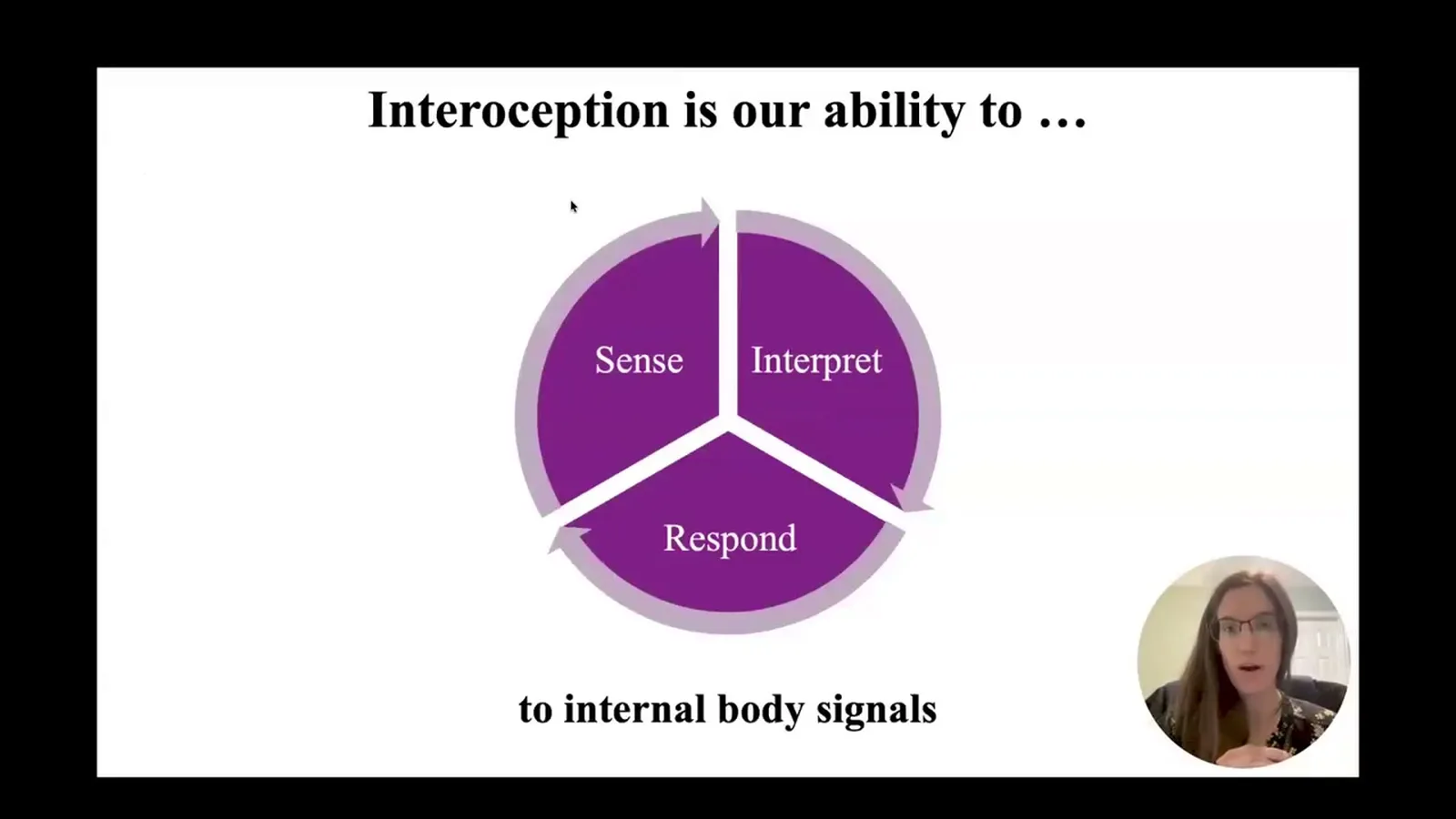
What Does Your Body Know? Teaching Individuals with IDD to Recognize Internal Warning Signs`
Free learning path on this topic
PDA and Demand Avoidance
B. Kuereine Gray's three PDA talks plus Clelia Sigaud on the logic of anxiety. What PDA is and isn't, how to collaborate with caregivers, how to handle complex profiles and replacement behaviors, and why demand-avoidant learners respond the way they do.
On this page · 9 sections▾
Carolyn Trump, BCBA, opened her half of this CEU with a working inventory of the public accompaniments of private events that practitioners can actually see at the table: escape and avoidance moves like leaning back or refusing entry into a room, postural shifts like crossed arms and shoulders climbing toward the ears, autonomic tells like flushed skin and rapid breathing, and verbal shifts like scripted "I'm okay" lines or sudden topic changes. That single inventory reframed what most teams already collect on their data sheets. If you have run a safety skills program in the last year and felt like the data was missing something, this is the piece you were missing.
Why body cues matter in ABA safety work#
Most of the safety programs running in clinics right now are built on rule-following. No-go-tell. Good touch, bad touch. Color-coded relationship circles. Those frameworks all assume the learner already knows when something is wrong. Tricia Lund's argument in this CEU is that for autistic learners and others with IDD, the discrimination step is exactly where the rule chain breaks. The body often registers a threat well before the conscious mind can label it, and a learner who has never been taught to notice that body data has no early-warning system at all.
Carolyn framed this in radical-behaviorist terms that make the work feel native to ABA rather than borrowed from another field. Private events are still events. They are covert behavior subject to the same environmental influences as anything observable, and as practitioners we already have a way in: the public accompaniments that ride alongside those internal shifts. Track the public side, and you build a path to the private side.
Public accompaniments of private events: what to look for#
The clinical move is to stop treating subtle body shifts as noise and start treating them as data. Carolyn grouped the observable proxies into a handful of categories that map cleanly onto an ABC sheet. Approach behavior, posture, proximity-seeking with caregivers, self-soothing patterns, the quiet shutdown signals, autonomic responses, and verbal-behavior shifts. None of these are new to a working BCBA. What is new is treating them as a coordinated set that may co-vary with a private event the learner cannot yet tact.
We may see a child tense their body, hold their breath, scan the room, cover their body, move away, become quiet, laugh nervously, refuse, or suddenly engage in challenging behavior.
Reading that list as a unified signal, rather than as eight separate problem behaviors, changes how a clinician designs the response. If the learner's body is the antecedent, then the intervention is teaching the learner to notice and tact what their body is doing before any of those public signs show up on the outside.
Escape and avoidance signals to track#
The earliest observable shift is almost always in approach behavior. The learner pulls back. They lean away from a person who has stepped too close. They hesitate at the door of a familiar room. They suddenly need to use the bathroom right when a particular staff member walks in. Latency to approach climbs. The learner finds a reason to leave the area during a social interaction that looked fine yesterday.
These are not new operants. RBTs see them every shift. The shift Carolyn is asking for is to log them as potential proxies for an aversive private event rather than as task refusal. The same topography, recoded, becomes a precursor data point instead of a maladaptive behavior to extinguish.
Posture, breathing, and autonomic responses#
The next observable layer is what the body itself is doing. Arms cross tightly. Shoulders climb. The chin tucks in. The learner curls inward, covers their chest, or covers their face and ears. Underneath that you start to see the autonomic layer: flushed skin, sweating, faster breathing, repeated swallowing, trembling, muscle rigidity, foot tapping that was not there a minute ago.
Tight shoulders, a racing heart, a stomach that suddenly doesn't feel right, an urge to move closer to or further away from someone.
For an RBT running a session, the practical move is to add a single column to the ABC sheet for body sensations. You are not asking the learner to introspect mid-session. You are noting what you see on the outside that may be sitting on top of what they feel on the inside. Over a few weeks of data, patterns start to surface.
The cues most teams miss (freezing, flat affect, sudden compliance)#
This is the part of the CEU that lands hardest if you have ever worked with a high-masking autistic learner. Carolyn was direct that the most clinically important signs are also the easiest to miss because they look like "good behavior."
Decreased eye contact, the flat affect, the reduced vocalizations, the shorter responses, the delayed responding, freezing, going quiet, or sudden compliance without engagement.
A learner who has been shaped by years of compliance-focused programming may not protest at all. They go still. They give a one-word answer where they would have given a sentence yesterday. They comply, but the engagement is gone. In a safety and grooming context that is exactly the response a predator wants. Logging "sudden compliance without engagement" as a data point, rather than scoring it as a successful trial, is one of the most important shifts a team can make.
How to log body cues alongside ABC data#
The practical implementation is small. Tricia and Carolyn both endorsed adding an interoceptive column to the standard ABC log. Antecedent, body sensation, behavior, consequence. The clinician or RBT codes the body column from the observable side: shoulders up, breath held, hand on stomach, flushed skin, frozen for three seconds. Over time those entries either correlate with downstream escalation or they correlate with a specific antecedent, and either correlation gives the BCBA a place to write a teaching target.
The second piece is a brief check-in routine embedded in the session. A 0 to 5 tension scale. A body thermometer the learner colors in. A quick "check your chest, is your heart calm or is it racing" prompt. None of these are outside the scope of an RBT running standard programs. They are protocols, run with the same fidelity as a discrete trial. The point is to build tacting of private events as an early member of the learner's response hierarchy, which is exactly how Carolyn framed the clinical goal.
Building a body-cue vocabulary with your learner#
Before a learner can say "I feel unsafe," they need a vocabulary for what the body is doing. The CEU walked through six implementation areas, but the foundational one is body discrimination before safety rules. Body maps. Mirrors. Visual scales. Tactile body outlines. Questions like "what does your body feel like right now" and "is your body tight, calm, busy, heavy." This is mand training and tact training in service of safety, not a separate curriculum.
Once the learner has the vocabulary, the next step is the pause-scan-decide chain Carolyn taught. Pause to interrupt automatic responding. Scan to check heart rate, breathing, muscle tension, urge to move away. Decide on an adaptive response. That chain converts safety from rule-following into body-informed decision-making, and it travels with the learner into every situation, not just the ones the team has prepared them for.
The other thing worth saying out loud: every reported discomfort needs to be reinforced. If a learner says "I don't like that" and the program response is to push through the trial, you have just put the safety-reporting response on extinction. The goal is to strengthen "I need space" and "something feels weird" as functional mands, even when they are inconvenient.
FAQ#
What are body cues in ABA? Body cues are the observable public accompaniments of private events. Tense shoulders, held breath, flushed skin, leaning away, going quiet, and sudden compliance are all body cues. In ABA we treat them as data points that may co-vary with an internal state the learner cannot yet tact.
How do you teach autistic kids to notice their bodies? You start with discrimination before rules. Use body maps, mirrors, visual scales, and tactile outlines to help the learner notice and label internal states. Then pair check-ins with naturally occurring antecedents like greetings, transitions, or proximity to new people. Over time, build a pause-scan-decide chain.
What body cues should I track on my data sheet? Add an interoceptive column to your ABC log. Track approach and avoidance shifts, posture changes, proximity-seeking, self-soothing topographies, the quiet signals like flat affect and reduced vocalizations, autonomic responses like flushed skin and rapid breathing, and verbal-behavior shifts like scripted reassurance.
Is freezing or sudden compliance a warning sign? Yes, and it is one of the most missed warning signs in safety contexts. A learner who freezes, goes quiet, or complies without engagement may be contacting an aversive private event they cannot yet report. In a grooming context this is the response a predator looks for, so logging it as a precursor rather than a successful trial is critical.
Can RBTs run body-cue programs? RBTs can run the data collection and the discrimination drills under BCBA supervision. The pause-scan-decide chain, the 0 to 5 tension scale, the body check-ins, and the interoceptive column on the ABC sheet are all protocols an RBT can run with fidelity. The functional assessment and the broader interdisciplinary coordination sit with the BCBA.
Bridge to your practice#
If you are a BCBA writing safety goals this quarter, the practical starting point is one column. Add interoceptive data to your ABC sheet for two learners. Pick two of the observable categories Carolyn outlined, train your RBTs to log them, and look at the pattern after two weeks. From there, build the discrimination program. The CEU lays out the rest of the chain in detail, and the recording is the fastest way to get every team member on the same page.
Watch the full CEU with Tricia Lund and Carolyn Trump on openceu.com to see the public-accompaniments inventory, the six implementation areas, and the interdisciplinary collaboration map in full. Earn your BACB CEU at the same time.
Turn this topic into a CEU
You just studied this. Now get credit for it.
Watch What Does Your Body Know? Teaching Individuals with IDD to Recognize Internal Warning Signs` with Tricia Lund and earn 1 free BCBA CEU. Detailed certificate, delivered the moment you finish.
Keep going with a free learning path
PDA and Demand Avoidance
B. Kuereine Gray's three PDA talks plus Clelia Sigaud on the logic of anxiety. What PDA is and isn't, how to collaborate with caregivers, how to handle complex profiles and replacement behaviors, and why demand-avoidant learners respond the way they do.