Ethical Guardrails in Behavior Reduction
Presented by Matt Harrington
This 60-minute CEU presents a practical framework of “ethical guardrails” to guide behavior analysts in designing and implementing interventions for complex, challenging behavior across settings. Rather than treating ethics as a checklist of rules, participants are invited to conceptualize ethics as flexible guardrails that keep treatment both effective and values-aligned over time. The presenter outlines three core guardrails: (a) cause no further harm, which includes recognizing potential and historical trauma and monitoring second- and third-order behavior effects beyond a single target; (b) continuously informed and assented to, emphasizing ongoing consent/assent conversations with caregivers and clients rather than one-time signatures; and (c) build resistant repertoires, focusing on constructional, skill-building approaches that improve quality of life instead of simply suppressing behavior. The presentation integrates assent-forward care, trauma-informed care, and the constructional approach, and introduces practical tools such as caseload-wide assent tracking, degrees of freedom analysis, and staff training routines for “tapping out” and protecting client dignity. Case examples illustrate how these guardrails can be used to evaluate and revise existing behavior plans, balance efficiency with safety, and align daily clinical decisions with the BACB Ethics Code and contemporary best practices in compassionate, trauma-aware service delivery.
Cancel any time. Cert delivered to your inbox the moment you pass the quiz.
Learner ratings
from 143 learners
100% would recommend this CEU to other professionals in their field (99 responses)
“I feel so happy”
— Akshaya K.“I like the real life examples that the presenter provided.”
— Maria G.“Really Insightful”
— Mahnoor B.
About this CEU
This 60-minute CEU presents a practical framework of “ethical guardrails” to guide behavior analysts in designing and implementing interventions for complex, challenging behavior across settings. Rather than treating ethics as a checklist of rules, participants are invited to conceptualize ethics as flexible guardrails that keep treatment both effective and values-aligned over time. The presenter outlines three core guardrails: (a) cause no further harm, which includes recognizing potential and historical trauma and monitoring second- and third-order behavior effects beyond a single target; (b) continuously informed and assented to, emphasizing ongoing consent/assent conversations with caregivers and clients rather than one-time signatures; and (c) build resistant repertoires, focusing on constructional, skill-building approaches that improve quality of life instead of simply suppressing behavior. The presentation integrates assent-forward care, trauma-informed care, and the constructional approach, and introduces practical tools such as caseload-wide assent tracking, degrees of freedom analysis, and staff training routines for “tapping out” and protecting client dignity. Case examples illustrate how these guardrails can be used to evaluate and revise existing behavior plans, balance efficiency with safety, and align daily clinical decisions with the BACB Ethics Code and contemporary best practices in compassionate, trauma-aware service delivery.
From the talk
What was covered
Three ethical guardrails for behavior reduction: cause no further harm, keep consent and assent live, and build resistant repertoires.
- Write your own guardrails as values, then re-read every plan against them about once a month.
- Judge a goal by the whole client, not by the one graph that is going up.
- Run a momentary time sample every 15 or 30 minutes and ask if assent is happening, yes or no.
- Train staff on when to tap out and which boundaries have to hold for safety.
- Count the real choices a learner has right now, and change the plan when the answer is zero.
- Cut down to two primary behavior reduction goals that move quality of life, and track the rest.
Why Ethics Works Better as Guardrails Than a Checklist
Picture a bowling lane. With the rails up, the ball bounces off one side, then the other. It still knocks pins down. With the rails down, one bad roll finds the gutter. The score is zero. Matt Harrington uses that lane to explain ethics. Your plan has to stay between two lines.
Most of us were trained to treat ethics as a checklist. Do one, two, three, four. Then you are clear. Real clinical work does not hold still. Plans change. Staff change. The family's week changes. You lean toward one rail, bounce, and correct. Then you lean the other way and correct again. A checklist cannot follow that.
He got here the hard way. He worked in schools, homes, inpatient units, and outpatient clinics. Ethics looked different in every setting. As a supervisee, he tried to match whoever was above him. It never settled. Each new plan pulled him between speed and safety. Move fast and you may cut risk sooner. Move slow and steady and the change is gentler, but it lands later.
So he stopped writing rules and drew rails. Guardrails are values, and you lay them over any method you use. Then you check them on a set schedule. He reviewed his own plans about once a month. He looked for plans leaning hard on one rail. He also looked for plans that had sailed clean over it. Fidelity errors (not running the plan as written) knock plans off course. So does a tweak you tried once and then kept. Put the guardrail check next to your IOA (two people scoring the same thing) and fidelity checks.
Which means the guardrails are values. They are not procedures.
From the talk — Matt Harrington
Guardrail One: Cause No Further Harm and Watch the Whole Client
The first guardrail is cause no further harm. It opens with a hard admission. Harm has happened in this field, from us and from people before us. Harrington says he never meant to cause any. He also says the harm still counts. That is his split between compassionate intent and compassionate behavior. Intent sits in your head. Behavior lands on the learner.
The guardrail also means watching more than your target. Electronic data makes it easy to sit back and watch one graph climb. Say mands (requests for things a person wants) are going up. On the graph that is a win. It reads differently if every mand is for cookie. It reads differently if every mand needs a heavy prompt. The count grew. The repertoire may not have.
He told a case from early in his career. A young learner was on a fixed-schedule potty training plan. The data looked great, so he called the goal a success. Then a caregiver asked what was happening in session. The child used to jump out of the car and run in. Now he did not want to come. He was talking less. The plan had quietly eaten the reinforcers that made sessions worth showing up for.
He calls this the second and third order effects (ripple effects beyond the target behavior) of a plan. Research asks about X and reports on X. Clinics run A through Z at the same time. Your results come from all of it, not from the one graph you chose.
It's good to have the intent of being compassionate. But what ultimately matters is the learner's reaction to that behavior.
From the talk — Matt Harrington
Guardrail Two: Consent and Assent That Stay Live
The second guardrail is continuously informed and assented to. Consent (permission from a legal guardian) is the half we know. You lay out risks and benefits up front. In most settings that happens once, near intake. Harrington wants it live the whole way through. Plans change often, and every real change is new information.
He is not asking for a fresh signature every week. Small changes do not need paper. He is asking that every party stay current. At any moment, a family should be able to say stop and know what they are stopping.
Assent (a learner's willingness to take part) is the other half. The BACB ethics code describes it as vocal or non-vocal behavior that shows willingness to take part. At the table, he keeps it simple. Behavior that moves toward the thing is assent. Behavior that moves away is assent withdrawal. Assent also expires. A young child can change his mind thirty times in thirty minutes. Our learners sit with us for five, six, sometimes eight hours. A yes at 8 a.m. is not a yes at 4 p.m.
One word does a lot of work here: uncompelled. He reviews plans where the assent line is clearly copy and paste. Walking to the table and sitting down gets counted as assent. People also walk to tables under threat. If the only road to the thing they want runs through your table, that is not assent.
But just in general, tracking, measuring, and moving forward only if we have assent is what we're looking for.
From the talk — Matt Harrington
What Assent-Forward Care Is Not
Assent-forward care picked up a reputation it did not earn. The myths he hears: it is NCR (free reinforcement on a timer) all day. It is slow and wasteful. You never push past discomfort. One twitch and you back off for weeks. Nothing hard ever happens. And the loudest one: extinction (no longer reinforcing a behavior) is banned.
His counterexample is laundry. He hates it. He does it anyway, because the clean pile sits on the bed. He wants that bed for lying down and watching a show. So he grumbles through a chore to get something better later. Weightlifting, runs, and saving for retirement all work that way. Clients hold that same right. It is the right to be uncomfortable in service of a bigger goal.
So this work does not mean nobody cries. It means the learner is choosing to be where they are. It is client led and therapist encouraged. You still give your opinion. You still point toward hard things. You just walk next to the person instead of pulling.
Extinction is not off the table either. Shaping (reinforcing closer and closer tries) runs on small extinctions. You stop paying at ten seconds and pay at fifteen. Full extinction shows up rarely in his work. He says the reason is risk, not assent. He offers one test for the rest. Picture your own therapist's office. You sit down and clamps close on your arms. Then you hear tell me about your day. You would want out. Give clients that same door.
That's an example of doing something you don't want to do because of a later reinforcer.
From the talk — Matt Harrington
Tracking Assent Across a Full Caseload
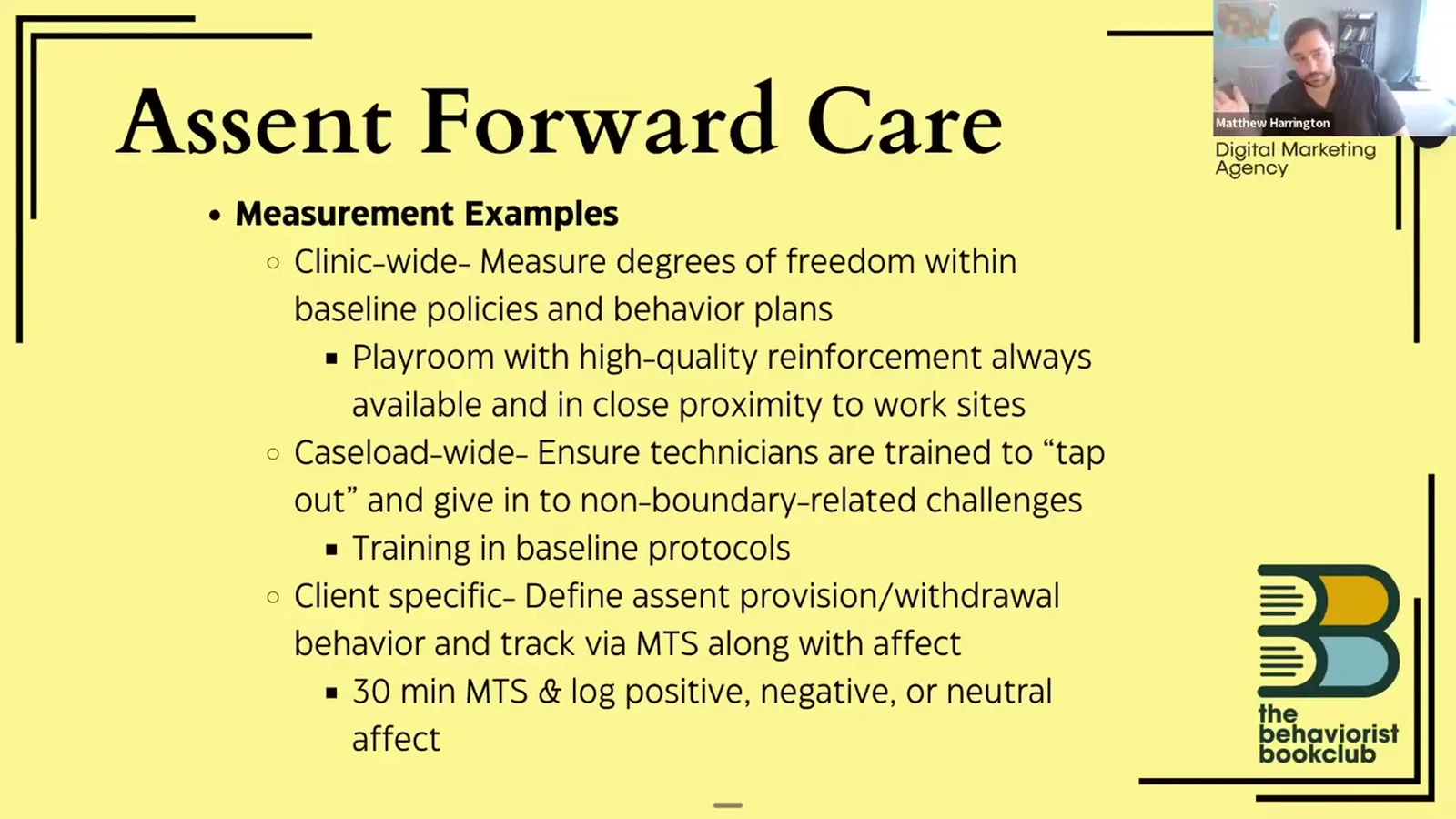
Tracking assent for one client is easy. Doing it for twelve is the real problem. Harrington splits the work into three layers. The first is policy. Set spaces in the building that are always open for a break, with strong reinforcement in them. People worry a client will live in that room. He says that might happen, and it tells you something. It means your other activities are not worth choosing.
The second layer is staff training. Teach technicians how to tap out and live to fight another day. Teach them which fights are not about boundaries at all. Teach them which boundaries have to hold for safety. This does not belong in a behavior plan. It belongs in a room with your team and a set of scenarios. It is also how you stop a child being held somewhere over a power trip.
The third layer is client specific. He puts momentary time sampling (a quick timed yes or no check) on every case. Every 15 or 30 minutes the timer pops. Assent behaviors sit on one side with examples under them. The question is simple: is assent happening right now, yes or no. If yes, keep going. He added this after the potty training case, and it lit the problem up fast. Assent during potty training. Withdrawal everywhere else.
That level of attention needs room to breathe. So he argues for fewer primary behavior reduction goals. Two that move quality of life beat seven that fill a plan. You still track the rest. You just stop pretending you can analyze twenty at once.
Trauma-Informed Care as the Modification Method
Trauma means exposure to an event, or a run of events, that hurts functioning and well-being. Trauma-informed care (care shaped by a learner's history) does three things. You learn the history. You change the plan because of it. You get more real participation. Harrington pairs his guardrails here. Assent is the tracking method. Trauma-informed care is the modification method.
He waves off the label fight between informed, assumed, and sensitive. Call it noise. You will not know a learner's whole history. You also should not assume every learner has one, though he notes the rates are high. He is firmer on another point. No procedure is trauma-informed or trauma-causing by itself. A standard functional analysis (a test of why behavior happens) is not automatically worse than a synthesized one. Application decides.
The pillars he works from are concrete. Acknowledge trauma and its likely effects. A learner with food insecurity may jump from step one to step ten when food is involved. A learner restrained after mistakes may react hard to error correction, so use errorless learning (prompting so mistakes do not happen). Then ensure safety and trust. Some things cost you trust, including pushing someone through a hard task they agreed to. Pay it back. He defines behavioral artistry (skill in reading and repairing rapport) as noticing lost rapport and working to rebuild it. Use multiple schedule arrangements (clear signals for what is available) so the next thing is never a surprise.
Then promote choice and shared governance (let the client help decide). Respect assent and withdrawal. Flex the day around what is possible, not around your list. He described an enhanced choice arrangement where learners could leave and go home. Almost nobody left. The one learner who did was getting sick, and leaving kept him out of crisis. Last, emphasize skill building. That does not mean the next box in an assessment. It means skills that move the quality of life needle.
It is not pre-session pairing. It is consistent association with reinforcement.
From the talk — Matt Harrington
Guardrail Three: Resistant Repertoires and Degrees of Freedom
The third guardrail is build resistant repertoires. The first two mostly live in behavior reduction. This one lives in skill building. It leans on the constructional approach (building skills instead of removing them). He points to a small blue book called Non-Linear Contingency Analysis. The approach asks four plain questions. Where do you want to go, meaning the reason behind the goal. Where are you now, in skills and prerequisites. What has to happen to get there. What will keep it going once you arrive. Those last two are your generalization (skills holding up in new places) and discharge plan.
He walks a linear case to show the gap. Staff hands over work. The client hits. The work goes away. So we run functional communication training (teaching a request to replace behavior) and put hitting on extinction. Then the request stops working and hitting comes back. The nonlinear read asks what else sits in the history. Maybe the client tried the work before and could not do it. Maybe every try earned a zero and some embarrassment. Maybe they asked for help once and got none. That is a skill problem, not a words problem.
Degrees of freedom (how many real choices exist) is the other tool. The math is choices minus one. He uses groceries. You can drive, walk, or stay home hungry. On paper that is choice. Walking takes ninety minutes, so the costs are not equal. Give yourself a thirty minute window and you have one option. Now swap in a client. If the only path to the iPad is discrete trial teaching (structured drills at a table), the choice is fake.
He puts this tool in staff training first. He wants technicians counting the live options in the moment. Zero means change something now. Organization-wide changes are the hardest to make and pay the most. Caseload changes are easy but only reach your own clients. His answer is to work both levels at once.
There has to be other equal opportunities to earn equal levels of reinforcement, to have true degrees of freedom.
From the talk — Matt Harrington
How to Build Your Own Guardrails This Month
He closes with homework. Write your own guardrails. Use his three as a starting sample, not a template. Yours may weight one value more than he does. That does not make either of you a different kind of analyst. It changes what you notice.
Then go read your own plans against them. Look at what you had to change. If one area needed a pile of fixes, ask why. If one type of intervention kept drifting, ask why. That pattern is a blind spot with a name on it. Knowing about a blind spot is good. Changing it is better.
None of this works as a one-time audit. The rails only help if you keep checking that the ball is still between them. Put the check on a calendar next to your other routines. That is the whole system. Values you can name, plans you re-read, and a way to catch the drift early.
Guardrails are individual, and we need to stay within them, not kick things out because they feel icky or something.
From the talk — Matt Harrington
Common questions
What are the three ethical guardrails in behavior reduction?▾
They are cause no further harm, continuously informed and assented to, and build resistant repertoires. The first watches for harm beyond your target behavior. The second keeps consent and assent running through the whole case. The third keeps the focus on building skills instead of only suppressing behavior.
Does assent-forward care mean you can never use extinction?▾
No. Harrington says shaping already runs on small extinctions, since you stop paying for one level and start paying for the next. Full extinction shows up rarely in his work, and he says the reason is risk, not assent. The real question is whether the learner is choosing to be in the situation.
How do you track assent across a whole caseload?▾
He uses momentary time sampling on every client. A timer pops every 15 or 30 minutes and asks one question: is assent happening right now, yes or no. Each plan lists that client's own assent behaviors with examples under them. It is deliberately simple so staff can actually run it all day.
What are degrees of freedom in ABA?▾
It is a count of the real options a learner has when the costs are equal. The math is choices minus one. If the only way to earn a favorite item is one specific task, the learner has no real choice. That is true even if they comply on their own. He trains staff to check that count in the moment and change something when it hits zero.
How often should you review your guardrails?▾
He worked through all of his plans about once a month. He looked for plans leaning hard on one guardrail and for plans that had cleared it completely. The more often you check, the easier it is for staff to stay consistent. Treat it like your IOA and fidelity routines.
About the speaker
Matt Harrington started out in respite work, then moved into RBT roles on a severe behavior unit and a feeding unit, where he built his focus on complex challenging behavior. He worked as a BCaBA and has spent over five years in BCBA and clinic director roles across school, home, inpatient, and outpatient settings. He says he has delivered more than 4,000 CEUs to behavior analysts, and he also runs a digital marketing agency that works with providers.
This summary was generated from the recording’s transcript. Quotes are taken word for word from the talk.
What you'll learn
- 1Learning Objectives
- 2At the conclusion of this event, participants will be able to:
- 31. Describe the three ethical guardrails (cause no further harm, continuously informed and assented to, and building resistant repertoires) and explain how they can be applied to evaluate ongoing ABA interventions.
- 42. Identify observable indicators of assent provision and assent withdrawal, and outline at least one procedure for continuously tracking and responding to assent across a client’s treatment day.
- 53. Analyze a behavior intervention in terms of trauma-informed care and the constructional approach, and generate at least two specific treatment modifications that increase client degrees of freedom and support quality-of-life outcomes.
Concepts in this CEU
Related talks
Talks that cover the same concepts
Analyzing Assent and Taking Data
The Behaviorist Bookclub
12 days of PFA & SBT
The Behaviorist Bookclub
Hey, Chillax Man! Understanding the Logic of Anxiety
The Behaviorist Bookclub
The Math Behind Behavior Reduction
The Behaviorist Bookclub

Beyond Compliance: What Assent-Based ABA Looks Like in Real Life
Dani Elle Mentorship and Consulting
PDA Caregivers, Complex Profiles, Replacement Behaviors, and Being Trauma Informed
The Behaviorist Bookclub
More from The Behaviorist Bookclub

Harm Reduction Within ABA Practice
The Behaviorist Bookclub
Supervising Beyond Technical Skills: Professionalism, Communication, and Clinical Judgment
The Behaviorist Bookclub
Reflective Supervision and Client Outcomes
The Behaviorist Bookclub
OpenCEU is supported by advertising from third-party sponsors. Sponsors are clearly labeled, have no influence over course content, instructors, or CEU decisions, and never appear on certificates. The BACB does not sponsor, approve, or endorse OpenCEU sponsors or their products.