Degrees of Freedom in ABA: Real Choice and Assent
Degrees of freedom counts how many equal choices a learner truly has. Learn the N minus one rule and why it protects real assent in ABA.
Key takeaway
Degrees of freedom is a way to count real choice. It asks how many equal options a learner actually has. When the options are equal in cost and payoff, choice is real.
Analyzing Assent and Taking Data
Experts who cover this
2 recordings on openceu cover degrees of freedom aba.
- Featured talk3.50 Ethics CEUs
Analyzing Assent and Taking Data
Matt HarringtonThe Behaviorist Bookclub
Borrowed from nonlinear contingency analysis and defined as N minus one equally-costed, equally-reinforced options; the talk argues every protocol should have…
- 1 Ethics CEU
Ethical Guardrails in Behavior Reduction
Matt HarringtonThe Behaviorist Bookclub
Harrington defines degrees of freedom as the number of genuinely equal-cost options a learner has (choices minus one) and uses it to argue that if the only…
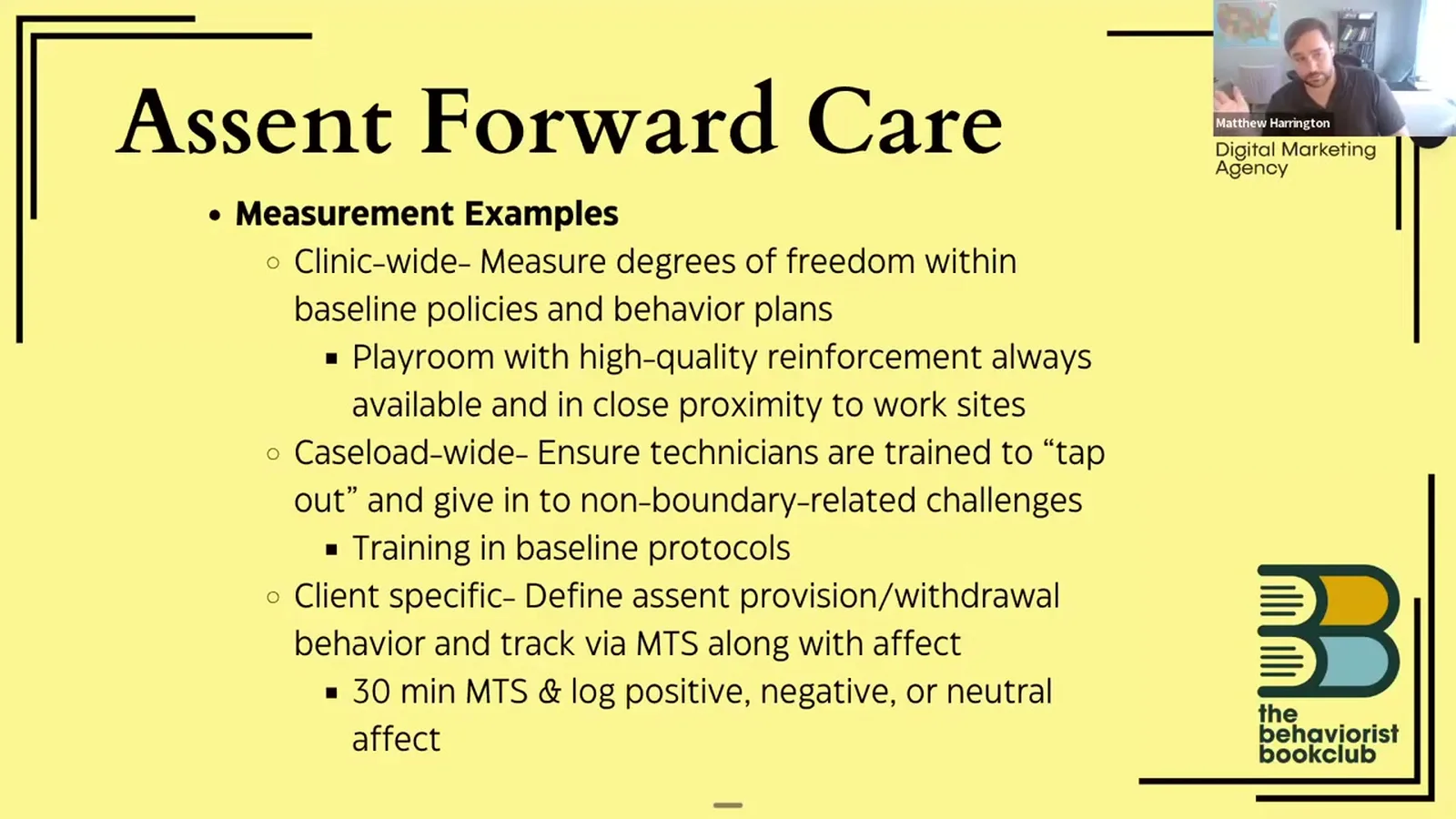
On this page · 6 sections▾
Degrees of freedom is a way to count real choice. It asks how many equal options a learner actually has. When the options are equal in cost and payoff, choice is real. When they are not, choice can be fake.
This idea matters for assent. Assent means the learner agrees to take part. If a child has no true option to say no, that is not assent. It is just compliance. BCBAs and RBTs can use this concept to check their own plans.
What degrees of freedom means#
The term comes from nonlinear contingency analysis. Matt Harrington borrows it to talk about choice in ABA. The math is simple.
Degrees of freedom or DOF is simply N minus one. From the talk — Matt Harrington
Here N is the number of choices. You subtract one to get the degrees of freedom. So two equal choices give you one degree of freedom. Three equal choices give you two.
Harrington states the rule again in a second talk. He says the precise definition is choices minus one. He wants it to be clear and easy to hold.
One key word is "equal." The choices must cost the same effort. They must earn the same kind and amount of reinforcement.
Why does "equal" matter so much? Picture two paths where one is far easier. The learner will almost always pick the easy one. That is not a free choice. It is a nudge dressed up as an option. Real degrees of freedom need options that stand on level ground.
Why more than zero matters#
Zero degrees of freedom means only one real path. The learner has no true say. More than zero means real options exist.
If you have more than zero degrees of freedom, that means that there are multiple different options for you to use. From the talk — Matt Harrington
Harrington sets a clear target for good plans. He wants a small buffer built in.
you want to have, one or more degrees of freedom. Um, as much as possible, I'd like to have at least two degrees of freedom. From the talk — Matt Harrington
Why aim for two and not just one? A buffer is safer. If one option stops working that day, the learner still has another. Choice does not collapse the moment a value shifts.
How degrees of freedom protects assent#
 Advertisement
This is the heart of the idea. Real choice is what makes assent real. Without equal options, "yes" has no meaning.
Harrington gives a sharp example with an iPad and table work.
If the only way for the learner to get the iPad, the thing that they want, is to sit at the table and do DTT, it's not true ascent. There has to be other equal opportunities to earn equal levels of reinforcement, to have true degrees of freedom. From the talk — Matt Harrington
Think about what that setup does. The child wants the iPad badly. The only path to it runs through the demand. So the child "agrees," but only because there is no other way.
That is not agreement. It is a corner with one exit. Degrees of freedom gives you a way to spot this trap.
How choices can quietly drop to zero#
You can start with real choice and lose it by accident. A value can change during a session. What was equal at 9am may not be equal at 10am.
Harrington shares a case where he did this himself. He set up a contingency that broke the balance.
by setting up this contingency that I had set up, I'd actually removed one of the choices. And one of the choices no longer equal if that client was really valuing the tech's attention at the time. By doing that, I switched the degrees of freedom from one to zero for a specific circumstance. From the talk — Matt Harrington
Notice the lesson here. The options looked equal on paper. But the client valued the tech's attention more that day. That tipped the balance and killed the real choice.
This is why you watch the learner, not just the plan. Motivation moves. Your job is to keep the options truly equal in the moment.
Harrington frames this as a way to sort real choice from fake choice. He says the term simply classifies how many options a learner has when all things are equal. That last part is the whole point. Two options that are not equal do not give real freedom. One rich option and one weak option still leave the learner cornered.
So the count is not just about how many choices you list. It is about how equal those choices feel to the learner right now. A menu with one good item is not really a menu. Degrees of freedom asks you to check the balance, not just the number.
How to use this in your plans#
Start by counting the real choices in a task. Be honest about whether they are equal. Equal effort and equal payoff are the test.
Ask a few simple questions. Can the learner earn the same reinforcer another way? Does saying no lead to a fair outcome, not a punishment? Is one path far easier or far richer than the rest?
If you find zero degrees of freedom, add an equal option. Give a second path to the same kind of reinforcer. Aim for that buffer of two when you can.
Then keep checking during the session. Watch for shifts in what the learner wants. A degree of freedom you built in the morning can vanish by noon.
FAQ#
What is a simple definition of degrees of freedom in ABA? It is the number of equal choices a learner has, minus one. Two equal options give one degree of freedom. Zero degrees of freedom means only one real path exists. It measures how much true choice a person has.
How does degrees of freedom relate to assent? Assent means the learner truly agrees to take part. Real agreement needs real options. If the only way to get a reinforcer is to comply, there is no true choice. Degrees of freedom helps you check that equal options exist.
How many degrees of freedom should a plan have? At least one, so the learner has a real option to choose. Two is even better as a safety buffer. That way choice survives even if one option loses value during the session. Zero should be a red flag to fix the setup.
For a deeper look at these ethics, see Ethical Guardrails in Behavior Reduction. That talk uses this same idea to test whether a demand setup is fair.
 Advertisement
Turn this topic into a CEU
You just studied this. Now get credit for it.
Watch Analyzing Assent and Taking Data with Matt Harrington and earn 3.5 free BCBA CEUs. Detailed certificate, delivered the moment you finish.