What Training Does a BCBA Actually Need to Do School-Based ABA?
Grad school does not teach school work. Here is the real training stack: coursework, supervision, shadowing, from a BCBA-led CEU.
Key takeaway
Your training stack for school work has three parts grad school skips: real coursework in IDEA and IEP procedure, a reading list that goes past the BACB task list into special ed law and team practice, and shadowing hours sitting next to a BCBA who has already lived through a hundred IEP meetings.
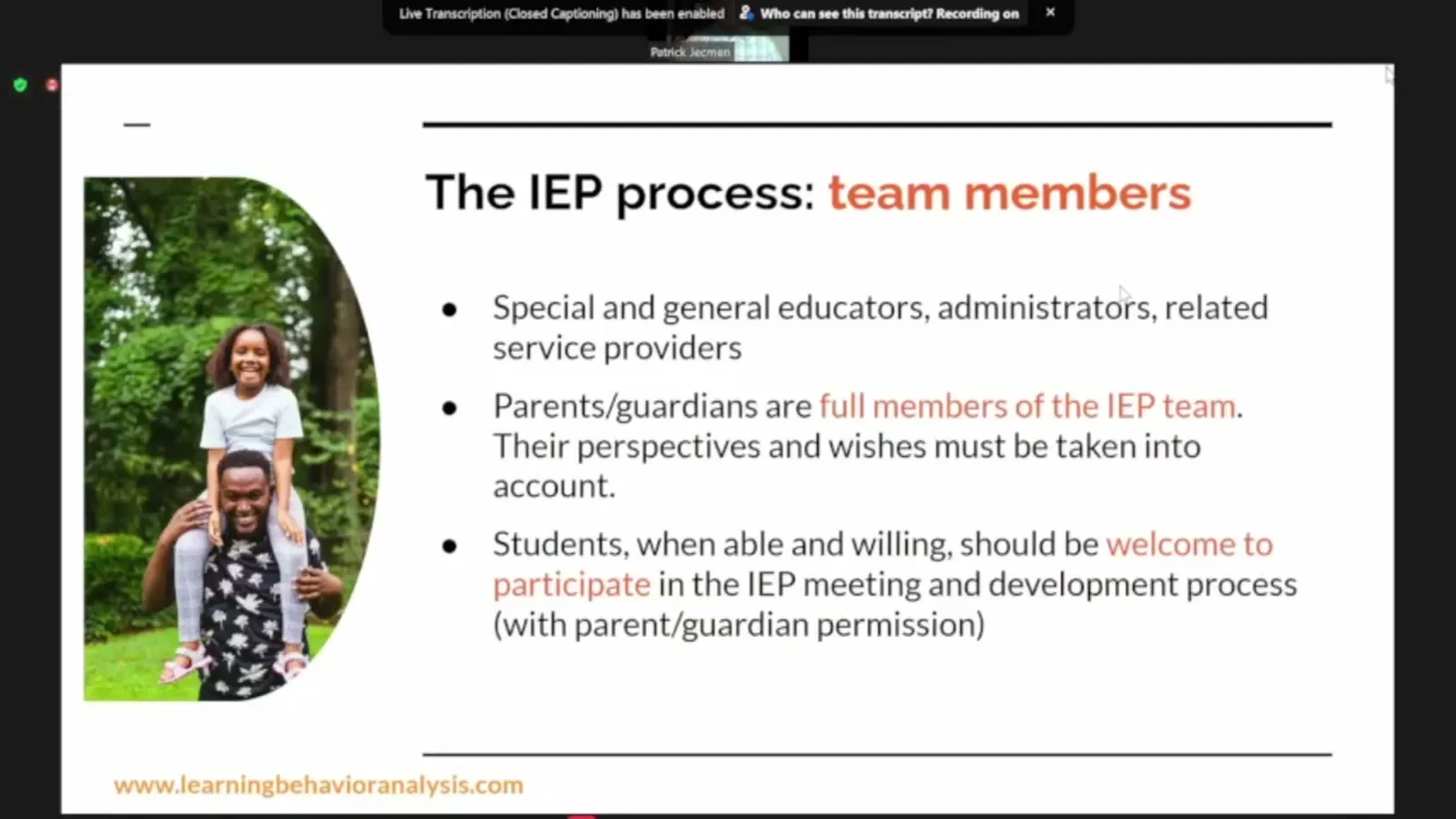
School Collaboration as an Area of Competence - Applied 2022
Free learning path on this topic
Caregiver Collaboration and Parent Training
Leanne Page on why caregivers disengage and how to tell a skill gap from a relationship problem. Then Matt Harrington's seven habits for parent training and a workflow for setting collaboration goals with schools, pediatricians and other partners. Four CEUs, all free.
On this page · 9 sections▾
Your training stack for school work has three parts grad school skips: real coursework in IDEA and IEP procedure, a reading list that goes past the BACB task list into special ed law and team practice, and shadowing hours sitting next to a BCBA who has already lived through a hundred IEP meetings. This page walks the whole stack. It pulls from Dr. Clelia Sigaud's CEU on school collaboration as an area of competence, and it gives you a clear order: what to learn first, what to read, who to shadow, and how to know you are ready to lead a school case on your own.
Why a BCBA degree does not equal school readiness#
A BCBA program teaches you how human behavior works. It does not teach you how a public school works. Those are two different jobs. Sigaud says it plainly on the recording:
that's not something, of course, that's going to be covered in your BCBA-specific training at the university level
That is the gap. You leave grad school knowing FCT, reinforcement schedules, and functional analysis. You do not leave knowing what an IEP team is, how a school is legally bound to deliver the services in that document, or how a consensus decision works at a table of eight people. Those are the things you need to learn before you sit at your first meeting.
The good news: this is a learnable stack. You do not need a second degree. You need the right reading list, the right shadowing hours, and a school-veteran BCBA who will let you ask dumb questions.
Coursework gaps most BCBA programs leave behind#
Here is what your program probably did not cover, in the order you should learn it:
- IDEA basics. What the Individuals with Disabilities Education Act is, what FAPE means, what an eligibility category is, what an IEP is, and why all of it is legally binding.
- The IEP cycle. Referral, evaluation, eligibility, IEP development, service delivery, progress monitoring, annual review, and triennial re-evaluation. You need to know where in the cycle your client sits when you walk in.
- Roles at the table. Special ed teacher, general ed teacher, school psych, SLP, OT, PT, social worker, admin, parent, and the student. Each person has a job. You should know what each one does before you meet them.
- Consent that holds up. Informed consent in a school is not a signature on a form. It is a parent or guardian understanding what is being proposed, in plain language, before they agree.
- Progress monitoring rules. Schools report progress on IEP goals at set intervals. You need to know how often, in what format, and what counts as enough progress.
- Discipline and restraint law. Manifestation determinations, FBAs as a legal requirement after certain suspensions, and your state's restraint and seclusion rules.
That list is the floor. None of it is in the BACB task list. All of it shows up your first week on a school case.
The IDEA / FAPE basics you should know before your first IEP#
Three ideas, in order:
FAPE. Every student with a qualifying disability has a right to a free and appropriate public education. Appropriate is the load-bearing word. It does not mean optimal. It means designed to make meaningful progress for that student.
The IEP is the plan. It lists present levels, annual goals, services, accommodations, and how progress will be measured. Once it is signed, the school must deliver every line of it, regardless of staffing.
The team decides by consensus. This is the part that trips up new BCBAs the most. You do not vote. You do not push the loudest opinion. Sigaud's framing is the cleanest version of this I have heard:
an IEP team works like a jury and not a democracy
A jury keeps talking until everyone can sign on. That is the model. If you walk into a meeting expecting a vote, you are going to push too hard, lose the room, and become the jerk at the IEP meeting. Learn the consensus model first. Practice it in low-stakes meetings before you try to use it in a high-stakes one.
Supervised hours that actually build school competence#
Hours in a clinic do not transfer to hours in a school. Same credential, different setting, different skill stack. If you want school competence, your supervised hours need to include the things you will actually do:
- Sit in on at least 10 IEP meetings before you lead one. Take notes. Watch how your supervisor talks to the parent. Watch how she pushes back on a goal she disagrees with.
- Co-write at least three IEPs end to end with a supervisor. Present levels, goals, service minutes, the whole document.
- Run at least one FBA inside a school, with a school team, and present the results at a meeting.
- Sit in on at least two re-evaluation meetings. Watch how eligibility is debated.
- Shadow a school psych for a day. Shadow an SLP for a day. Shadow an OT for a day. You will work with these people for the rest of your career.
Sigaud puts the supervision standard this way:
experienced quality supervised experience in the area
Experienced. Quality. Supervised. All three words matter. A supervisor who has never worked in a school cannot give you school supervision. Find someone who has.
Free and paid CEUs worth doing before you take a school case#
Start with what you can read for free, then layer paid CEUs on top:
- IDEA statute, Part B. It is long. Read the sections on IEPs, eligibility, and discipline at minimum. The full text is on the federal Department of Ed site.
- Your state's special education regulations. Every state has its own layer on top of IDEA. Find your state's department of education site and read the manual.
- Brodhead's scope of competence checklist. From the 2018 article Sigaud cites. Print it. Use it on every new case.
- Brodhead 2015 on non-behavioral treatment recommendations. Same author, different paper. Teaches you how to respond when an SLP or OT proposes a treatment that is not on your list.
For paid CEUs, prioritize sessions led by BCBAs who actively work in schools, not consultants who visit them. Sigaud's session is one. Look for CEUs that cover the IEP cycle, consent, and interdisciplinary collaboration with SLPs and OTs.
Sigaud's frame for what real preparation looks like:
robust history of coursework of literature mastery in the topic
Coursework. Literature. Mastery. Not one webinar.
How to ask a school-veteran BCBA to mentor you#
Most school BCBAs will say yes. They remember being new. Make it easy for them.
- Be specific about the ask. Not "can you mentor me." Try: "Can I shadow one IEP meeting and one parent meeting this month, and buy you coffee after each?"
- Bring a question. Show up with one written question about a real case or a real document. People help faster when the help has a target.
- Trade value. Offer to take notes, write the meeting summary, or pull data on a case they care about.
- Respect their time. School BCBAs are stretched. Ask for 30 minutes a month, not two hours a week. If it works, you can ask for more later.
- Stay in touch between meetings. A short email two weeks later, with what you tried and how it went, keeps the door open.
The point is to build a relationship where you can ask the dumb question fast, before you make the mistake in front of a parent.
How to know when you are ready to lead a school case alone#
Use this checklist. If you can answer yes to all of it, you are probably ready. If not, stay in supervision longer.
- I can explain the IEP cycle without notes.
- I have sat in on at least 10 IEP meetings and led parts of at least 3.
- I can write a present-levels paragraph and an annual goal that a school will accept.
- I know my state's restraint and seclusion rules and have read the manifestation determination process.
- I have explained a behavior plan to a parent in plain language and the parent signed informed consent.
- I have disagreed with a teammate at a meeting without losing the room.
- I know which related service provider to call for which kind of problem.
- I have a school-veteran BCBA I can text on a hard day.
That is the floor for solo work. Below that floor, stay supervised.
FAQ#
Why does my BCBA program not cover school work? BCBA programs teach the science of behavior. School practice is a specialized application that sits on top. Programs assume you will learn it from supervision and CEUs after you credential.
Do I need a special education certification to work in schools as a BCBA? No. You do not need a teaching license to consult or provide ABA services in a school as a BCBA. You do need to know the law and the IEP process well enough to participate as a full team member.
What is the fastest ethical way to build school competence? Find a school-veteran BCBA supervisor, shadow IEP meetings, read IDEA Part B and your state regs, and use Brodhead's scope of competence checklist on every new referral. Six months of focused effort gets most BCBAs to a workable floor.
Can supervision hours in a school count toward general BCBA hours? Yes. If your supervisor is a qualified BCBA and the work is in your scope of practice, school hours count just like clinic hours toward fieldwork or annual supervision.
How long does it usually take to feel competent in school work? Most BCBAs need 12 to 24 months of regular school casework before they feel solid leading IEPs and FBAs alone. The first six months are mostly shadowing and reading.
Ready to build the training stack?#
Watch Dr. Clelia Sigaud's full session on school collaboration as an area of competence. It is the cleanest one-hour overview of the BCBA-in-schools competence model I have found, and it pairs with the reading list above.
Turn this topic into a CEU
You just studied this. Now get credit for it.
Watch School Collaboration as an Area of Competence - Applied 2022 with Dr. Clelia Sigaud and earn 1 free BCBA CEU. Detailed certificate, delivered the moment you finish.
Keep going with a free learning path
Caregiver Collaboration and Parent Training
Leanne Page on why caregivers disengage and how to tell a skill gap from a relationship problem. Then Matt Harrington's seven habits for parent training and a workflow for setting collaboration goals with schools, pediatricians and other partners. Four CEUs, all free.