School Collaboration as an Area of Competence - Applied 2022
Presented by Dr. Clelia Sigaud
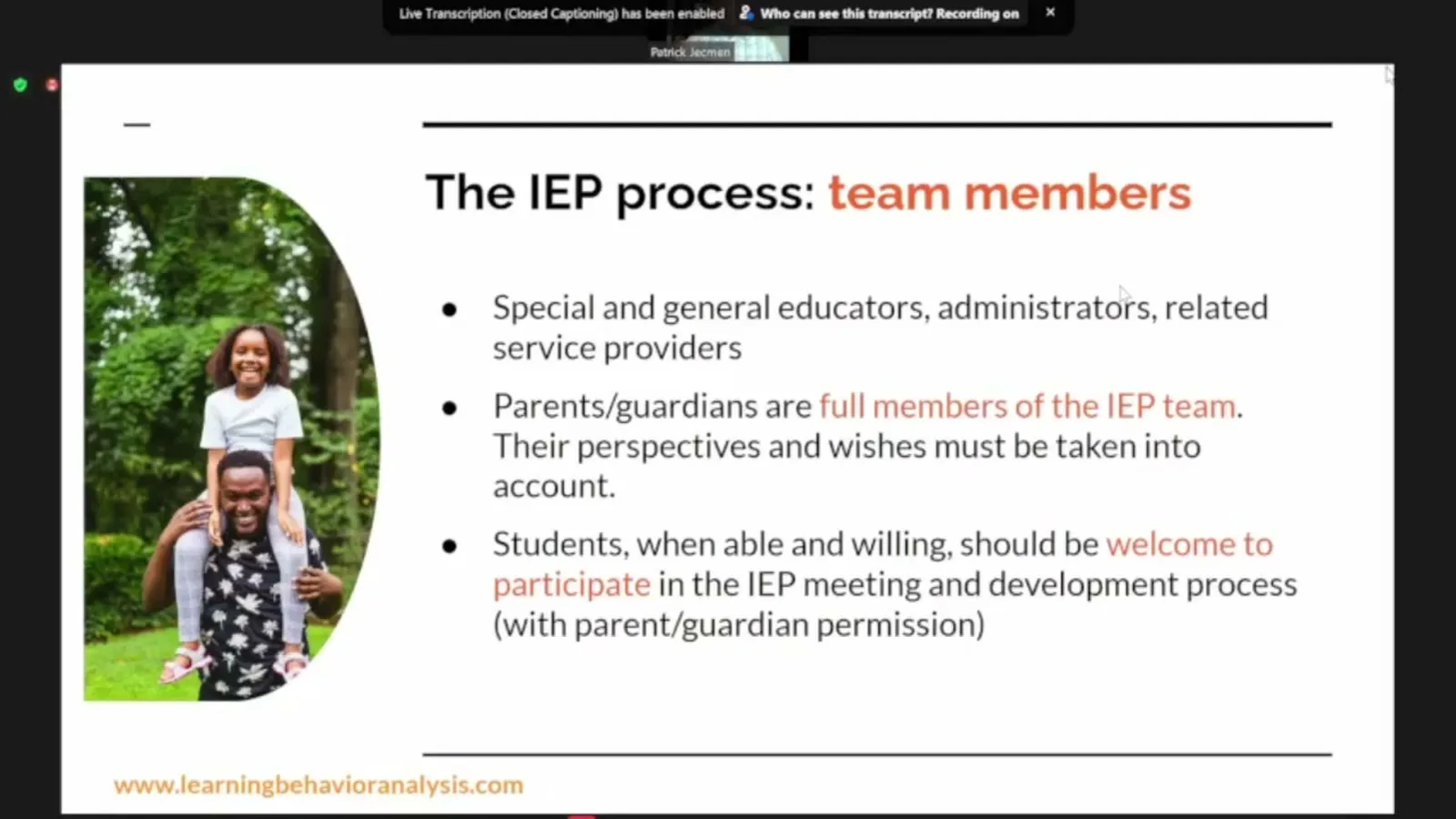
This session translates “school collaboration” into concrete, ethical competencies for behavior analysts working in educational settings. The presenter contrasts scope of practice with scope of competence and offers practical decision aids for determining when to accept, defer, or seek supervision on school-based cases. Attendees review the IDEA/IEP landscape—what an IEP is, why it is legally binding, how teams operate by consensus, and how to secure informed consent for assessments and interventions. The talk centers collaborative behaviors that prevent “being the jerk at the IEP meeting”: plain-language communication, humility, pairing, and truly treating families and students as full team members. Interdisciplinary strategies show how to co-design goals (e.g., FCT) with SLPs/OTs while accounting for access methods and response effort. The session also provides a framework for responding to non-behavioral or low-evidence proposals—prioritizing safety, data, and relationships—while articulating a compassionate behavior-analytic worldview oriented around function, dignity, and socially significant outcomes.
Register free & watch nowCancel any time. Cert delivered to your inbox the moment you pass the quiz.
About this CEU
This session translates “school collaboration” into concrete, ethical competencies for behavior analysts working in educational settings. The presenter contrasts scope of practice with scope of competence and offers practical decision aids for determining when to accept, defer, or seek supervision on school-based cases. Attendees review the IDEA/IEP landscape—what an IEP is, why it is legally binding, how teams operate by consensus, and how to secure informed consent for assessments and interventions. The talk centers collaborative behaviors that prevent “being the jerk at the IEP meeting”: plain-language communication, humility, pairing, and truly treating families and students as full team members. Interdisciplinary strategies show how to co-design goals (e.g., FCT) with SLPs/OTs while accounting for access methods and response effort. The session also provides a framework for responding to non-behavioral or low-evidence proposals—prioritizing safety, data, and relationships—while articulating a compassionate behavior-analytic worldview oriented around function, dignity, and socially significant outcomes.
What you'll learn
- 1Learning Objectives • Differentiate scope of practice from scope of competence, and use structured checklists to decide when to accept, defer, or seek supervision on school-based referrals.
- 2• Identify key legal and procedural features of IDEA/IEPs, including team composition, consensus decision-making, and requirements for informed consent and ongoing progress monitoring.
- 3• Explain collaboration behaviors that build trust at IEP tables (e.g., minimizing jargon, de-centering one’s own norms, pairing, and behavior-specific praise).
- 4• Design cross-disciplinary goals (e.g., FCT) in coordination with SLPs/OTs by selecting response topographies that consider access method, motor demands, and response effort.
- 5• Evaluate non-behavioral or low-evidence treatment proposals with an ethical decision model that prioritizes client safety, data-based judgments, and preservation of effective working relationships.
- 6• Develop and deliver a concise “behavior-analytic worldview” elevator statement that frames behaviorism as compassionate, functional, and collaborative in IEP contexts.
Concepts in this CEU
More from The Behaviorist Bookclub
Foundations of Reflective Supervision in Behavior Analysis
The Behaviorist Bookclub
Teaching WH-Questions Isn’t Enough: Building True Conditional Discrimination
The Behaviorist Bookclub
Reframing Behavior through an ADHD Lens
The Behaviorist Bookclub
OpenCEU is supported by advertising from third-party sponsors. Sponsors are clearly labeled, have no influence over course content, instructors, or CEU decisions, and never appear on certificates. The BACB does not sponsor, approve, or endorse OpenCEU sponsors or their products.