Is School Collaboration in a BCBA's Scope of Practice or Scope of Competence?
Scope of practice covers what BCBAs can do. Scope of competence covers what you can do well. Where school work fits, from a BCBA-led CEU.
Key takeaway
The quick answer to "is school work in our box" is yes for the profession and maybe for you. Dr.
School Collaboration as an Area of Competence - Applied 2022
Free learning path on this topic
Caregiver Collaboration and Parent Training
Leanne Page on why caregivers disengage and how to tell a skill gap from a relationship problem. Then Matt Harrington's seven habits for parent training and a workflow for setting collaboration goals with schools, pediatricians and other partners. Four CEUs, all free.
On this page · 9 sections▾
The quick answer to "is school work in our box" is yes for the profession and maybe for you. Dr. Clelia Sigaud uses a simple blue, green, orange, purple, and red visual (drawn from Brodhead 2018) to show what a Board Certified Behavior Analyst can do as a field versus what one person can do well. School collaboration sits inside the blue box for the field. Whether it sits inside your green box is a separate question.
The quick answer: school work is in scope of practice, not always in your competence#
If you hold a BCBA credential, you are allowed to do school collaboration work. The field has a wide scope, and school consultation, classroom support, and IEP team participation all live inside it. That does not mean you are ready to do it on day one. Scope of competence is always smaller than scope of practice, and school work is a setting that asks you to learn special education law, team dynamics, and a stack of professional roles you never met in grad school.
Scope of practice vs scope of competence in plain words#
Scope of practice is what the whole field is allowed to do. Scope of competence is what you, the individual, can do well enough to help a real client right now. Sigaud points out the gap in the talk.
scope of practice is what a profession as a whole is able to do... Scope of competence is going to always be smaller than scope of practice for us as behavior analysts. From the talk — Dr. Clelia Sigaud
Here is the picture she draws. Blue is the field's scope of practice. Green is your personal competence, and it sits fully inside blue. Orange is inside blue too, but with no overlap with green. That is the gray zone: things the field can do, but you cannot yet. Purple sits outside the blue circle entirely. Those are your personal life skills, not your professional ones. Giving a friend diet advice over coffee is purple. Giving a parent diet advice in an IEP meeting is not. Red sits outside both blue and green, like prescribing medication. That is a hard no without another credential.
The point of the visual is to stop the binary thinking. You are not either fully competent or fully not. You move toward competence one area, one population, one setting at a time.
Why schools are a setting, not a single skill#
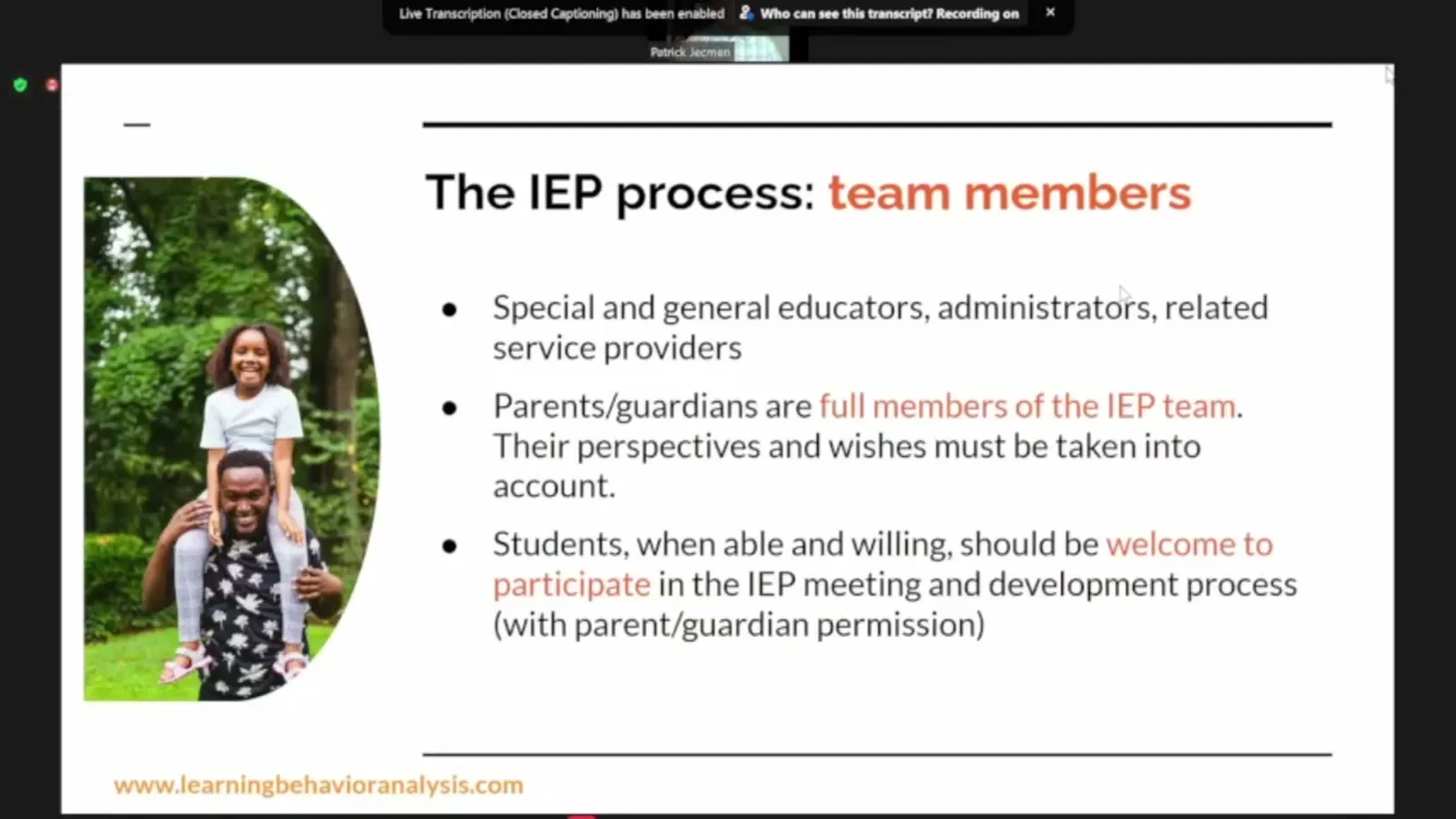
A common mistake is to treat "school work" as one skill. It is not. It is a setting with its own laws, its own meetings, its own team members, and its own norms. The Individuals with Disabilities Education Act and the Individualized Education Program drive the work. The IEP team usually includes special and general education teachers, an administrator, related service providers like speech and occupational therapists, the parent or guardian, and when possible the student. Sigaud and her co-presenter call it a jury, not a democracy. The team has to reach decisions together, not by majority vote.
That setting changes what counts as competence. You can be a strong clinic BCBA and still not know how to run a Functional Communication Training plan with a speech language pathologist who is choosing a response topography based on motor access. You can be great with parents at home and still freeze up at an IEP table with seven other people watching. School is its own competence area.
The Brodhead checklist for deciding if school work is in your competence#
The clearest tool Sigaud points to is Brodhead and colleagues 2018, A Call for Discussion About Scope of Competence in Behavior Analysis. It gives you a checklist instead of a gut feel. She tells the audience why that matters.
competence incorporates more than one consideration within it. So we have to have this robust history of coursework of literature mastery in the topic. From the talk — Dr. Clelia Sigaud
She lists what to weigh: have you read the current literature on this kind of case, have you had quality supervised experience in this setting, and have you shown you can run the procedures well under that supervision. She then layers in three dimensions to check: procedures and strategies, populations (more than a diagnosis), and settings. School is the settings axis. You can be solid on Functional Communication Training as a procedure and solid with school-age learners as a population, and still not be ready for the school setting if you have never sat at an IEP table.
If you cannot answer yes to coursework, literature, and supervised experience for school-based work specifically, you are in the orange zone. The field can do it. You cannot do it well yet.
When to accept a school referral, when to defer, when to ask for supervision#
Use the checklist as a triage tool. Three buckets are useful.
Accept the case when school work is already inside your green zone. You have read the law, you have run cases in the setting under supervision, you can talk plainly to teachers and parents, and you can co-write goals with a speech language pathologist or occupational therapist without taking over.
Defer the case when it sits in orange and there is no clear path to support. If you have never been on an IEP team and your only behavior analyst contact is a supervisor who has also never worked in a school, you are setting yourself up to be, as Sigaud puts it, the jerk at the IEP table. Refer the case to a school-based behavior analyst who has the setting in their green zone.
Ask for supervision when the case is orange but a path exists. Find a BCBA who has school competence. Read the law. Sit in on meetings. Co-treat the first cases. You are building green one case at a time.
What to do if you took on a school case and now feel over your head#
This happens. Sometimes the employer pushes you in. Sometimes the family needs help and there is no one else. Sigaud is honest about the stakes.
when we disregard scope of practice or scope of competence, we're not performing a service for our clients that's going to be optimally helpful for them. From the talk — Dr. Clelia Sigaud
Start by naming the gap to yourself. Then act. Pull the Brodhead checklist and mark which boxes are empty. Read the most relevant literature for the part of the case that scares you, whether that is severe self-injury, elopement with safety risk, or a non-behavioral treatment proposal from another provider. Find a supervisor or peer consultant with real school competence and ask for help on the specific skill, not just the case. Tell the team where you are still learning. Plain honesty preserves trust at the IEP table. Quiet bluffing destroys it.
If safety is the issue, slow down. Sigaud shares cases where extinction was used on a student making suicidal statements and where elopement was treated without enough safety planning. Those are points where you stop and ask for help, not push through alone.
Where this came from in the CEU#
The framing in this guide tracks Sigaud's full session, "School Collaboration as an Area of Competence." She and her co-presenter walk through the scope visual, the Brodhead 2018 checklist, the IDEA and IEP basics, and the collaboration habits that build trust at the table. Watch the full talk if you want the deeper version, including the cross-discipline FCT example and the response model for non-behavioral treatment proposals.
FAQ#
Is doing school work a separate BCBA credential? No. The Behavior Analyst Certification Board does not issue a separate school credential. School collaboration is inside the general scope of practice for a BCBA. Your readiness is a personal competence question, not a credential question.
Can I take a school case if I have never been on an IEP team? Probably not as the lead, not yet. Use the Brodhead checklist. If you have no coursework, no literature mastery, and no supervised experience in the school setting, get supervision from a BCBA who has all three before you take it solo.
What is the difference between scope of practice and scope of competence? Scope of practice is what the field is allowed to do. Scope of competence is what you can do well right now. Practice is the big circle. Competence is the smaller circle inside it.
Does the BACB say BCBAs can work in schools? Yes. The general scope of practice covers school-based consultation and treatment. The ethics code still expects you to work only inside your personal competence, so the field saying yes does not let you skip the readiness check.
What if my employer asks me to do school work I am not ready for? Name the gap honestly. Ask for supervision, training time, and a co-treating partner with school competence. If none of that is on offer and the case has safety risk, decline the lead role. Doing harm is worse than declining work.
Keep learning#
Want the full picture, the visual, and the live discussion of the Brodhead checklist?
Watch the full CEU with Dr. Clelia Sigaud
Turn this topic into a CEU
You just studied this. Now get credit for it.
Watch School Collaboration as an Area of Competence - Applied 2022 with Dr. Clelia Sigaud and earn 1 free BCBA CEU. Detailed certificate, delivered the moment you finish.
Keep going with a free learning path
Caregiver Collaboration and Parent Training
Leanne Page on why caregivers disengage and how to tell a skill gap from a relationship problem. Then Matt Harrington's seven habits for parent training and a workflow for setting collaboration goals with schools, pediatricians and other partners. Four CEUs, all free.