BCBA School Consultation: Should You Accept This Case?
A short ethical checklist for deciding if a school referral is inside your scope of competence, from a BCBA-led CEU.
Key takeaway
Before you say yes to that school referral, run it through one filter: accept, defer, or decline.
School Collaboration as an Area of Competence - Applied 2022
Free learning path on this topic
Culturally Responsive Practice
Makenzie Sandler's three-part series on culturally responsive practice, each worth an ethics CEU. Cultural competence in clinical work, unconscious bias and values, then culture across teams and systems using OBM.
On this page · 9 sections▾
Before you say yes to that school referral, run it through one filter: accept, defer, or decline. Sigaud names three real cases where BCBAs got the call wrong: treating attention-maintained elopement with extinction, allowing a child to engage in masturbation at school, and reading a student's suicide statements as escape behavior. Each is a school referral. Each looks like a normal BCBA case on paper. None of them belong with a BCBA who only has clinic-based supervised hours.
This page is the front-end decision: do I even take this referral? If you want the wider setting overview, the scope of competence page is the next step. If you want to know whether schools are inside the credential at all, start with scope of practice vs scope of competence.
Why school referrals need their own accept / defer / decline filter#
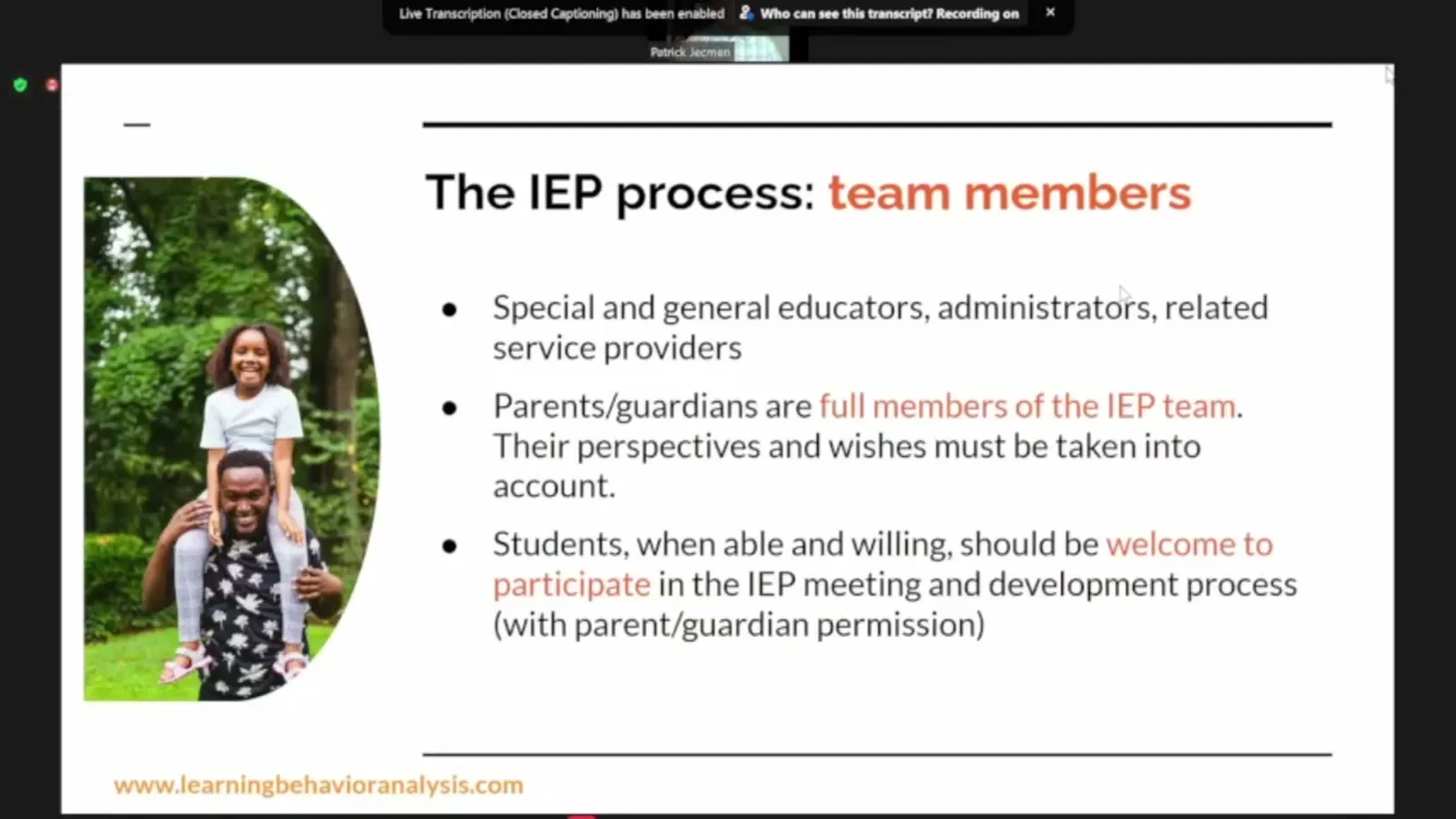
A clinic case and a school case share the same letters after your name. They do not share the same risk profile. In a school, you sit at an IEP table with general ed staff, special ed staff, an administrator, related service providers, parents, and sometimes the student. The plan you write is legally binding. The school has to deliver it whether or not they have the staff to do it. That is a very different stakes setup than a 1-to-1 clinic plan you can revise next Tuesday.
Sigaud names the pull this creates:
Pressure to potentially provide services to individuals that we're not competent to serve.
There is always more need than there are trained people. That pressure does not change what you are competent to do. It just makes saying no harder. A filter helps because you decide before the pressure shows up, not during.
The five questions to ask before you say yes to a school case#
The Brodhead 2018 checklist for considering competence gives you a clean structure. Translate it into five plain questions for any school referral:
- Do I have coursework or reading mastery in this topic? Not opinions. Not one CEU. Real reading.
- Do I have supervised experience with this problem, in something close to this setting?
- Do I understand the population beyond the diagnosis line in the file?
- Do I understand the setting, which here means IDEA, IEPs, consent, team consensus, and what a school can and cannot do legally?
- If something goes wrong in the first month, who do I call, and can I reach them in under 24 hours?
If you can't answer yes to all five, the answer is not "no." The answer is defer or accept with supervision. Sigaud is clear that competence is not a switch you flip:
We're consistently continuing to move, hopefully, towards becoming better and better at helping our clients.
That sentence is the point of the whole checklist. You are not deciding if you are smart enough. You are deciding what this child gets in the next 12 months.
Red flag examples from real school settings (safety, sex, suicide statements)#
Three cases from the talk. Read these slowly.
Elopement treated with extinction. A student elopes from the classroom. Function: attention. A BCBA reads the FA and pulls attention on elopement. Function-matched on paper. Now the student is in a parking lot. Sigaud's note:
Treating attention-maintained elopement with extinction has a safety concern.
If you cannot design a safe treatment for a behavior that ends in traffic, this is not your referral.
Masturbation at school. A team wants to give the student "an opportunity" to engage in masturbation during the school day. Depending on state law, that decision can be illegal. It almost always ends a job. Sigaud's frame: if you don't already know the legal context, you are not the BCBA for this case.
Suicide statements read as escape. A student says they want to kill themselves during work demands. A team assumes it is escape-maintained verbal behavior. Sigaud has seen the next step in person:
Somebody in a school I was working with literally attempted suicide in school after making these statements and experiencing that extinction based treatment.
If you do not have supervised hours in suicide-risk assessment, you do not assess suicide statements as a function. You refer. Today.
A school referral that names any of these three signals out loud is not a routine intake call. It is a sorting decision. Sort it before you accept.
How to defer a case without burning the school relationship#
Defer is not refuse. Defer is "not me, not yet, here's a real next step."
A clean defer has three parts:
- You name what you can and cannot do in plain language. No jargon. No long defense of your training.
- You name the safer option. A BCBA-D with school hours. A school psych. The district behavior coach. A consult with a hospital outpatient team.
- You stay available for the routine parts of the case. You can keep running a token system while a different clinician owns the suicide-risk piece.
The tone matters. The team in front of you is usually short-staffed, stressed, and worried about this kid. If you frame the defer as "this case deserves more than I can give it solo," the team hears care. If you frame it as "not my problem," the team hears a closed door. Same decision. Different relationship after.
Schools remember the people who solved a problem with one phone call. They also remember the people who walked away clean. They do not remember the people who took the case and made it worse.
How to negotiate for supervision instead of refusing outright#
Sometimes the case is one notch outside your competence, not three. Then ask for supervision before you ask to be removed.
Three asks that work in a school setting:
- A one-hour-per-week consult with a BCBA-D or licensed school psych on this case only. Paid by the district.
- A 90-day check-in built into the IEP. If the data is not moving, the case re-routes without anyone saving face.
- Permission to bring a second set of eyes to the next FA or the next BIP review.
Schools say yes to these more often than people think because the alternative is finding a new provider mid-year. The cost of a one-hour weekly consult is small next to the cost of a denied IEP request or a parent calling a lawyer. Frame the ask that way. Most directors of student services have already done that math.
One more thing. Supervision is not just for hard cases. If you are new to schools, ask for a standing supervision slot on your first three school cases regardless of complexity. The setting is the part you are learning, not just the problem.
What to put in writing when you decline a school referral#
If you decline, write it down the same day. A short email, addressed to whoever made the referral, with these lines:
- The student's name (or initials, if that is how the district works).
- The referral question.
- One sentence: this referral sits outside my current scope of competence.
- The reason in plain language. Example: "I do not have supervised hours assessing suicide statements in school settings."
- The next-step recommendation. A name. A team. A clinic. Something concrete.
- Your offer to support routine parts of the case if the team wants that.
Why write it. Three reasons. First, you protect the student because the written record forces the team to make a real plan. Second, you protect yourself because there is now a paper trail showing you flagged the gap. Third, you protect the field because the school sees a BCBA who took ethics seriously.
What to do if you already said yes and now regret it#
You said yes a month ago. The case is bigger than you thought. The data is flat. You are losing sleep. What now.
Five steps, in order:
- Call your supervisor or a peer-consult BCBA the same day. Not next week.
- Write down the specific skill you do not have. "I do not know how to design a safe extinction protocol for elopement." Precise beats vague.
- Bring the gap to the IEP team in writing. Frame it as a request for supervision or a co-treater, not a resignation.
- Stabilize. Pause any procedure that has a safety concern. Run the room with the existing supports while you get help.
- If supervision is not available, hand the case over. The wrong person doing the case is worse than a brief gap.
You will not be punished for catching a mistake. You will be punished for hiding one.
FAQ#
How do I tell a school no without losing the contract? You don't say no to the school. You say "not this case, not solo." Offer to keep running the routine parts and bring in a BCBA-D for the high-risk piece. Schools value providers who solve the problem, not providers who say yes to everything.
What are red flag cases I should never accept solo? The three Sigaud names: attention-maintained elopement treated with extinction, any plan that involves a student engaging in masturbation at school, and any case where a student is making suicide statements being read as escape. Add a fourth: any case where the IEP team is pressuring you to skip informed consent.
Can I take a school case if I only have supervision in clinic settings? Sometimes, with paid supervision built in. The setting changes the case. Consent works differently. The team is bigger. The plan is legally binding. A BCBA-D or licensed school psych on a weekly consult covers most of the gap. A solo clinic-trained BCBA running a school case unsupervised is the pattern Sigaud is warning you about.
What if the school will not give me time to consult with a supervisor? That is a decline signal, not a workaround signal. Put it in writing. "I cannot ethically take this case without supervision time. Here is who I recommend instead." The school will either find the time or find the right provider. Both outcomes are fine.
How do I document that I declined a case for competence reasons? Short email, same day. Student name, referral question, one line that says this sits outside your scope of competence, the specific gap in plain language, your recommended next step, and your offer to support the routine parts of the case. Save a copy. Done.
Take the full session#
The full CEU walks through Brodhead 2018, the FADs decision model from Newman et al. 2010, and the 2015 Brodhead paper on interdisciplinary practice. Dr. Sigaud and Patrick Jackman also cover the IEP table behaviors that build trust with a team you may need to lean on for the hard cases.
Turn this topic into a CEU
You just studied this. Now get credit for it.
Watch School Collaboration as an Area of Competence - Applied 2022 with Dr. Clelia Sigaud and earn 1 free BCBA CEU. Detailed certificate, delivered the moment you finish.
Keep going with a free learning path
Culturally Responsive Practice
Makenzie Sandler's three-part series on culturally responsive practice, each worth an ethics CEU. Cultural competence in clinical work, unconscious bias and values, then culture across teams and systems using OBM.