Clinic BCBA Moving Into School-Based ABA: Where to Start
You ran a clinic, now you have a school case. The skills that do not transfer and the ones that do, from a BCBA-led CEU.
Key takeaway
You ran a solid clinic for years, you can do an FA in your sleep, and now your boss just handed you a school case. The good news is more of your skill set transfers than you think.
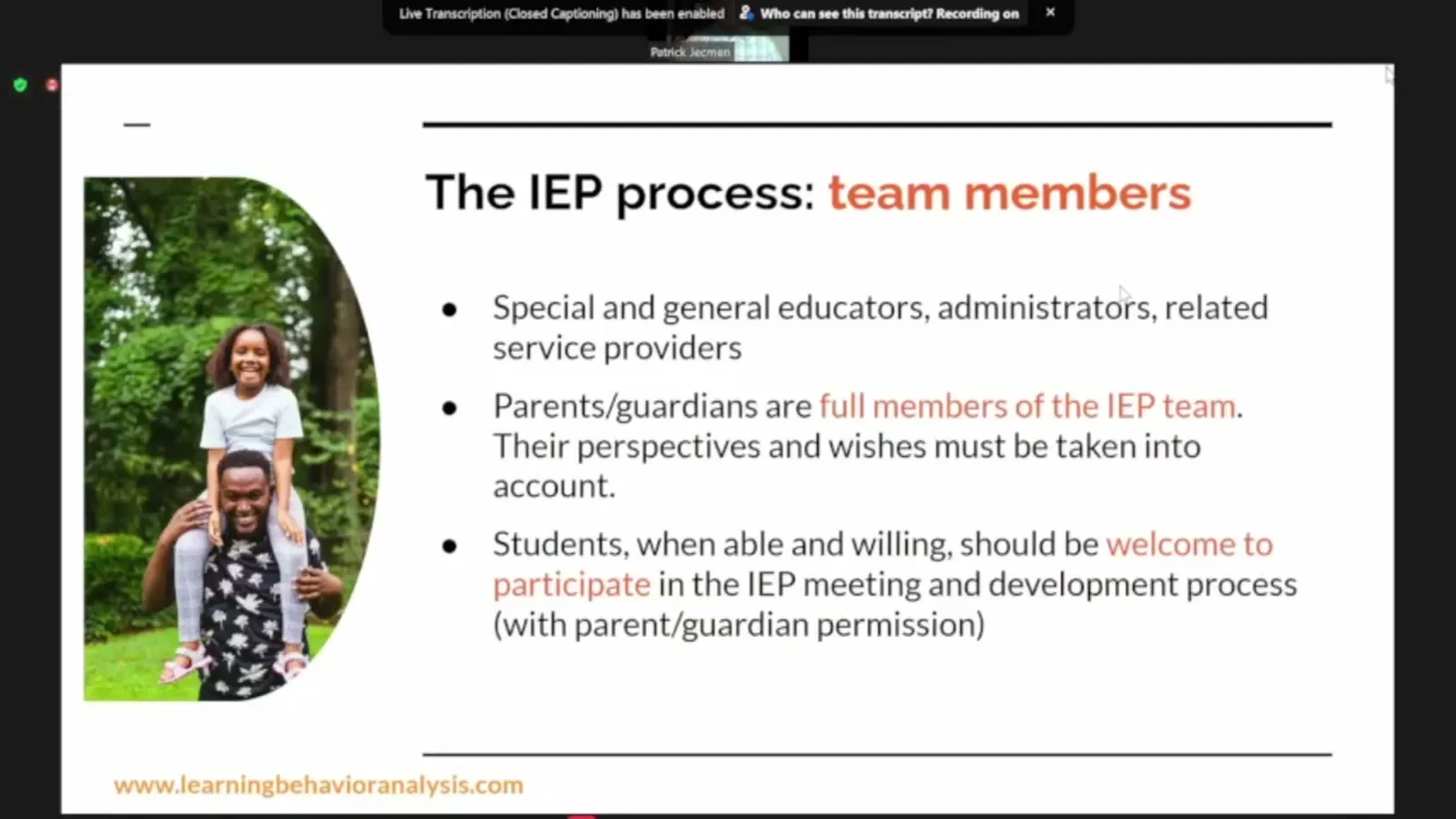
School Collaboration as an Area of Competence - Applied 2022
Free learning path on this topic
Your 4 Ethics CEUs, Done
Four ethics CEUs in three courses, all free. Start with Matt Harrington's assent and data course, then ethical guardrails in behavior reduction, then cultural considerations in clinical practice. Every course carries ethics credit, so this path covers the BACB requirement with nothing to buy.
On this page · 9 sections▾
You ran a solid clinic for years, you can do an FA in your sleep, and now your boss just handed you a school case. The good news is more of your skill set transfers than you think. The hard part is the stuff nobody trained you on: a legal document called an IEP, a team that votes like a jury instead of a democracy, and a building full of people who do not speak ABA.
This page is for the experienced clinic BCBA, not the new grad. You already know how to run a session. The work below is about translating that to a building where you do not own the schedule, the room, or the goals.
Why a strong clinic BCBA can still flop on day one in a school#
In a clinic you control almost everything. The room, the staff, the data sheet, the start time, the goal list. You can run a pair, change a program mid-session, and pull a parent meeting together by the end of the week.
A school strips most of that out. You walk into a building where the teacher owns the room, the schedule is locked, the goals were written by a team you were not on, and the kid you are there to help is in a class of 22 other kids with their own needs. The behavior science is the same. The system you have to push it through is brand new.
That is the gap that trips up clinic-trained BCBAs in the first week. Dr. Clelia Sigaud puts it plainly:
folks need to be coming from inpatient, outpatient settings, early intervention, whatever the deal may be, coming into school settings or by the amount of other information that needs to be known beyond how human behavior works.
The behavior part is not the hard part. Everything around it is.
What transfers from clinic to school#
Plenty of your clinic toolkit carries over. Do not throw it out.
- Function-based thinking. An FA is still an FA. The contingencies that drove behavior in the clinic still drive behavior in a hallway, a cafeteria, and a math block.
- FCT design. You already know how to build a replacement response, fade prompts, and thin reinforcement. That logic does not change.
- Data systems. Frequency, duration, partial interval, IRT. The same data you ran on a session sheet works in a classroom, you just have to design it so a teacher or a para can collect it without stopping instruction.
- Skills-based treatment logic. If you ran SBT in a clinic, the omnibus mand into differentiated mands still applies. You will just lean harder on an SLP partner.
- Generalization planning. You already think in terms of new people, new settings, new SDs. Schools are a generalization paradise, you just have less direct control over the conditions.
If you can run a clean FA and write a clean FCT plan, you have the engine. You just need a new chassis.
What does not transfer#
Here is the stuff that is genuinely new, no matter how senior you were in the clinic.
IEP law
An IEP is not a treatment plan. It is a legal document. Dr. Sigaud is clear about what that means once it is signed:
the IEP is a legally binding document. And when that IEP is created and it is finalized, the services and supports the school is obligated to provide those things to that learner, regardless of what their staffing is.
In a clinic you can write "we will pilot this for two weeks and adjust." In an IEP, if you wrote it, the district owes it. That changes how you write goals, how you scope services, and what you commit to in a meeting.
Team consensus
A clinic team usually runs on a clear hierarchy. The BCBA writes the program, the RBT runs it, the family signs off.
An IEP team works like a jury. There is no vote. The team has to leave the room aligned, with the special ed teacher, the gen ed teacher, the SLP, the OT, the admin, the parents, and when appropriate the student, all on the same page. If you walk in trying to win the meeting, you have already lost it.
Paraprofessional coaching
In a clinic you trained RBTs who went through the 40-hour course and shared your vocabulary. In a school, the person sitting next to your client all day is often a paraprofessional with no behavior analytic training. Coaching them looks different. Less jargon, more modeling, more behavior-specific praise, more checking that your written plan actually fits the body of the room.
A worldview that is not yours
Most of the people in the building did not come up through behavior analysis. They came up through education, special education, speech, OT, social work, or psychology. Each one brings a real framework with its own evidence base. You are not the smartest person in the room by default. You are one expert at a table of experts.
First 30 days: things to read, watch, and ask about#
You do not need to know everything before your first case. You do need a baseline.
- Read the kid's current IEP cover to cover. Present levels, goals, services, accommodations, minutes per week, where each minute is delivered.
- Read the most recent evaluation reports. Psych, SLP, OT, academic. You are not going to redo their work, but you need to know what is on the record.
- Watch the classroom for a full block before you write anything. Arrival, transition, instruction, break, transition out. You are baselining the environment, not just the kid.
- Ask the teacher what is hardest about this student in their day. Their answer tells you the socially significant target, often faster than a record review.
- Ask the para what they actually do. Not what the plan says. What they do.
- Ask the parent what a good week looks like at home. That is your generalization target.
- Find out who else is on this kid's team and when they meet. SLP, OT, social worker, case manager, admin. Get their names before you need them.
That is the first 30 days. Notice that almost none of it is "write a program." That comes after.
First IEP meeting prep checklist#
Before you sit at your first IEP table, run through this.
- I have read the current IEP and the most recent evals.
- I have at least one piece of data I collected myself, not pulled from someone else's report.
- I have one clear recommendation, written in plain language a parent can repeat.
- I have a question for every other provider on the team, not just a statement.
- I know what the team is being asked to decide today. New goals, a re-eval, a placement change, a BIP, an amendment.
- I have a plan for how I will respond if a parent disagrees with me. Listen first, restate their concern, then respond.
- I have removed jargon from my section. No "MO," no "SR+," no "function-based" without translation.
- I know the legal minutes of service I am recommending and I can defend the number.
If you cannot check all of those, you are not ready to write into a legally binding document.
Who to shadow and what to ask them#
Pick three people in your first month and ask to shadow each one for a half day.
- A veteran special ed teacher. Ask: how do you decide when to push back at an IEP meeting and when to let it go?
- The school SLP or OT. Ask: where do you wish BCBAs collaborated with you and where do you wish they would back off?
- A school psychologist or case manager. Ask: what is the part of the IEP process that BCBAs from clinics get wrong most often?
Those three conversations will save you a year of mistakes.
Common clinic-brain mistakes that hurt school cases#
These are the patterns that show up over and over when a clinic BCBA gets dropped into a building.
- Writing goals you cannot staff. "1:1 prompting across all transitions" sounds great until you remember the para is shared across three kids.
- Treating the IEP like a draft. It is not. Once it is signed, the district owes it.
- Talking over the parent. They have lived with this kid for years. You have known them for two weeks.
- Dismissing non-behavioral recommendations on sight. Non-behavioral is not the same as not supported. Read Brodhead's interdisciplinary work before you say no.
- Trying to "win" the meeting. There is no winner. There is a kid with a plan or a kid without one.
- Using clinic-grade jargon at the table. If a parent cannot repeat what you said back to you, you did not get informed consent. You got a signature.
- Centering your own norms. Dr. Sigaud names this directly:
It is my job when I go into work with a student or an IEP team to decenter my experience.
That is the posture. Decenter, then contribute.
FAQ#
I came from a clinic. Can I just take school cases the same way? No. The behavior science transfers. The legal framework, the team structure, the consent process, and the way you talk about your work all change. Treat your first three school cases as a supervised learning experience, not a sideline of your clinic caseload.
What is the single biggest difference between clinic ABA and school ABA? Control. In a clinic you control the environment and the schedule. In a school you contribute to a team that controls them. Your job shifts from running the program to shaping a team that runs it.
Do I need to understand IDEA before my first school case? You need the basics: what an IEP is, why it is legally binding, who is on the team, how consent works, and what role you play. You do not need to be a special ed lawyer. You do need enough to not write the district into a service it cannot deliver.
How do I talk to a teacher without sounding like I am in a clinic? Drop the jargon. Lead with what you observed, not what you concluded. Ask what their day looks like before you suggest a change to it. Praise specific things you saw work. Coach the same way you would want to be coached.
What if my employer treats school cases like clinic cases? Push back, in writing, with the scope of competence framework. Schools sit inside scope of practice for most BCBAs, but inside scope of competence only for BCBAs who have done the work to get there. If you have not, ask for supervision, ask for time to ramp, or ask to defer the case.
Where to go next#
If you want to go deeper before your first case, the CEU above walks through scope of competence, IEP structure, and collaboration behaviors in detail. Watch it on a Saturday morning with a notepad. It will save you a meeting or three.
Turn this topic into a CEU
You just studied this. Now get credit for it.
Watch School Collaboration as an Area of Competence - Applied 2022 with Dr. Clelia Sigaud and earn 1 free BCBA CEU. Detailed certificate, delivered the moment you finish.
Keep going with a free learning path
Your 4 Ethics CEUs, Done
Four ethics CEUs in three courses, all free. Start with Matt Harrington's assent and data course, then ethical guardrails in behavior reduction, then cultural considerations in clinical practice. Every course carries ethics credit, so this path covers the BACB requirement with nothing to buy.