School Collaboration as a Scope of Competence Area for BCBAs
School collab is a competence area, not a job title. Coursework, supervised hours, populations, settings. The four pieces, from a BCBA-led CEU.
Key takeaway
School collaboration is its own area of competence, not a side skill you pick up by showing up at meetings: it has its own coursework, its own supervised hours, its own populations, and its own settings. That framing comes straight from Dr.
School Collaboration as an Area of Competence - Applied 2022
Free learning path on this topic
Caregiver Collaboration and Parent Training
Leanne Page on why caregivers disengage and how to tell a skill gap from a relationship problem. Then Matt Harrington's seven habits for parent training and a workflow for setting collaboration goals with schools, pediatricians and other partners. Four CEUs, all free.
On this page · 9 sections▾
School collaboration is its own area of competence, not a side skill you pick up by showing up at meetings: it has its own coursework, its own supervised hours, its own populations, and its own settings. That framing comes straight from Dr. Clelia Sigaud's CEU, and it changes how a Board Certified Behavior Analyst (BCBA) should plan a move into school work. If you would not claim feeding or sleep without training, you should not claim schools either.
Why 'school collaboration' is its own competence area, not a side skill#
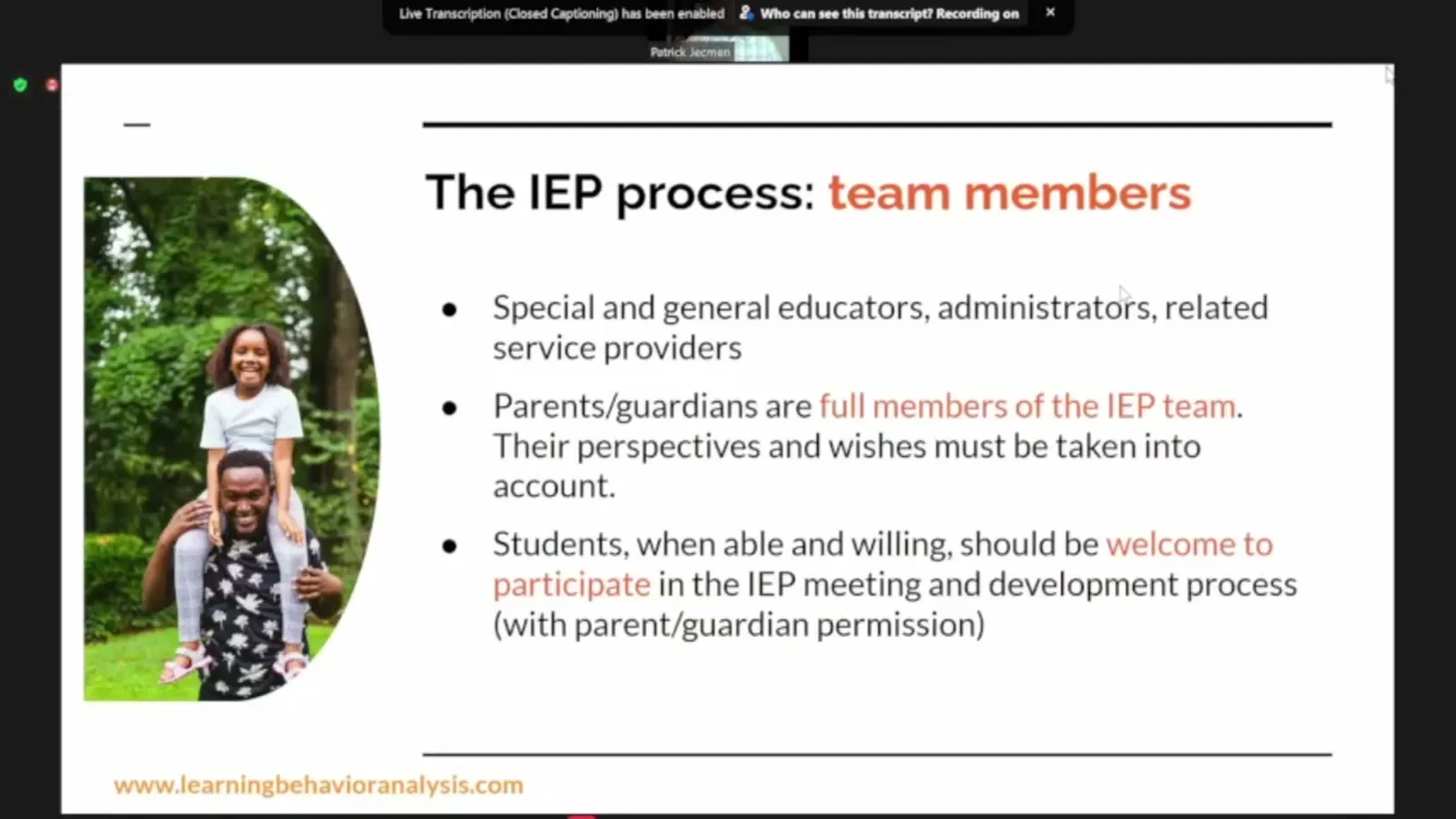
Plenty of BCBAs treat schools as just another place to bring their toolbox. The CEU pushes back on that. Schools have legal rules, team norms, and adult dynamics that do not show up in early intervention or clinic work. If you have never sat through an IEP meeting, you do not know what you do not know yet.
Dr. Sigaud puts it plainly:
There's so much to know about schools legally, procedurally, interpersonally, beyond what we're going to learn in ABA context specifically.
That sentence is the whole reason this page exists. School work is not a setting you walk into. It is a body of knowledge you build, just like you would build sleep or severe behavior or feeding. Treat it like a real area of competence and you stop being the person other team members quietly dread.
The four dimensions of competence (procedures, populations, settings, ethics)#
The talk leans on Brodhead and colleagues (2018), which gives behavior analysts a checklist for thinking about competence. The core idea: competence is not one thing. It is several things at once.
competence cuts across multiple dimensions of our work
Here are the four pieces, mapped to school work:
- Procedures and strategies. Functional Communication Training (FCT), token systems, paired teaching, behavior skills training, progress monitoring. Can you run them in a classroom, not just a clinic room?
- Populations. Not just diagnosis. Age, language, family context, classroom history, prior school trauma, peer dynamics. Schools mix populations on purpose.
- Settings. General education, self-contained, resource room, specialized day school, the bus, the cafeteria, recess. Each one has its own rules.
- Ethics. Consent, team consensus, mandated reporting, IDEA (Individuals with Disabilities Education Act), least restrictive environment, behavior intervention plans that have to hold up under legal review.
If you can check three of the four but not the fourth, you have a gap. Name the gap. Then build it on purpose.
What counts as coursework for school competence#
Coursework does not mean a single webinar. The CEU is direct about what real preparation looks like:
we have to have this robust history of coursework of literature mastery in the topic
For school work specifically, "literature mastery" means you have read the foundational articles and can talk about them without notes. A starter set:
- Brodhead (2015) on responding to non-behavioral treatment recommendations in interdisciplinary teams.
- Brodhead and colleagues (2018) on scope of competence as a checklist, not a single yes or no.
- Newhouse-Oisten and colleagues (2017) on ethics in school-based behavior analysis.
- LaFrance and colleagues (2019) on multidisciplinary collaboration between BCBAs and Speech-Language Pathologists (SLPs).
- Wright (2019) on power and humility in collaborative work.
Pair those with structured CEUs that focus on schools, not clinic work with a school label slapped on. Read the article, then watch a CEU that uses it. That sequence sticks better than either one alone.
If you have a Behavior Analyst Certification Board (BACB) supervisor, ask them to assign one school article a month and discuss it in supervision. You will close the coursework gap inside a year.
What counts as supervised experience for school competence#
Reading is one piece. Doing the work under someone who already does it well is the other. Hours alone are not the goal. Quality of feedback is.
A useful test: in the last 90 days, did someone who knows schools watch you in a real school meeting and give you concrete feedback after? If yes, you are building supervised experience. If no, you are practicing in isolation, which is not the same thing.
What good school supervision looks like:
- You shadow IEP meetings before you run pieces of them.
- Your supervisor reviews your draft goals before the team meeting, not after.
- You debrief at least one meeting a week with someone who can name what you did well and what you missed.
- You build a list of "I do not know yet" questions and bring them to supervision.
A reasonable target for someone moving into school work is 50 to 100 hours of school-specific supervised practice across at least three different students, with at least one student in general education and at least one in a more restrictive setting. That is not a BACB rule. It is a working floor that comes up over and over in school-based ABA writing.
Reading list to build your school competence base#
If you want a quick stack of work to start with, this is a fair starter library. Most of it is open access or available through a university library:
- IDEA, Section 1414 (the part that defines the IEP team and process).
- BACB Ethics Code for Behavior Analysts, sections on competence (1.05), collaboration (2.10), and risk assessment (2.14).
- Brodhead (2015), 2018 competence checklist, and any follow-up commentary in Behavior Analysis in Practice.
- A general special education law primer such as Wrightslaw's free articles on FAPE and LRE.
- One SLP article and one OT article on shared goals like FCT or self-advocacy, so you can see how partners on the team think.
You will not memorize all of it. The point is that you can find an answer fast when a team member asks a question you have not heard before.
Self-check: am I building school competence on purpose or by accident?#
Run yourself through this quick check before you accept the next school case:
- Can you name three peer-reviewed articles on school-based behavior analysis you have read in the last 12 months?
- Can you name the BCBA, SLP, or school psychologist who is currently giving you school-specific feedback?
- Can you name the legal rules in your state that govern restraint, seclusion, and behavior intervention plans?
- Can you name two populations you have served well in schools, and two you have not?
- Can you name one setting you are still uncomfortable in?
Zero or one yes: you are doing school work by accident. Two or three: you are building on purpose, but with gaps. Four or five: you are inside your scope of competence for the cases that match what you named.
This is not about gatekeeping. It is about being honest before you sign a service plan that becomes a legally binding document the day the team approves it.
How to log school competence the way you log other CEUs#
Most BCBAs already track CEUs for renewal. Few track competence by dimension. A simple log fixes that.
A sample row in a school competence log:
- Date. 2026-06-12.
- Activity. Watched Dr. Sigaud's CEU on school collaboration as an area of competence.
- Dimension. Settings + ethics.
- Article read. Brodhead (2018).
- Population. Elementary, autism, English language learner.
- Supervised hours added. 0 (CEU only).
- Gap noticed. I have never co-written an FCT goal with an SLP.
- Next step. Ask my SLP partner to co-draft one goal in July.
Keep this in a spreadsheet, a Notion doc, or even a notebook. The format does not matter. What matters is that you can show your supervisor, your employer, or your future self that you built school competence the same way you would build any other area. On purpose. With evidence.
That is also how you protect yourself if a case ever goes sideways. "I had read the literature, I had supervised hours, and I had a written log of how I built competence in this area" is a much stronger answer than "I figured it out as I went."
FAQ#
What makes school collaboration a competence area and not just a setting? A setting is where you work. A competence area is what you have to study, practice, and be supervised in before you can work there well. Schools have their own law, their own team rules, and their own population mix. That is enough to make it a competence area on its own, not a footnote on your clinic skills.
How many hours of supervised school work is "enough"? There is no BACB number. A reasonable working floor is 50 to 100 hours of school-specific supervised practice across at least three students and at least two settings, with regular feedback from someone who already does the work well. Hours without feedback do not count.
Do I need a teaching background to be competent in schools? No. Plenty of strong school BCBAs were never teachers. You do need to understand how teachers think, how classrooms run, and how IEP teams make decisions. You can build that without a teaching credential, but you cannot skip it.
Can I claim school competence after one consult case? No. One case tells you the work exists. It does not tell you that you can do it across populations, settings, and team types. Treat one case as the start of supervised experience, not the proof you finished it.
How do I document my school competence for my supervisor? Keep a written log with date, activity, dimension (procedures, populations, settings, ethics), article read, supervised hours, gaps noticed, and next step. Review it in supervision once a quarter. That gives both of you a real picture of where you are.
Want the source talk?#
Dr. Sigaud's full CEU walks through the competence framing, the Brodhead checklist, and the IEP team dynamics that come with school work. It is 54 minutes and earns 1 BACB CEU.
Watch the full CEU on openceu.com
Turn this topic into a CEU
You just studied this. Now get credit for it.
Watch School Collaboration as an Area of Competence - Applied 2022 with Dr. Clelia Sigaud and earn 1 free BCBA CEU. Detailed certificate, delivered the moment you finish.
Keep going with a free learning path
Caregiver Collaboration and Parent Training
Leanne Page on why caregivers disengage and how to tell a skill gap from a relationship problem. Then Matt Harrington's seven habits for parent training and a workflow for setting collaboration goals with schools, pediatricians and other partners. Four CEUs, all free.