Your ABA Case Is Stuck. Here Is the Research Process to Unstick It.
Step-by-step protocol for using research to break open a stuck ABA case in under an hour, from a BCBA-led CEU.
Key takeaway
Before you open a single journal, do the move most BCBAs skip: have a peer interview you about the case like they have never heard of it. A BCBA is a board certified behavior analyst.
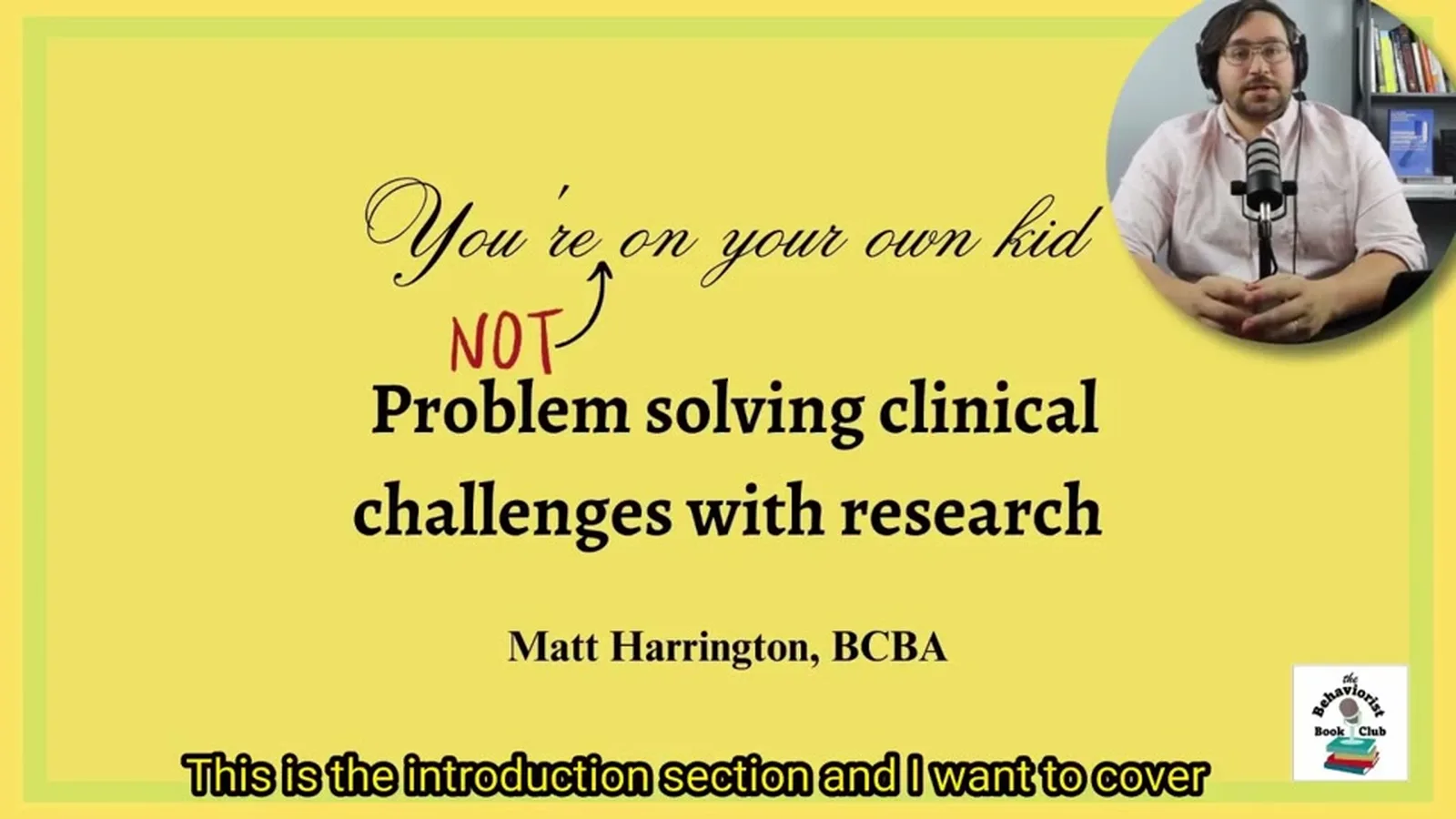
Solving Clinical Challenges with Research
Free learning path on this topic
Child Development for Behavior Analysts
Typical development for behavior analysts. Kristen Byra's overview, then Kelly Brzak's deep dives on ages 2 to 5, 6 to 8, and 9 to 11, with milestones, common problem behaviors, and programming tips for each band.
On this page · 9 sections▾
Before you open a single journal, do the move most BCBAs skip: have a peer interview you about the case like they have never heard of it. A BCBA is a board certified behavior analyst. Then run the get-specific-then-vague loop. Specific means the exact client, the exact prompt, the exact thing that breaks. Vague means the textbook words for that same thing. Functional communication training. Prompt fading. Property destruction maintained by escape. That loop is the difference between a search that returns 400 articles you cannot use and a search that hands you the one paper that fits. This page walks the loop, then shows what it looks like on a real FCT plateau, then gives you the 20-minute version you can run tonight.
What "Stuck" Actually Means in an ABA Case#
Stuck is not a technical term. It is the word every BCBA uses in their own head when a plan that should be working is not. The kid was making gains on functional communication. Now they are not. The protocol on paper looks fine. The data does not move. That feeling has a respectful name.
I'm using the terms clinical challenge because I think it's a respectful way to refer to kind of like a stuck spot in your intervention. This is a situation where you're trying to master a goal, you're trying to train a new functional communication response, and you're not making progress. From the talk — Matthew Harrington
That definition matters because it sets the boundary. A stuck case is not a failed case. It is a case where the gain is real but the next step has not landed. The job is not to throw the plan out. The job is to find the one bolt that came loose and tighten it. Research is the wrench. But the wrench only works if you know what you are tightening.
Step 1: Get a Peer to Interview You About the Case (Even a Technician Works)#
The first move is not the search bar. The first move is a person. Not a senior BCBA, not a supervisor, not a researcher. A peer. Or a BT (a behavior technician, the person running daily sessions) who has not touched this case. Someone who does not know what you know.
You first want to write down or describe or talk to somebody about the whole situation. Ask them to basically interview you. I like to do this with a peer or even a technician who's not really familiar with the case and ask them to just pass through you with questions and see what directions those questions go. From the talk — Matthew Harrington
Why a peer or a BT. Because they will ask the questions you stopped asking three months ago. They will say things like, "Wait, what does he do when you delay the prompt by two seconds versus five?" or "Is the same staff in the room every time?" Those are the questions that surface the broken piece. You wrote the plan, so you cannot see it. Their job is not to solve the case. Their job is to be confused at you out loud.
If no peer is around tonight, do this. Open a blank doc. Write the case at the top in one paragraph. Then write the five questions you think they would ask. Answer them. That is the consult.
Step 2: Narrate the Exact Hiccup in Specific Client Language#
Once the peer (or the blank doc) has walked you through it, you write the hiccup down in client words. Not Cooper-book words. Client words. The exact prompt that fails. The exact behavior that follows. The exact thing the staff is doing in the room when it happens. No jargon yet.
Here is what specific sounds like for the FCT case above. The client is able to use FCRs (functional communication responses, the new way the kid is being taught to ask for what they want) following a motor imitation prompt. But whenever you try to delay that motor imitation prompt, the FCR does not come, and property destruction happens instead. That is the specific hiccup. Not "the plan is failing." Not "the kid is regressing." One sentence that says where the break is and what the break looks like.
Notice what that one sentence does. It does not say "the client is having a hard time." It says where the break is. The FCR works with a full motor model. The break shows up the second you try to fade that model. That sentence is your search target.
If you cannot write a sentence that specific, you are not ready to search yet. Go back to step one and let a peer ask one more round.
Step 3: Translate the Hiccup Into Cooper-Book Glossary Terms#
Now you flip the language. Take the specific client paragraph and write it again in the vague, formal terms a textbook uses. This is the step most BCBAs skip. It is also the reason most searches fail.
Once we get specific, we're then going to translate back into as vague terms as possible. As if you were trying to look up in the glossary of the Cooper book, describe a challenge to an old and fancy professor, someone who doesn't say things like encouragement and instead talks about positive reinforcement through praise. From the talk — Matthew Harrington
So the worksheet example becomes this. Prompt fading. Time delay procedure. FCT. Escape-maintained property destruction. Treatment integrity during prompt thinning. Now you have six phrases a database can match. Not "kid getting frustrated." Not "plan not working." The textbook words.
Here is the simple rule. Specific tells you what is broken. Vague tells the database what you are looking for. You need both. If you only get specific, you write a great session note and a useless search. If you only stay vague, you find 4,000 papers and not one of them is your kid.
Step 4: Pick One Hiccup. Use Parsimony.#
Now the hard part. Once you do the get-specific-then-vague loop, you will not find one broken thing. You will find five. The contingency is fuzzy. The SD (the cue that signals the behavior should happen) is doing two jobs. The reinforcement schedule has drifted. The fade steps are too big. The data sheet is mixing two response types. All of that is real. You cannot fix all of it tonight.
You may find many hiccups. This has happened to me before where I'm like, well, that contingency could be clearer. That SD isn't really doing what I wanted it to do. All right, there's three, four, five issues that I'm seeing. Let's utilize parsimony and go with the least likely or the most likely one first. From the talk — Matthew Harrington
Parsimony is the rule that says pick the simplest fix that could explain the problem. Either the most likely cause, or the easiest one to test. Both are fine. The wrong move is to try to fix all five at once and not know which one moved the data. Pick one. Search the literature for that one. Run that one change for a full week. Then look at the data and decide what is next.
This is the step that turns research from a homework assignment into a clinical tool. You are not writing a thesis. You are picking one bolt and finding one paper that tells you how to tighten it.
What This Process Looks Like for a Real FCT Plateau#
Walk it through with the example above. A six-year-old client, FCT in place, FCR works with a full motor model, falls apart the moment the prompt is delayed, property destruction follows. Step one. A peer asks, "When you delay the prompt, how long is the delay?" You realize the BT has been delaying inconsistently. Sometimes one second, sometimes five.
Step two. The specific hiccup is now: the FCR has not generalized past a zero-second time delay because the time delay is being applied inconsistently across sessions and staff. Step three. The vague version is: prompt dependency, time delay fading, treatment integrity, FCT, escape-maintained problem behavior, transfer of stimulus control. Step four. Five things are broken: integrity, prompt level, schedule of reinforcement for the FCR, extinction tolerance for the property destruction, and staff training. The most likely one and the easiest to test is integrity. Fix the integrity, hold everything else still, and see if the FCR generalizes.
Now the search. You type "time delay" AND "functional communication" AND "treatment integrity" into a behavior journal database. You get a small, useful list. You find one paper that tested staff integrity on time delay procedures in FCT and reported what happened when integrity dropped below 80%. You read the procedure section in 15 minutes. You write a one-page integrity checklist for the BTs. You run it for a week.
That is the loop. One case, one hiccup, one paper, one week of data.
Tonight's Move: 20 Minutes to a Better Search Term#
If you are reading this at 9pm Sunday and Monday's clinical meeting is at 8am, here is the 20-minute version. Set a timer. Five minutes to write the case in one paragraph in client words. Five minutes to write the same paragraph again in textbook words. Five minutes to circle the top three hiccups and pick one by parsimony. Five minutes to turn that one hiccup into three search terms with AND between them.
Open the search bar with those three terms. Read titles only until you find one paper that fits. Save it. Close the laptop. Read the paper in the morning over coffee. You do not need to solve the case tonight. You need a better search term than you had at 9pm. That alone changes Monday.
Frequently asked questions#
Why is my client's behavior plan not making progress anymore?
In most stuck cases, the plan is not broken. One piece of the plan is. The usual suspects are prompt fading that moved too fast, a reinforcement schedule that drifted, treatment integrity that dropped across staff, or an SD that is doing two jobs at once. The way to find which one is the get-specific-then-vague loop. Write the exact hiccup in client words, then in textbook words, then pick one piece to test for a week.
How long should I try an ABA intervention before changing it?
There is no fixed number, but most clinicians give a procedure two to four weeks of clean data before deciding it is not working. Clean data means the BTs are running the procedure with high integrity. If integrity is below 80%, the timer does not start. If you are at four weeks with clean integrity and no progress, that is the signal to run the research loop on this page. Pick one hiccup, find one paper, change one variable for the next week.
Is it normal for ABA cases to plateau, and what do I do first?
Yes. Plateaus are part of the work, not a sign you missed something big. The first step is not a new assessment or a full plan rewrite. The first step is the peer interview. Ask a peer or a BT who does not know the case to interview you for ten minutes. Then write the stuck spot in specific client language. Most cases unstick once that one sentence gets written.
Watch the full talk#
If this lined up with a case you have open right now, the full CEU walks the Research Finding Framework end to end. It also covers the Key Places Framework for reading a paper in under 15 minutes. It is free and counts for one general learning credit.
Watch the full CEU on solving clinical challenges with research
Turn this topic into a CEU
You just studied this. Now get credit for it.
Watch Solving Clinical Challenges with Research with Matthew Harrington and earn 2.5 free BCBA CEUs. Detailed certificate, delivered the moment you finish.
Keep going with a free learning path
Child Development for Behavior Analysts
Typical development for behavior analysts. Kristen Byra's overview, then Kelly Brzak's deep dives on ages 2 to 5, 6 to 8, and 9 to 11, with milestones, common problem behaviors, and programming tips for each band.