Response Class in ABA: One Function, Many Forms
A response class is a group of behaviors that serve the same function. See how BCBAs define, measure, and shape response classes in real cases.
Key takeaway
A response class is a group of different behaviors that all serve the same function. The forms can look nothing alike. What ties them together is the goal they reach for the person.
PDA: Collaborating for Success
Experts who cover this
6 recordings on openceu cover response class.
- Featured talk1 CEU
PDA: Collaborating for Success
B. Kuereine GrayThe Behaviorist Bookclub
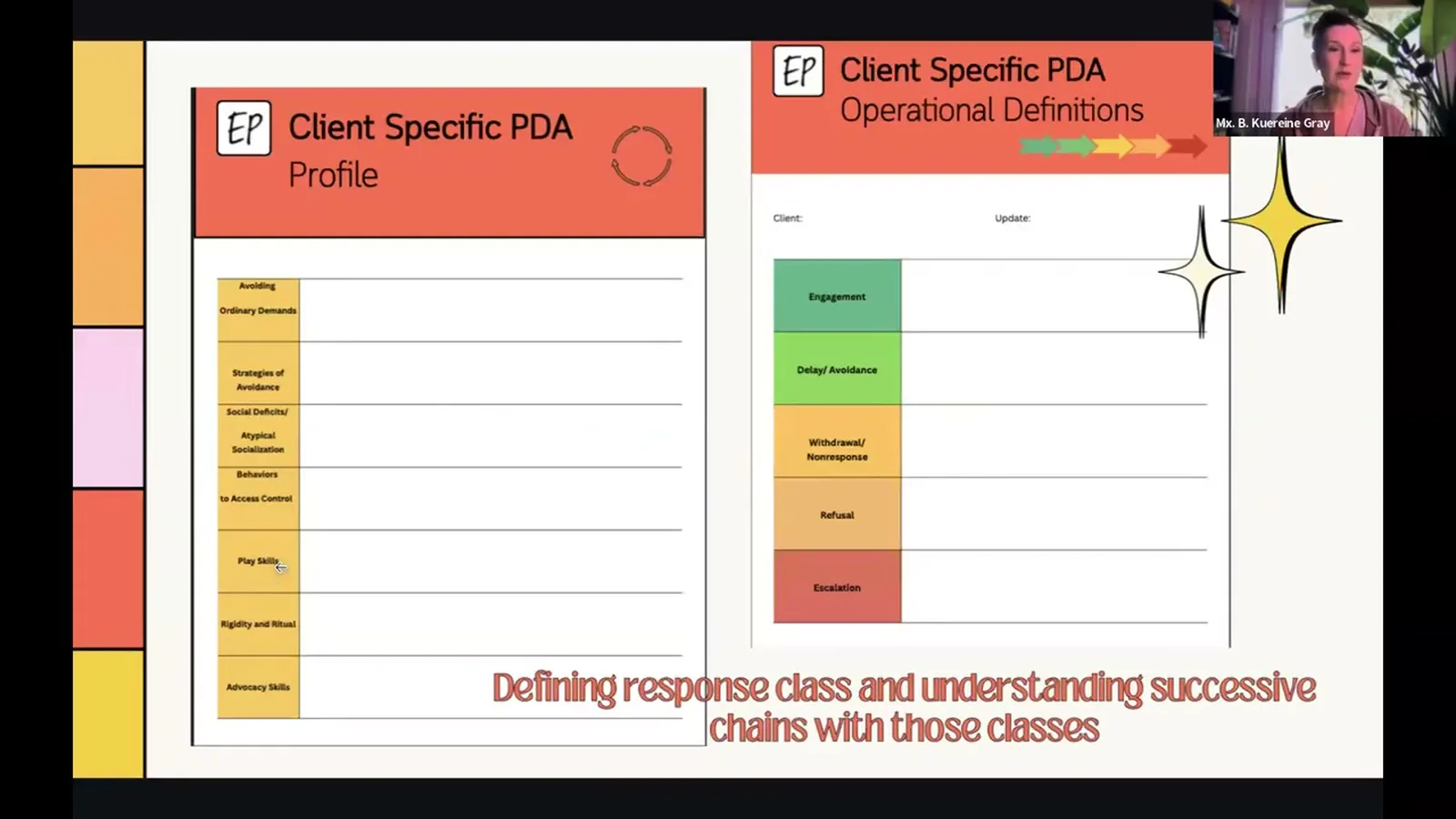
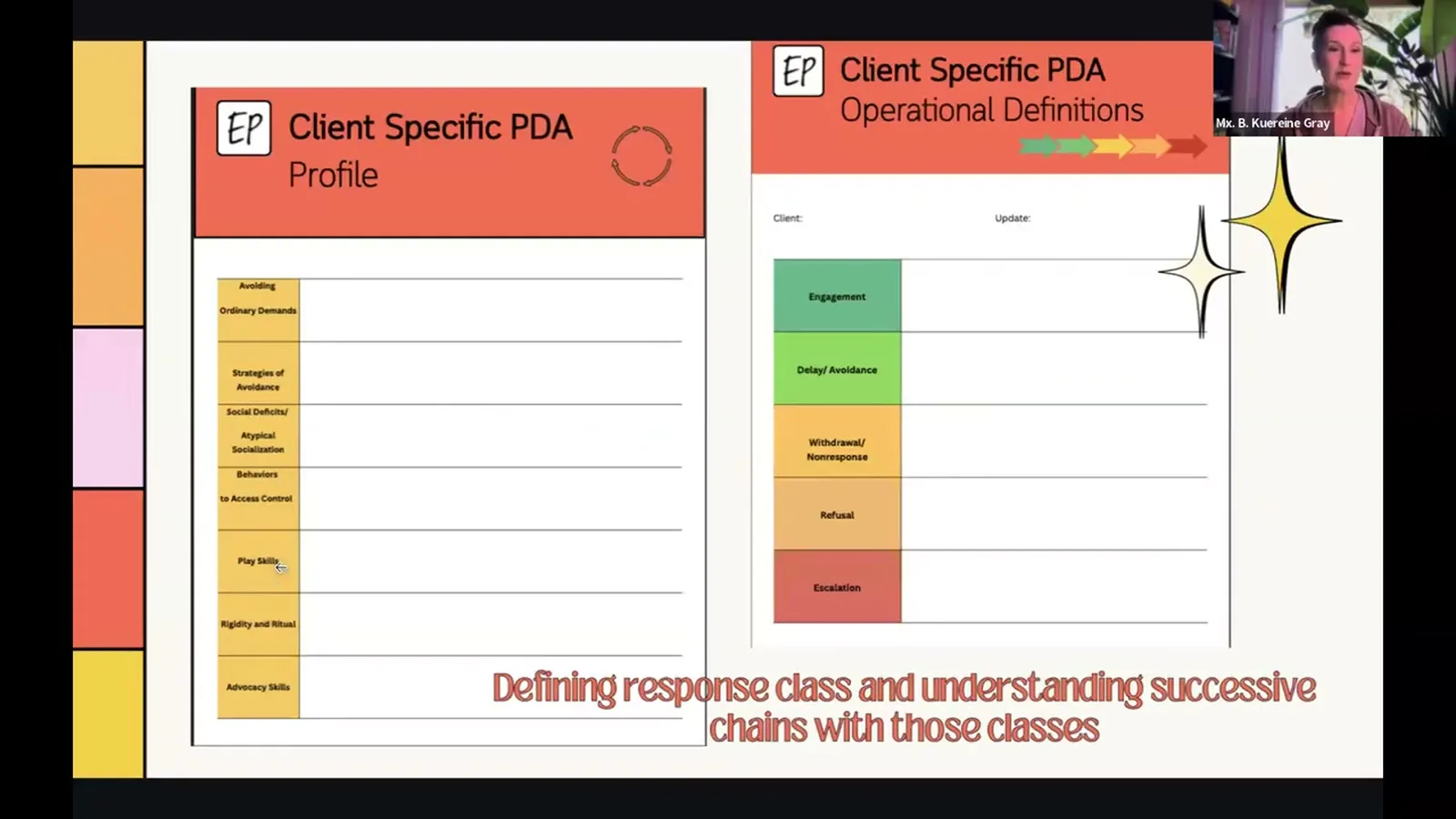
The presenter operationalizes PDA clinically as a response class rather than a single behavior, mapping out its component clusters (avoidance, social deficits…
- 0.50 PDUs
Bite-Size Behavior Analysis: Differential Reinforcement
Anlara HoskinsCandid Contingencies, LLC
A response class is defined as a group of responses/topographies that serve the same function or purpose (e.g., calling, texting, emailing all serving the…
- 1.50 CEUs
PDA Caregivers, Complex Profiles, Replacement Behaviors, and Being Trauma Informed
B. Kuerine GrayThe Behaviorist Bookclub
Gray frames PDA behaviors as a single response class of escalating topographies that all serve the same function (delay/avoidance of a demand), meaning the…
- 1 CEU
Streamlining BIPs & Data Collection Systems for Schools
Nicola Schneider, LBA-NJNRS Compassionate Behavior Services
Schneider groups differing behavior topographies (hitting, kicking, biting) into a single response class rather than tracking each separately, focusing on how…
- 1 CEU
Assent: Don't just say Yes!-
Matt HarringtonThe Behaviorist Bookclub
The presenter's favorite ABA term, used to explain that severe behavior and mild assent-withdrawal behaviors sit on the same continuum, so a clinician can…
- 1 Ethics CEU
Cultural Sensitivity: Unconscious Bias
Mackenzie SandlerThe Behaviorist Bookclub
Responding to an audience question about racial bias in the term 'physical aggression,' Matt (moderating) suggests breaking the response class into its…


On this page · 11 sections▾
A response class is a group of different behaviors that all serve the same function. The forms can look nothing alike. What ties them together is the goal they reach for the person.
This idea matters because it changes how you read behavior. A child who whines, then yells, then hits may not have three problems. They may have one problem shown three ways. When you see the class, you can write better definitions and take cleaner data. You can also plan treatment that works on the whole group at once.
What a response class is#
Anlara Hoskins, a BCBA who teaches differential reinforcement, starts with an everyday example. Say you need to get a message to a friend. You could talk to them in person. You could call, text, email, write a note, or send a DM. Each one looks different. But each one gets the same message to the same friend.
We call all of those behaviors that are accomplishing the same goal, response class.
From the talk — Anlara Hoskins
Hoskins compares it to a classroom at school. Everyone with the same teacher is in the same class. In the same way, every response that serves the same purpose belongs to the same response class. She also ties it to a word most clinicians already know. Another way to say "same purpose" is "same function." Function means the reason a behavior keeps happening, or what it gets or avoids for the person.
That is why the idea sits at the heart of differential reinforcement. Differential reinforcement means rewarding one behavior while no longer rewarding another. It only works well when you know which behaviors are competing for the same payoff.
A response is not the same as a behavior#
Hoskins makes a careful point that many new clinicians skip. A response and a behavior are not the same thing. A response is one single instance. It has a clear beginning and a clear end. A behavior is the larger pattern those instances belong to.
Her example is eating. Eating is a behavior. Eating bacon and eggs this morning is one response. Texting works the same way. Sending one text is a single response. Texting overall is the behavior. And texting is also part of an even bigger branch, which is communicating. As Hoskins puts it, that layering is what a response class describes. It is a group of responses that all serve the same purpose, so they belong in the same class.
This layering helps when you build a treatment plan. You count responses. You describe behaviors. And you group those behaviors into a class by what they do for the person. Keeping the three levels apart stops you from mixing up "how often" with "what for." It also makes it easier to explain your plan to parents and teachers in plain words.
Function stays the same while the form changes#
B. Kuereine Gray is a BCBA who works with Pathological Demand Avoidance (PDA), a profile of intense avoidance of everyday demands. She uses the response class to explain escalation. Her key point is simple. When behavior gets bigger, the reason behind it usually does not change. Only the look of it changes.
It's not that the function of behavior is changing. It's that the topography of how it looks can be changing.
From the talk — B. Kuereine Gray
Topography means the physical form of a behavior, or what it looks like from the outside. Gray walks through the steps a clinician can map. What does the person do to engage? What do they do to delay or avoid? What do they do to withdraw or stop responding? What do they do to refuse the demand outright? And what does full escalation look like?
It's that all of the behaviors are set to have that same function, that same access or delay avoidance of a specific outcome. And we can look at the response class increasing in intensity.
From the talk — B. Kuereine Gray
Gray adds that the class is not one behavior at one fixed level. It shifts in intensity when earlier forms are not reinforced. That is a practical warning. If you block a mild form without meeting the need, a stronger form in the same class may show up next.
Treating PDA as a response class#
Gray also uses the response class to solve a naming problem. PDA does not have its own diagnostic code. Some people call it a subtype of autism. Others call it a profile or a presentation. Gray notes that the lack of peer-reviewed research and clear definitions has kept it from becoming its own category.
For our purposes in behavior analysis, it is a response class. And we'll get into that more.
From the talk — B. Kuereine Gray
This framing lets a BCBA work with PDA without waiting for a diagnosis to settle. It moves the focus to things you can see and count. Gray lists the areas she typically sees. These include avoiding ordinary demands, strategies of avoidance, and social differences. They also include behaviors used to gain control, plus rigidity and rituals.
The areas that we typically see in PDA are going to be that avoiding ordinary demands, strategies of avoidance, social deficits or atypical socialization, behaviors that are an access to control or used to access control to items, activities, sequence.
From the talk — B. Kuereine Gray
Gray ties this straight to paperwork. Goals for funders need to be objective, individualized, and measurable. So each cluster needs its own operational definition. An operational definition is a clear, countable description of a behavior that two people would score the same way. She shares planning forms clinicians can use at intake, or when deciding whether to refer out.
Seeing the chain before the big behavior#
 Advertisement
Families often say that behavior "comes out of nowhere." Gray pushes back on this gently. Behavior does not come out of nowhere. But the early steps of escalation can be very small and easy to miss. Once you notice the chain of responses that go together, you can write them down.
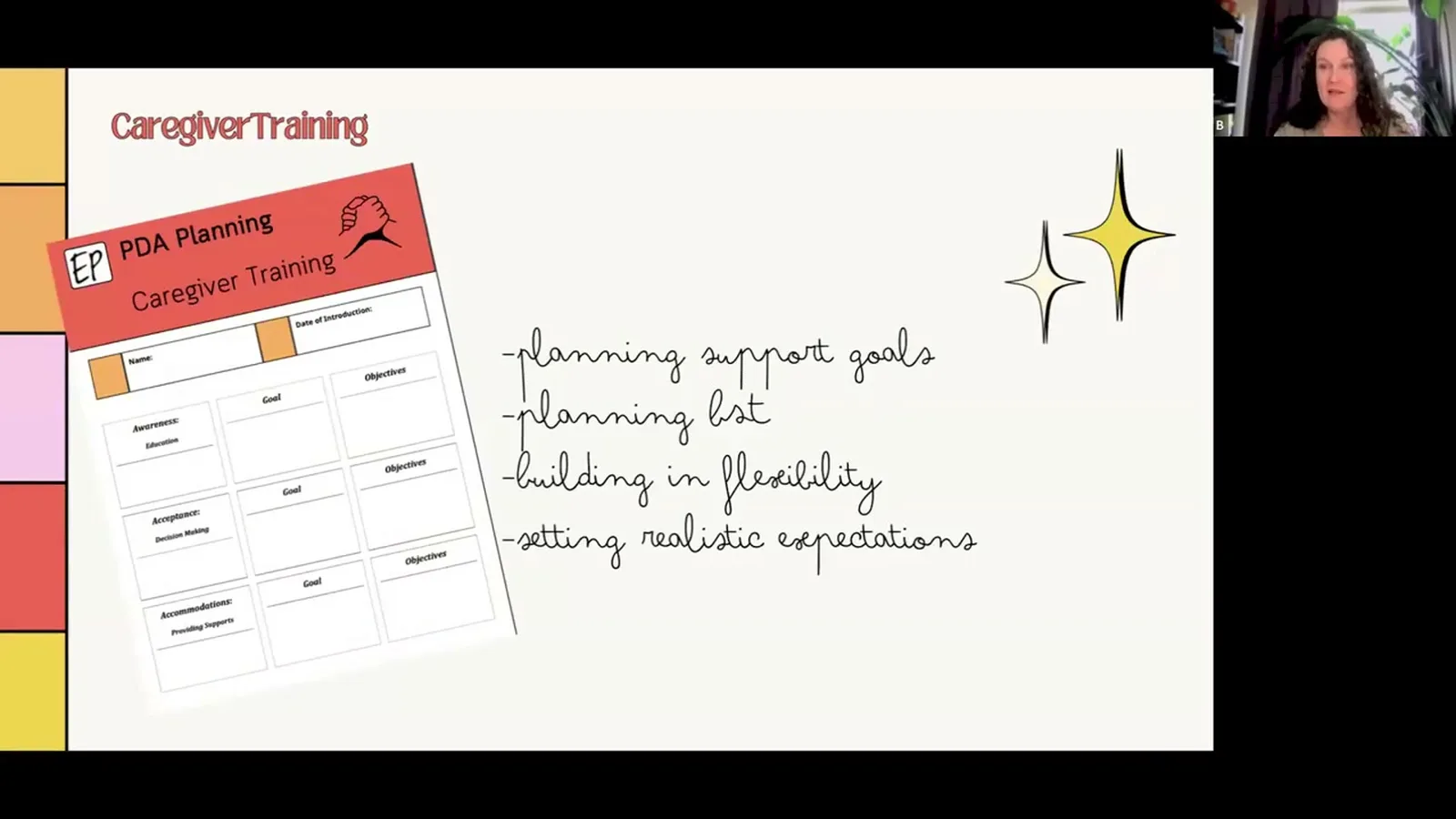
That outline helps everyone on the team. Teachers, caregivers, and support staff can learn where the person is in the chain. They can respond earlier, before the most intense form shows up.
So instead of being like, oh, this response class is to access this function. This entire, all of these together are to access safety and address anxiety over uncertainty.
From the talk — B. Kuereine Gray
Gray is honest about the limits here. We cannot see inside a person's mind, and talk of anxiety can sound mentalistic. Mentalistic means explaining behavior with inner states instead of things we can observe. She uses the language found in the current PDA literature so the field shares one vocabulary. She also frames PDA as a drive for autonomy. She argues that framing opens more caring and collaborative talks than calling it a broken pattern.
Shaping down within the same class#
Matt Harrington, who teaches on assent in ABA, calls the response class his favorite term in the field. Assent means a client's ongoing, moment-to-moment agreement to take part. Assent withdrawal is how a client shows they want to stop.
I love response classes more than any other ABA term.
From the talk — Matt Harrington
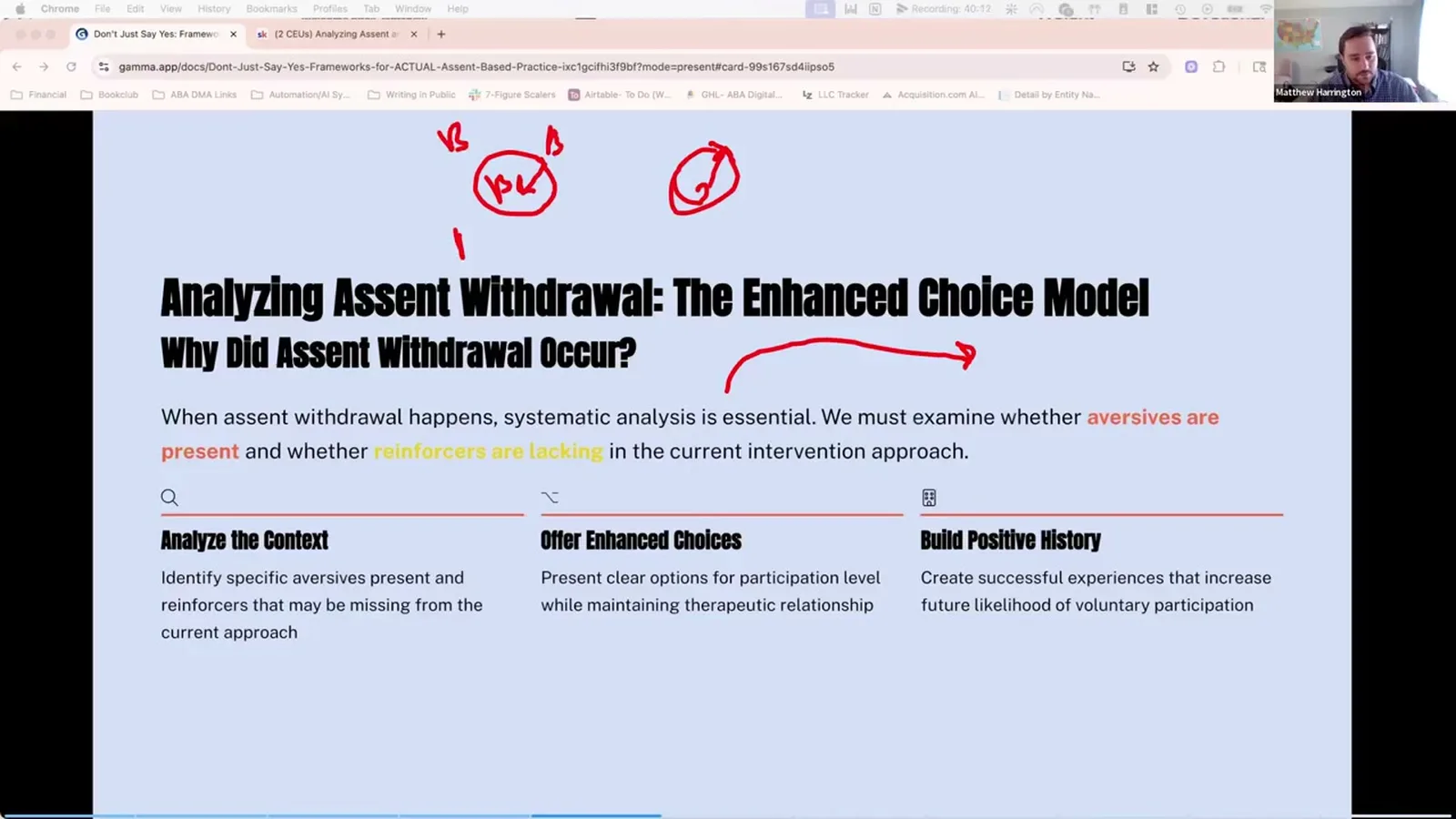
Harrington pictures a line. Severe behavior sits on one end. A calm "no thank you" sits on the other. Between them are many small behaviors, often called precursors, which are early signs that come before bigger behavior. Some clients jump straight to severe behavior. They may not know any safer way to say "stop."
His advice is to avoid trying to leap across the whole line at once. The goal is not to go from headbanging to "no thank you" in one step. It is to move from headbanging, to headbanging with less force, to self-biting. From there it moves to screaming "no," saying "no," asking, and shaking the head.
Because we're in the same response class, we can shape down just as much as we can shape up when we're learning a skill.
From the talk — Matt Harrington
Shaping means rewarding small steps that get closer and closer to a goal. Harrington's point is that shaping works in both directions inside a class. If you feel stuck, you may need to shape assent withdrawal into a safer form first. Then you can reset the relationship and build from there.
Grouping topographies to keep school data simple#
Nicola Schneider, a BCBA and former classroom teacher, brings the response class into data collection. She asks whether schools really need to track every single form of aggression apart. Hitting, kicking, and biting could each get their own line. But is that always needed to make a good decision?
my answer might be yes for certain students, but for me, I'm really looking at that response class and how it impedes that student or their learning environment.
From the talk — Nicola Schneider
For Schneider, the key question is impact. How does the class of behavior affect the student and the room around them? Intensity still matters to her. She wants to know whether an event was a single hit or a long, continuous episode. But the exact form often matters less than the effect in a school setting.
This view led her to design a level system for school behavior plans. It keeps data useful without burying teachers in detail they may not need. It is a practical use of the response class. You measure the group of behaviors by how much it gets in the way of learning.
Breaking up a loaded label#
Matt Harrington also shows the response class being used the other way. In a talk on unconscious bias, a clinician raised a family's concern. The family worried about the racial assumptions tied to the phrase "physical aggression." Harrington, moderating, pointed out that physical aggression is itself a response class.
physical aggression by nature is a response class of multiple different behaviors. Typically when we define it, um, we'll say physical aggression in the form of hitting and slapping, right?
From the talk — Matt Harrington
His suggestion was to split the class into its parts. Define hitting and slapping as two separate behaviors. Count each one. Then roll the counts up under a more neutral label, such as "physical behavior toward others." He noted that the right choice depends on the audience. A report for insurance, a school district, or a family may each need something different. He also admitted there is a difference between working around a label and facing a concern head on.
Where experts disagree#
The sources do not fully agree on how to handle a response class in practice. The clearest split is about lumping versus splitting when you take data.
Nicola Schneider leans toward lumping. For many students, she tracks the response class as a whole and asks how it impacts learning. Breaking out every form can add work without helping the decision. Matt Harrington, in the bias discussion, leans toward splitting. He suggests defining each form on its own and then combining the counts. His reason is different, though. He is less concerned with data load and more concerned with how a broad label reads to families. Both keep a total count. They differ on which level should carry the name and the definition.
There is also a quieter debate about what the term should mean at all. Hoskins and Gray define a response class by shared function. Behaviors that get the same result belong together, even if they look different. Palmer (2021) argues for a narrower use. He suggests reserving "response class" for units that rise and fall together partly because they look alike. He would call groups united only by a shared consequence "functional classes" instead. In daily clinical talk, the function-based meaning is the common one. Knowing the narrower view helps when you read the research.
What the research says#
Research on response classes backs up much of what these clinicians describe. It also adds some careful limits.
Warner et al. (2020) studied children whose caregivers reported several forms of problem behavior that happened together. The team used extinction, meaning they stopped reinforcing the behavior, on one or more forms. They wanted to see whether all forms were sensitive to the same reinforcement contingency. For nine of 10 participants, the most concerning forms responded to the same contingency as the milder ones. One result was unclear. The authors caution against assuming class membership from a single analysis. (Warner, C. A., Hanley, G. P., Landa, R. K., Ruppel, K. W., Rajaraman, A., Ghaemmaghami, M., Slaton, J. D., & Gover, H. C. (2020). Toward accurate inferences of response class membership. Journal of Applied Behavior Analysis, 53(1), 331-354.)
Palmer (2021) takes up the theory side. He defends "response strength" as a useful summary of how reinforcement works. He then proposes the narrower definition described above. In his view, a response class shares form, and a functional class shares consequences. (Palmer, D. C. (2021). On response strength and the concept of response classes. Perspectives on Behavior Science, 44(2-3), 483-499.)
Dixon, McCord, and Belisle (2018) looked at a different kind of class. They taught two children a generalized skill of unscrambling sight words. One child was typically developing and one had autism. Both learned to unscramble words alone and inside sentences. Nearly all of the test items, 98%, were new to them. This shows that a class can also be built on purpose as a skill, not only found in problem behavior. (Dixon, M. R., McCord, B. E., & Belisle, J. (2018). A demonstration of higher-order response class development in children. Journal of Applied Behavior Analysis, 51(3), 590-595.)
If you want to see how this plays out in treatment, Anlara Hoskins covers it in Bite-Size Behavior Analysis: Differential Reinforcement.
FAQ#
What is an example of a response class in ABA?
Getting a message to a friend is a common example. Talking, calling, texting, emailing, and writing a note all look different. But they all serve the same goal, so they form one response class. In clinical work, whining, yelling, and hitting to escape a task may form one class too.
Is a response class the same as a function?
Not quite. Function is the reason a behavior keeps happening. A response class is the group of behaviors that share that reason. So function is what ties the class together. Some researchers, like Palmer (2021), use a narrower meaning based on shared form.
Why do response classes matter for behavior plans?
They help you see that bigger behaviors often serve the same need as smaller ones. That means you can catch the early forms and teach safer ways to meet the need. You can then shape severe behavior down step by step. It also helps you decide whether to track each form alone or as one group.
 Advertisement
Turn this topic into a CEU
You just studied this. Now get credit for it.
Watch PDA: Collaborating for Success with B. Kuereine Gray and earn 1 free BCBA CEU. Detailed certificate, delivered the moment you finish.