Assent: Don't just say Yes!-
Presented by Matt Harrington
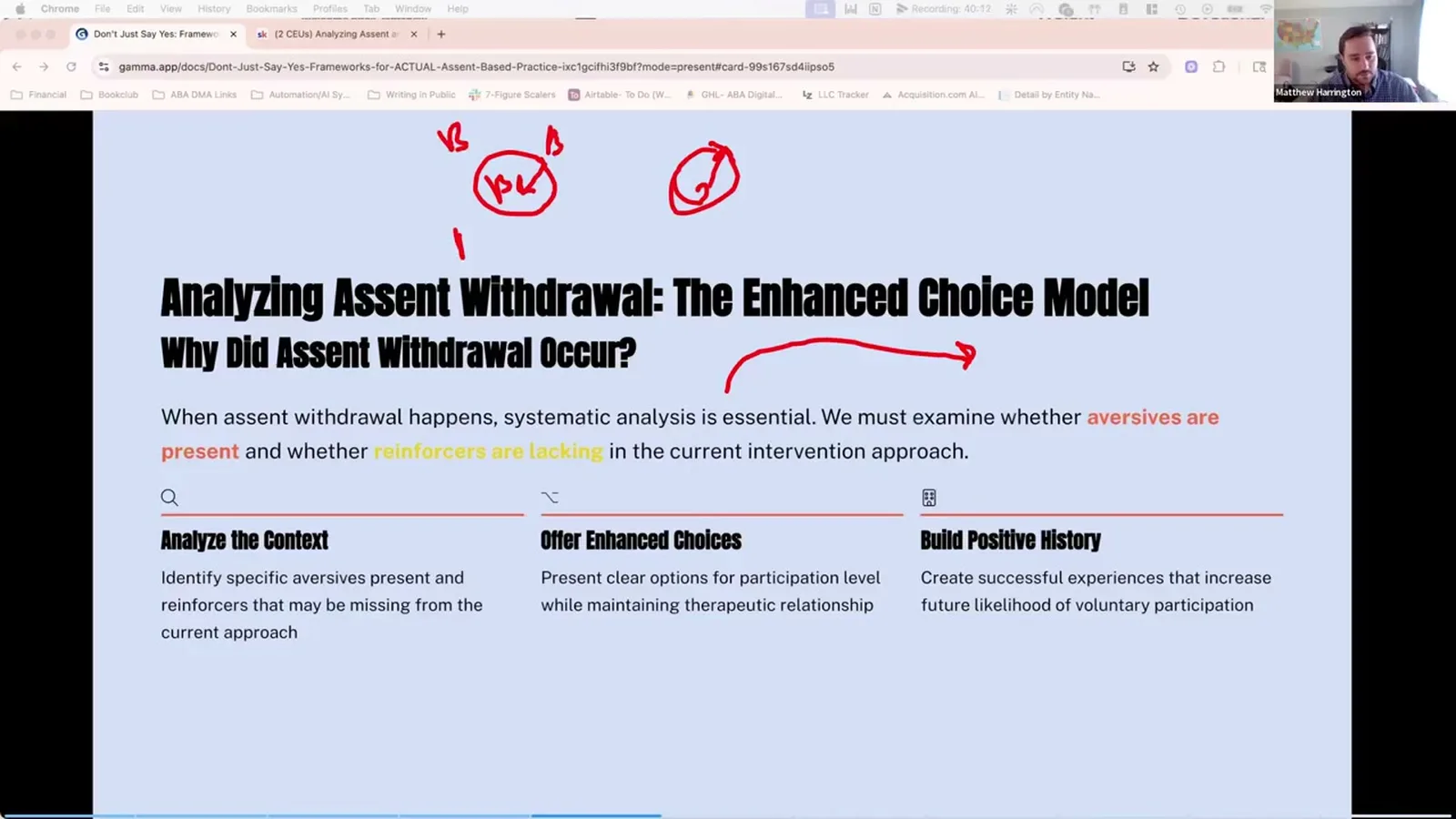
This practical session moves beyond “assent withdrawn → back off” and into what to do next. Attendees learn a simple decision process for responding to assent withdrawal: quickly analyze what’s worth moving away from vs. toward, modify the environment, and re-present with altered conditions. Using an intuitive “shrink the bad / grow the good” framework (a matching-law lens), the talk shows how to rebalance contingencies by (a) reducing aversives (duration, difficulty, sensory load, task formatting) and (b) increasing appetitives (embedded preferences, interest alignment, values linkage, richer schedules). The session integrates skill acquisition—toleration, communication, and cooperation repertoires—to make tough contexts easier, and uses response-class thinking to shape severe withdrawal into safer, earlier precursors. Concrete guardrails (e.g., “3 withdrawals → call the BCBA,” faster pivots when risk is high), enhanced-choice arrangements, and school/caregiver buy-in tactics (show-then-tell) round out a fully operational, dataable approach to assent-based care.
Register free & watch nowCancel any time. Cert delivered to your inbox the moment you pass the quiz.
About this CEU
This practical session moves beyond “assent withdrawn → back off” and into what to do next. Attendees learn a simple decision process for responding to assent withdrawal: quickly analyze what’s worth moving away from vs. toward, modify the environment, and re-present with altered conditions. Using an intuitive “shrink the bad / grow the good” framework (a matching-law lens), the talk shows how to rebalance contingencies by (a) reducing aversives (duration, difficulty, sensory load, task formatting) and (b) increasing appetitives (embedded preferences, interest alignment, values linkage, richer schedules). The session integrates skill acquisition—toleration, communication, and cooperation repertoires—to make tough contexts easier, and uses response-class thinking to shape severe withdrawal into safer, earlier precursors. Concrete guardrails (e.g., “3 withdrawals → call the BCBA,” faster pivots when risk is high), enhanced-choice arrangements, and school/caregiver buy-in tactics (show-then-tell) round out a fully operational, dataable approach to assent-based care.
What you'll learn
- 1Learning Objectives
- 2By the end of this CEU, participants will be able to:
- 3Differentiate assent (ongoing, dynamic agreement) from consent (one-time, informed authorization) and list at least three observable indicators of assent withdrawal beyond overt escape.
- 4Apply a stepwise response to assent withdrawal: pause and ensure safety, analyze antecedents and reinforcers, modify the arrangement, and re-present—rather than repeating unchanged trials.
- 5Use the “shrink the bad / grow the good” heuristic to rebalance contingencies, naming ≥3 ways to reduce aversives (e.g., shorten duration, simplify steps, sensory accommodations) and ≥3 ways to increase appetitives (e.g., embed interests, values linkage, denser reinforcement).
- 6Set and communicate clear change criteria (e.g., after 2–3 withdrawals or any high-risk precursor, pivot plans; escalate sooner when severity risk is higher) so BCBAs/RBTs act consistently.
- 7Design toleration and cooperation shaping plans (define step size, success criteria, progression rate) that build durable assent rather than relying on accidental exposure.
- 8Implement response-class strategies to shape from severe behavior to safer assent-withdrawal precursors and to discriminate precursors from crisis behaviors.
- 9Arrange enhanced-choice contexts that equalize available reinforcement for “participate” vs. “hang out,” biasing allocation toward learning without coercion.
- 10Plan caregiver/school team buy-in using show-then-tell demonstrations, values-aligned outcomes, and simple written protocols that specify who changes what, when, and how.
- 11Document and evaluate assent-based care by tracking assent provision/withdrawal rates, treatment fidelity, and progress toward quality-of-life goals—not just behavior reduction.
Concepts in this CEU
More from The Behaviorist Bookclub
Foundations of Reflective Supervision in Behavior Analysis
The Behaviorist Bookclub
Teaching WH-Questions Isn’t Enough: Building True Conditional Discrimination
The Behaviorist Bookclub
Reframing Behavior through an ADHD Lens
The Behaviorist Bookclub
OpenCEU is supported by advertising from third-party sponsors. Sponsors are clearly labeled, have no influence over course content, instructors, or CEU decisions, and never appear on certificates. The BACB does not sponsor, approve, or endorse OpenCEU sponsors or their products.