PDA: Collaborating for Success
Presented by B. Kuereine Gray
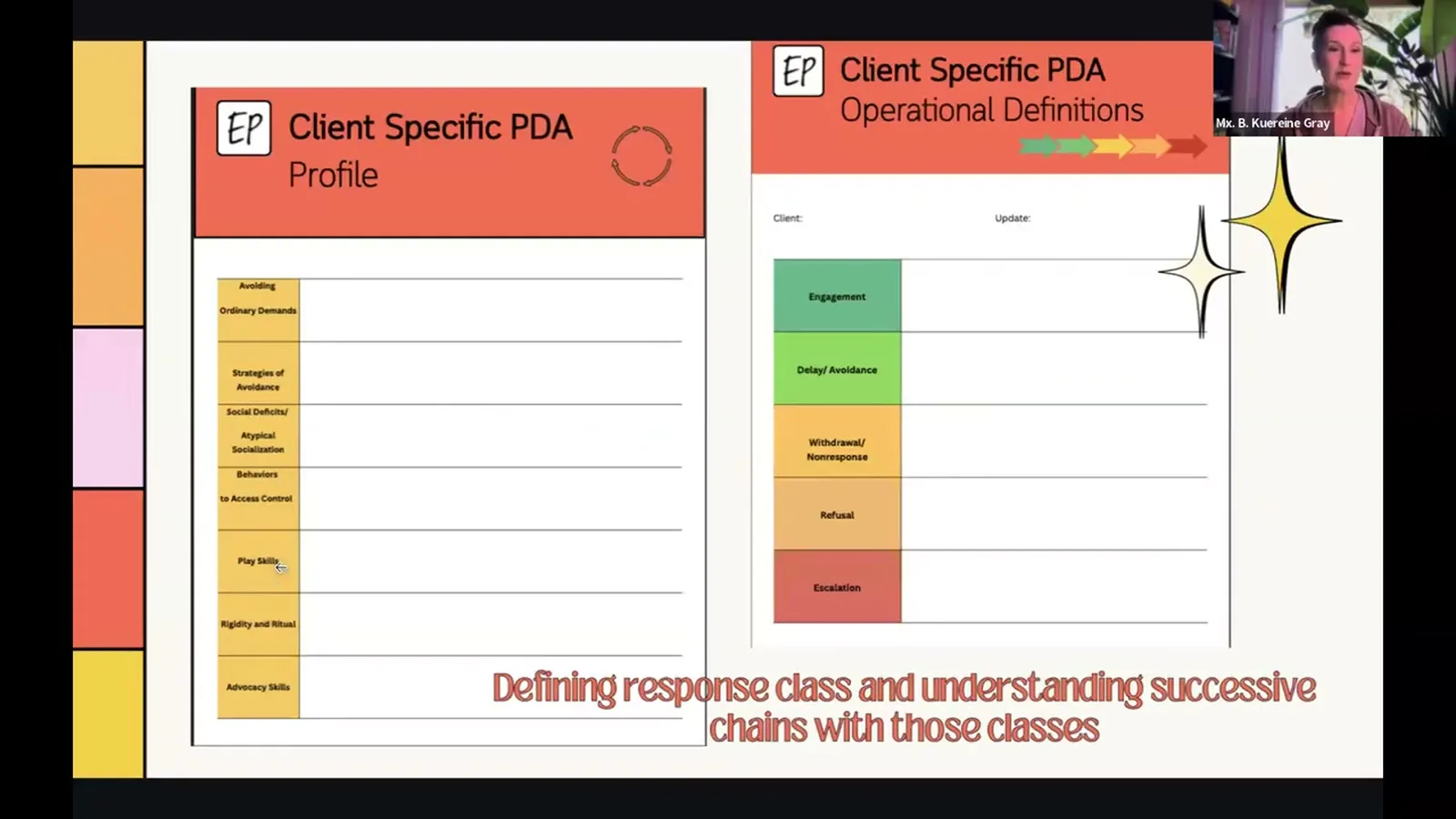
What You’ll Learn & How It Applies to Your Practice This presentation explores Pathological Demand Avoidance (PDA) as a behavioral response pattern and highlights collaborative, evidence-based strategies to support learners with a PDA profile. Participants will review key characteristics of PDA, reflect on personal bias, and identify proactive interventions that increase positive outcomes. The session emphasizes competence, collaboration, and practical application in educational and behavioral settings.
Register free & watch nowCancel any time. Cert delivered to your inbox the moment you pass the quiz.
Learner ratings
from 31 learners
100% would recommend this CEU to other professionals in their field (11 responses)
“Love learning more about PDA, especially across the different levels of learners”
— Emma H.“This was fantastic, I loved the PANDA visual”
— Anna B.“Was very good! It’s been a little bit since I did her part one so she may have mentioned it then, but I do think it’s important to go over the brain states and what’s happening (survival mode) & discuss tolerance/threshold (cup metaphor being very helpful) and what happens when someone is in a constant state of burnout (cup constantly overflowing past threshold). I think it would have been useful to give more emphasis to how a lot of people with autism that have this are often high masking (and how that affects them both in an academic setting, public setting, or during a brief assessment). ”
— Casey R.“This presentation was so informative. I will go straight to next one”
— Dharana S.“I am over the moon that this CEU was available. So clearly stated and the supports provided and someone who already works with multiple kiddos with a PDA presentation I want to learn MORE, and be better and this was more than helpful, it was encouraging”
— Bohdanna K.“Thank you!”
— Lee D.
About this CEU
What You’ll Learn & How It Applies to Your Practice This presentation explores Pathological Demand Avoidance (PDA) as a behavioral response pattern and highlights collaborative, evidence-based strategies to support learners with a PDA profile. Participants will review key characteristics of PDA, reflect on personal bias, and identify proactive interventions that increase positive outcomes. The session emphasizes competence, collaboration, and practical application in educational and behavioral settings.
What you'll learn
- 1Learning Objectives
- 21.06 Maintaining Competence
- 3Review of PDA presentation as a response class
- 42.14 Selecting, designing and implementing behavior change procedures
- 5Will identify evidence based behavioral interventions and explicit changes to increase probability of successful outcomes for learners with PDA profile
- 61.10 Personal Bias and Challenge
- 7Will demonstrate reflective practice with regard to personal bias or challenge when encountering PDA behavior response and generate collaborative and proactive support interventions for self, colleagues and stakeholders
Concepts in this CEU
More from The Behaviorist Bookclub

Empowering Autonomy and Self-Management in ADHD Learners
The Behaviorist Bookclub
Shaping Behavior Change when ADHD is in the Picture
The Behaviorist Bookclub
From Hours to Competence: Assessing and Developing Supervisee Skills
The Behaviorist Bookclub
OpenCEU is supported by advertising from third-party sponsors. Sponsors are clearly labeled, have no influence over course content, instructors, or CEU decisions, and never appear on certificates. The BACB does not sponsor, approve, or endorse OpenCEU sponsors or their products.