The PANDA Approach: Five Strategies for Supporting a PDA Profile
Pick battles, anxiety management, negotiation, disguised demands, adaptation. The PANDA framework for PDA support, from a BCBA-led CEU.
Key takeaway
PANDA stands for Pick your battles, Anxiety management, Negotiation and collaboration, Disguised and managed demands, and Adaptation. It is a five-part plan from the U.S.
PDA: Collaborating for Success
On this page · 8 sections▾
PANDA stands for Pick your battles, Anxiety management, Negotiation and collaboration, Disguised and managed demands, and Adaptation. It is a five-part plan from the U.S. and U.K. PDA associations. The goal is to shape demands so a learner with a PDA profile can act on them. PANDA assumes the learner has the skill. They just can't show it when their threat system is hot. This page is the how-to. You will see what each letter looks like in a session, the speaker's real cases, and how to write it into a BSP (behavior support plan, the written plan the funder will say yes to).
Before You Use PANDA: The Two Preconditions Most Clinicians Skip#
PANDA does not work on a body that is already in fight or flight. Before the five letters can help, two things must be in place. Basic body needs must be met. The learner must also feel safe. Skip either one and PANDA just feels like more demands.
Body needs are what most clinicians miss. They don't look like behavior. The speaker shared a case that makes the point stick. An 18-year-old avoided the toilet so strongly his family could predict full escalation by tracking when he needed a bowel movement.
I worked with an 18 year old and avoidance of toileting was so severe that the family knew when they needed to have a bowel movement, that they were going to get to full escalation… it was not his choice to go. And because he didn't have control over that bodily function, it would result in escalation. And they started being able to see the full escalation cycle, with caregiver training on that escalation cycle. It allowed them to be much more supportive.From the talk — B. Kuereine Gray
The fix was not a new reward plan. Caregivers learned to step back. They stopped piling on kind prompts like "go to the bathroom, man, it'll be fine." His body was already refusing. They gave the moment space.
Safety needs sit right behind body needs. The learner needs trust with the clinician. The team needs steady handoffs. Back-end staff need training, so people in the room can stay calm too. Once both are stable, PANDA has a place to land.
P: Pick Your Battles: What's Actually Non-Negotiable Today?#
"Pick your battles" sounds like a parenting cliché until you spell out exactly what to do. The question is not "what would be nice to get compliance on." The question is, "what does this demand cost today, and does it matter for safety, health, or the law?"
The speaker's home examples set the right level:
It does not matter what clothes we leave the house with. If they are blue pants or red pants, because they are pants and it's winter and it's cold where they live. It does not matter if they decide that they want to do math homework first or, uh, the dishes first because their parent has asked for both of them to be done.From the talk — B. Kuereine Gray
The non-negotiable is "pants, because cold." The color is noise. The non-negotiable is "both tasks done before bed." The order is noise. When you let the noise drop, both nervous systems calm down. You also stop adding new "I lost a fight over pants" memories.
Before a session, write down the two or three real non-negotiables for that block. Everything else is up for compromise or quiet removal. If your list has more than three items for a 90-minute session with a PDA learner, you are about to lose the day.
A: Anxiety Management: Why "We've Only Got Five Minutes" Backfires#
In PANDA, anxiety management is closer to ABA's low-arousal antecedent strategy (a calm-the-room approach). It is not a coping skill you teach in the moment. The learner is not going to count to four when their threat system is firing. Your job is to keep the room from getting hot in the first place.
The speaker's counterexample is sharp:
Things like, well, you know, we've only got five minutes to go. That is really counterproductive. Because it makes that situation hot. It makes it spicy. And so it makes the probability of even very easy skills being demonstrated… it is not about the skills, not being part of baseline competencies. It is, we have skills that are baseline competencies, but we are inconsistently able to demonstrate them because of the difficulty with regulation.From the talk — B. Kuereine Gray
The "spicy" word is doing real work. A countdown adds time pressure. Loud cheerleading like "buddy, I know you can do this, let's put your shoes on" reads as a hotter demand, not a warmer one. A stern tone you think is neutral does the same. So does standing too close.
What lowers the heat: a quieter voice. Slower speech. More space. No countdowns. Look totally unbothered by a delay. If the learner sees you stay calm about the gap, they learn the demand is not a threat. That is where real regulation work starts.
N: Negotiation: Offering Two, Letting Them Sequence#
The PANDA materials list "negotiation" and "collaboration" as two ideas. In the talk, she folds them together. The move is the same. You hand the learner control over the order. You do not hand them control over whether the task happens.
I have another individual that I work with that we can only talk about the next couple of things. And it's more of a, these are the next two things that we're going to do, but I want you to choose which is going to come first. And that gives them some certainty with flexibility, but it also gives them agency and control.From the talk — B. Kuereine Gray
Two things. Learner picks the order. That is the whole move. It is forced-choice (two options, both okay) with the choices set as order, not as opt-out. Both tasks are happening. The learner picks which comes first. The speaker called this "certainty with flexibility."
The pattern scales. For a learner who needs the whole day mapped, you give them the day. They sequence inside blocks. For a learner who would shut down at eight steps, you give them the next two. The size changes per person. The move stays the same. They control the order, not whether it happens.
Do not stretch this into "let's negotiate whether we do it at all." Once that is on the table, you have offered a different choice than you meant to. You also build a history where the demand itself was up for debate. PANDA is not opt-out.
D: Disguised and Managed Demands: When the Wording Is the Intervention#
A disguised demand (asking without it sounding like a command) is the same target behavior, wrapped so the demand-detector doesn't catch it. "Put your shoes on" is a demand. "I'm grabbing my keys, race you to the door" is the same target behavior wrapped in play. "Sit at the table" is a demand. "I need a second set of eyes on this, come help me figure out where the apostrophe goes" puts the same body in the same chair. Now it sounds like you need their help.
PANDA uses the word "managed" next to "disguised" because not every demand can or should be hidden. Some demands are direct and non-negotiable. We named those in the precondition section. "Managed" means you control the size, the wording, the timing, and the order. One demand at a time. Direct demands spaced out by stretches of no demand. New demands held until the learner is calm and engaged. Do not slip a new demand in during a slow drift toward refusal.
The speaker's earlier point fits here. Social-communication differences do not mean the learner can't read your patterns. Disguised demands fail when they sound like a script. The wording has to sound like something you would say to a coworker. Curious. Sideways. Not "behavior-analyst voice." If you can hear yourself doing the therapist voice, the learner can too, and the disguise is gone.
A: Adaptation: Knowing When to Step Back and Try Again#
Most clinicians skip adaptation because it feels like losing. It is not. A bad ending becomes part of the learning history. The person, the room, the activity, and the item all pick up a fresh bad link. That is a cost you do not want to pay.
The 11-year-old at the art exhibit is the clean case. The learner wanted to be there. He rehearsed his exit plan. He still got overwhelmed by crowd noise. The caregiver's first move was the standard script: "you're upset, it's okay, use your code word, we can leave." The learner refused. He did not refuse the calm. He refused the exit. The overwhelm was not a choice. The wish to stay was real.
What worked was sideways problem-solving. The caregiver pulled out headphones with low music. They took a few minutes to settle. The learner saw the art. Then he cued the exit himself. Same goal (a safe outing). Different path (sensory help, then learner-led exit).
In a session, adaptation looks like this. Hold the goal. Swap the path. Two minutes of independent work instead of ten, with a plan to come back. A worksheet done out loud instead of in writing. A transition that lands in the next room instead of the planned one. Co-regulation (you helping them stay calm) instead of self-regulation. For many young learners, and learners with a PDA profile, self-regulation is not yet ready. Asking for it is asking for the thing they can't do.
If you are not seeing a positive trend across sessions in a week, the plan is not working yet. Pushing harder just builds the bad link. Adapt the path. Keep the goal.
Putting PANDA in a Behavior Support Plan Without Losing Funder Approval#
Funders want plans that are clear, measurable, and made for one person. PANDA, written loosely, reads like a feelings document. Written with care, it reads like a standard antecedent-strategy plan with a calm-the-room layer on top.
Translate each letter into BSP language:
- Pick your battles becomes a set list of non-negotiable demands per setting. Everything else gets marked as flexible. Funders read this as antecedent priority.
- Anxiety management becomes a list of low-arousal moves: pacing, tone, distance, no time pressure, and phrases to avoid (like countdowns during early warning signs).
- Negotiation becomes a forced-choice plan with clear wording ("two next-task options offered, learner picks the order").
- Disguised and managed demands becomes wording rules and clear rules for how many requests in a row are allowed (one direct demand per X minutes, spacing written down).
- Adaptation becomes a written order of changes (the order you change things). Path changes first. The goal stays. Pair it with co-regulation steps tied to set points in the escalation cycle.
Track movement from precursor to escalation, not just the big behavior at the end. PANDA does its work before the full meltdown. Your data has to be fine enough to show that.
Frequently asked questions#
Where does the PANDA approach come from. is it evidence-based? PANDA lives on the U.S. and U.K. PDA association sites. It draws from clinical work with PDA-profile learners. It is not an RCT-validated protocol. The strongest peer-reviewed work is Carlazi (2025), the first U.S. peer-reviewed PDA article. It looked at caregiver-led intervention and social validity, not PANDA itself. Treat PANDA like any antecedent-strategy pack built from clinical pattern recognition. Each part (low-arousal antecedents, forced-choice, demand fading, co-regulation) has its own evidence base in the wider ABA literature. The full bundle is still being tested.
How do I run PANDA strategies in a school setting where teachers control the demands? You do not run PANDA. You train the team running it. The best places to push are staff coaching on the escalation cycle, written rules for how many requests in a row in the IEP (a student's school plan) or BIP (behavior intervention plan), and a small set of agreed phrases that replace common hot phrases (countdowns, loud cheerleading mid-meltdown, stern-neutral tone). Pick one or two letters at a time. Anxiety management and negotiation are usually first. Spell out exactly what to do, so a paraprofessional (a classroom aide who supports the student) can run it without guessing.
Does PANDA replace traditional ABA programming or layer on top of it? It layers on top. PANDA is an antecedent and consequence-framing pack for a specific group of responses. It does not replace skill teaching, FCT (functional communication training, where you teach a kid to ask for what they need), or the rest of the program. The change is in how demands get delivered and how the team responds to early warning signs, not in what skills get taught. A learner with a PDA profile still needs an FCT plan, leisure skills, and self-advocacy work. PANDA is what makes the demands inside those programs land.
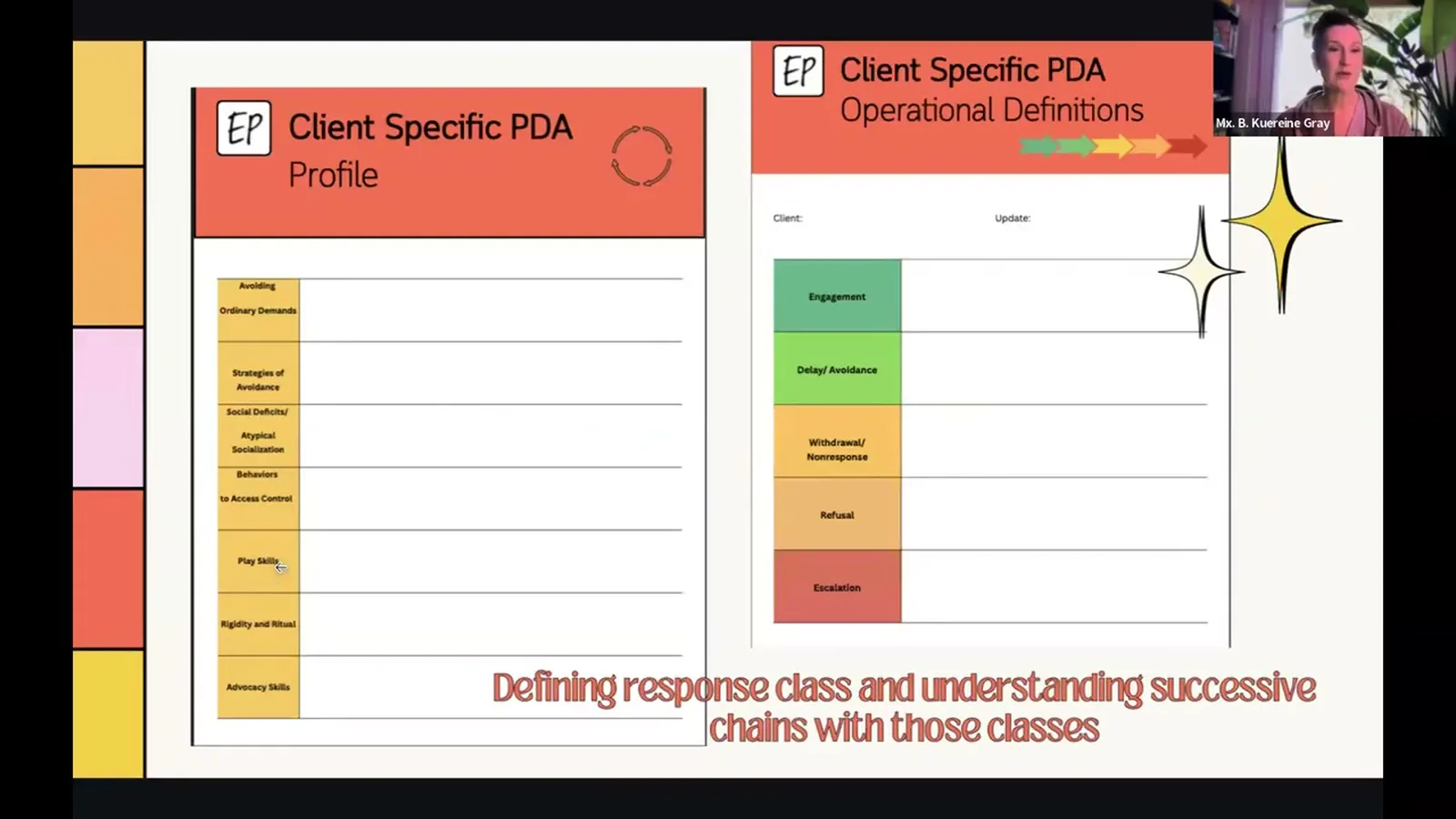
Watch the full talk →. The recording walks through the response-class planning forms B. Kuereine Gray uses to spell out each letter. It also covers the 8-year-old's delayed-echolalia case, plus the caregiver-training piece you pair with PANDA at home.
Turn this topic into a CEU
You just studied this. Now get credit for it.
Watch PDA: Collaborating for Success with B. Kuereine Gray and earn 1 free BCBA CEU. Detailed certificate, delivered the moment you finish.