Is PDA a Form of Autism? What the Current Research Actually Says
PDA's relationship to autism, ADHD, and other diagnoses. what the 2025 research shows and what's still unsettled, from a BCBA-led CEU.
Key takeaway
No. PDA is not a form of autism right now. It has no ICD code. It has no DSM-5 entry. It is not being added to the next DSM.
PDA: Collaborating for Success
On this page · 7 sections▾
No. PDA is not a form of autism right now. It has no ICD code. It has no DSM-5 entry. It is not being added to the next DSM. So the honest answer to most clinical questions starts with "the research isn't there yet." People mix up PDA with autism for a real reason. Most PDA studies have used autistic kids. So the pattern got mapped onto the group we were already studying. This page walks through what the research really shows. It covers where the autism overlap likely lives. It also covers what adult PDA self-advocates have been saying for years.
The Short Answer: PDA Is Not Currently a Form of Autism. Here's What It Is#
Where PDA fits is still unsettled. But it is not vague. PDA is not in the DSM-5. It has no ICD code of its own. It is not on the list for the next DSM update. Some clinicians call it a kind of autism. Others call it a profile. Others call it a presentation. None of those words are wrong in everyday talk. But none of them are formal diagnostic labels either.
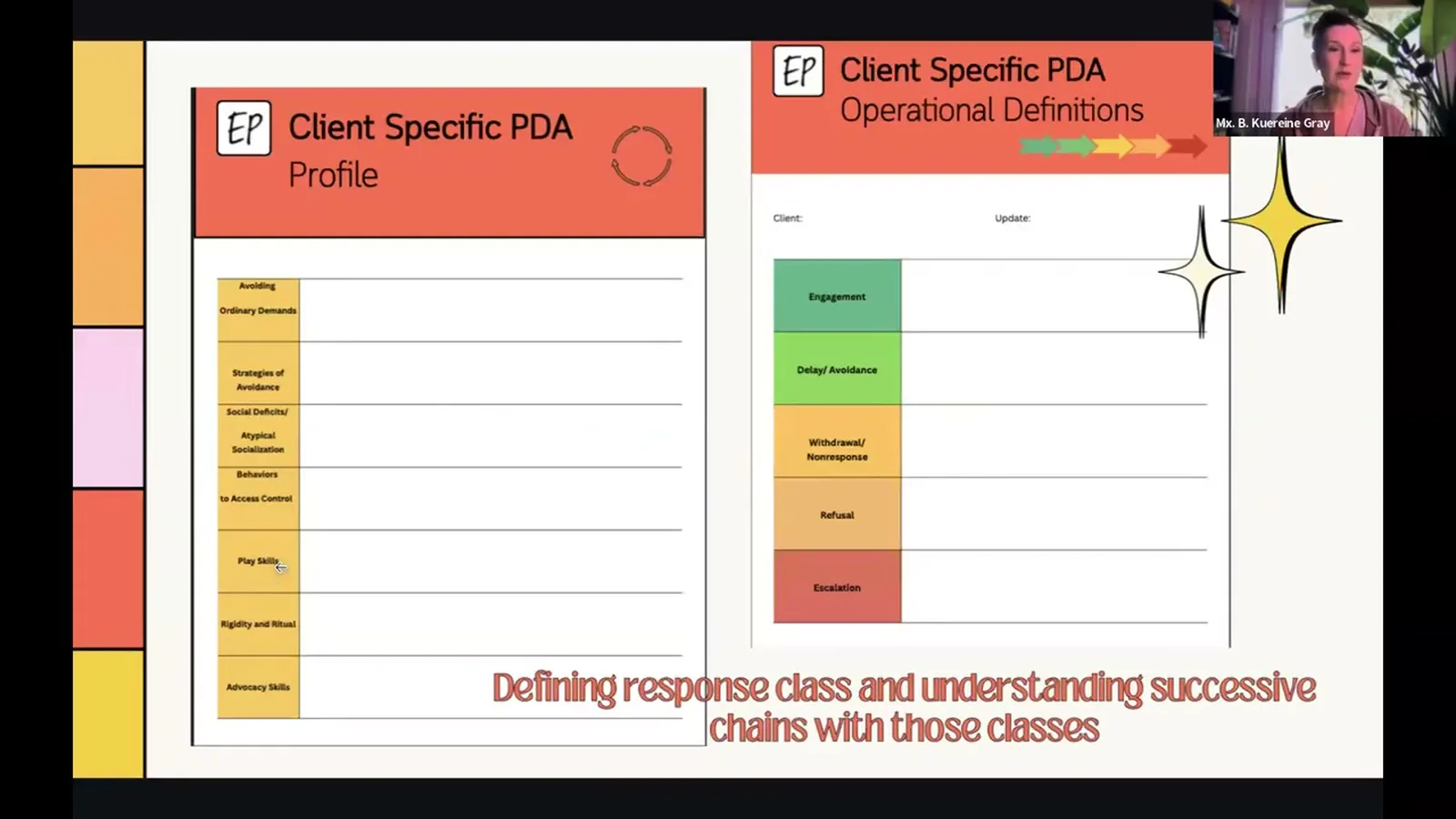
For BCBAs (board certified behavior analysts), the most useful frame is the one B. Kuereine Gray uses in the talk. PDA is a response class. That means it is a cluster of behaviors that share one job. That is a solid clinical idea. It lets you build assessment and treatment plans now. You do not have to wait on a diagnosis system that may take ten years to catch up.
Because of the lack of peer-reviewed research, because of the lack of specificity in defining how it presents for people, that has prevented PDA from becoming its own recognized diagnostic category. So some people are like, oh, it's a subtype of autism. Or, oh, it's a profile. And for our purposes in behavior analysis, it is a response class. From the talk — B. Kuereine Gray
That framing matters. It sets the bar for what you can and cannot say. You can describe the response class. You can plan for it. You should not tell a parent their child "has PDA" the way you would say a child has autism. Those two statements carry very different weights of proof.
Why PDA Got Tied to Autism in the First Place#
The mix-up is not random. It comes from where the research has happened. PDA was first named in the 1980s. The studies after that mostly used autistic kids. That is because clinicians were already looking at that group. When you only look at one group, every pattern you find looks like part of that group.
I really think that we associate it with autism because we have a huge research base across multiple fields that have populations of individuals with autism. And we start noticing these patterns. And we're like, oh, PDA goes with this. When we first started noticing it, it was because we were already looking at one population of individuals. From the talk — B. Kuereine Gray
This is worth holding onto when you read older PDA papers. Early write-ups described "precociously vocal" kids. They had big vocabularies and high IQs. That picture is being walked back. The Kildall 2021 review found no link between IQ and PDA. PDA shows up across the full IQ range. It also shows up in kids with big communication differences. The early picture was narrow because the early sampling was narrow.
If you use a checklist that filters for verbal, high-IQ kids, you are probably missing PDA in the rest of your caseload.
What the 2025 Sensory Sensitivity Study Suggests About the Overlap#
This is the newest paper Gray mentions. It is worth reading slowly. In March 2025, a peer-reviewed paper came out. (Peer-reviewed means other scientists checked it before publishing.) Gray believes it ran in the journal Autism Research. She is not sure about the exact title, and you should be careful too. The study looked at sensory sensitivity (how strong sights, sounds, and touches feel) in three groups. Group one was autistic kids with PDA. Group two was kids with PDA who were not autistic. Group three was neurotypical kids. The study found clear differences between the groups.
The point is not that PDA is autism. It is the opposite. The study could separate "autistic with PDA" from "PDA without autism" in real measurable ways. That tells you PDA has its own signal. The tie to autism is probably best called high co-occurrence (having two things at once). It is not a subset.
There are some distinct differentiations between them, which points to this may end up being... we may be at the emergence of this window where we're learning a lot. And this may end up being another comorbidity where we see a high comorbidity. But it is not actually a subtype of autism. From the talk — B. Kuereine Gray
Two warnings. First, one paper is one paper. The honest read is, "this is a hint and the field is moving." It is not, "this is settled." Second, sensory sensitivity is just one piece. The groups split on sensory measures. That is real. But it is not the whole picture. Treat the 2025 study as a sign the autism-only frame is loosening. Do not treat it as proof of a clean split.
Where PDA, ADHD, and Other Co-occurring Conditions Show Up#
If PDA is not a kind of autism, what does the co-occurrence map look like? The research is thin. Gray is honest about that. The Kildall 2021 review pulled several studies showing PDA in kids with ADHD. One study showed ADHD plus epilepsy in a PDA sample. There is no clear pattern with specific mental health diagnoses yet. The field has not screened enough non-autistic PDA samples to know what shows up together.
In practice, this matters. Say you are assessing a kid with anxiety, OCD features, ADHD, or strong demand avoidance. They have no autism diagnosis. Do not rule out a PDA response class just because they do not fit the old sampling profile. The data we have is biased toward who we have been studying. It is not a map of who really presents this way.
This is a place to stay curious, not certain. The honest stance is this. The response class is real. The co-occurrence map is incomplete. We will probably be revising this in five years.
How Adult Self-Advocates Are Pushing Back on the Autism-Only Frame#
The clinical research has been behind the lived-experience community on this. Adult PDA self-advocates have been saying for years that PDA is not the same as autism. A real chunk of that community does not see themselves as autistic at all. The PAST community in the UK is one visible place this shows up. Gray quotes a teen from PAST early in the talk.
That is the view that I see prevalent in the PDA community, the adult PDA community, because there are a lot of adults who identify as having PDA profile or PDA behaviors, but they do not consider themselves autistic or they have comorbidity with ADHD. From the talk — B. Kuereine Gray
This is not a side note. It is clinical data. The self-advocate community has inside information no rating scale can pick up. They have pointed at the autism-PDA gap longer than the peer-reviewed research has. Studies are only now getting the power to split these groups apart. The 2025 sensory study is an early sign of that. When the data catches up, it is likely to back up what self-advocates have said.
For practice, the takeaway is simple. When an adult client tells you they identify with PDA but not autism, that is not a mistake to correct. That is data.
What This Means for How You Assess and Plan Treatment#
A few practical positions fall out of all this. None of them tell you exactly what to do clinically. That is the job of the PANDA approach page. The escalation cycle page covers how to read the behavior live. This page is about how you frame the presentation in notes, team meetings, and talks with funders.
First, do not write "PDA" as a diagnosis. It is not one. Write what you are actually seeing. A response class with avoidance of ordinary demands, atypical socialization, control-seeking behaviors, and rigidity. All of it works to keep the person regulated and feeling safe. That description is solid. Funders can read it. "Diagnosed with PDA" is not solid.
Second, do not require an autism diagnosis to take the response class seriously. The old sampling does not support that bar. If a learner shows the pattern, build for the pattern.
Third, watch your language with caregivers. Many BCBAs now use "persistent drive for autonomy" as a parallel reframe. Same response class, different wording. It helps with families who would hear "pathological demand avoidance" as a verdict on their child. That is a separate choice from the diagnosis question on this page. But the two interact. When there is no formal diagnosis and the label itself is still emerging, your words carry extra weight.
Fourth, stay current. The research is moving. The 2025 sensory sensitivity work, the 2021 Kildall review, and the 2024 Carlazi paper on caregiver implementation are the recent anchors. More will come in the next two years. Plan to revisit your case write-ups as that base grows.
Frequently asked questions#
If PDA isn't in the DSM-5, can a child be formally diagnosed with it in the US?
Not on its own. There is no ICD-10 or DSM-5 code for PDA. So no US clinician can give it as a formal diagnosis. What you will see is PDA described in clinical notes as a profile or presentation. It sits next to another formal diagnosis. Most often that is autism. Sometimes it is ADHD or anxiety. Some assessment reports name PDA features without calling it a diagnosis. That is the current ceiling.
Does insurance cover services for PDA without a primary autism diagnosis?
Usually no. At least not through ABA-specific funding like CPT 97153. Those codes usually need an autism diagnosis. This is one big reason the lack of a formal label matters. With no ICD code, there is no clean billing path. Some families get services through anxiety, ADHD, or behavior-focused diagnoses. But coverage changes by payer and by state. It is often less generous than autism-linked coverage. If you are working with a non-autistic learner who shows PDA, expect a harder funding talk.
Is PDA seen in adults who were never identified as autistic as kids?
Yes. This group is a real and growing part of the self-advocate community. Many adults see the PDA profile in their own lifelong patterns. They notice demand avoidance, control-seeking, and shutdown driven by regulation needs. They never met autism criteria. They were never assessed for it. Some have ADHD diagnoses. Some have no diagnoses at all. They reached PDA through community talk, not clinical assessment. This group is mostly missing from the older PDA research. That is part of why the autism-only frame has held on so long.
Watch the full talk → PDA: Collaborating for Success. The recording goes deeper into how the response class shows up in session. You will see the eight-year-old quoting a sibling's YouTube video as atypical socialization. You will see the eighteen-year-old whose escalation cycle was set off by bowel-movement avoidance. You will see the eleven-year-old at the art exhibit whose caregiver figured out a sensory exit plan in real time. Where PDA fits is the foundation. The recording is where you see what the response class looks like on the ground.
Turn this topic into a CEU
You just studied this. Now get credit for it.
Watch PDA: Collaborating for Success with B. Kuereine Gray and earn 1 free BCBA CEU. Detailed certificate, delivered the moment you finish.