How to Build a Research-Based BIP for Severe Behavior in One Evening
Build a BIP for severe behavior backed by published research using a 15-minute-per-article triage, from a BCBA-led CEU.
Key takeaway
When you are rebuilding a behavior intervention plan for severe behavior, pull the assessment article first and the intervention article second, treat fidelity and function as the two things that broke the old plan, and let safety override speed every single time.
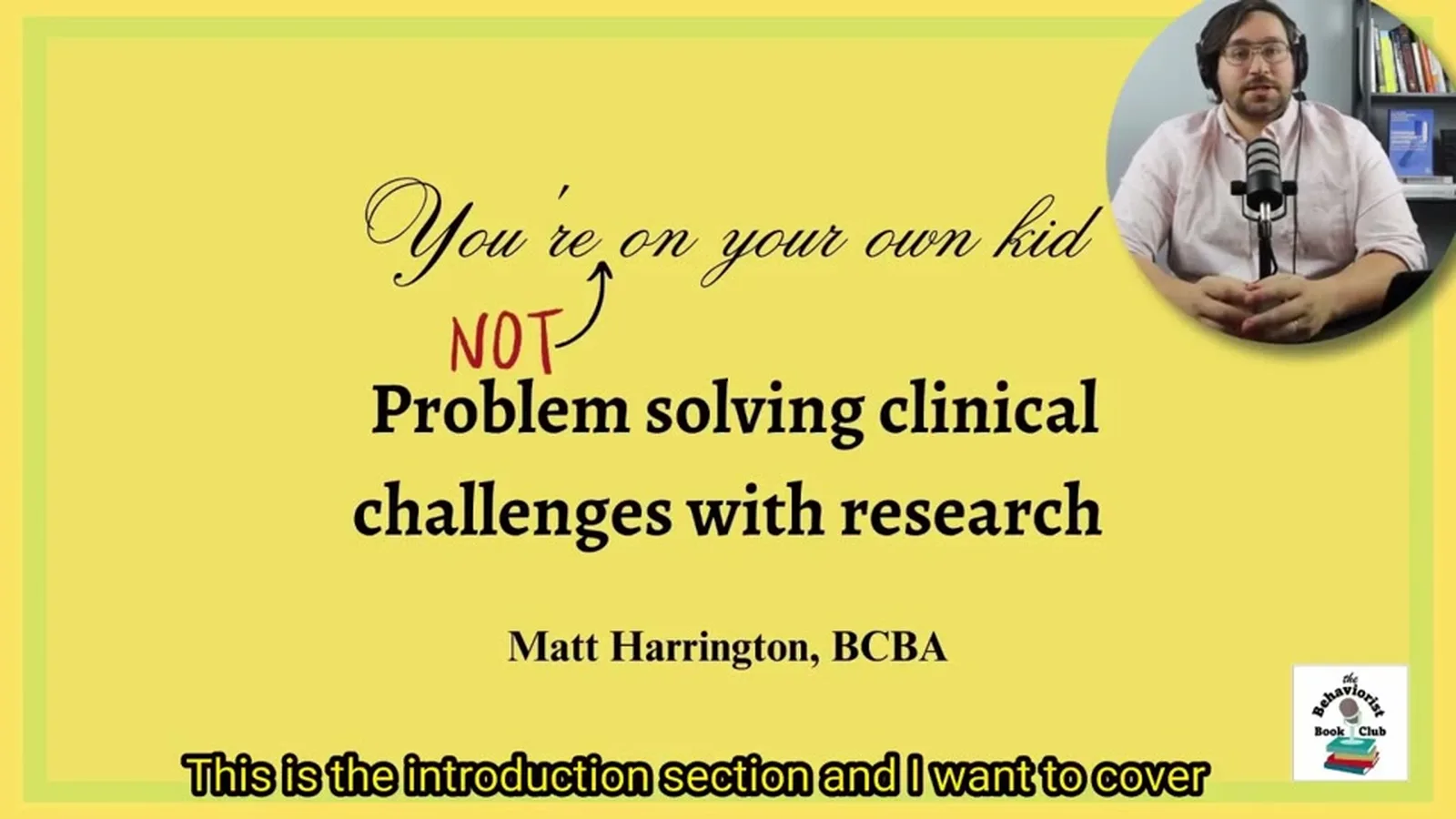
Solving Clinical Challenges with Research
Free learning path on this topic
Child Development for Behavior Analysts
Typical development for behavior analysts. Kristen Byra's overview, then Kelly Brzak's deep dives on ages 2 to 5, 6 to 8, and 9 to 11, with milestones, common problem behaviors, and programming tips for each band.
On this page · 9 sections▾
When you are rebuilding a behavior intervention plan for severe behavior, pull the assessment article first and the intervention article second, treat fidelity and function as the two things that broke the old plan, and let safety override speed every single time. A BIP is a behavior intervention plan, the written document that says how the team will respond to the kid's behavior. A BCBA is a board certified behavior analyst, the person on the case who writes that plan. This page walks the steps you can run in one evening with a laptop and a free journal account. It is built on a real case from the talk linked below.
What Counts as Severe Behavior for This Process#
Severe behavior is behavior that can hurt the kid, a peer, or a staff member if it goes one more round. The list most BCBAs use is aggression that lands, self-injury that breaks skin, property destruction that puts someone in the path of a thrown object, and elopement that puts the kid in traffic or near water. If the behavior has any of those, you are in this lane. The lane changes how you read research. You will read methods sections closer, you will not skim safety pieces, and you will pull at least two articles before you write a new plan. The reason is simple. A wrong call on a mild behavior costs you a session. A wrong call on a severe behavior puts someone in the ER.
Why Your Current Plan Probably Failed on One of Two Variables#
If a plan is escalating, the cause is almost always one of two things. Either the team is not running the plan with fidelity, which is doing it the same way every time, or the function is wrong, which is the reason the kid does the behavior. Walk in expecting both, and you will be right most days. A common case is a plan that says escape extinction. Escape extinction means you do not let the kid out of the task when they hit, scream, or drop. It only works if escape is what the kid is after. If the kid is hitting to get the teacher to come over, escape extinction does nothing. Worse, the team gets tired, fidelity slips, and the behavior gets bigger. That is the loop you have to break.
Either we don't have fidelity in what we're working with, or we have the wrong function. From the talk — Matthew Harrington
So step one before you open a journal is to ask which of the two it is. If you cannot tell, you need a fresh functional analysis. A functional analysis, or FA, is a short test where you set up the conditions that might be driving the behavior and watch which one makes it spike.
Pull the Assessment Article First, Intervention Article Second#
This is the rule most BCBAs miss. When you are rebuilding a severe-behavior BIP, you do not start at the intervention article. You start at the assessment article. Find a paper that ran an FA in a setting like yours, with a kid like yours, and pull the method. Only after you have a clean function from that FA do you go pull the intervention article. The reason is that the wrong function will send you to the wrong intervention every time. If the old plan died because the function was wrong, opening another intervention paper just gives you a fancier wrong answer.
The order also saves time. A good assessment paper tells you in the methods exactly how to run the test in your setting. You read the method, you copy the procedure with small edits, you run it Monday, and you have a clean function by Friday. Now your intervention search is narrow. You are not looking for any aggression paper. You are looking for one that matched the function the FA gave you.
How to Read a Methods Section Specifically for Safety#
When the behavior is severe, the methods section is the part you read first and read twice. You are not looking for the result yet. You are looking for the steps. The first question is whether the procedure can be run without anyone getting hurt. The second question is whether you have the staff and the room to run it that way. If the answer to either is no, that paper is not your paper today. Put it down and pull the next one.
Three things to scan for in any methods section for a severe case. One, what the staff did when the behavior happened. Two, how the trial ended. Three, how peers or other people in the room were kept clear. If the paper used a setup where one disruption ends the trial and adults are positioned between the kid and the peers, that is a paper you can run in a classroom. If the paper used a padded room and three trained staff, that is not a paper you can run in a four-hour-a-week school consult.
Worked Example: Rebuilding a School-Based BIP for Peer Aggression#
Here is the case the talk walks. A nine-year-old kid with Down syndrome, in a public school, four hours a week of BCBA consult, no behavior technician on the case. The current BIP says escape extinction. The behavior is going up, not down. Aggression toward peers is happening when tasks get put in front of the kid, when the teacher turns to talk to someone else, and when the favorite staff member is out that day. That is the case you sit down to fix on a Tuesday night.
School-based, four hours a week of consult, no technician. The client is diagnosed with Down syndrome and is nine years old. The current behavior intervention plan is escape extinction, and the behavior was escalating prior to you coming onto the case. From the talk — Matthew Harrington
Step one is the fidelity-or-function check. The antecedents in the case point in two directions. Tasks being put in front of the kid sounds like escape. The teacher turning away and the preferred staff being out sound like attention. Two functions in the same case is normal. The plan is built on one of them, and it is the wrong one for at least half the events. So you need a fresh FA.
Step two is the journal pull. Open the Journal of Applied Behavior Analysis search, type a Boolean string like "functional analysis" AND "school" AND "aggression," and sort by date. You are scanning the result list for three matches. The setting matches school. The conductor matches a teacher or a single consultant. The assessment type is short enough to run in your hours.
Brief practice, which means it's going to be a short, highly clinically relevant process. It's teacher conducted, which lines up with our demographic. It's a latency-based functional analysis, which is perfect. That's a brief functional analysis, and it looks like exactly what we need. From the talk — Matthew Harrington
A latency-based FA times how long it takes the behavior to happen once you set up the condition. It is short because you stop the trial the second the behavior shows. That fits a school day better than a long multi-element FA does.
Step three is the safety pass on the methods. In the paper that fits, the adult sits between the kid and the peer, the trial ends on the first disruption, and the attention condition runs by having the adult face away. That is a setup you can run in a real classroom without putting a peer in the path of a fist.
Step four is the rewrite. You take the procedure into your BIP as the assessment step. You write a one-page protocol the teacher can run with you in the room. You set a date to score it. You do not write the new intervention yet. You wait for the FA to tell you the function. Then you go pull the intervention article that matches.
When You Have to Stop Skimming and Read the Full Paper#
Most of the time, a 15-minute scan of the abstract, the participants, and the methods is enough to decide if a paper is your paper. Severe behavior is the place where that rule changes. If the behavior could hurt someone, you read the full paper before you copy any step. If the topic is one you do not know well, you read the full paper, period. Behavioral feeding is the example from the talk. Feeding has gag risk, choke risk, and aspiration risk that you cannot guess at from an abstract.
I don't want you to skim as a way to gain information about a topic that you're not very well versed in. A great example of this is behavioral feeding. If you aren't very well versed in behavioral feeding, there is a lot of safety things that come into play. From the talk — Matthew Harrington
The honest rule is this. Skim when you know the topic and the risk is low. Read all of it when the risk is high or the topic is new to you. Severe behavior is almost always one of those two.
What to Bring Back to the Treatment Team Tomorrow#
You do not bring a 20-page paper to the team meeting. You bring three things. One, a one-paragraph note on which of the two variables you think broke the old plan, fidelity or function. Two, the one-page assessment protocol you copied out of the paper, with the citation at the bottom. Three, a date for the FA and a name next to who is running each step. That is it. The team can read the rest later. What they need from you on Wednesday morning is a clear next step they can run on Thursday.
Write the new BIP only after the FA gives you a function. A plan written off a guess for severe behavior is the same plan you are trying to replace. The point of all this work is to make sure the next version is built on data and on a paper you can name.
Frequently asked questions#
What research should I cite in a BIP for severe aggression?
Cite at least one assessment paper and at least one intervention paper. The assessment paper should match your setting, your kid's age, and your staff ratio. The intervention paper should match the function your FA pulled out. If the FA said attention, cite an attention-based intervention paper. If the FA said escape, cite an escape paper. For severe aggression, also cite a safety or crisis-response paper if your plan uses any restraint or room-clear step. Three citations on a severe BIP is normal.
Can I write a BIP based on a single ABA research article?
Not for severe behavior. One paper rarely covers both the assessment and the intervention well enough to write a full plan. Pull the assessment article first, run the FA, then pull the intervention article that matches the function. Two papers is the floor for a severe case. If your plan uses any safety step like blocking, three is closer to right.
How do I pick an FA type for a school-based severe behavior case?
Pick the shortest FA you can run safely in your hours. A brief latency-based FA fits a school consult well because it ends fast, can be teacher conducted, and keeps peers clear. A long multi-element FA fits a clinic with trained staff. Match the FA to the room you actually have. If the paper used staff or space you do not have, find a different paper. Do not modify safety steps to make a procedure fit your setting.
Watch the full talk#
If this matched what you are seeing on a case at work, the full CEU walks the Research Finding Framework and the Key Places Framework. It is the system Matt uses to pick the right paper in 15 minutes per article. The talk is free and earns one general learning credit.
Watch the full CEU on solving clinical challenges with research
Turn this topic into a CEU
You just studied this. Now get credit for it.
Watch Solving Clinical Challenges with Research with Matthew Harrington and earn 2.5 free BCBA CEUs. Detailed certificate, delivered the moment you finish.
Keep going with a free learning path
Child Development for Behavior Analysts
Typical development for behavior analysts. Kristen Byra's overview, then Kelly Brzak's deep dives on ages 2 to 5, 6 to 8, and 9 to 11, with milestones, common problem behaviors, and programming tips for each band.