Perspective Taking in ABA: A Practical Guide
Perspective taking means picturing a situation from someone else's view. See how it shapes supervision, teaching, and care in behavior analysis.
Key takeaway
Perspective taking means picturing a situation from someone else's point of view. You try to guess what another person sees, thinks, or feels. In applied behavior analysis (ABA), practitioners use the science of learning to change behavior.
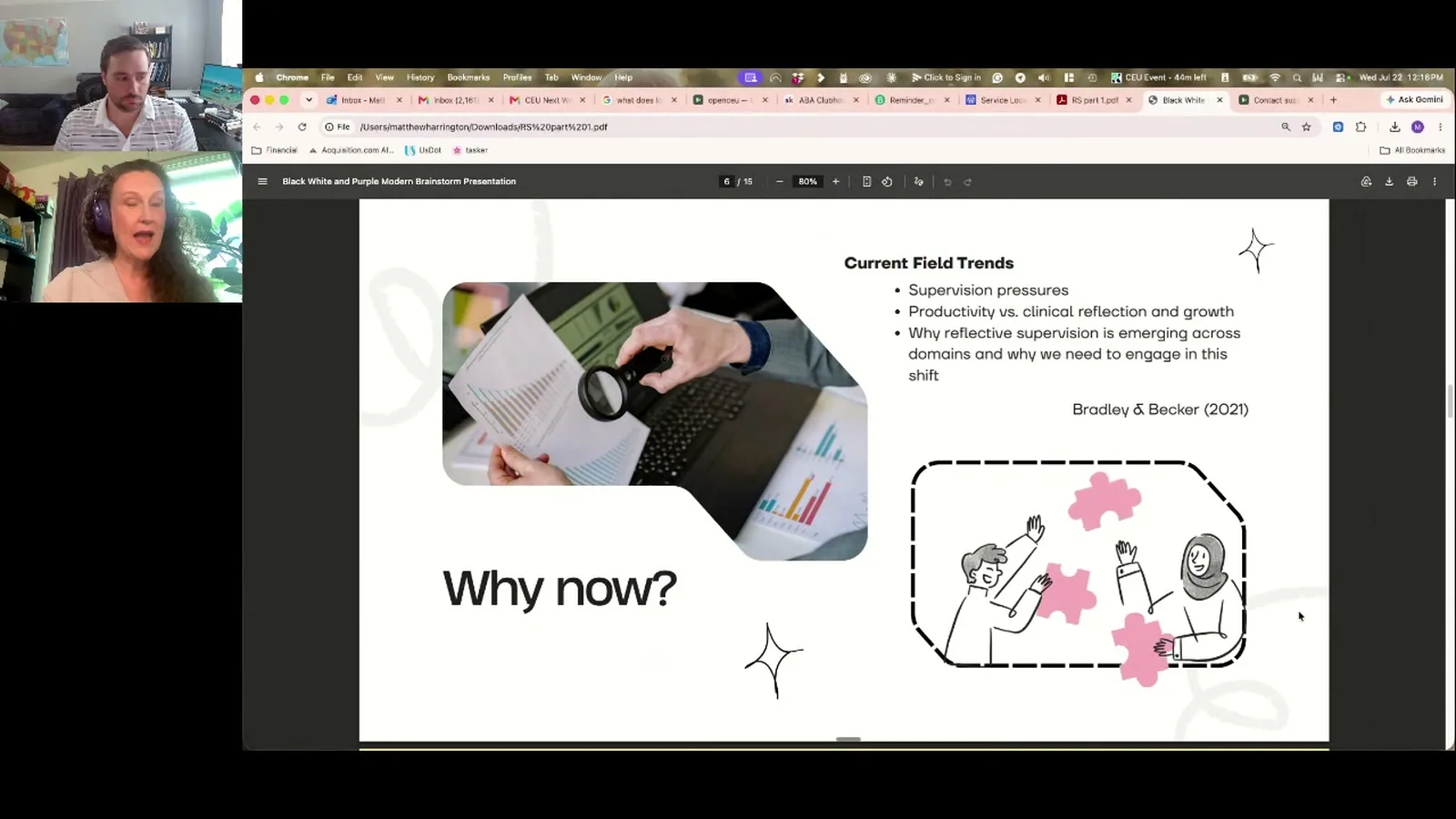
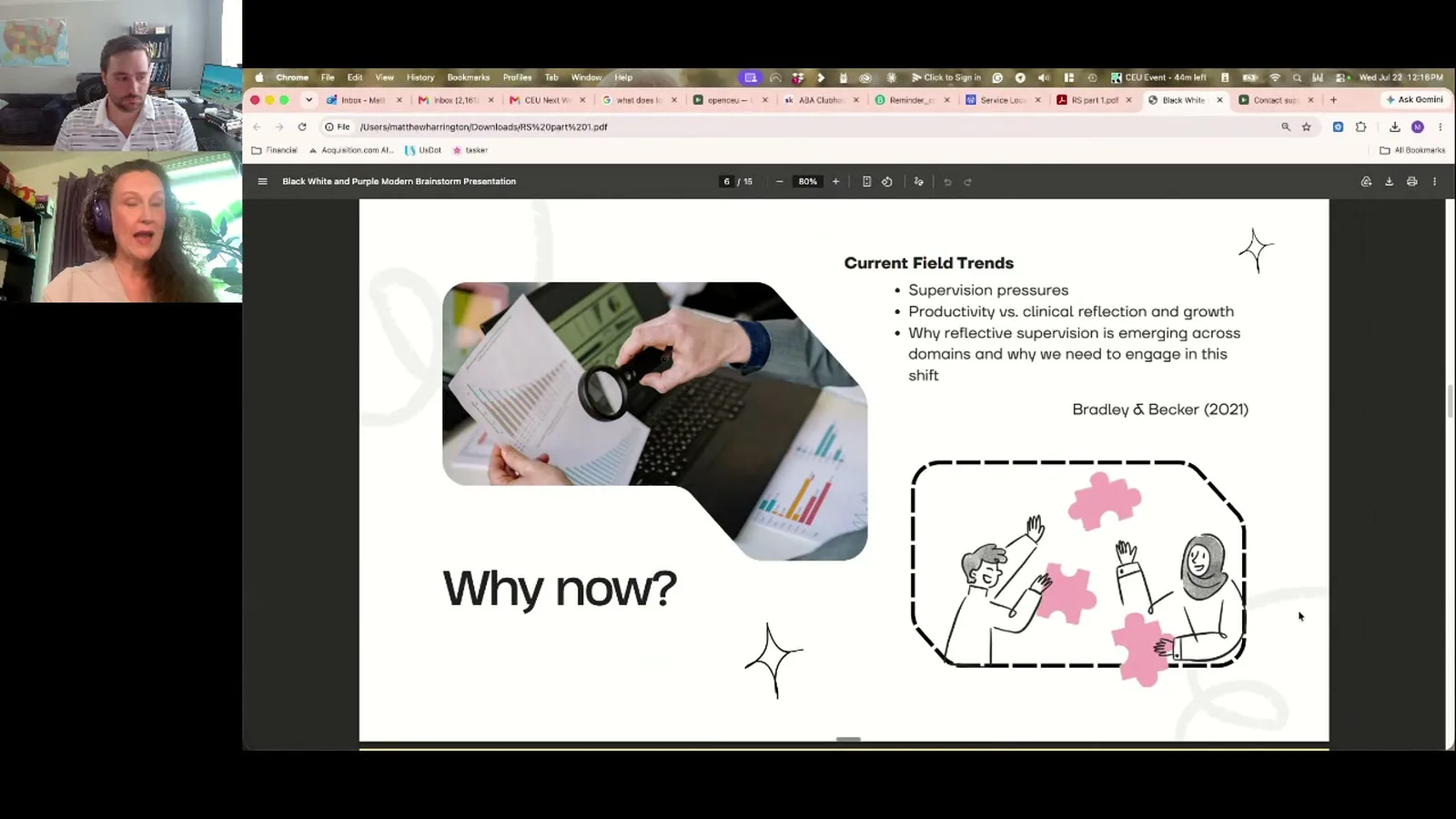
Foundations of Reflective Supervision in Behavior Analysis
Experts who cover this
The recording behind this guide covers perspective taking.
- Featured talk1 Supervision CEU
Foundations of Reflective Supervision in Behavior Analysis
B. Kuereine GrayThe Behaviorist Bookclub
Perspective taking is presented as a core element of reflective supervision, prompting supervisors to imagine a situation from the supervisee's, client's, or…
On this page · 8 sections▾
Perspective taking means picturing a situation from someone else's point of view. You try to guess what another person sees, thinks, or feels. In applied behavior analysis (ABA), practitioners use the science of learning to change behavior. In that work, perspective taking shows up with clients, with families, and with the people you supervise.
It matters because behavior never happens in a vacuum. A child, a parent, and a teacher can each read the same moment in a different way. When you slow down and take another view, you make better calls. You also build trust. This page pulls together what several experts and studies say about the skill.
What perspective taking really means#
At its core, perspective taking is about reading another person's inner world. You infer what they know, want, or believe. Nicky Schneider frames it in plain terms during a talk on school behavior work.
Perspective taking is really about the ability to infer other people's mental states, right? From the talk — Nicky Schneider
Researchers split this skill into layers. One layer is visual. Can you tell what someone else can see from where they stand? Another layer is mental. Can you guess what they believe, even when it differs from what you know? Both layers matter, but they are not the same thing. A person can be strong at one and weak at the other.
Perspective taking as a supervision tool#
Supervision is where this skill earns its keep. B. Kuereine Gray teaches reflective supervision, a coaching style where the supervisor pauses to think before advising. She uses perspective taking to unstick hard cases. When a case stalls, she asks the supervisor to step into the shoes of the supervisee, the client, or the caregiver.
That small shift opens up new options. You stop asking "why won't this work" and start asking "what does this look like from their side." Gray models the inner voice she wants supervisors to use. It starts with a simple, curious thought: I wonder what might be going through this person's head.
The point is curiosity, not certainty. You do not need the exact right answer about someone's thoughts. You need to stay open long enough to see more of the picture. That curiosity often reveals a barrier you missed. Perspective taking helps you troubleshoot the case instead of blaming the person.
Flipping the script: change your own behavior#
Here is a twist worth sitting with. Most ABA programs teach the client to take other people's perspectives. Schneider argues the field should flip that. Often the practitioner is the one who needs to shift first.
It's not about changing the student's behavior. We have to change our own behavior to change their behavior. And we have to take the perspective of the student into account in order to do that. From the talk — Nicky Schneider
This reframes the whole job. You watch a student and ask what the world feels like from their seat. Then you adjust your own words, pace, or demands. The student's behavior often changes as a result. It is a humbling idea. It puts the pressure on the adult to move first.
Is it a skill you can teach?#
 Advertisement
Practitioners often get asked to add perspective taking to a client's plan. So a fair question is: does teaching it actually help? The research gives a careful answer. You can teach the tasks that look like perspective taking. Students can learn to pass false belief tests, where they track what another person wrongly believes. They can learn deictic frames, which are the "I versus you" and "here versus there" relations that support this skill.
But passing those tasks does not always carry over to real life. The social wins show up when you teach the exact social skill you care about. If you want a child to comfort a sad friend, teach that. Do not assume a lab task will transfer on its own. This is a key lesson for anyone building a program.
Different brains, different routes#
Perspective taking looks different across groups, and that is worth knowing. Studies of people with autism spectrum disorder, a developmental difference affecting social and sensory processing, show mixed results on visual tasks. Neurotypical adults, meaning adults without autism, feel an automatic pull toward what another person can see. Some autistic adults do not show that pull. That does not mean they cannot take a perspective. It may mean they get there by a different route or strategy.
Down syndrome is a genetic condition that affects learning and development. Research shows people with Down syndrome can score close to matched peers on visual perspective tasks. Task design matters a lot here. A simple task and a complex task can give very different scores from the same person. So when you assess this skill, the tool you pick shapes what you see.
Why families need it too#
Perspective taking is not only for clinicians. Caregivers carry a heavy load, and this skill can ease it. When a parent can picture their autistic child's inner world without drowning in that child's distress, the parent tends to feel calmer. This is called cognitive empathy. You understand the feeling without being swamped by it.
That balance protects the caregiver and helps the child. A parent who reads a meltdown as sensory overload instead of defiance responds with more patience. Short, simple supports can build this view over time. One study tested brief awareness videos with 24 caregivers of autistic children. The caregivers watched for two to three minutes a day, for three days. Their distress dropped within a week and stayed lower for three weeks. Their cognitive empathy rose as well. Helping families take their child's perspective is real clinical work.
What the research says#
Several studies give this concept a solid base. They also warn against easy assumptions.
A 2018 review looked at how teaching perspective taking affects social skills in autistic learners. The underlying tasks, like false belief tests and deictic frames, can be taught. But those gains did not reliably carry over to real social skills. Direct teaching of the target social skill did improve them (Peters & Thompson, 2018, Behavior Analysis in Practice).
Another paper argues that perspective taking can be treated as a form of problem solving. In both, a person emits helpful behavior that sets up the right response, or "solution" (Taylor & Edwards, 2021, Perspectives on Behavior Science).
A 2024 study looked at adults with borderline personality disorder, a mental health condition marked by intense emotions and unstable relationships. They rated their own perspective taking as worse than a control group did. Yet their scores on a direct perspective taking task matched the controls. Self-report and performance do not always agree (Walton et al., 2024, Journal of Contextual Behavioral Science).
Three more studies inform this page. None had a full citation on file, so they appear here by title. "Lack of implicit visual perspective taking in adult males with autism spectrum disorders" found that autistic men did not show the automatic pull of another viewpoint that neurotypical adults showed. "Visuospatial perspective taking in people with Down syndrome" found performance close to matched peers on two classic tasks, with task difficulty shaping scores for both groups. "Seeing it my way" found that short perspective taking videos lowered distress in caregivers of autistic children.
Frequently asked questions#
What is the difference between perspective taking and empathy?
Perspective taking is the thinking part. You work out what another person sees or believes. Empathy adds a feeling response. Cognitive empathy blends both. You grasp the other view and care, but you do not get swept away by their emotion. That balance helps you stay useful and steady.
Can perspective taking be taught to people with autism?
Yes, but with care. Research shows people can learn the tasks that look like perspective taking. The gains in real social life come when you teach the actual social skill you want. So target the specific behavior, and do not count on a lab task to transfer on its own.
How does perspective taking help in ABA supervision?
It gives supervisors a way to unstick stalled cases. When you pause and picture the case from the supervisee's, client's, or caregiver's side, you spot barriers you missed. It turns blame into curiosity. That shift often points to a fresh next step you would not have tried otherwise.
Want to see this skill used inside real supervision? Watch Foundations of Reflective Supervision in Behavior Analysis with B. Kuereine Gray.
 Advertisement
Turn this topic into a CEU
You just studied this. Now get credit for it.
Watch Foundations of Reflective Supervision in Behavior Analysis with B. Kuereine Gray and earn 1 free BCBA CEU. Detailed certificate, delivered the moment you finish.