How to Search ABA Journals for One Specific Client
Boolean operators, journal-by-journal triage, and search-bar moves to find research for your exact case, from a BCBA-led CEU.
Key takeaway
If you only have twenty minutes between sessions, search Behavior Analysis in Practice (BAP) before the Journal of Applied Behavior Analysis (JABA), type Boolean operators like AND and NOT directly into the journal's own search bar for your real case, look for one of two article types (a direct comparison study or a study that shows the thing working as part of a larger process), and when those first three searches come up empty, open the most useful paper you can find and chase its citations and first-author names.
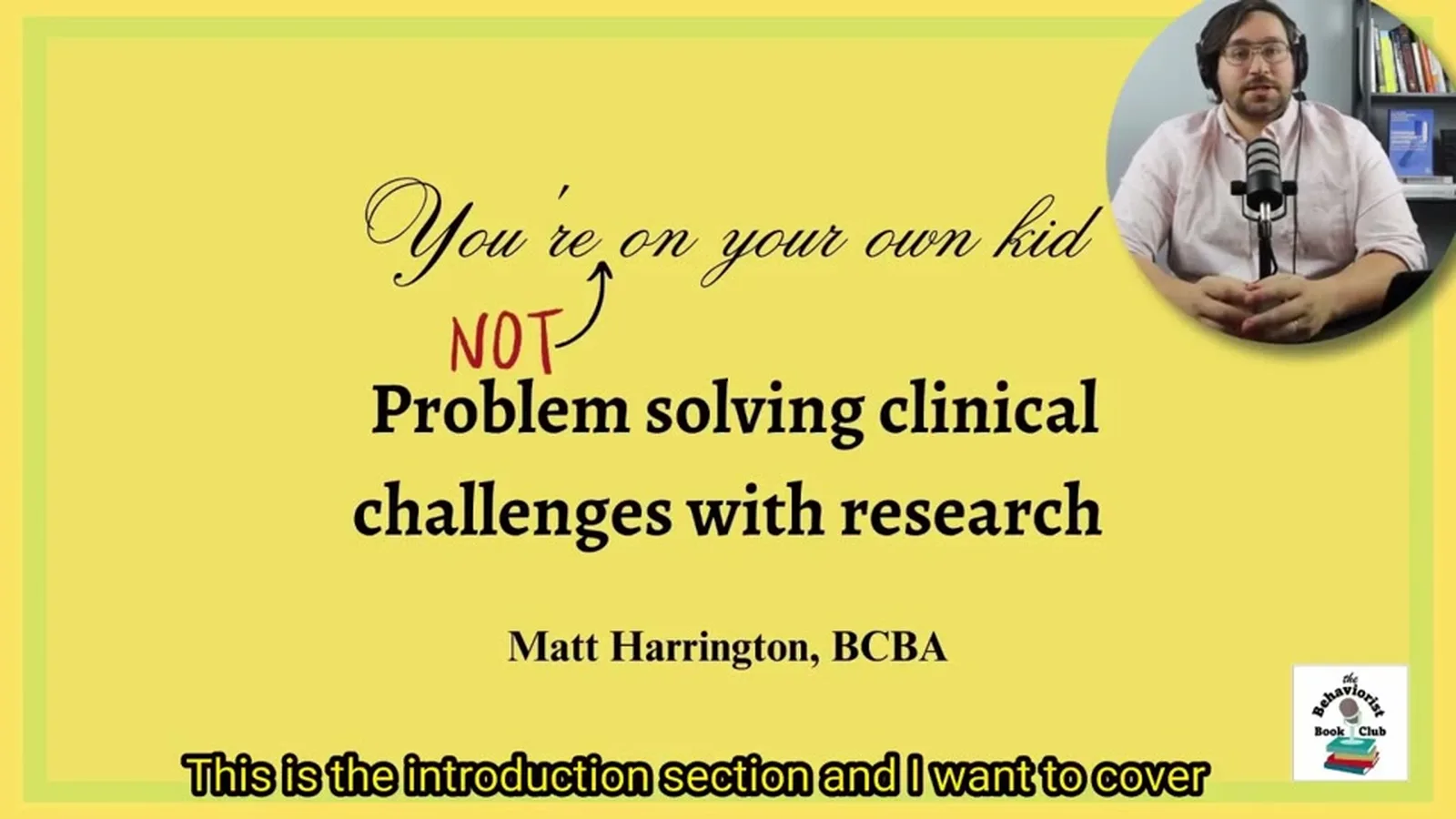
Solving Clinical Challenges with Research
Free learning path on this topic
Child Development for Behavior Analysts
Typical development for behavior analysts. Kristen Byra's overview, then Kelly Brzak's deep dives on ages 2 to 5, 6 to 8, and 9 to 11, with milestones, common problem behaviors, and programming tips for each band.
On this page · 9 sections▾
If you only have twenty minutes between sessions, search Behavior Analysis in Practice (BAP) before the Journal of Applied Behavior Analysis (JABA), type Boolean operators like AND and NOT directly into the journal's own search bar for your real case, look for one of two article types (a direct comparison study or a study that shows the thing working as part of a larger process), and when those first three searches come up empty, open the most useful paper you can find and chase its citations and first-author names.
That is the whole page. The rest is just unpacking why each move works for a real BCBA sitting at a kitchen table on a Tuesday night trying to figure out what to do with a kid on Wednesday morning.
Search the Journal Directly, Not Google Scholar#
Google Scholar is a great wide net. It is a terrible scalpel.
When you have a specific client and a specific question, a wide net is the wrong tool. You will get psychology papers, education papers, speech papers, and a handful of behavior-analytic ones mixed in. By the time you sort them, your kid is in the room.
Open the journal's own website. Use its search bar. Behavior Analysis in Practice has one. JABA has one. The Analysis of Verbal Behavior (AVB) has one. Every paper that comes back is already a behavior paper, already peer-reviewed, and already aimed at the kind of work you do.
That single move (skip Google Scholar, go to the journal) probably saves more time than every other tip on this page combined.
Which Journal First: BAP, JABA, or AVB#
The order matters. Three years ago, the answer was easy. JABA first. Now the answer has changed.
If you had asked me three years ago, I would have said, just go to JABA. My opinion has changed based on the things that they've been publishing. I've really been enjoying Behavior Analysis in Practice. They're very clinical based, they're very simple to read, simple to understand. So for efficiency sake, I typically lean towards behavior analysis and practice.
So the working order for a BCBA who needs an answer this week:
- Behavior Analysis in Practice (BAP) first. Clinical voice. Shorter studies. Practitioners writing for practitioners. Easier to translate into a BIP by Friday.
- JABA second. More technical, often longer single-subject designs, deeper methods sections. Worth it when BAP comes up empty.
- AVB if the case is verbal behavior. Mand training, tact training, intraverbals. Do not start here for a behavior reduction case.
If you are a supervisor reading this, the takeaway is the same. Stop telling your supervisees to start with JABA out of habit. BAP is where they will actually find something they can use on Monday.
Search-Bar Do's and Don'ts (Including the Misspelled-Maintained Trap)#
A search bar is dumb. It does exactly what you type, and nothing else. Use keywords instead of full sentences. Don't describe what's happening; put the behavioral principle in. And don't trust your own spelling, because the word maintained is misspelled in real BCBA search bars more often than anyone wants to admit.
The rules:
- Do type the behavioral principle, not the story. Type
escape-maintained aggressioninstead ofkid hits when asked to do math. - Do add the population if it narrows the field.
escape-maintained aggression autismis fine.escape-maintained aggression autism schoolis better if your case is in a school. - Don't type sentences. The search bar does not read English. It reads tokens.
- Don't wrap every search in quotes. Quotes mean exact match. If you wrap
"escape-maintained aggression"in quotes and the article actually saysaggression maintained by escape,you will get zero hits and assume nothing exists. - Don't trust your spelling. The word
maintainedis misspelled in real BCBA search bars more often than anyone wants to admit. If you get zero hits on a phrase that should obviously exist, retype it before you give up.
The misspelled-maintained trap is the most common reason a search returns nothing for a case that has been written about a hundred times.
AND, OR, NOT: Boolean Operators on a Real Case#
Boolean operators are the part of library science that BCBAs skipped in grad school. They are also the single biggest upgrade you can make to your search bar this week.
If it is school AND aggression, it's going to look for, it's going to prioritize articles where school and aggression are in that record. So if you're looking for an intervention that is only done in the school, you want to include AND school.
Three operators, three uses:
- AND narrows.
aggression AND schoolonly returns articles that mention both. Use this when your case has a setting you cannot ignore. - OR widens.
aggression OR self-injuryreturns articles that mention either. Use this when the topography of the behavior matters less than the function. - NOT carves out.
aggression NOT typically developingfilters out the studies that do not match your population. Use this carefully, because NOT will throw out articles that happen to mention a thing in passing.
Type the operators in caps. Most journal search bars treat lowercase and as a regular word and uppercase AND as the operator. This is a quiet rule that nobody explains.
A real search for a real case might look like this: functional communication training AND aggression AND school NOT preschool. That is four moves in one search bar. The hit list will be small. Small is the point.
What You Are Actually Looking For: Two Article Archetypes#
This is the part most search-strategy guides skip, and it is the part that changes how you read your results page.
So this is like, I'm going to compare four different types of prompt fading techniques to see what works the best. But those are pretty rare. So the other article that you can be looking for is including a demonstration of the question successfully being answered or completed.
Two archetypes. Memorize them.
Archetype 1: the direct-comparison study. The authors picked your exact variable and tested it against other variables. Four prompt-fading techniques head to head. Three reinforcement schedules side by side. These are the dream papers. They are also rare. If you search for one and find it, screenshot the abstract and send it to your team. Then keep going, because you probably will not find a second one for the same question.
Archetype 2: the successful-demonstration study. The authors ran a bigger process, and the thing you care about was a step inside it. The PFA and SBT paper across 25 cases is the textbook example. Your question was prompt fading. The paper is not about prompt fading. But the paper used prompt fading as part of a larger procedure that worked, and the methods section describes exactly how they did it.
Archetype 2 is what you will actually find most days. Stop treating it like a consolation prize. A method that worked inside a real treatment package is more useful, not less, than a stripped-down comparison study, because it shows you the thing surviving contact with real clinical messiness.
When you scan a results page, ask one question: "Does this study show the thing happening successfully, even as a side ingredient?" If yes, open it.
When the First Three Searches Fail: Citation Chasing#
You will run three searches and get nothing. That is normal. It does not mean the literature is empty. It means your starting keywords were not the keywords the field uses.
If you can find an article that you really like, especially a topic that you really like, look at what citations they're referencing, and go search those too. It's a really cool way to kind of like trace the research back. It also is a really good way of finding researchers whose work aligns with what you're doing.
Pick the closest article you found, even if it is only loosely related, and open its reference list. Two things happen.
First, you see the words the authors used to describe your topic. Those are the keywords you should have been searching the whole time. Go put those back in the BAP search bar and run it again.
Second, you see authors who keep showing up. If three of the references are by the same first author, that person has built a body of work on this question. Search their name directly in BAP and JABA. You will find five more papers in ten minutes.
This is the move that unsticks most searches that feel hopeless after twenty minutes.
Pro Move: Track the First-Author Names You Keep Seeing#
Once you have done this for a few cases, start a list. A note on your phone. A page in your supervision binder. Doesn't matter where.
Write down the first-author names that keep coming up for the topics you work on most. Severe behavior. Verbal behavior. Social skills. Toileting. Sleep. Whatever your caseload actually looks like.
Next time you get a case that fits one of those categories, you do not start with a keyword. You start with a name. You search the journal for that author. You skim their last three papers. You probably find your answer in fifteen minutes instead of two hours.
That is the trick experienced BCBAs use, and nobody hands it to you in grad school. Build the list yourself.
FAQ#
How do you search behavior analysis journals for a specific client case? Start at the journal itself, not Google Scholar. Open Behavior Analysis in Practice first, then JABA. Type the behavioral principle as keywords (not a sentence), add Boolean operators like AND and NOT in caps to narrow the case, and look for either a direct-comparison study or a study that uses your variable as part of a larger successful procedure.
What ABA journal should I search first as a BCBA? Behavior Analysis in Practice. The clinical voice is closer to how a BCBA actually writes a BIP, the studies are shorter, and the language is easier to read at the end of a long day. JABA is still the right second stop, especially when you need a deeper methods section or a single-subject design you can replicate.
How do I use Boolean operators in JABA or BAP search bars?
Type AND, OR, and NOT in capital letters. AND narrows your search to articles that mention both terms. OR widens it to either term. NOT excludes a term. A real-case example: functional communication training AND aggression AND school NOT preschool. Most journal search bars treat lowercase and as a regular word, so the caps actually matter.
Keep Going#
If the first three searches still come up empty, the case might be stuck for a different reason than missing research. Walk the case through the rest of the framework.
Want the full framework, with the Research Finding Framework and the Key Places Framework walked through end to end? Watch the CEU with Matthew Harrington and earn the credit while you learn the system.
Watch Solving Clinical Challenges with Research on openceu.com
Turn this topic into a CEU
You just studied this. Now get credit for it.
Watch Solving Clinical Challenges with Research with Matthew Harrington and earn 2.5 free BCBA CEUs. Detailed certificate, delivered the moment you finish.
Keep going with a free learning path
Child Development for Behavior Analysts
Typical development for behavior analysts. Kristen Byra's overview, then Kelly Brzak's deep dives on ages 2 to 5, 6 to 8, and 9 to 11, with milestones, common problem behaviors, and programming tips for each band.