How to Choose a Skill Assessment for an Autistic Learner
A 6-step way to choose a skill assessment that fits the learner instead of forcing the learner into the tool, from a BCBA-led CEU.
Key takeaway
Picking a skill assessment for an autistic learner is a 6-step job: run a pie chart audit on your last 10 learners, score every instrument against a 5-question checklist, use the intake interview to filter, build a small package instead of forcing one tool, write down why you picked what you picked, then turn that into a team rubric.
Generate: Learner Centered Skill Assessments
Free learning path on this topic
Child Development for Behavior Analysts
Typical development for behavior analysts. Kristen Byra's overview, then Kelly Brzak's deep dives on ages 2 to 5, 6 to 8, and 9 to 11, with milestones, common problem behaviors, and programming tips for each band.
On this page · 9 sections▾
Picking a skill assessment for an autistic learner is a 6-step job: run a pie chart audit on your last 10 learners, score every instrument against a 5-question checklist, use the intake interview to filter, build a small package instead of forcing one tool, write down why you picked what you picked, then turn that into a team rubric. Most clinics skip all six steps. They open the file, write "VB-MAPP," and move on. That is the problem this guide fixes.
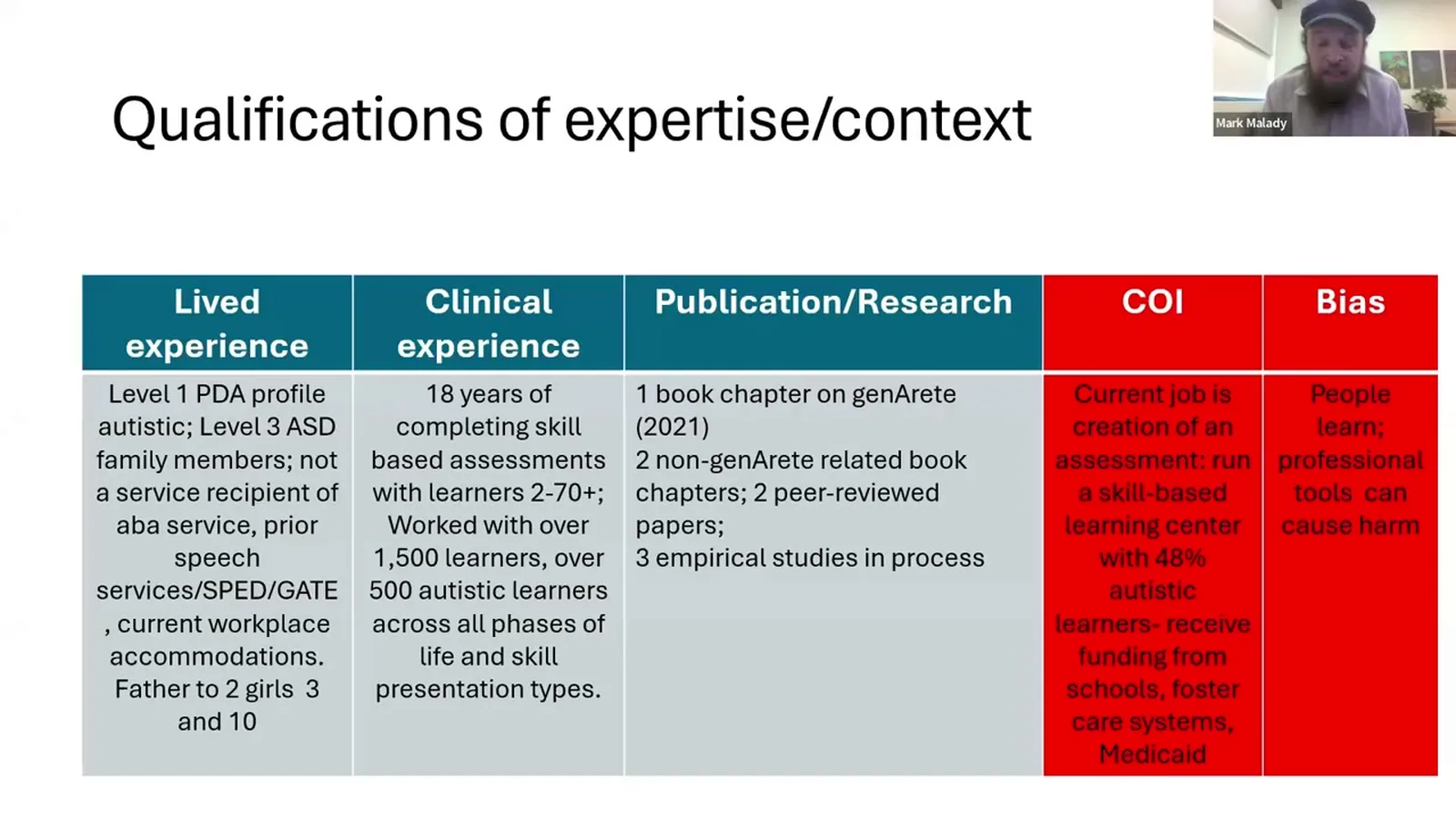
This walkthrough comes from a CEU by Mark Malady, a Board Certified Behavior Analyst (BCBA, the clinician who designs and supervises ABA programs) who co-built the Generate assessment. He sat with the Council of Autism Service Providers (CASP) and Association of Professional Behavior Analysts (APBA) guidance on multimodal assessment and turned it into something you can actually do on Monday morning.
The wrong way most clinics pick a skill assessment#
Most clinics do not pick. They default. Someone got trained on the VB-MAPP in grad school, the funder pays for it, and that becomes the house tool for every learner who walks in. A 4-year-old who is gestalt-language gets the same assessment as a 9-year-old who reads chapter books. The tool decides what the learner gets to work on. That is backwards.
Mark surfaced two specific problems with this default. First, the field's most-used tools, VB-MAPP and ABLLS-R, sit in the "emerging" tier for empirical support in the 2025 Banda and Hart review, while better-validated tools get used less. Second, funders in the United States autism market often pay for, and sometimes require, the legacy tools. That pressure is real. But it does not get you off the hook for choosing on purpose.
The CASP and APBA joint guidance is clear: no single instrument fits every learner. You need a multimodal package, picked for the person in front of you. The six steps below are how you do that without breaking your current workflow.
Step 1: Run the pie chart audit on your last 10 learners#
Before you change anything, find out what you are actually doing right now. Pull your last 10 intakes. For each one, write down the assessment package you used. Code each unique combo with a color. Put it in a pie chart.
So one thing you want to do is actually take like the last 10 learners that you provided services to and just make a real simple pie chart... if you have one color, that should be a red flag. That means that the multimodal vision is not playing out, right? From the talk — Mark Malady
One color means you have a default, not a process. Two or three colors that are all "VB-MAPP plus the same thing" still means you have a default. A healthy chart looks messy because real learners are messy. This audit takes about an hour, costs nothing, and gives you the honest baseline you need before step 2 makes sense.
Step 2: The 5 questions every assessment has to pass#
Once you see what you are using, you need a way to evaluate every tool that might join the rotation. Mark gave a clean checklist. Run every assessment, including the ones you already use, through these five questions.
Some things that you want to know about every instrument that you use is what's the target audience? What assumptions was this instrument based off of and where philosophically and conceptually does this assessment come from? What's the empirical support... Potential misapplications. From the talk — Mark Malady
In plain words:
- Target audience. Who was this built for? Age range, diagnosis profile, support needs.
- Assumptions. What does the tool believe about how skills develop? Does it assume the learner should look like a non-autistic peer at the same age?
- Empirical support. Are there validity and reliability studies? How recent?
- Misapplications. How can this tool be used wrong? Teaching to the test is a common one for criterion-referenced tools.
- Common roadblocks. Where do practitioners hit walls? What learner profiles does it fit poorly?
Write the answers down for each tool. One page each. Keep them in a shared folder so your team is not re-Googling the same thing every quarter.
Step 3: Use the intake interview to filter, not just collect#
Most intake interviews are data-gathering. The parent talks, you scribe. Then you go pick an assessment based on habit. Mark says the interview itself should be the first filter.
If you're doing a multimodal assessment process, what I would highly recommend that you consider is in that intake interview, all the assessments that you use inside of your practice, you come up with a way post that interview to capture and document kind of like this table of what instruments do we want to explore? From the talk — Mark Malady
Build a small post-interview table with three columns: instruments you want to explore, instruments the learner is probably strong in (so you can skip or skim), and instruments that are not related to where they are right now. This forces a decision. It also leaves a paper trail showing the interview shaped the package. That trail matters in step 5.
A quick example. A 7-year-old who reads above grade level but has trouble making friends and managing transitions. The interview should push you toward a social and adaptive package, maybe with a quality-of-life measure. It should push you away from spending an hour probing tact-by-feature responses they nailed when they were 4.
Step 4: Pick a package, not a single tool#
CASP and APBA flat-out recommend multimodal. That means you stop asking "which assessment?" and start asking "which package?" A package usually has 2 to 4 pieces:
- One broad skill survey to map the landscape (VB-MAPP, ABLLS-R, AFLS, or Generate, depending on the learner).
- One adaptive or daily-living measure (Vineland, AFLS, or a criterion-referenced subset).
- One quality-of-life or preference measure tied to what the learner and family actually want.
- One direct-observation piece you run yourself in the natural environment.
You will not use every piece for every learner. The intake table from step 3 tells you which pieces fire. The whole point is that the package fits the person, not the calendar slot you have available.
If your funder will only pay for one instrument, your package still has 4 pieces. Three of them are just shorter, free, and built by you. The funder paying for VB-MAPP does not stop you from doing a 20-minute interview-based quality-of-life check.
Step 5: Document why you picked what you picked#
This is the step almost everyone skips. You picked a package. Write down why. One paragraph per piece. What did the intake interview say that pointed you here? What did you rule out and why? What is the learner's goal that this piece is meant to answer?
Flexible assessment selection, use semi-structured interviews to create a system of selection. So you want to have a meaningful way that you can go back and analyze is selection occurring as differentiation of the information that we're getting on a person. From the talk — Mark Malady
Two things happen when you do this. One, audits get easier. If a funder asks why you ran the AFLS instead of just the VB-MAPP, you have the answer in writing from the day you made the call. Two, your future self gets smarter. Six months later, when you are picking again for a similar learner, you can look back at what you did and what worked. Without the paper trail, every intake starts from scratch.
Step 6: Build a selection rubric your whole team uses#
A clinic-wide rubric turns Mark's process into your process. Pull steps 2, 3, and 5 into a one-page checklist every BCBA on your team runs at intake. The rubric should include:
- The 5-question summary for each instrument in your library (from step 2).
- A blank intake-filter table to fill in (from step 3).
- A "why this package" section to write in (from step 5).
- A required reviewer signoff before the package is finalized.
Run the pie chart audit again after 90 days of using the rubric. If the chart got more colorful, the rubric is working. If it did not, something is still defaulting and you need to find it.
This is also where you build reliability across assessors. Two BCBAs reading the same intake should pick similar packages. If they do not, your rubric is too loose. Tighten the questions.
Frequently asked questions#
What if my supervisor only lets me use one assessment?
You can still run the process around it. Do the intake filter table. Document why the one tool fits or does not fit this learner. Add a short interview-based quality-of-life check on top, which costs nothing and does not break the funder rule. When you have three or four cases where the single tool clearly missed something a different package would have caught, bring those cases to your supervisor. Real cases beat principle arguments every time.
How do I justify a non-VB-MAPP choice to a parent who asked for VB-MAPP?
Most parents asking for VB-MAPP heard the name from another parent or a Facebook group. They want the assessment that works, not that specific tool. Walk them through what their child needs to learn next year, then show how the package you picked answers those questions and the VB-MAPP alone would not. Use the documentation from step 5. Parents respect a written reason. The conversation gets easier when you stop defending against VB-MAPP and start explaining what you are doing instead.
Do I need a new assessment for every reauthorization?
Not always. You need fresh data, which is not the same thing. If the package you picked still answers the questions that matter for this learner, rerun the relevant pieces. If the learner's goals shifted, like they are now aiming at a community job instead of school readiness, your package needs to shift too. The reauthorization is a good moment to redo step 3, the intake filter, and check whether your old package still fits.
Watch the full talk#
Mark walks through the Generate assessment, the CASP guidance, and the evidence base behind these recommendations in the full hour. If you are about to overhaul your intake process, the talk is the briefing you give your team first.
Turn this topic into a CEU
You just studied this. Now get credit for it.
Watch Generate: Learner Centered Skill Assessments with Mark Malady and earn 1 free BCBA CEU. Detailed certificate, delivered the moment you finish.
Keep going with a free learning path
Child Development for Behavior Analysts
Typical development for behavior analysts. Kristen Byra's overview, then Kelly Brzak's deep dives on ages 2 to 5, 6 to 8, and 9 to 11, with milestones, common problem behaviors, and programming tips for each band.