What Care Collaboration in ABA Really Means (Beyond the Ethics Code)
Care collaboration in ABA is coordinated treatment across providers so kids get one plan, not five. Plain-English guide from a BCBA-led CEU.
Key takeaway
Care collaboration in ABA is the work of getting every provider on a kid's case (the BCBA, or Board Certified Behavior Analyst; the SLP, or speech language pathologist; the OT, or occupational therapist; the pediatrician; the psychiatrist; the teacher) to share one plan instead of five, so a child using an AAC (augmentative and alternative communication) tablet with 70 icons isn't also being asked to use a 2-icon PECS (Picture Exchange Communication System) board across the hallway, and so a Medicaid family who got handed an ABA packet learns that speech, OT, and psychiatry exist for them too.
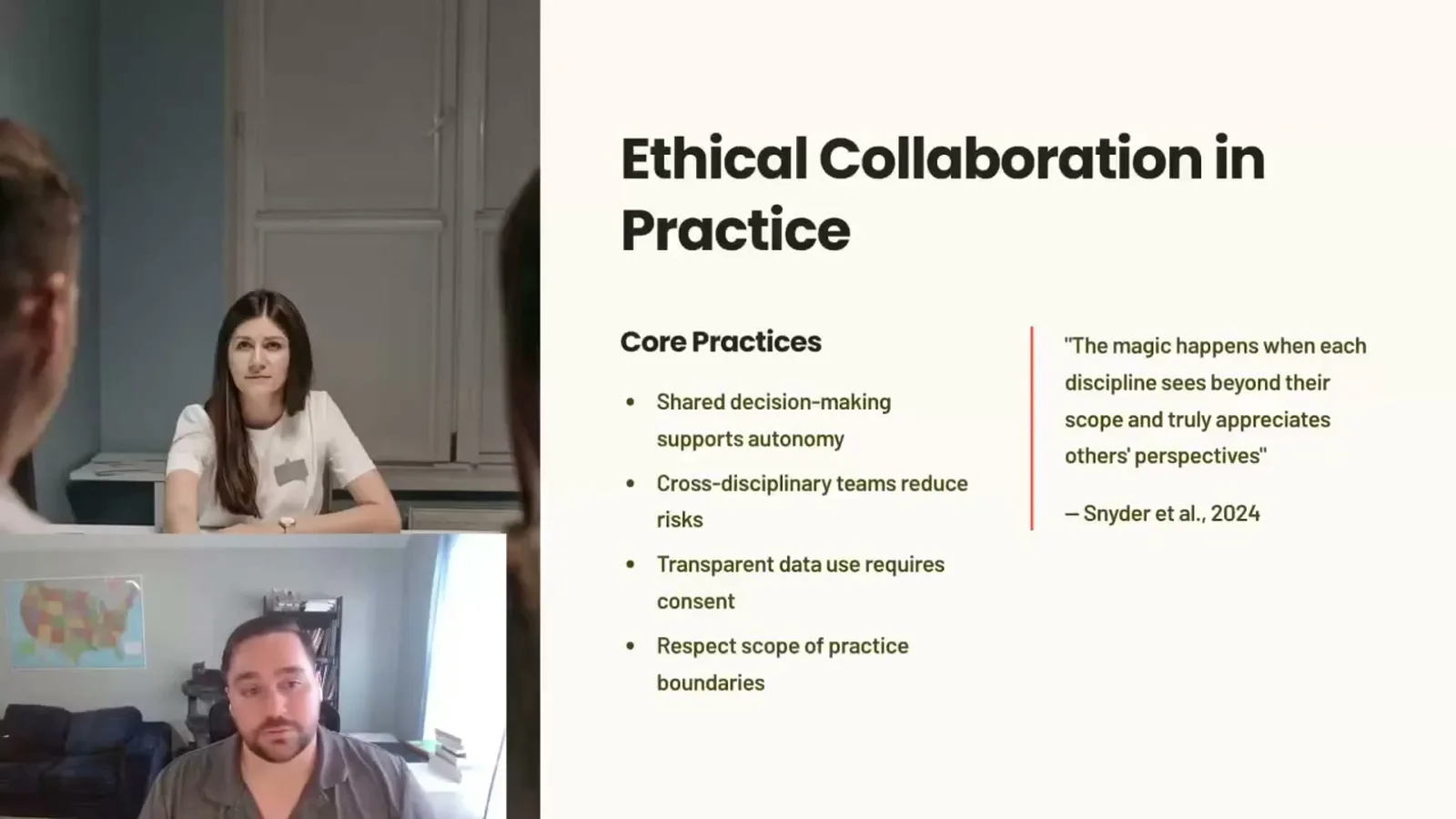
New Year, New Care Collab Goals
On this page · 8 sections▾
Care collaboration in ABA is the work of getting every provider on a kid's case (the BCBA, or Board Certified Behavior Analyst; the SLP, or speech language pathologist; the OT, or occupational therapist; the pediatrician; the psychiatrist; the teacher) to share one plan instead of five, so a child using an AAC (augmentative and alternative communication) tablet with 70 icons isn't also being asked to use a 2-icon PECS (Picture Exchange Communication System) board across the hallway, and so a Medicaid family who got handed an ABA packet learns that speech, OT, and psychiatry exist for them too. That last piece is the access-equity part most "what is care collab" pages skip. The BACB (Behavior Analyst Certification Board) ethics code names collaboration as a duty, but the real reason it matters is much simpler than the code makes it sound. Kids do better when adults talk to each other.
Care collaboration in one sentence (and why the ethics code names it)#
Care collaboration in ABA is coordinated treatment across every provider a client sees, run with consent and with the family in the room, so progress made by any one provider is not erased by a different provider working at cross purposes. The ethics code names it because uncoordinated care can hurt clients in ways no single provider can see from inside their own session. A BCBA cannot fix a sleep cycle that is really a GI issue. An SLP cannot generalize language if the home team is reinforcing a different communication system. A psychiatrist cannot dose a medication well if no one is tracking what the medication is actually doing all week.
The shortest version: care collab is one plan for one kid, written by people who actually talked to each other.
What it looks like in real life: the AAC icons vs. PECS board story#
The clearest picture in the talk is the one about fragmented communication. A child works with an SLP who has loaded an AAC tablet with about 70 icons. The same child works with a BCBA who is running a PECS board with two icons. Each provider is doing real work. The child is doing real work. The progress just is not stacking, because the tools do not point at the same target.
Coordinated care maximizes welfare and minimizes risk from fragmented interventions. Imagine if the SLP is working on AAC, you're working on PECS, but the SLP has 70 different icons on their iPad and you're doing two on your PECS board. Ultimately, it's a fragmented intervention and whatever progress is made separately would be way better made together. From the talk — Matt Harrington
Care collaboration is what closes that gap. It is the email, the 15-minute call, the shared one-pager that gets two providers pointed at the same icons, the same prompt level, the same words for the same skill. None of that requires anyone to give up their methods. It requires both sides to know what the other side is doing.
The four ethical pillars: shared decisions, ROI, scope, caregiver inclusion#
The ethics code language can sound heavy, but it shrinks to four concrete moves you can do this week:
- Shared decision-making. The family and client choose. You inform.
- ROI (release of information). Signed paperwork on file before any data leaves your hands.
- Scope of practice. You stay in your lane and respect the other provider's lane.
- Caregiver inclusion. The parent is on the call, on the email, in the room.
Shared decision-making supports autonomy, not by us making decisions, but for the client and the caregiver. We're reducing risk. We're using transparent data with ROIs in place. That's release of information. And we're respecting our scope of practice boundaries. From the talk — Matt Harrington
If you can point at those four things in your last collaboration, you were doing ethical care collab. If one is missing, that is the part to fix next time.
A small but important note on the ROI piece. Release of information is not a formality. It is the thing that lets you share data at all. No ROI, no email, no call, no shared graph. If you remember nothing else from the ethics frame, remember that the signed ROI is what unlocks everything else, and the caregiver is the one who signs it. So the order is always: caregiver consent first, paperwork second, provider conversation third.
Why skipping it hurts caregivers most (the "pick one provider" problem)#
The part of skipping collab that does not get talked about enough is what it does to the parent. When two providers give a family two different plans and never speak, the parent is the one stuck choosing. They are not running a side-by-side study at 9pm. They are picking the person who was kindest to them on the phone.
When you don't care collaborate, caregivers are going to end up feeling like I have to choose one or the other. I have to listen to my BCBA or listen to my speech therapist or listen to my psychiatrist. And ultimately, they're probably just going to go with the one who has the best people skills with them. From the talk — Matt Harrington
That is not a failure of the parent. That is a failure of the team around them. Care collaboration is partly a protection move for the family. It takes the impossible choice off their plate.
The equity angle most BCBAs miss#
The other piece most definitions skip is access. A lot of families do not know what their kid is eligible for. They got handed a packet, they called the first number, the number went to an ABA company, and now they are at 40 hours a week of ABA without knowing speech, OT, or psychiatry were ever options.
There are people and caregivers who do not know what access to care they should or could have. I see this a lot when I'm working with lower-income Medicaid clients. They simply know that they were given a packet, they called a company, it turned out to be an ABA company, and now they're in 40 hours a week. From the talk — Matt Harrington
If you are a BCBA on a Medicaid-heavy caseload, the most ethical care collab move you can make is sometimes the first one. Ask the family if they have been seen by anyone else. If the answer is no, name the options out loud. That is a referral, not a sales pitch, and it is one of the few ways a single provider can quietly fix an access gap for one family at a time.
This also works the other direction. If you find out the family is already seeing an SLP, OT, or psychiatrist that no one mentioned in intake, that is not a problem. That is a gift. The other provider is already there. You only need to write one email to start a collaboration. The hard part (getting the family into the door of a second provider) has already been done.
Where care collab fits next to your behavior plan (not on top of it)#
A common worry is that adding care collaboration means adding another document, another meeting, another binder. It does not. Care collab sits next to the behavior plan, not on top of it. The plan still does the work it was written to do. The collaboration is what keeps it from getting overwritten by a different plan in a different room.
In practice, that looks like a one-page summary instead of a 60-page plan, a 15-minute call instead of a re-write, and a shared data point or two instead of a whole new intervention. The behavior plan is still yours. The collaboration is how you keep it useful in the rest of the kid's week.
Frequently asked questions#
Is care collaboration required by the BACB ethics code? Yes, with limits. The code requires you to collaborate with other providers when it is in the client's interest, when you have consent, and when it is within your scope. It does not require you to collaborate on everything with everyone. The trigger is client benefit, not a checkbox.
Who counts as a "collaborator" for an ABA client? Anyone on the care team whose work overlaps with yours. That usually means the SLP, OT, pediatrician, psychiatrist or other prescriber, mental health therapist, and teacher or school team. It also includes the caregiver, who is the most important collaborator and the one most often left off the email thread. If their decisions touch your goals, they are a collaborator.
Does care collaboration replace a behavior plan or sit alongside it? It sits alongside. Your behavior plan still names the goals, the interventions, and the data. Care collaboration is the workflow that keeps that plan aligned with what every other provider is doing, so the kid is not getting different versions of the same skill in different rooms. Same plan, more people pulling in the same direction.
Watch the full CEU#
If you want the templates, scripts, and partner-by-partner walk-through behind every idea on this page (pediatricians, SLPs, OTs, schools, mental health, psychiatry), the full free CEU is on openceu.com. It is one CEU credit, it is free, and it gives you the one-pager and email templates Matt mentioned. Watch "New Year, New Care Collab Goals" on openceu.com.
Turn this topic into a CEU
You just studied this. Now get credit for it.
Watch New Year, New Care Collab Goals with Matt Harrington and earn 1 free BCBA CEU. Detailed certificate, delivered the moment you finish.