Your Job on the Interdisciplinary Team Is to Enhance, Not Win
What a BCBA actually does on an interdisciplinary team meeting with SLPs, OTs, teachers, and parents. Scope, scripts, and posture from a BCBA-led CEU.
Key takeaway
Your job on the interdisciplinary team is to enhance the work other clinicians are doing, not win the room.
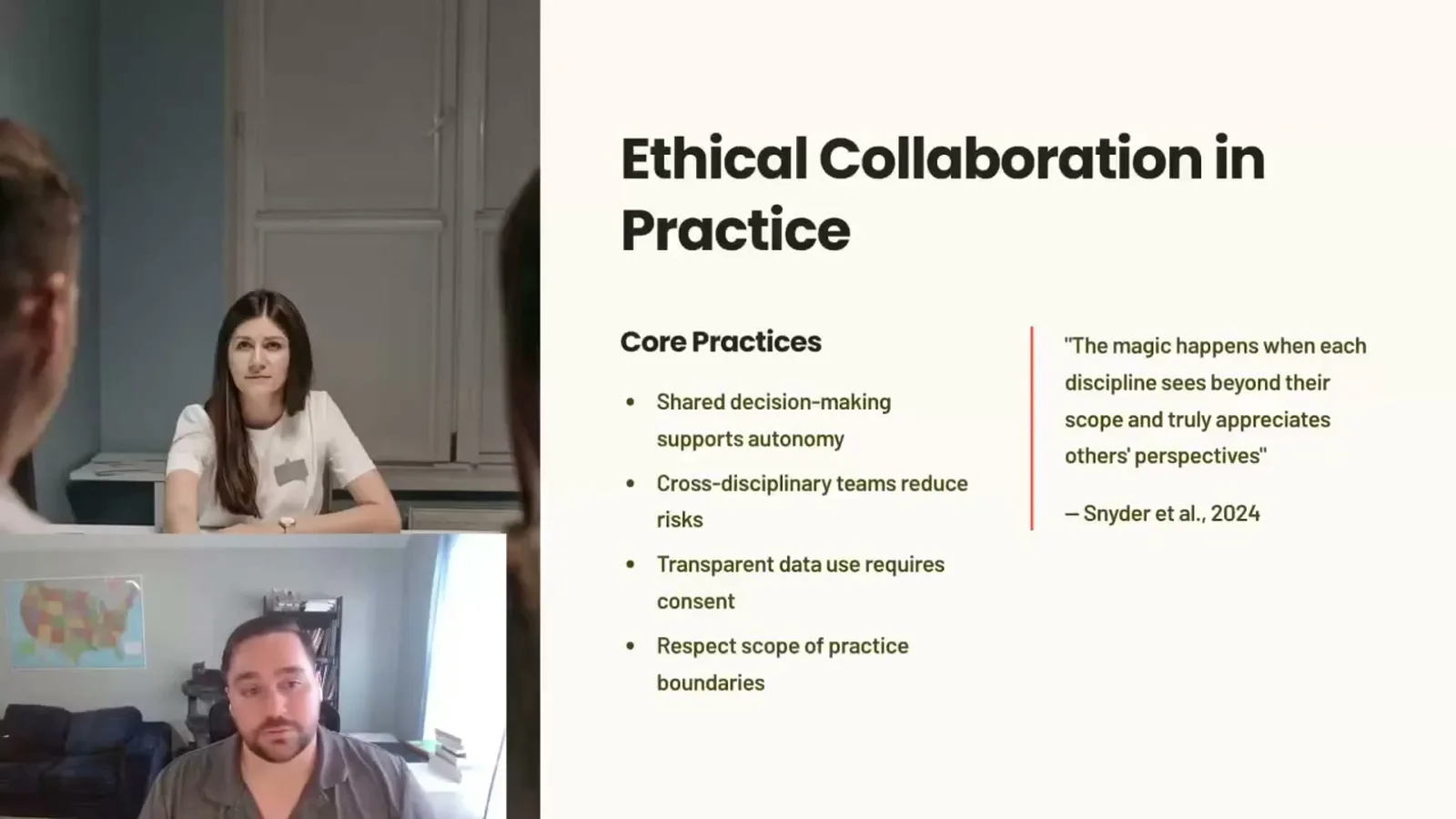
New Year, New Care Collab Goals
On this page · 9 sections▾
Your job on the interdisciplinary team is to enhance the work other clinicians are doing, not win the room. Matt Harrington, a Board Certified Behavior Analyst (BCBA), has sent thousands of cold emails to thousands of Speech-Language Pathologists (SLPs) through his marketing work, and he has gotten exactly two replies he would call negative. That number alone should change how you walk into your next meeting.
This page is for the BCBA who is about to sit at a table with an SLP, an Occupational Therapist (OT), a teacher, a pediatrician, or a parent, and is not sure what their job actually is. The short version: bring data, ask for help, write it down, and loop the parent in the same day. The longer version is below.
Your real job at the table: enhance, not win#
You wrote a behavior plan. It covers a lot of ground. You also have a finite number of hours, and a finite number of skills. The SLP in the room has spent four times the hours you have on language. The OT has spent four times the hours you have on sensory and emotional regulation. The teacher has 180 days a year with this kid in a setting you cannot recreate.
If you go into the meeting trying to prove your plan is the right one, you lose. Not because the other clinicians are mean, but because you walked in with the wrong goal. The right goal is tightening. You came in with a plan that works. You leave with a plan that works better because someone with more reps in a specific domain shaped a piece of it.
We're not going into conversations trying to win. We're going into conversations trying to enhance. I have a behavior plan. It covers these domains. And I have spent this amount of time on this domain, along with many others. And another professional has spent triple, quadruple amount of time on that domain. From the talk — Matt Harrington
That is the posture. Read it again before your next meeting.
The posture problem the field still has (and how SLPs describe us)#
Other clinicians have a story about us. A lot of BCBAs do not want to hear what the story is, but it matters because it shapes how the SLP across the table is going to read your first sentence.
Behavior analysts have this small tendency to think that we know better than everyone and that we are the right person all the time because everything is behavior. And of course, while I think that that attitude has significantly decreased over the last five, ten years or so, there is still a little bit of that bias sometimes. From the talk — Matt Harrington
The fix is not a personality change. The fix is one sentence at the top of your first email or your first ten seconds in the room: I want to learn what you are working on, and I want to share what I have. That is it. When Matt has done outreach the right way, here is what comes back.
The feedback I get is, I'm so glad you're not so arrogant like all the other BCBAs. Or I'm so glad you don't just tell me I'm wrong like all the other BCBAs. So when it comes to SLPs, the best thing you can do to have a good conversation is simply to respect them and listen to them. From the talk — Matt Harrington
That is the whole skill. Respect them. Listen to them. The reason it works is that they almost never hear it.
What to bring: a one-page data summary, not a 60-page plan#
The single most common mistake BCBAs make in a meeting is bringing the full behavior plan. Sixty pages. Operational definitions. A literature review. The pediatrician will thank you and put it in the shredder. The teacher will smile and forget it by Tuesday.
Bring a one-pager instead. On it: client name, the two or three goals you are tracking right now, one behavior graph, one skill acquisition graph, and a sentence on what you would like the other clinician to weigh in on. That is the whole document. If you cannot fit it on one page, the meeting will not use it.
The one-pager has a second job. It tells the other clinician that you respect their time. A pediatrician has eleven minutes with this family. An SLP has thirty minutes a week. If you hand them a packet, you are asking them to do homework. If you hand them a page, you are asking them to think for two minutes. They will say yes to two minutes.
What to ask: "what data would help you at our next visit?"#
You are not going to fix the SLP's language program in one meeting. You are going to start a feedback loop. The way you start it is by asking one question at the end of the meeting: what data would help you at our next visit?
The psychiatrist might say sleep. The pediatrician might say a graph of afternoon dysregulation. The OT might say fidelity on the sensory diet. The teacher might say a tally of when the kid asks for a break versus when the kid bolts. Now you have a job for the next four weeks. You go run the data. You bring it back. You did not win the meeting. You made the next one useful.
Scope boundaries in plain language#
Scope is not a wall. It is a sentence. Here is the sentence you can say out loud: I track behavior and I teach skills. I do not prescribe. I do not diagnose. I do not evaluate language or feeding or motor planning. I will share what I see, and I will ask you what you see.
If the conversation goes somewhere outside that sentence, you say so. You can use language like, that is outside what I do, but I can track it for you. Or, I do not have training in that, can you walk me through how you think about it. You are not weak when you say that. You are useful. The other clinicians in the room have spent their career inside their lane. They notice when you stay in yours.
When the caregiver is in the room (the default) vs. provider-only side conversations#
The default is that the parent is in the room. On the call, on the email thread, in the meeting. Not on copy. Not bcc'd. In the room.
The reason is medical gaslighting. When a parent has to say the same thing six times to six different clinicians, they stop saying it. They feel unheard. They start to disengage. When you keep them in the room, they say it once. They hear how the team handles it. They feel like there is a team at all.
Sometimes you do need a side conversation. A clinical question, a delicate scope question, a worry you do not want to put on a parent's plate at 4pm on a Tuesday. That is okay. Have the conversation. Keep it short. Then loop the parent in the same day with a plain-language summary of what was said and what is changing. Same day. Not next week.
What to do after the meeting: write it down, loop the parent in same day#
The meeting is not done when the meeting ends. It is done when three things happen.
One, you write down what was decided. Two sentences per decision. What changed, who owns it, when you check back.
Two, you send the parent a same-day note. Plain language. What you talked about. What is changing. What you would like them to watch for at home this week.
Three, you put the next check-in on the calendar before you close the laptop. If you do not, it slides. Care collaboration slides to the bottom of the list, every six months, on every caseload, until you make it a routine. You do not need willpower. You need a calendar invite.
Frequently asked questions#
Should I email another provider before talking to the parent?
No. Talk to the parent first. Always. The parent is the one who holds the release of information and the relationships with the other clinicians. Ask them who they want you to reach out to, and ask if they want to make the introduction. A warm intro from the parent gets a response. A cold email from a BCBA the parent has not mentioned gets ignored or worse, gets a confused call back to the parent.
What do I do if another provider says my plan is wrong?
Listen first. Repeat back what you heard so they know you heard it. Then ask one question: what would you like to see different in the data over the next month? You do not have to agree on the spot. You do not have to defend the plan in the room. You take it back, you look at it with fresh eyes, and you reply in writing within a week. Most disagreements get smaller once you slow them down.
Can I bill for time spent on interdisciplinary meetings?
In most states, yes, under care coordination or treatment planning codes, depending on the payer. Check your funder's billing guide and your company's policy. The bigger point is this: even when you cannot bill the full hour, a fifteen-minute call that prevents a six-month plateau is the highest return on time you have all month.
Get the full CEU#
If this changed how you are thinking about your next team meeting, the full talk goes deeper into the six partner types (pediatricians, SLPs, OTs, schools, mental health, psychiatry) with the scripts and one-pagers for each. It is one free Continuing Education Unit (CEU) on openceu.com.
Turn this topic into a CEU
You just studied this. Now get credit for it.
Watch New Year, New Care Collab Goals with Matt Harrington and earn 1 free BCBA CEU. Detailed certificate, delivered the moment you finish.