BCBA and SLP Collaboration: How to Email an SLP Without a Fight
Most BCBAs are scared to email an SLP about AAC, manding, or feeding. Here is the posture, the script, and what to send from a BCBA-led CEU.
Key takeaway
The relationship between a BCBA (a board certified behavior analyst, the person running an ABA plan) and an SLP (a speech-language pathologist, the person running speech and language goals) often stalls before the first email gets sent, because the BCBA is quietly scared the SLP uses gestalt language processing (treating natural speech chunks as whole units) and will see a mand program (teaching a kid to ask for things) as harm, and because anyone doing feeding work with swallowing risk should not be working alone in the first place.
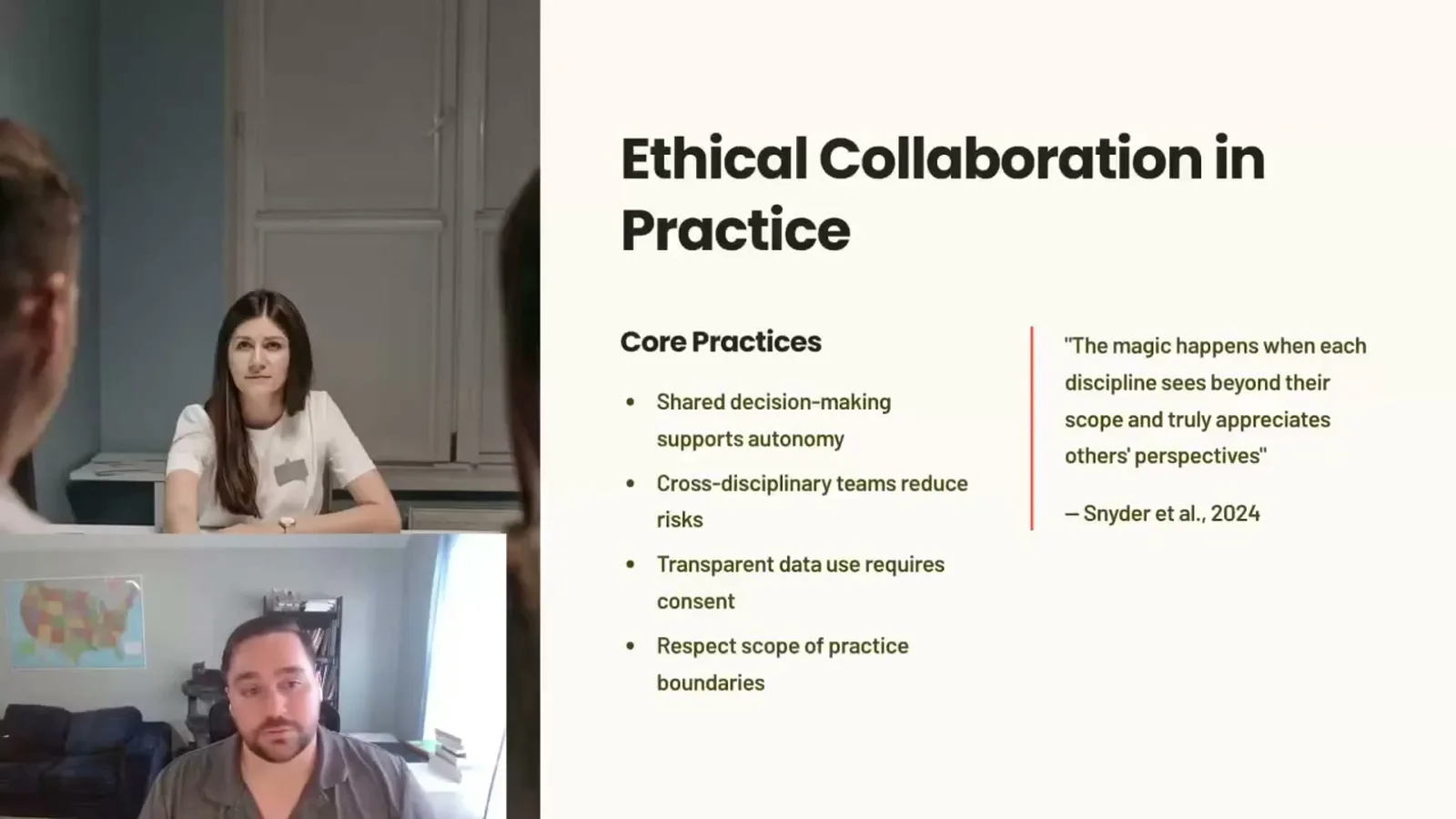
New Year, New Care Collab Goals
On this page · 9 sections▾
The relationship between a BCBA (a board certified behavior analyst, the person running an ABA plan) and an SLP (a speech-language pathologist, the person running speech and language goals) often stalls before the first email gets sent, because the BCBA is quietly scared the SLP uses gestalt language processing (treating natural speech chunks as whole units) and will see a mand program (teaching a kid to ask for things) as harm, and because anyone doing feeding work with swallowing risk should not be working alone in the first place. That fear is usually wrong. The work is real. This page is about what to actually send, what to leave out, and where the line is.
Why BCBAs and SLPs are scared of each other (the verbal behavior history)#
When Skinner wrote about verbal behavior, our field took the mand, the tact, the echoic, and built a whole teaching system on top of them. SLPs were trained in a different lineage with different words for the same children. Both sides watched the other from across the hall and made up stories about who was helping the kid and who was getting in the way.
SLPs, I think, get the worst rap with BCBAs and BCBAs get the worst rap with SLPs. I blame Skinner and verbal behavior. And ultimately, us not developing the science of verbal behavior as aggressively as I think that we could have. From the talk — Matt Harrington
The takeaway is simple. The tension is real, but it is historical. You did not cause it. You also do not have to keep it going. Most SLPs you will write to today were trained after that wall started to come down, and they want a teammate.
The 'gestalt vs. mand' fear, and the email data that should calm it#
Here is the fear in one sentence. You teach a kid to say "juice" to ask for juice. The SLP on the case uses gestalt language processing, which honors the long, melodic chunks of speech a kid is already using. You think she will read your plan, see the word "mand," and call you abusive.
That almost never happens. Most SLPs who hold gestalt views will tell you what they prefer for the kid and ask what you are seeing in your sessions. A few will say no thanks. Almost none will attack you.
I have sent thousands of emails to thousands of SLPs. I've gotten two responses that I would classify as negative. From the talk — Matt Harrington
Two. Out of thousands. If you have been sitting on an email for a week because you are scared of the reply, that math should free you up.
What SLPs are actually good at (and we are not)#
SLPs spend years learning how speech actually grows in a child. They can hear a sound a kid is almost making and shape it into a real word in a way most BCBAs cannot. They know which AAC device fits a kid's motor planning. They know when a sound is a real attempt and when it is a habit.
They are also better than we are at natural language. A BCBA might run twenty mand trials at a table. An SLP can pull language out of a snack, a book, a walk to the door. When you put their natural-language shaping next to our high-trial structure, the kid grows faster than either side alone can pull off.
If you have never worked with an SLP, picture this. You teach the kid to ask for the iPad. The SLP teaches the kid to ask for the iPad, then ask which app, then say what they want to do with it. Same starting point. More language by the end of the month.
What we are actually good at (and they need)#
We see the kid a lot. An SLP gets thirty to sixty minutes a week if she is lucky. We can be in the home twenty hours a week. That is a different kind of data set.
SLPs really do have a gift for shaping up natural language. And I really like incorporating their shaping with our plans. SLPs are probably going to have 30 minutes to an hour per week with a kid if they're lucky. We have a ton more. And so, therefore, our ABA data can help refine their language targets. From the talk — Matt Harrington
What does that look like in practice? You can tell the SLP that her target word "more" is showing up nineteen times a day at home, but only with food, never with toys. You can tell her the AAC icon for "help" gets pressed twice as often when dad is home. You can tell her the kid is dropping the final consonant in "ball" only when he is tired. None of that data exists on her caseload without you.
Your job is not to grade her plan. Your job is to feed her the picture only you can see.
The first email: lead with respect, ask one question, no scope-flexing#
Here is the posture. You are writing to a peer who has more hours of speech training than you do. You are not writing to prove you also know about language. You are writing to ask one small question and offer one piece of useful data.
Keep the first email under one hundred and fifty words. Open by naming the kid and saying the release of information (the form the parent signs that lets two providers talk) is on file. Name one thing you have noticed. Ask one question. Offer to send a one-page summary. Stop.
A draft you can steal:
Subject: Quick note on Mateo, ROI on file
Hi Dr. Patel. I am the BCBA on Mateo's case at home. His mom signed an ROI for us last week, copy attached. I wanted to flag one thing I am seeing and ask one question.
I am seeing him use a four-icon string on his AAC at lunch most days. He almost never uses it at snack. I am wondering if you have seen the same gap, and if there is a target you are working on that would be useful for us to reinforce in the afternoons.
If a one-page summary of our current goals would be useful, I am happy to send it. Either way, thank you for the work you are doing with him.
That is it. No paragraph about your training. No defending the word "mand." No fifty-page plan attached. One observation. One question. One offer.
Feeding: the one area where SLP involvement is non-negotiable#
Most of this page is about how to lower the bar so you actually reach out. The feeding section is the opposite. Here, the bar should be high, and you should not be doing the work without an SLP.
Picky eating is one thing. A kid who eats only chicken nuggets and refuses broccoli has a behavior problem you can probably work on with parent training, demand fading, and reinforcement. A kid who gags, who has trouble moving food from the front of the mouth to the back, who is on thickened liquids, who has any swallowing risk at all, is a different case.
Feeding especially needs to be done within care collaboration. If you're doing any feeding, I like to have SLPs involved. I especially like to have them involved to the point where it's really a non-negotiable if we're doing any swallowing. From the talk — Matt Harrington
If your case has any swallowing component, your first call is to a feeding-trained SLP. Not your second. Not after you try a few sessions. First. The risk of running a feeding program alone, with a kid who has a swallowing issue, is not the kind of risk you recover from.
The shared communication goal map. what to actually build together#
The deliverable that makes this whole relationship work is a shared communication goal map. One page. Two columns. Left column is what the SLP is targeting and how. Right column is how the ABA team will support that target across the rest of the week.
For example. Left column: SLP working on two-word requests using "want plus item" with food and toys, modeled three times before prompting. Right column: BCBA team will reinforce two-word requests across snack, play, and transitions, model three times before prompting, log frequency on the AAC tab of the data sheet.
Build it together on a fifteen-minute call. Review it once a month. Update it when the SLP's goals shift. Share the kid's caregiver on every version, because the caregiver is the one who has to live the plan after both of you go home.
That single page solves the biggest problem you have right now, which is two providers running parallel language plans the kid has to translate between. With the map, there is one plan. You both signed it.
Frequently asked questions#
What if the SLP uses a gestalt language processing approach and I run a mand program?
Ask her what she is targeting and why. Most gestalt-trained SLPs are happy to explain. Then look at your plan and ask which mand targets you can adjust to support her natural chunks instead of fighting them. You do not have to throw out your program. You do have to read hers.
Can a BCBA run a feeding program without an SLP on the case?
For pure food selectivity with no swallowing concern, you can run a behavioral feeding plan with caregiver training and reinforcement. For anything involving gagging, choking, thickened liquids, or moving from purees to solids, get an SLP on the case before your next session. That is not a paperwork rule. That is a safety rule.
How do I respond if an SLP refuses to share session notes?
Thank her, do not push, and ask if she would be open to a fifteen-minute monthly call instead. Some SLPs are not allowed to share notes by their employer. A short call gets you most of what the notes would have. Loop the caregiver in, keep it short, and never make her feel like she has to defend her practice.
Watch the full CEU#
Everything on this page came out of a one-hour, BCBA-led, free CEU on care collaboration. The session covers the SLP relationship in more depth, plus five other partner types, plus the email templates and the one-page summary format.
Watch the full session and earn one free CEU on openceu.com.
Turn this topic into a CEU
You just studied this. Now get credit for it.
Watch New Year, New Care Collab Goals with Matt Harrington and earn 1 free BCBA CEU. Detailed certificate, delivered the moment you finish.