Practical Takeaways for School-Based Behavior Analysts
Presented by Dr. Kaci Ellis
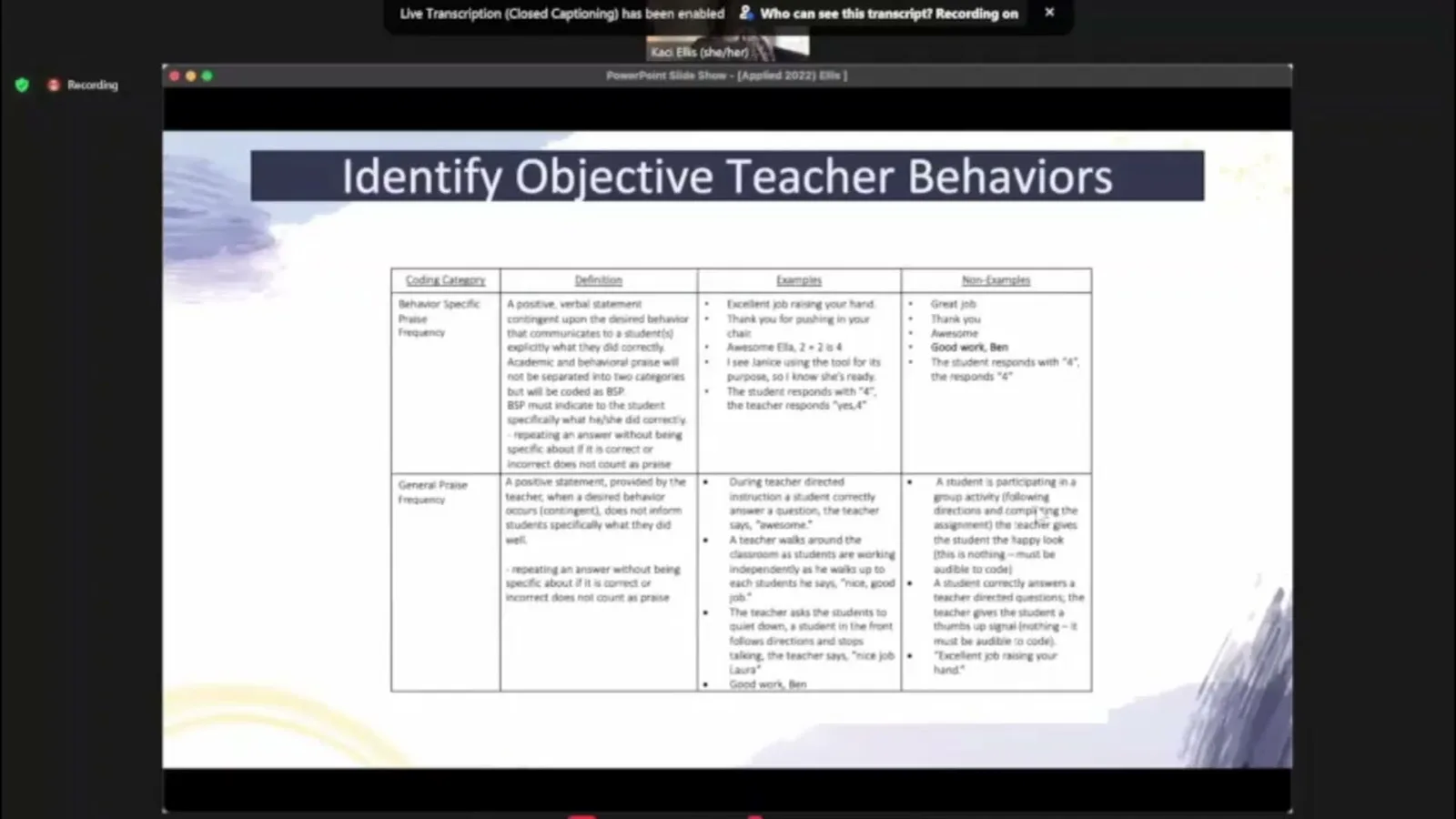
This session distills school-based, PBIS-aligned practices into concrete moves BCBAs can use the next school day. The presenter frames collaboration through an inquiry—not evaluative—stance, sharing survey data on how teachers perceive BCBAs and why partnerships succeed or fail. Attendees learn how to set up work through pre-meetings, role/scope contracts, and clarity on IEP status, consent, and restraint/seclusion policies. The talk then maps PBIS tiers to clinical decision-making: what to look for at Tier 1 (routines, visual schedules, posted/ taught expectations, attention signals, opportunities to respond, behavior-specific praise and 5:1 ratios, classwide reinforcement, token economies done right), when and how Tier 2 adds targeted supports (check-in/check-out, behavior contracts, performance vs. skill deficits), and how Tier 3 integrates FBA/BIP with true team involvement rather than “superhero” fixes. Practical supervision angles include coaching scripts, feedback that preserves rapport, progress-monitoring and fidelity checks, and safety planning (don’t work alone, know the school’s response team). Throughout, the emphasis is on ethical compliance, feasible interventions, and building a positive classroom ecology before writing intensive plans.
Register free & watch nowCancel any time. Cert delivered to your inbox the moment you pass the quiz.
Learner ratings
from 99 learners
97% would recommend this CEU to other professionals in their field (58 responses)
“Provided a lot of concrete ideas and applications”
— Jill M.“There was soo much good information. I loved it!”
— Katrina R.“very informative”
— Farwah A.“very informative with real life examples.”
— Denice H.“Very informative”
— Nawal M.“too basic”
— Jeanette J.
About this CEU
This session distills school-based, PBIS-aligned practices into concrete moves BCBAs can use the next school day. The presenter frames collaboration through an inquiry—not evaluative—stance, sharing survey data on how teachers perceive BCBAs and why partnerships succeed or fail. Attendees learn how to set up work through pre-meetings, role/scope contracts, and clarity on IEP status, consent, and restraint/seclusion policies. The talk then maps PBIS tiers to clinical decision-making: what to look for at Tier 1 (routines, visual schedules, posted/ taught expectations, attention signals, opportunities to respond, behavior-specific praise and 5:1 ratios, classwide reinforcement, token economies done right), when and how Tier 2 adds targeted supports (check-in/check-out, behavior contracts, performance vs. skill deficits), and how Tier 3 integrates FBA/BIP with true team involvement rather than “superhero” fixes. Practical supervision angles include coaching scripts, feedback that preserves rapport, progress-monitoring and fidelity checks, and safety planning (don’t work alone, know the school’s response team). Throughout, the emphasis is on ethical compliance, feasible interventions, and building a positive classroom ecology before writing intensive plans.
From the talk
What was covered
Dr. Kaci Ellis on reading Tier 1 before you write a Tier 3 plan, plus consent rules, scope limits, and what to ask a school first.
- Hold a pre-meeting and put your scope in writing before you set foot on campus.
- Ask whether the student has an IEP (a legal school services plan) and whether parents signed consent before you observe anything.
- Read Tier 1 first: if most of the class is off task, that is not one student's behavior.
- Tally opportunities to respond and count praise against corrections during every observation.
- Ask what Tier 1 and Tier 2 supports are still running, because tiers add on and never replace.
- Never write the behavior plan alone, and never let staff be alone with a student who is escalating.
What 1,680 Teachers Said About Working With BCBAs
Dr. Ellis opened with data, not advice. Her team at the University of Florida surveyed 1,680 teachers across the state. The survey asked what teachers knew about BCBAs (board certified behavior analysts). It covered shared work, behavior assessments, plan writing, and the wish to work together again. The paper is still being written. Treat the numbers as early, but useful.
Some findings were better than you might guess. 82% of teachers said they knew the terms their BCBA used. Jargon is the usual complaint, so that is a good sign. 64% said they felt supported. Most teachers who had worked with a BCBA wanted to do it again. They said the BCBA brought real skill. They said plan writing got easier. They liked the second set of eyes.
The other half of the data is where the work is. Teachers who did not want a repeat gave clear reasons. The plans were not realistic for their room. The tools never showed up. A BCBA would say to use a first then board or a token board. Then no one built one, and the teacher did not know how. Teachers also named overstepped boundaries. And they named plans that nobody followed. The BCBA wrote it, left, and never came back to check.
One role finding is worth sitting with. About 27% of the sample said their BCBA collected data on student behavior. Very few said their BCBA led staff training. If you work at the district level, that gap may be an opening for you.
So 79% of teachers who worked with the BCBA wanted to collaborate again.
From the talk — Dr. Kaci Ellis
Set Up the Work Before You Walk Into the School
Most of the trouble she described starts before the first observation. Her fix is a pre-meeting. Sit down with the admin who asked for you. Ask to review student data and past plans. Ask what has already been tried. Ask the teacher what is working and what is not. Fifteen minutes is enough. If there is no time to meet, send an email or a short form.
Then write a contract. Spell out your role, your limits, and what you will deliver. She suggests building your own matrix of what you can and cannot do in a school. Schools do not run on the BACB code, and most staff have never read it. A written scope gives you a calm way to say no later. You can point back to the meeting instead of arguing in the moment.
Ask two more setup questions. Does the school run PBIS (a school wide plan for behavior)? If not, do they run something like it? Then ask for the school's restraint policy (rules for holding or blocking students). Only a few staff are trained for that. Schools must report restraints to the state. Even holding a hand while a child pulls away can count. Know what you may do, and who to call instead.
The must knows come last, and they gate everything else. Does the student have an IEP (a legal school services plan)? If not, does the team want to start that process? Have the parents been told? Has consent been signed? Handle all of this by phone or email before you drive over. District BCBAs can build these questions right into the request form.
So that's my giant caveat here is you need to be listening to the school professionals before you do anything.
From the talk — Dr. Kaci Ellis
The PBIS Tiers and Why You Get Called So Late
Dr. Ellis framed the tiers with a parable. Two people are fishing. Kids keep floating down the river, so the fishermen keep pulling them out. One of them walks upstream to find out why. The bridge is broken. So they start fixing the bridge.
PBIS is a framework for that upstream work. It sits inside MTSS (the umbrella for tiered supports). The goal is a school that is safe, steady, and easy to predict. At the universal tier, 80 to 90% of students do fine with what everyone gets. Targeted supports are for the 5 to 10% who need more. Intensive supports are for the 1 to 5% who need a plan of their own.
Two rules matter here. First, each tier adds on. It never replaces the tier below it. So when a school says a student gets Tier 3 help, ask a follow up question. What Tier 1 and Tier 2 supports are still running? Second, tiers label behavior, not kids. No one is a Tier 3 kid. A student may need Tier 2 help with organizing, Tier 3 help in math, and nothing extra in reading.
This is also why the phone rings so late. BCBAs are rarely in the room for the early, simple fixes. By the time you arrive, staff are worn out and the student is in crisis. The room hopes you are the hero who saves the day. You are not, and she said so plainly. What you can do is find out what the school already built, then help them stand back up.
We want to fix that bridge before the kids are falling down the river.
From the talk — Dr. Kaci Ellis
Tier 1 Look Fors: Routines, Visuals, and Stated Rules
Read the room before you read the student. Look for structure. Are there routines the kids already know? Is the space set up so adults can see everyone? She warned about cute reading nooks built from cabinets and curtains. One blocked sight lines so well that a student slept inside it. Check lines of sight before you write a word about one child.
Look for posted visuals. Her second grade room had the class schedule on the wall. The specials schedule was up too, so kids stopped asking when PE was. Morning routine steps were posted as pictures. That gives the whole class a visual schedule. A few students will still need their own. Many will not, and that is the point of Tier 1.
Then listen for expectations. Each room should have three to five rules. They should be positive, short, and easy to see happen. They should be taught with examples and non examples. They should be prompted right before the hard moment. Note how the teacher gets the class to look up, too. A call and response signal beats shouting. Some teachers will say kids should just know the rules.
How many of us know what to do, but don't do it?
From the talk — Dr. Kaci Ellis
Watch the Peers, Not Just Your Student
Half of a good observation is watching everyone else. If a rule was never stated, you cannot fault one student for breaking it. If most of the class is up and moving, that is a Tier 1 problem, not a Tier 3 one. She once watched a class lick crumbs off snack plates while the referred student sat and waited. That tells you where to start.
She offered a rough test you can use out loud. Picture a class of 20. If 16 or more meet the expectation, Tier 1 looks like it is working. If fewer do, that piece of Tier 1 needs to change. You can ask an admin the same question: how many students in here do you think are meeting this expectation? It moves the talk off one child.
Write context into your notes. A line like student fell out of the chair tells the next reader nothing. Say what came before, what the adult did, and what happened next. If you want a handoff tool, the free classroom assistance tool on pbis.org walks a teacher through these pieces. You do not have to score it. You can hand it over as a self check.
Count Opportunities to Respond and the 5 to 1 Praise Ratio
Opportunities to respond (chances for kids to answer) are easy to count. One happens when the teacher asks one student, the whole class, or partners to respond. More chances to respond means less open time for problem behavior. Match the response type to what the student can actually do. That matters most in intensive special education rooms.
So bring a tally. Fifteen minutes of teacher talk with zero chances to respond is data. You do not have to grade anyone for it. You can say what you counted and stop there. That is the inquiry stance: report what you saw, and let the team draw the line.
Praise is the other count. Behavior specific praise (praise that names the exact action) was her favorite move. It is quick, needs no prep, and it lands right after the behavior. She also runs a praise assessment, much like a preference assessment (a check of what someone finds rewarding). Some kids love being called out in front of the class. Others hate it. Ask first, then write the answer into the plan.
Ratios tell the story fast. She watched a kindergarten room for 15 minutes. She counted 35 negative statements and 3 behavior specific praise statements. The research she cited supports five positive statements for every correction. If a room is far off that mark, say so before you write anything intensive.
And so my magic intervention plan is not going to work if the classroom environment does not feel safe and positive.
From the talk — Dr. Kaci Ellis
Classwide Reinforcement and Token Economies Done Right
Group contingencies (a shared reward for the group) come in three shapes. In the all for one shape, the class works toward one goal together. Her second grade class filled in pieces of a superhero poster, then voted on the reward. She used it for hallway, cafeteria, and specials behavior.
The second shape rides on one student. That is the secret student setup. The teacher watches one student whose name the class never hears. That last part is the whole rule. She saw a teacher name the secret student after a rough day and tell the class they lost the sticker. The student threw something. Of course they did. If the student does earn it, ask in private whether they want it shared.
The third shape is each student earning their own reward. Behavior contracts fit here, and so do token economies (earning tokens to trade for rewards). She had a warning about those.
So walk the steps with the teacher. Explain what a token economy is in plain words. Define what earns a token. Check that the target is worth reinforcing, not just something the student should already do. Set the trade rate. Set a plan for who monitors it. Schools use tickets, class apps, and punch cards. Her favorite rewards were coupons: class DJ for a brain break, or a drawing left on her board. The reward does not need to be a party. It needs to matter to that student.
Just because a teacher has a token economy doesn't mean it's going correctly.
From the talk — Dr. Kaci Ellis
Tier 2: Performance Deficit or Skill Deficit
Tier 2 adds targeted help for a smaller group. The school should have a menu of options, not one default. Dr. Ellis sorts students by the type of gap. A performance deficit (the student knows how but is not doing it) means the gap is about will, not skill. A skill deficit (the student does not know how yet) means the gap is about ability. The support has to match the gap.
For performance gaps, she leans on simple motivation systems. Behavior contracts. Chart Moose, where a student fills in dots around a picture of something they like, such as basketball or pizza. Dots for motivation, where finishing a set of work earns a sticker. Check in check out (a daily goal check with an adult) is the classic one. Mystery motivators hide the reward. That is fun for some kids and rough for a student who needs to know what is coming.
One caution on the work itself. If the number of problems gets cut, the teacher picks which ones stay. Students still need access to the standards. Do not hand that call to an RBT (a behavior tech you supervise). Choosing academic work sits outside our scope.
Skill gaps need teaching, not a sticker. That usually means small group instruction from a counselor, social worker, or school psychologist. A BCBA is not the default person to run those groups. A district BCBA might, if the school asks and it fits your skill set. Either way, ask the same questions at every tier. What does the data show? Is the plan being run the right way? Is the student better off?
So holding people accountable in an inquiry way is really important.
From the talk — Dr. Kaci Ellis
Tier 3, Consent, and Staying Inside Your Scope
Tier 3 is where most of us get the call. IDEA (the federal special education law) says a school must build a behavior plan when behavior blocks a student's learning. The same rule applies if the behavior blocks other students from learning. The law does not say how. So practice varies a lot. Some schools ask teachers to run the FBA (a study of why behavior happens). In her survey, 67% of teachers felt they could carry one out. She was blunt about that number. She would not want a surgeon who felt 67% ready.
Consent is the question she hears most. The BACB code says you must know and follow every condition for informed consent (written parent okay before you start). Under IDEA, schools need parent consent before a first evaluation. They need it before a reevaluation. They need it before special education services start. And they need it before any assessment of a student with a disability.
So the answer to can I just pop in and watch is usually no. If the student has an IEP, get consent first. If the student has no IEP but is getting tiered supports, parents should still be told what is changing. She errs toward consent every time. If someone says the parents do not know because this is just a planning tool, wait for consent.
Two more limits keep you safe. Never write the behavior plan by yourself. It should come from the school team, and the family should get the results of the FBA and the plan. And no one should be alone with a student who is escalating. She described an RBT who walked a student outside alone while the teacher watched from a window. Decide in advance who gets called and how. Learn the school's response team before you need it.
There has to be parent consent before an FBA happens, which means that you have to have parent consent before you go in and do your observation.
From the talk — Dr. Kaci Ellis
Common questions
Do I need parent consent to observe a student who already has an IEP?▾
Dr. Ellis reads IDEA as yes. If a student has an IEP and you plan to observe, study the data, and recommend a plan, parents should sign consent first. Consent is required before an FBA. The observation counts as part of that work. When in doubt, she errs toward getting consent.
How can I tell if Tier 1 is strong enough to support a Tier 3 plan?▾
Watch the peers, not just the referred student. Picture a class of 20. She treats 16 or more students meeting an expectation as a sign Tier 1 is working. If fewer meet it, that piece of Tier 1 needs to change first. Look for stated rules, posted routines, chances to respond, and more praise than correction.
What do I say when I walk into a classroom that is total chaos?▾
Take objective notes on what you see, then ask the admin who requested you for a few minutes. Describe what you observed: no routines, no stated expectations, a lot of negative feedback. Say that you are not confident calling this a Tier 3 need when Tier 1 looks like this. Offer to share what classwide supports look like instead of writing a plan on the spot.
Should the BCBA run Tier 2 social skills or self regulation groups?▾
Usually not. Those groups are tailored instruction, and schools normally assign them to a counselor, social worker, or school psychologist. A district level BCBA might lead one if the school asks and it fits their skill set. Your job is more often to ask for the data, the fidelity check, and the progress monitoring.
Can a BCBA restrain a student at school?▾
That depends on the school's policy, and you have to ask before you start. Only certain staff are trained, and schools must report restraints to the state. Even holding a student's hand while they pull away may count as a restraint on campus. Find out who to call, and do not end up alone in a room with an escalating student.
About the speaker
Dr. Kaci Ellis taught general education and special education in kindergarten through fourth grade. She served as an exceptional student education department chair, then earned a PhD in special education and became a BCBA. Her work at the University of Florida included a survey of 1,680 teachers on how they see behavior analysts in schools. She says school based practice is where she feels most at home.
This summary was generated from the recording’s transcript. Quotes are taken word for word from the talk.
What you'll learn
- 1Abstract This session distills school-based, PBIS-aligned practices into concrete moves BCBAs can use the next school day. The presenter frames collaboration through an inquiry—not evaluative—stance, sharing survey data on how teachers perceive BCBAs and why partnerships succeed or fail. Attendees learn how to set up work through pre-meetings, role/scope contracts, and clarity on IEP status, consent, and restraint/seclusion policies. The talk then maps PBIS tiers to clinical decision-making: what to look for at Tier 1 (routines, visual schedules, posted/ taught expectations, attention signals, opportunities to respond, behavior-specific praise and 5:1 ratios, classwide reinforcement, token economies done right), when and how Tier 2 adds targeted supports (check-in/check-out, behavior contracts, performance vs. skill deficits), and how Tier 3 integrates FBA/BIP with true team involvement rather than “superhero” fixes. Practical supervision angles include coaching scripts, feedback that preserves rapport, progress-monitoring and fidelity checks, and safety planning (don’t work alone, know the school’s response team). Throughout, the emphasis is on ethical compliance, feasible interventions, and building a positive classroom ecology before writing intensive plans.
Concepts in this CEU
Related talks
Talks that cover the same concepts

The Interdisciplinary Case Conference
The Mindful Learner LLC
School Collaboration as an Area of Competence - Applied 2022
The Behaviorist Bookclub
Beyond 1:1: The Ethical Path to Creating a Scalable Course as a BCBA
The Behaviorist Bookclub

Streamlining BIPs & Data Collection Systems for Schools
NRS Compassionate Behavior Services

Empowering Autonomy and Self-Management in ADHD Learners
The Behaviorist Bookclub
Shaping Behavior Change when ADHD is in the Picture
The Behaviorist Bookclub
More from The Behaviorist Bookclub
Harm Reduction Within ABA Practice
The Behaviorist Bookclub
Supervising Beyond Technical Skills: Professionalism, Communication, and Clinical Judgment
The Behaviorist Bookclub
Reflective Supervision and Client Outcomes
The Behaviorist Bookclub
OpenCEU is supported by advertising from third-party sponsors. Sponsors are clearly labeled, have no influence over course content, instructors, or CEU decisions, and never appear on certificates. The BACB does not sponsor, approve, or endorse OpenCEU sponsors or their products.