The Life of a Showgirl (BCBA’s Version)
Presented by Amber Feick, BCBA
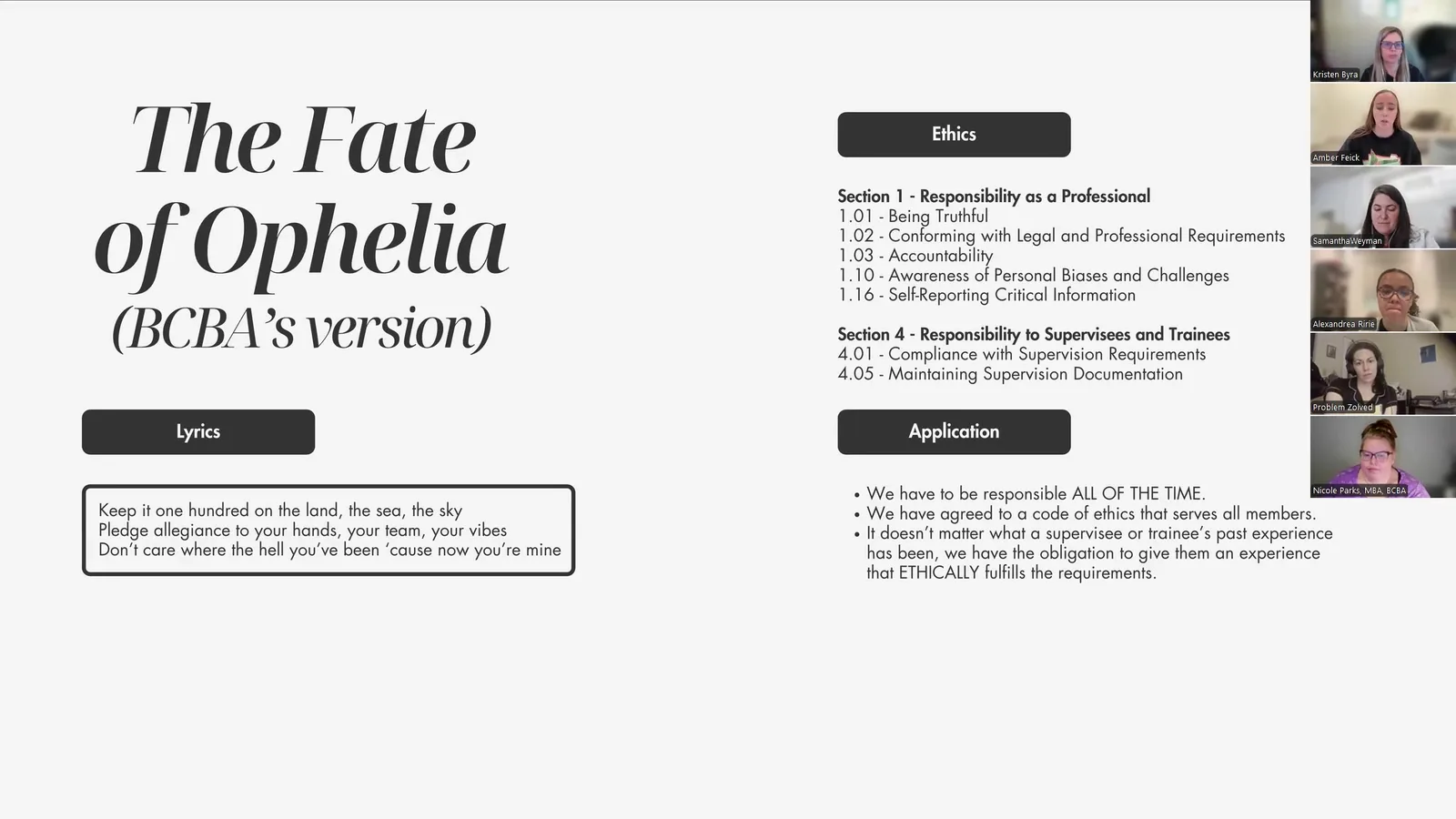
This ethics-focused presentation uses pop culture narratives and music-inspired case examples to examine real-world ethical responsibilities of behavior analysts. Through relatable scenarios involving supervision, professional boundaries, documentation, social media use, collaboration, and accountability, participants will explore how everyday decisions leave lasting professional “footprints.” The training emphasizes ethical consistency across roles, settings, and platforms, highlighting responsibilities to clients, supervisees, trainees, colleagues, and the public. Attendees will strengthen their ability to identify ethical risks, apply relevant sections of the BACB Ethics Code, and implement proactive strategies to protect client dignity, maintain professional integrity, and uphold the standards of the field.
Register free & watch nowCancel any time. Cert delivered to your inbox the moment you pass the quiz.
Learner ratings
from 3 learners
67% would recommend this CEU to other professionals in their field (3 responses)
“This was interesting to see how music and songs can be related in real life ABA terms especially ethics. Super cool and creative CEU”
— Elizabeth M.
About this CEU
This ethics-focused presentation uses pop culture narratives and music-inspired case examples to examine real-world ethical responsibilities of behavior analysts. Through relatable scenarios involving supervision, professional boundaries, documentation, social media use, collaboration, and accountability, participants will explore how everyday decisions leave lasting professional “footprints.” The training emphasizes ethical consistency across roles, settings, and platforms, highlighting responsibilities to clients, supervisees, trainees, colleagues, and the public. Attendees will strengthen their ability to identify ethical risks, apply relevant sections of the BACB Ethics Code, and implement proactive strategies to protect client dignity, maintain professional integrity, and uphold the standards of the field.
Credits
1 ethics CEU · 56 min
From the talk
What was covered
A BCBA (board certified behavior analyst) walks through the BACB Ethics Code (the field's rulebook for ethical practice) using one Taylor Swift album. The topics include supervision, boundaries, social media, assent, and ending services well.
- Use the ethics code as a daily compass, not as a document you open after something goes wrong.
- Give supervisees honest feedback as you see it, so no review ever surprises them.
- Bring clients into goal choice, materials, and setting, not just the consent form at intake.
- Before you post about your work, ask who gains from the post and who carries the risk.
- When a case sits outside your training, get mentorship or transfer it instead of pushing through alone.
- Build a plan for discontinuing or transitioning services before you are forced to make one.
Why the Ethics Code Works Better as a Compass Than a Fact-Check
Most of us open the ethics code only after something already feels off, or when we are fact-checking ourselves. Amber Feick made a case for the other use of the code. Open it on the good days too.
Her talk follows one album, track by track, with each song tied to a duty we carry. The frame is playful, but the point is not. You do not get to turn ethics on and off. We have to be ethical in everything we do, whether we work directly with clients or with our supervisees. That means being honest, holding ourselves accountable, and keeping our documentation accurate.
She also named the first safeguard, and it is you. Know your own bias (the leanings we bring in) and know your limits. Notice when you are stretched too thin to do good work. A company may back you up, and other entities may help. But you are the one who signs the plan and owns the call.
we really should be using our ethics code as a compass to guide our everyday decisions
From the talk — Amber Feick, BCBA
Your Professional Footprint Lasts Longer Than the Case
People hold on to how you treated them. Feick put it plainly: what you do and say stays with people forever. Everyone's perception becomes their own reality. That is true for clients and for supervisees alike.
Her fix starts at the front end. Be clear about expectations with clients and supervisees from day one. Say what you will do, how often, and what you cannot do. Then do what you said you would do. The goal is work you can stand behind later.
She offered a blunt gut check for the gray moments. If part of you thinks you should not be doing this, you probably should not. That may mean stopping, or it may mean doing it a different way.
She tied the same idea to the field itself. Look back ten or fifteen years in ABA (applied behavior analysis), and some of it makes us wince. That is not a reason to look away from it. It is a reason to keep changing the work.
everything that we do leaves a footprint. So we need to be keeping that in mind with anything that we are doing now and in the future.
From the talk — Amber Feick, BCBA
Bring Clients Into the Plan, Not Just the Consent Form
One way to avoid a bad ending is to share control early. Feick pointed to Code 2.09 (the code on involving clients). It names goal choice and treatment choice as two places to bring people in.
She pushed the idea smaller than most of us do. Ask which materials a client wants to use today. Ask where the session should happen. These are small calls, and they come up all day long.
Informed consent (clear agreement before services begin) does the same job at the start. Everyone should hear what the service is and what it is not. If a family asks for something you cannot give, say so clearly. Then tell them what you can give instead.
Feick works as a clinical BCBA, and she said so during the talk. Most of her examples involve kids and families for that reason. The same code sections still apply in schools, in companies, and in work with adults.
Code 2.09 gives examples such as involving them in goal selection, in intervention selection.
From the talk — Amber Feick, BCBA
The Feedback a Supervisee Never Saw Coming
Feick shared a story from her first years in the field. She worked with two providers at once, each with its own supervisor. With one supervisor, the work felt great, and she liked the relationship. She thought her clients were making real progress.
With the second supervisor, the feedback felt harsh and nothing meshed. She could not work out why one person was getting two very different reviews. So she sat down with the first supervisor and asked for help.
The answer landed hard. That supervisor had seen the same problems, because the two supervision schedules overlapped. She had simply never said any of it out loud. Feick was mortified. She had assumed the two experiences were unrelated, when the first supervisor had seen the same issues all along and never said so.
That is the ethics lesson behind performance monitoring and feedback (watching work and saying what you see). Silence is not kindness, and a good relationship is not a reason to hold back. If you share a trainee with another supervisor, compare notes early. Small corrections given often will beat one hard review later.
our supervisees or trainees should never be surprised by the feedback that they're getting
From the talk — Amber Feick, BCBA
Dissemination, Social Media, and Who Carries the Risk
Search ABA on any platform and you will find pages making claims. Some of it is built on research, and some of it is not. Feick is firmly for dissemination (sharing our science in public). She believes ABA could help with many problems in the world.
The limit she drew is about who pays for the post. A story that gets clicks can still expose a client. A clip of a hard moment can follow a client for years. The same holds for supervisees and trainees, whose rough day is not your content.
A short check works before you hit post on anything. Ask who gains from this and who carries the risk. If the client carries the risk, the post is not worth it. Dissemination can wait, but dignity and privacy cannot.
dissemination cannot be done at the expense of the clients or the supervisees or the trainees that we have
From the talk — Amber Feick, BCBA
What To Do When You Are Not the Right Provider
Feick spent real time on power, and she kept the frame simple. The work is not about us; it is about the people we serve. She was open about her own limits too. Being good at this job does not mean knowing everything.
The wrong answer is the reflex one: I am a BCBA and I can take anything. That reflex shows up as fieldwork supervision (supervised hours before you certify) you have no time to give. It shows up as a case you cannot treat well. The better answer is almost always more help. Consult with peers, or call another BCBA for a second read. Bring in SLPs and OTs (speech and occupational therapists) when the client needs them. Sometimes the right move is handing the case to someone else.
The code also keeps us inside our scope of competence (the work we are trained for). We are not guessing, and we are not crossing our fingers and hoping. Feick asked a sharper version of that question. Can you even track whether you did what you said you would do? If you cannot, that is the first gap to close.
An attendee asked what to do the moment you realize your services are not working. The answer from the discussion came in two parts. First, sort out whether the gap is your skill or the fit of the service. If it is your skill, get mentorship inside your agency or transfer the case. If you practice alone, find a mentor or refer the client out. And ask whether the client needs more than ABA, such as medical or psychiatric support alongside it.
just because you start with that person doesn't mean that their experience needs to necessarily end with you, especially if you are not the provider that can give them what they need.
From the talk — Amber Feick, BCBA
Boundaries Get Decided Before They Get Tested
Feick was direct here. You already made the choice to be ethical when you certified. After that, it is not a fresh decision every time. So do not put yourself in a spot where a relationship competes with the code.
If lines do start to blur, do not keep blurring them. Say something, even if you are the awkward person in the room. She warned about the softer version of this too. You want a supervisee to feel fully supported. But not through a dual relationship (a second role with one person).
The harder boundary is with other professionals. Our job is not to claim that ABA is everything. Our job is to push for the treatment the client actually needs. That can upset another provider, and that is sometimes the cost.
Her risk benefit analysis (weighing the harm against the gain) was short. Say the thing and risk getting canceled. Or keep the peace and let the client absorb the difference. Keeping the peace is not a neutral choice. Stay professional, stay honest from the start, and then say the thing. The host added one more warning. Some people now use the code as a weapon in arguments. That is different from using it as the standard for their own conduct.
Codes 1.11 and 1.14 are in section one for a reason. Be professional from the beginning.
From the talk — Amber Feick, BCBA
Assent, Ending Services Well, and the Showgirl Theory
Feick's take on assent (a willing yes from the client) came with some history. When she certified about ten years ago, nobody asked her about assent. It was not modeled, and it was barely part of the conversation. She counts that change as real progress for the field.
Assent sits right next to neurodiversity affirming practice (respecting how different brains work). Both ask the same question about the service in front of you. What is this doing for this person right now? Sometimes the honest answer is more support, and sometimes it is a different provider.
She said the hardest parts of the job are discontinuing and transitioning care. We talk a lot about starting a case and very little about ending one. Funders are already asking the blunt question about whether you did what you promised. If the service is not right, end it or move it with care.
She closed with two theories. She credited Tyra Sellers with the zombie theory: one careless supervisor trains others, and poor practice spreads. Feick offered a better version and called it the showgirl theory. Seasoned people pass down good habits, and the field grows like a garden. The host added the reason this matters so much. Trainees copy what they see, because the person modeling it has more years in the field.
we are the seasoned professionals, um, and we can continue to pass along our ethical guidelines to support the growth of really amazing, amazing BCBAs.
From the talk — Amber Feick, BCBA
Common questions
Which parts of the BACB Ethics Code does this talk cover?▾
Feick names Code 2.09 on involving clients and stakeholders, plus Codes 1.11 and 1.14 on professional boundaries. She also works through broader duties: accountability, documentation, supervision and feedback, scope of competence, informed consent, and public statements. The talk connects each one to an everyday decision rather than a rare crisis.
How do I tell whether my services are actually effective?▾
Start with your own data on skill gains and behavior change. If the data are thin, the first problem is measurement. Get outcome measures (tools that track client progress) in place. Feick also asked whether you can show you did what you said you would do. If you cannot track that, close the gap before you judge the outcomes.
Can I post about my cases on social media?▾
Feick supports dissemination and thinks ABA has a lot to offer the public. The line is cost to the people you serve. If a post exposes a client, a supervisee, or a trainee, it is not worth publishing. That holds no matter how useful it looks. Ask who gains and who carries the risk before you post.
What should I do if I realize I am not the right provider for a client?▾
Treat that as an ethical finding, not a personal failure. Consult more, call another BCBA, or bring in other providers such as speech or occupational therapists. If the case still sits outside your training, get mentorship or transfer it. Starting with someone does not mean their care has to end with you.
Do I need to know the Taylor Swift album to follow this talk?▾
No. The album gives the talk its order, moving through tracks one to twelve, but each track is just an entry point into a code topic. The content stands alone for anyone who has never heard the songs.
About the speaker
Amber Feick is a BCBA who has supported children in clinic, home, school, and community settings, with a focus on early intervention (services for very young children). She has been a BCBA for ten years and works in a clinical role. She cares about training, compassionate support for providers, collaboration with other health care providers, and neurodiversity affirming practice. In March 2025 she created the self-care initiative, a community for service providers committed to sustainable well-being.
This summary was generated from the recording’s transcript. Quotes are taken word for word from the talk.
What you'll learn
- 11) Identify and apply relevant sections of the BACB Ethics Code related to professional accountability, supervision practices, documentation, and communication in clinical and supervisory roles. 2) Analyze common ethical dilemmas involving social media use, client and supervisee relationships, and professional boundaries, and determine ethically appropriate responses consistent with the Ethics Code. 3) Implement proactive strategies to reduce ethical risk, including self-reflection on personal bias, ethical decision-making in public and professional settings, and practices that promote transparency, dignity, and continuity of care.
Related talks
Talks that cover the same concepts

Crash Course in Behavior Analytic Toilet Training: Translating Research to Practice
Copper Consulting Group
Open the Door: Low Dosage ABA as an option
Nicole L. Stewart LLC

Rad N Bad: The Other Side of the Table — Ethical Failures, Compassionate Care, and Consumer Realities in ABA
Hickory Learning Group

Rad N Bad: Dosage by Tradition: What the Research Actually Says About ABA Hours, and the Contingencies Behind Them
Hickory Learning Group
Harm Reduction Within ABA Practice
The Behaviorist Bookclub

Roadmapping: A Guide to Lasting Independence
Hickory Learning Group
More from Upskill ABA
A Panel on Collaboration in Practice: SLP, OT & ABA Services
Upskill ABA
From Peer to Professional: Becoming & Supporting Early Career Behavior Analysts
Upskill ABA
From Idea to IRB: Conducting Research in Your ABA Practice
Upskill ABA
OpenCEU is supported by advertising from third-party sponsors. Sponsors are clearly labeled, have no influence over course content, instructors, or CEU decisions, and never appear on certificates. The BACB does not sponsor, approve, or endorse OpenCEU sponsors or their products.