Behavior-Specific Praise: A Classroom Guide
Behavior-specific praise tells a student exactly what they did right. Learn the four-to-one ratio, rate targets, and how to use it well in class.
Key takeaway
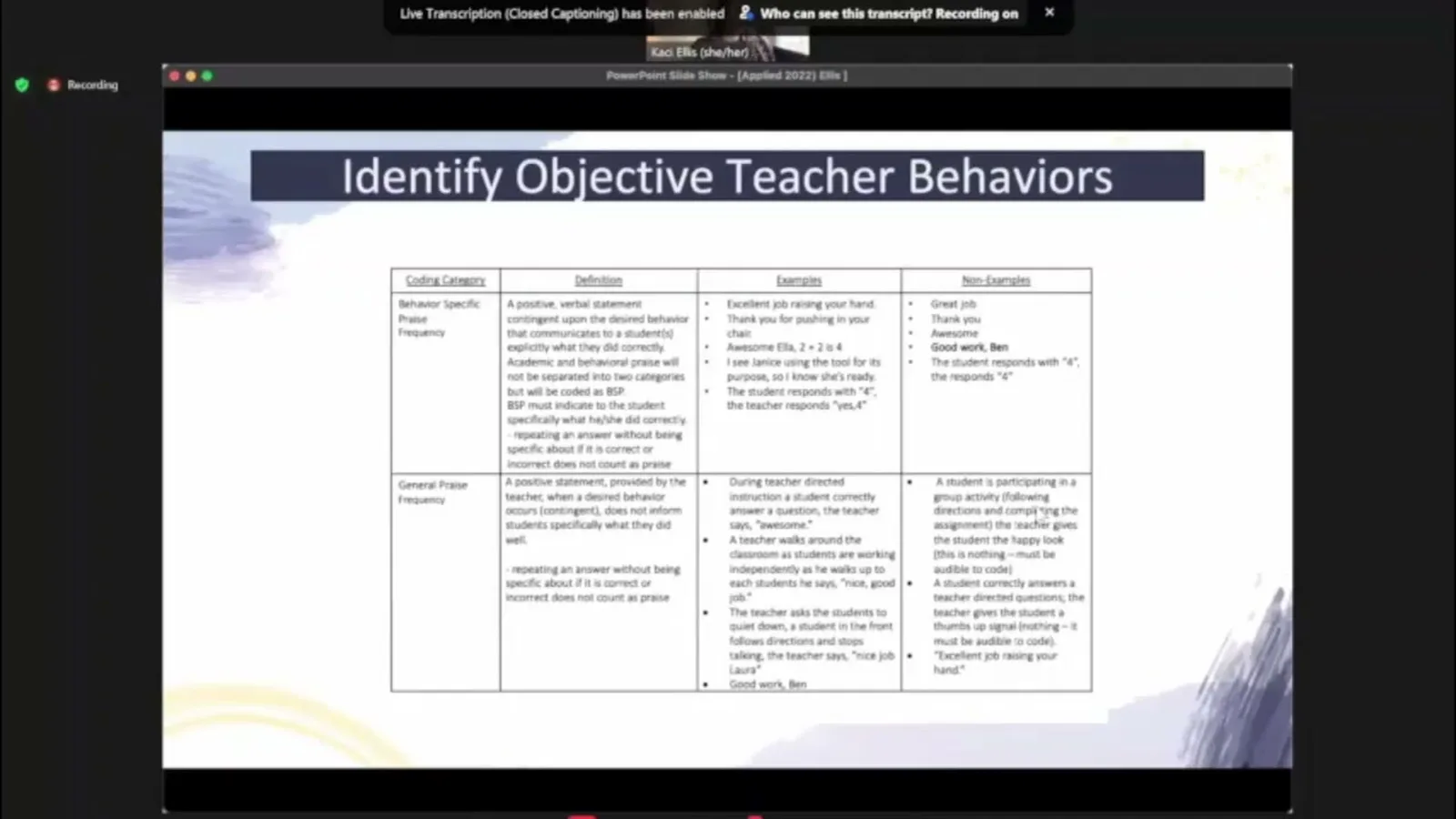
Behavior-specific praise tells a student exactly what they did right. It is not just "good job." It names the action, and it comes right after the action happens.
Explore free BCBA CEU courses
Free learning path on this topic
Master PFA and SBT
Matt Harrington's 12-article walk through practical functional assessment and skill-based treatment, from Hanley's 2014 study to the enhanced choice model. Then assent, since SBT depends on it, and the ethical guardrails that keep behavior reduction defensible. Five CEUs, one of them ethics.
Experts who cover this
The recording behind this guide covers behavior-specific praise.
- 1 Supervision CEU
Practical Takeaways for School-Based Behavior Analysts
Dr. Kaci EllisThe Behaviorist Bookclub
Recommended as the least intensive acknowledgment strategy, paired with the idea of running a preference assessment for praise itself since some students…
On this page · 8 sections▾
Behavior-specific praise tells a student exactly what they did right. It is not just "good job." It names the action, and it comes right after the action happens.
This small tool has a big payoff. It is easy to use and costs nothing. Teachers, RBTs, and BCBAs can use it every day. This page covers what it is, how much to use, and how to do it well.
What behavior-specific praise means#
General praise is vague. It says "nice work" but leaves out the details. Behavior-specific praise fills in the blank. It tells the student the exact behavior you liked.
Dr. Kaci Ellis explains the two key parts. You name the behavior, and you do it fast.
My favorite behavior specific praise. So we are telling students exactly what it is that they are doing correctly. It's right after it happens. From the talk — Dr. Kaci Ellis
So instead of "great," you say "I like how you raised your hand." The student now knows what to do again. Praise that names the action teaches. Praise that is vague does not.
Ellis also calls it the least intense strategy you can use. It is a gentle first step before bigger supports. That makes it a strong Tier 1 tool for a whole class.
The four-to-one ratio#
How much praise is enough? Experts point to a ratio, not a single number. You compare praise to correction.
Claudia Segoe shares a clear target backed by research. Praise should outweigh correction by a wide margin.
The goal really needs to be at least four praise statements for every one corrective statement for every single individual that I'm interacting with as an educator. From the talk — Claudia Segoe
So for each correction, aim for four praises. This keeps the tone of the room warm. Students hear far more about what they do right than wrong.
Note the last words in that quote. The ratio is per individual student. It is not an average across the whole class. Each child needs their own four-to-one balance.
Why does the ratio matter so much? Correction alone teaches what not to do. It does not teach what to do instead. Praise fills that gap by pointing to the right behavior. A room with far more praise than correction feels safe to learn in.
Raise the ratio for some students#
 Advertisement
Not every student needs the same dose. Some kids need more praise to stay on track. These are often the students who struggle most.
Segoe says to push the ratio higher for them. Four is a floor, not a ceiling.
But particularly for kids with, who are more likely to engage in challenging behavior, we really want to up that four and maybe make it look more like six or eight or 12. From the talk — Claudia Segoe
This may feel like a lot at first. But these students often hear too much correction already. More praise helps flip that pattern. It gives them reasons to keep trying.
Watch your rate, not just your ratio#
Ratio is one measure. Rate is another. Rate is how often praise happens over time.
Segoe gives a floor for group teaching. It helps keep praise from fading during a busy lesson.
In terms of rate, we want to be looking at six praise statements per 15 minutes of group instruction. From the talk — Claudia Segoe
That works out to about one praise every few minutes. It is a steady drumbeat, not a rare event. A simple tally on paper can help you track it. You may be surprised how low your rate is at first.
Some students dislike public praise#
Praise is a reinforcer only if the student likes it. Not every child enjoys being called out. Loud praise in front of peers can even backfire.
Dr. Kaci Ellis suggests you test it, just like any other reinforcer. You can run a praise assessment.
There are praise assessments that you can do with students, like our preference assessments, but with praise. And so you can see exactly what it is that that student likes. From the talk — Dr. Kaci Ellis
Some kids love a public shout-out. Others prefer a quiet word or a note on their desk. Ask and observe before you assume. Match the praise style to the student.
This step is easy to skip, but it protects your effort. You can deliver perfect, specific praise and still get no result. If the student hates the attention, your praise acts more like a punisher. A quick check saves you from that trap.
Putting it together in a lesson#
The pieces work best as a set, not alone. You want the right words, the right ratio, and the right rate. You also want a style each student enjoys.
Start small and build. Pick one class period to track your praise. Tally each specific praise and each correction. Then check your ratio and your rate against the targets. Adjust one thing at a time until it feels natural.
What the research says#
Studies confirm that praise works but that teachers often underuse it. The good news is that simple tools can raise it.
One study looked at how goals are worded for staff. Telling teachers the exact behavior was not enough on its own. Adherence went up when goals also stated how often to use the praise (Cohrs, Shriver, Burke, & Allen, 2016). So a clear frequency target helps, not just a vague reminder.
Another study tested a low-cost self-tracking tool. Teachers used a hand counter to tally their own praise. Their rate of behavior-specific praise went up when they self-monitored (Justus, Hott, & Heiniger, 2023). This gives you a cheap way to build the habit on your own.
FAQ#
What is an example of behavior-specific praise? A general praise is "good job." A behavior-specific version names the action. For example, "I like how you put your materials away quietly." The student hears the exact behavior that earned the praise.
What is the ideal praise-to-correction ratio? Aim for at least four praise statements for every one correction. Do this for each student, not as a class average. For students who struggle more, raise it to six, eight, or even twelve to one.
How do I know if a student likes being praised? Run a quick praise assessment, much like a preference assessment. Try public praise, quiet praise, and written notes. Watch which one the student responds to best. Then use the style that works for that child.
For more classroom-ready tools like this, see Practical Takeaways for School-Based Behavior Analysts.
 Advertisement
Keep learning
Earn free BCBA CEUs on openceu
Browse on-demand recordings from verified ACE providers and earn CEUs across autism, ABA, and behavior analysis. Detailed certificate, delivered the moment you finish.
Keep going with a free learning path
Master PFA and SBT
Matt Harrington's 12-article walk through practical functional assessment and skill-based treatment, from Hanley's 2014 study to the enhanced choice model. Then assent, since SBT depends on it, and the ethical guardrails that keep behavior reduction defensible. Five CEUs, one of them ethics.