Supporting Parents of a PDA Child: BCBA Caregiver Training That Works
How BCBAs can train and support parents of PDA kids without sounding condescending, including resetting baseline and scaffolding wins, from a BCBA-led CEU.
Key takeaway
Supporting a parent of a child with a PDA profile (pathological demand avoidance, a behavior pattern where any request can feel like a threat to autonomy) is mostly three things in a session: resetting the parent's own baseline before you teach anything, role-playing the next response with you standing beside them instead of in front of them, and asking "how else could we do it" instead of handing them a script.
PDA Caregivers, Complex Profiles, Replacement Behaviors, and Being Trauma Informed
On this page · 8 sections▾
Supporting a parent of a child with a PDA profile (pathological demand avoidance, a behavior pattern where any request can feel like a threat to autonomy) is mostly three things in a session: resetting the parent's own baseline before you teach anything, role-playing the next response with you standing beside them instead of in front of them, and asking "how else could we do it" instead of handing them a script. The clinical instinct is to fix the kid first. The work that actually moves the needle is fixing how the adult walks back into the next demand.
What parents of PDA kids actually walk into your office carrying#
Most parents you sit down with have already heard, from a pediatrician or a teacher or a relative, that this is a parenting problem. They have been told to be firmer. They have been told to be softer. They have tried both. The Nawaz and Speer caregiver experience research B. Kuerine Gray cites describes a pattern of judgment plus no real support plus very little accurate information from the people parents go to for help.
That stack is the reason your training session is starting at a deficit before you say a word. The parent in front of you is not a blank slate. They are carrying a learning history that says trying new things has not worked, and trying old things gets them judged. If you open with a script of "here is the intervention," you are the next person in line telling them what to do.
There's judgment that it's just parenting, it's poor parenting. And that's why the children are demonstrating this pattern of behaviors. From the talk — B. Kuerine Gray
The Carlozzi paradigm shift study, the first peer-reviewed PDA caregiver training study in the US, found the biggest effect sizes in caregiver strain, anxiety, and depression. The parents who got better at supporting their kids were the parents whose own mental load came down. That is the order of operations: parent first, plan second.
If you also need language for the very first conversation where a parent is hearing the term PDA for the first time, see → see the related page on this site. This page picks up after that, in the messy middle.
Resetting parent baseline before any training session#
When a caregiver walks in escalated, you do not start training. You reset them first. This is the single most repeated move in the talk and the one BCBAs skip the most.
"Escalated" in the moment can look like venting, fast speech, jumping straight to "what did I do wrong," or a parent who keeps trying to recap the last incident in detail. None of that is teachable. Their nervous system is reporting in. Until that quiets, your bullet points will not land.
One of the things that I found most helpful in getting parent buy-in is to reset their baseline. If there was an episode that I've gotten there directly following, I can see that parent is escalated. I can remove them and we can address resetting their baseline. From the talk — B. Kuerine Gray
In practice, that means stepping away from the child, sometimes physically into a different room, and spending the first five to ten minutes letting the parent breathe and name what happened. You ask what their goal was. You ask what got in the way. You agree the situation was hard. You do not, in those minutes, correct anything.
This is not therapy. It is co-regulation for the adult who is about to learn a new skill, using the same logic you would use with a learner who needs to come down before they can practice an FCR (functional communication response, the replacement behavior you are shaping). If the parent cannot regulate, the training session is just adding another demand to a person already at capacity.
Awareness, acceptance, accommodation: mapping BST onto PDA#
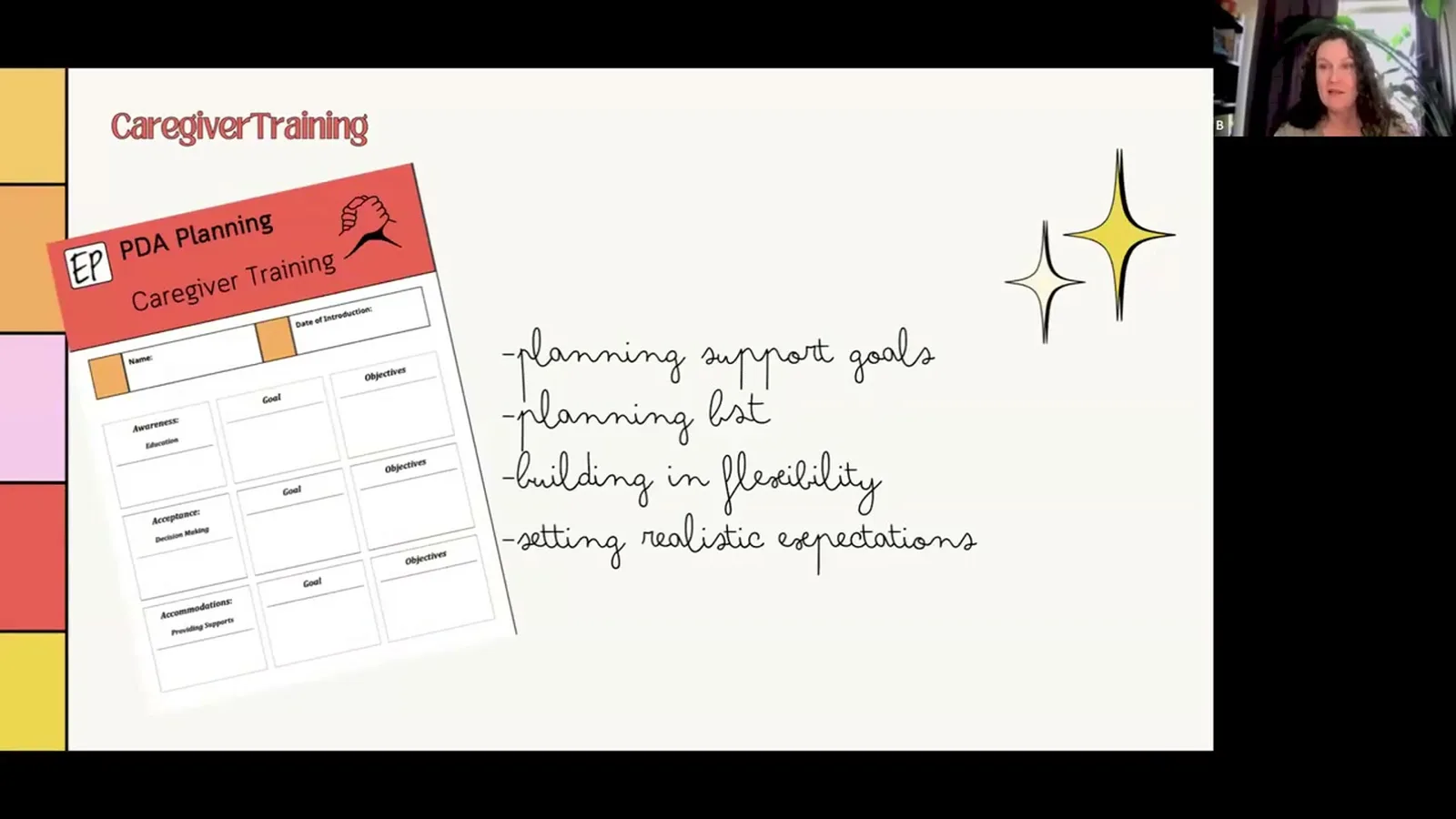
The paradigm shift program uses five A's: awareness, acceptance, accommodations, affirmation, and advocacy. The three that map cleanly onto BST (behavior skills training, the instruct-model-rehearse-feedback structure you already use) are the first three.
Awareness is the education piece. You teach the parent what a PDA profile is and why a request can register as a threat. Acceptance is the decision-making piece. You teach them how to respond to the behavior they see without escalating it. Accommodations are the proactive piece, the environment and the framing you build in before the demand ever lands.
The accommodations might be the proactive piece for setting up the environment that we would build into how we train parents. From the talk — B. Kuerine Gray
Where BCBAs lose parents is treating these as content, not as practice. You can lecture a parent on accommodation for an hour. They will still freeze the next time their kid refuses to put on shoes. The fix is rehearsal. Pick one accommodation, like offering two acceptable choices for the order of a non-negotiable task, and role-play it with the parent in the room. Three reps beats a handout.
Flexibility is the other piece. If you train a parent to do exactly one thing, you have built the same rigidity into them that the PDA learner is fighting. The goal is a range of acceptable adult responses to a range of kid responses, all pointed at the same outcome.
The "how else could we do it" question#
When a parent does the wrong thing in front of you, the instinct is to correct them. That is the move that loses buy-in fastest with PDA families. You become one more expert telling them they got it wrong.
Gray's framing flips this. Instead of explaining the right answer, you ask the parent to generate it.
Instead of you telling them "if you just do this" and that's that expert, like you're coming in as the expert, and it does seem invalidating, it does seem condescending. We kind of lead them to "how else do you think we could do it?" From the talk — B. Kuerine Gray
The script in session sounds like this. The parent says, "I told him it was time to put his shoes on and he had a tantrum." You say, "That is really frustrating. I hate when that happens too." Then, "When I do demands in session, I know he does better with choices. How else do you think we could have framed that?"
You wait. The parent says, "I could have said, do you want the red ones or the blue ones." You say, "I like that. Want to take a minute, and then come try it again? I will be right next to you, and I will step in if you need me."
You did not teach. You activated something the parent already half-knew, and you scaffolded the next attempt. That is the buy-in move. The parent owns the answer.
Scaffolded role-play: you stand next to them, not in front#
There is a difference between modeling for a parent and modeling with a parent. Modeling for them is what most caregiver training is. You demonstrate, they watch, they try later at home, it usually does not stick.
Modeling with them is side-by-side. You present the demand to the kid together. The parent runs the first attempt with you physically next to them. If the kid escalates, you do not take over. You whisper the next line. The parent says it. If it lands, the parent gets the win, not you. If it does not, you step in for one exchange, then hand it back.
This is the same logic Gray uses with adult day program staff. She trains the new response with one staff member to a high standard, then has that staff member do it with the next one at a slightly lower expectation, then keeps phasing it in. With parents, the order is: you alone, then you with the parent, then the parent with you backing them up, then the parent alone with you on call.
The clinical gain shows up over months, not days. For one of the learners in Gray's caseload (Y, a five-year-old with autism, ADHD, and explosive behavior), the outcome after this kind of work was one major escalation episode in six months and no self-injury. That number is the parent training working as much as it is the learner intervention working.
There's only been one major episode of escalation in the past six months. And there has not been any self-injury. From the talk — B. Kuerine Gray
Setting realistic, sliding-scale expectations after a hard day#
The last piece is teaching parents that their kid's capacity is not a fixed number. It is a sliding scale that shifts with sleep, food, sensory load, and what already happened that day.
This is hard for parents because it feels like letting the kid off the hook. The reframe is that you are not lowering the goal, you are matching today's demand to today's available bandwidth. The goal for putting on shoes is still putting on shoes. After a meltdown at school, the path to shoes might be three choices and a five-minute timer instead of a direct request.
Give parents one rule for hard days: step the demand back a level, do not drop it. Stepping back keeps the skill alive. Dropping it teaches the kid that escalation removes the demand entirely, which builds the exact pattern you are trying to shape away from.
Parents need permission for this in writing. Many of them have been told by other providers that any flexibility is the same as caving. It is not. It is reading the day and protecting the long arc.
Frequently asked questions#
How do I bill for caregiver training that's mostly emotional regulation? Bill it as parent training (97156 in most states for ABA). The clinical content is teaching the parent to recognize escalation, reset their own baseline, and respond to PDA behavior with framing changes. Document the specific skills targeted (demand reframing, choice presentation, scaffolded role-play) and the data you took on parent independence with each. Co-regulation is the mechanism, not the goal on the auth.
What if one caregiver is on board and the other thinks PDA is fake? Train the on-board parent first to a high level of fluency with the framing shifts. Then bring the second parent in to observe, not to participate, for two or three sessions. Watching the kid respond well to a parent who is using the modifications does more than a research article will. If the second parent stays disengaged, work with the first parent on how to hold the line when the other adult is using old-school demands, without making it a marriage problem in the room.
How long does it usually take to see buy-in from a skeptical parent? With consistent weekly contact and one small win per session, most parents shift somewhere between six and twelve weeks. Buy-in is not a one-time conversation. It is built on repeated experiences of "I tried what we practiced and it worked." If you are past three months with no movement, the issue is usually one of: the parent is too escalated at session start (go back to baseline reset), or the wins you are pointing to are too clinical and not visible at home (pick a different target).
Keep building your PDA caregiver toolkit#
The CEU this page is built from goes deeper on response classes, replacement behaviors, and the specific SBT modifications Gray uses with PDA learners. Watch it free. If you only have time for one thing this week, watch the co-regulation modeling section near the end.
→ see the related page on this site → see the related page on this site → see the related page on this site → see the related page on this site
Turn this topic into a CEU
You just studied this. Now get credit for it.
Watch PDA Caregivers, Complex Profiles, Replacement Behaviors, and Being Trauma Informed with B. Kuerine Gray and earn 1.5 free BCBA CEUs. Detailed certificate, delivered the moment you finish.