Restraint and Seclusion Under the BACB Ethics Code
When restraint and seclusion cross ethical lines, the safety-versus-efficiency tradeoff, and what to do instead, from a BCBA-led CEU.
Key takeaway
Most bad restraint and seclusion calls start the same way: a clinician trades the slow work of building skills for the fast promise of "safety," forgets that a kid's prior restraint history changes what is safe to do next, and writes the whole thing into a behavior plan instead of training staff to know when to tap out.
Ethical Guardrails in Behavior Reduction
On this page · 8 sections▾
Most bad restraint and seclusion calls start the same way: a clinician trades the slow work of building skills for the fast promise of "safety," forgets that a kid's prior restraint history changes what is safe to do next, and writes the whole thing into a behavior plan instead of training staff to know when to tap out. The Board Certified Behavior Analyst (BCBA) sitting at the laptop is not a bad person. They are stuck inside a system that rewards short timelines, and they have never been handed a clean way to think through the call. This page gives you that framework, pulled straight from a Behavior Analyst Certification Board (BACB) ethics CEU on the guardrails that should sit on either side of any behavior reduction work.
What the BACB Ethics Code actually says about restrictive procedures#
The BACB Ethics Code does not give you a checklist for restraint and seclusion. It gives you principles. Cause no harm. Use the least restrictive procedure that will work. Get ongoing consent from the caregiver and ongoing assent from the client. Build skills, do not just suppress behavior. Most BCBAs read that and look for the rule that says "restraint is fine if X" or "seclusion is banned." That rule does not exist on purpose. The Code treats restrictive procedures the way it treats every other clinical call. You are responsible for showing your work.
That means the Code does not pre-clear any restrictive procedure. It also does not pre-ban any of them. What it requires is that you can defend, in writing, why a less restrictive option would not work for this client at this time. If you cannot defend it, you are not in compliance. Saying "the team has always done it this way" or "the school requires it" does not count. The Code points back at you, the BCBA who wrote the plan.
The efficiency-versus-safety trap (and how it justifies harm)#
This is the trap that pulls otherwise careful clinicians into restrictive plans they later regret. Here is how the instructor describes it:
"I found myself every time I went to design a behavioral intervention being pulled in different ways, specifically around the how do I balance this magical concept we call efficiency and safety, right? The faster we go, the more safe we can make our clients in the long run versus the slow burn of reducing the behavior." From the talk — Matt Harrington
The trap is the word "safety." Restraint and seclusion get sold as safety procedures. The argument goes: if we stop the behavior fast, the client is safer in the long run. That sounds right until you slow it down. Faster suppression is not the same as more safety. It is just faster suppression. Real safety includes the client's body, the client's dignity, the staff's bodies, and the client's trust in the people who are supposed to help them.
The honest version of the calculation is uglier than most behavior plans admit:
"if we do this intervention and cause six more staff injuries, what does that mean for the client?" From the talk — Matt Harrington
A plan that "works" on paper but stacks staff injuries is not a working plan. It is a plan that has hidden the costs. When you are weighing a restrictive procedure, write down all of the costs, not just the target behavior rate. That includes second order effects like the client refusing to come to session, staff turnover on the case, or the client losing skills they used to have.
Prior restraint exposure as a clinical variable, not a footnote#
The single biggest thing missing from most restraint and seclusion decisions is the client's history with restraint and seclusion. Prior exposure is not background info you note in the intake and forget. It changes what counts as ethical for this client going forward.
"A large adult male. May react adversely to error correction. Due to exposure of contingent physical restraint in group homes. Basically, if they do something wrong. They got restrained in the past. Therefore, you probably should use errorless learning." From the talk — Matt Harrington
Read that again. The clinical recommendation flips because of history. The same error correction procedure that would be fine for a client without that history is not fine for this client. Errorless learning, more prompting, more reinforcement, slower shaping steps. These are the modifications that come out of taking trauma history seriously.
If you do not know the client's restraint history, you cannot write an ethical behavior plan for them. Ask the caregiver. Ask the prior provider. Ask the school. Document what you find. If a client has been restrained in a group home, an inpatient unit, a school, or a prior clinic, that is a clinical variable that has to show up in your decision making, the same way you would treat a known medication interaction.
Tapping out: training staff to know when not to follow through#
This is the part most behavior plans get wrong. They try to write the restraint decision into the plan. The plan says "if behavior reaches X intensity, staff will implement protective hold." Then it lives in a binder. The staff have never practiced the call. They have never been told it is okay to back off. So they follow through on a power struggle that did not need to happen.
"knowing when. A boundary. Needs to be upheld. Due to safety. Right. Knowing when something. Is worth upholding. And something. Is not. This to me. Comes in a staff training. Right. This is not something. I would write in a behavior plan. This is something. I would pull my. All of the RBTs." From the talk — Matt Harrington
The instructor calls this "tapping out." Living to fight another day. Teaching your Registered Behavior Technicians (RBTs) the difference between a boundary that has to hold because somebody could get hurt and a demand that you can drop because it is not worth a crisis. Most of what looks like a restraint decision in the moment is really a tap-out decision. The RBT had a choice. Nobody trained them to take the off-ramp.
So pull the team. Run real scenarios. "The kid is not sitting at the table. Do you push through or tap out?" "The kid is heading to the playground instead of the work area. Do you block or follow?" Walk through the answers. Make it boring. The goal is that every RBT on the case can name three situations where you push and three situations where you drop the demand. That training is what keeps your plan out of the gutter. It is also what keeps your guardrails real instead of decorative.
Documenting the least-restrictive analysis so it survives audit#
If a restrictive procedure ever lands on your plan, the documentation has to do real work. A line that says "behavior is dangerous, restraint is least restrictive" is not documentation. It is a placeholder. An audit, a parent complaint, or a Board investigation will tear it apart.
A defensible least-restrictive analysis lists every option you considered and why each one was ruled out for this client. Antecedent changes. Environmental changes. Reinforcement based options. Skill teaching. Functional communication training. Differential reinforcement. Environmental enrichment. Schedule changes. Then it says what you tried, for how long, with what data, and what the outcome was. Then it says what is left and why.
It also names the costs of the restrictive option you are recommending. Staff injury risk. Client trust impact. Skill loss risk. Generalization risk. Discharge plan risk. If you cannot list real costs, you have not thought about it hard enough. The Code does not ask you to be perfect. It asks you to show your reasoning. Reasoning has trade-offs in it.
When restraint policy belongs in staff training, not the behavior plan#
Most of what gets written into behavior plans as "restraint protocol" should not be in the behavior plan at all. It should be in the staff training file. The behavior plan is for the intervention. The staff training file is for the judgment calls.
Why does this distinction matter? Because the behavior plan is shared with caregivers, sits in the chart, and gets read by people who do not know the context. When you put "physical hold" into a behavior plan, you have just told the next clinician, the next school, the next placement, that physical hold is part of this client's treatment. That follows the client. It changes how the next team sees them. It can set them up for more restraint at the next stop. The exact thing the prior restraint section warned about.
The cleaner approach is a behavior plan that focuses on antecedent strategies, skill teaching, reinforcement, and communication. The staff training file holds the crisis response training, the tap-out scenarios, and the agency wide policy on physical management. The behavior plan tells the team how to help this client grow. The staff training file tells the team how to keep everybody safe when a plan is not enough. Two different documents. Two different jobs.
Frequently asked questions#
Can a BCBA include planned physical restraint in a behavior plan?
In most cases, no. Planned physical restraint belongs in crisis response training, not in the behavior plan. The plan should focus on antecedent changes, skill teaching, and reinforcement. If your setting truly requires a written restraint procedure, it should sit in a separate safety protocol with caregiver consent, agency sign-off, and a clear time-limited review schedule. The plan itself should be readable as a skill building document.
Does seclusion ever meet the BACB definition of least-restrictive treatment?
Almost never in standard outpatient or in-home ABA. Seclusion removes the client from access to reinforcement and from the people who can help them learn. By design, it is more restrictive than antecedent change, environmental enrichment, functional communication training, or differential reinforcement. If a setting is using seclusion, the BCBA's job is to document what less restrictive options have been tried, with data, and why each one was insufficient. If that analysis has not been done, seclusion is not least restrictive. It is just convenient.
What documentation do I need if a client has been restrained at a prior placement?
Document the history in the intake. Note the setting, the type of restraint, the frequency if known, and any caregiver report on how the client responded. Use that history to drive intervention design. Errorless learning, more reinforcement around error correction, slower shaping steps, and explicit rapport building should appear in the plan with a note tying them back to the history. If you change the plan because of restraint history, write that down. That is the audit trail that shows you applied the prior-restraint variable instead of ignoring it.
Where to go from here#
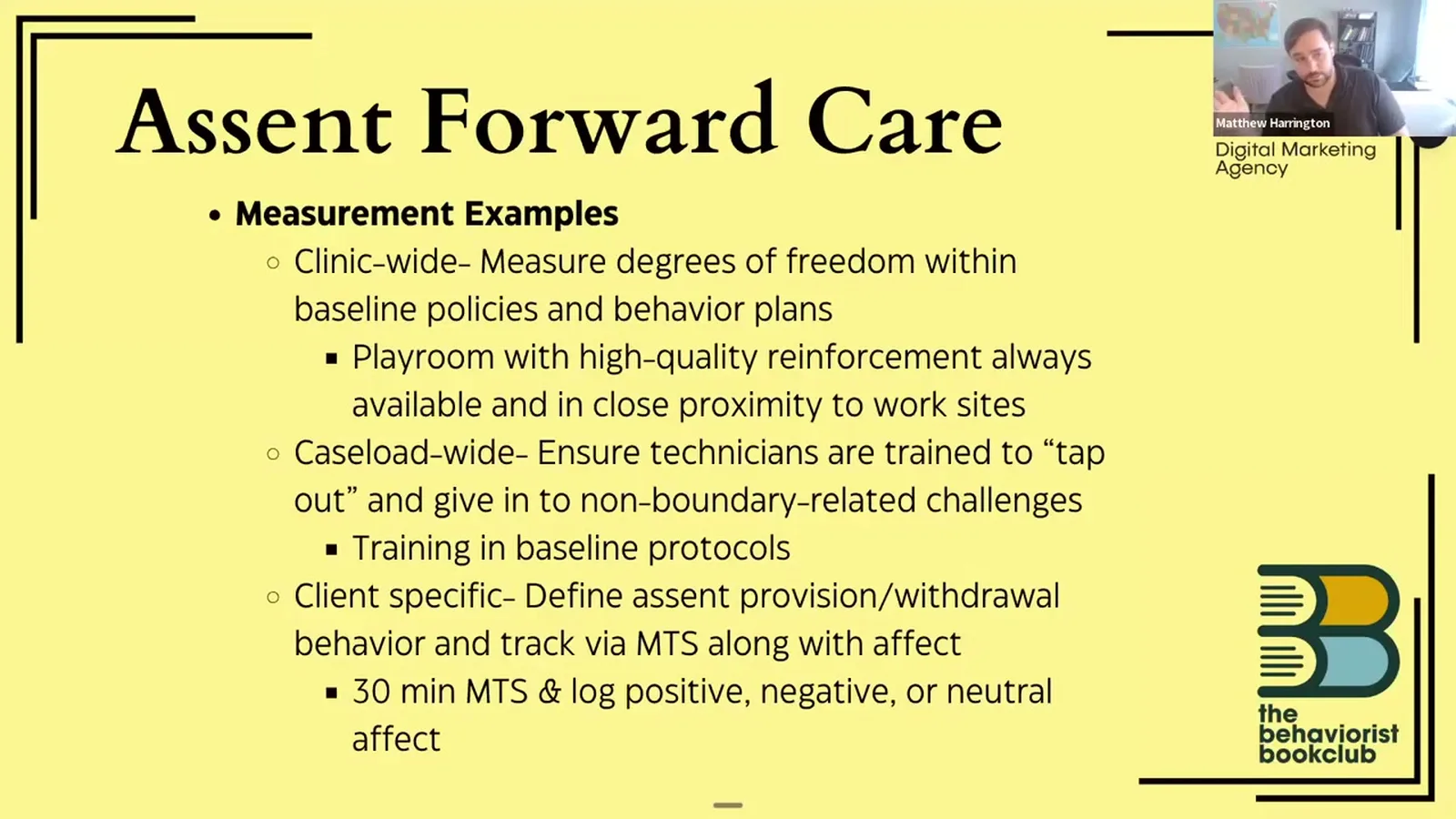
Restraint and seclusion calls are the sharpest version of a problem that runs through all of behavior reduction. The same trade-offs show up in punishment decisions, in consent conversations, and in every least-restrictive analysis you write. If you want to keep working the thinking, watch the full CEU above. The talk gives you the three guardrails the instructor uses on every plan, the assent tracking he runs across his caseload, and the degrees of freedom analysis that catches coercion before it shows up in the data.
Turn this topic into a CEU
You just studied this. Now get credit for it.
Watch Ethical Guardrails in Behavior Reduction with Matt Harrington and earn 1 free BCBA CEU. Detailed certificate, delivered the moment you finish.