BACB Code 2.08: How to Communicate About Services Without Overpromising
Code 2.08 examples on managing parent expectations, avoiding overpromised goals, and writing honest treatment plans from a BCBA-led CEU.
Key takeaway
BACB Code 2.08 is the rule that would have saved Michael Scott from the Scott's Tots moment, when he promised a room of kids a full college tuition ride and then had to walk it back with, "I am not going to be paying for your tuition." This page uses that overpromise as the lens for how Board Certified Behavior Analysts (BCBAs) talk about services, then gives you the roadmap script and the pivot script you can use in your next intake or progress meeting.
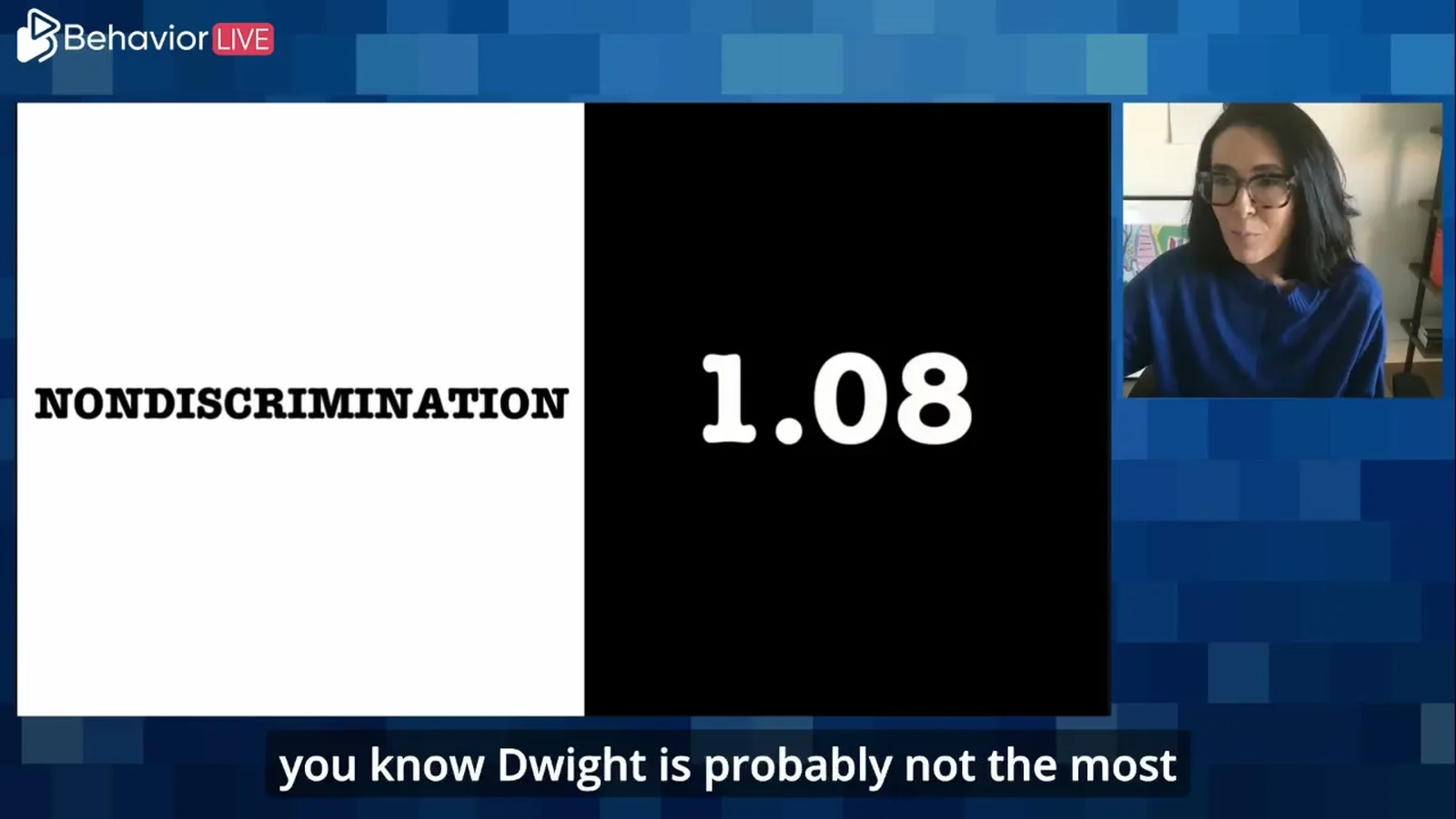
Dunder Mifflin’s Guide to BCBA Ethics: Lessons from The Office
Free learning path on this topic
Your 4 Ethics CEUs, Done
Four ethics CEUs in three courses, all free. Start with Matt Harrington's assent and data course, then ethical guardrails in behavior reduction, then cultural considerations in clinical practice. Every course carries ethics credit, so this path covers the BACB requirement with nothing to buy.
On this page · 10 sections▾
BACB Code 2.08 is the rule that would have saved Michael Scott from the Scott's Tots moment, when he promised a room of kids a full college tuition ride and then had to walk it back with, "I am not going to be paying for your tuition." This page uses that overpromise as the lens for how Board Certified Behavior Analysts (BCBAs) talk about services, then gives you the roadmap script and the pivot script you can use in your next intake or progress meeting.
What this page covers#
- What BACB Code 2.08 actually says about communicating services
- The Scott's Tots problem: why overpromising breaks trust
- Five ways BCBAs accidentally overpromise (timelines, goal count, generalization, recovery, hours)
- How to set expectations in the intake meeting
- Writing treatment plan language that protects you and the family
- What to do when a goal is not working: the pivot script
- Scripts you can copy for hard parent conversations
What BACB Code 2.08 actually says about communicating services#
Code 2.08 lives in the Board Certified Behavior Analyst ethics code under the responsibility you have to clients and caregivers. The short version: when you describe services, you have to be accurate. You cannot oversell what therapy will do. You cannot make a family believe a result is guaranteed when it is not. You also cannot leave out the risks, the limits, or the parts that depend on the family doing work at home.
This is the rule that protects honest practice. It is also the rule that quietly gets bent every time a clinician wants to look confident in an intake meeting and rounds up what therapy can deliver.
The Scott's Tots problem: why overpromising breaks trust#
In the talk, Mellanie Page pulls up the Scott's Tots scene because every BCBA recognizes the feeling. You walked into a room full of hope. You wanted to be the answer. So you promised more than you could pay for, and now you have to look those families in the eye.
I am not going to be paying for your tuition. Which brings me to my main point, and that is that I will not be able to pay for anybody's tuition. I'm so, so sorry. From the talk — Mellanie Page
The reason that scene lands is that the harm is not the original promise. The harm is the walk-back. Families do not lose trust because therapy is slow. They lose trust because the picture you painted on day one did not match what showed up on day ninety. Code 2.08 is asking you to skip the walk-back by never making the original promise in the first place.
Five ways BCBAs accidentally overpromise#
Most clinicians who run into Code 2.08 problems are not lying. They are just excited about the science. Here are the five spots where the overpromise sneaks in.
- Timelines. You tell a parent their child will be ready for kindergarten by fall. Fall is eight months away and you have not run a single assessment.
- Goal count. You write 60 goals into a treatment plan because the goal bank in your software made it easy. The child has 10 hours a week of therapy.
- Generalization. You promise the skill will show up at home and at school. You have no plan for how it gets there.
- Recovery from regression. You imply that any setback is temporary. You do not say what you will do if it is not.
- Hours of service. You promise that more hours will fix it. You did not check what the prescription supports.
Page's two anchor rules cover most of this. The first is about volume.
Plan within the prescription. If you're providing 10 hours a week, don't target 100 goals. From the talk — Mellanie Page
The second is about your role in the room.
Be a guide, not a hero. Outline a roadmap that clearly aligns on goals and then also how you'll evaluate when something is not working. From the talk — Mellanie Page
If you write those two sentences on a sticky note above your desk, you will catch most 2.08 problems before they reach a family.
How to set expectations in the intake meeting#
The intake meeting is where overpromising starts. The family is nervous. You want to ease that. So you say something like, "We will get him talking." You meant it as comfort. They heard it as a contract.
Try this structure instead.
- Name the goal in the family's words, not yours. "You said the priority is that she can ask for help when she is overwhelmed at school." Not "we are targeting mands for assistance."
- Show what you can do in the time you have. If the authorization is 10 hours a week, say what that level of service can realistically cover.
- Name what you cannot promise. You cannot promise a timeline. You cannot promise the child will reach a specific milestone by a specific birthday. You can promise an evaluation cycle.
- Describe the roadmap and the off-ramp in the same breath. "Here is what we will work on first. Here is when we will sit down and check if it is working. Here is what we will do if it is not."
That last bullet is the move that keeps you compliant with Code 2.08. You are pre-stating the pivot. You are telling the family that "this might not work" is a normal part of good therapy, not a failure.
Writing treatment plan language that protects you and the family#
The treatment plan is a permanent product. A parent can read it three months from now and decide whether you kept your word. Write it like that is true.
A few language swaps that hold up under Code 2.08:
- Swap "will master" for "will work toward" on goals that depend on dosage you do not control.
- Swap "will generalize across settings" for "will be probed across settings, with a parent training component to support transfer."
- Add an evaluation clause to every goal: when you will check it, what counts as progress, what happens if there is no progress.
- Include a section called something like "What we are not promising." Spell out that ABA is not a cure, that progress is not linear, and that family follow-through affects outcomes.
You are not being a downer. You are being the BCBA the family will still trust after the first hard month.
What to do when a goal is not working: the pivot script#
The pivot is the conversation Code 2.08 is really preparing you for. A goal is not progressing. You have data. The family has hope. You have to say something.
Try this script.
"When we built this plan, we agreed we would check in at this point and look at whether the approach was working. Here is what the data is showing. Here is what I think it means. I want to walk you through two options for what we change next, and I want your read on which one fits your family."
Notice what that script does. It does not blame the child. It does not blame the family. It does not pretend the original plan was the only plan. It returns to the agreement you made in intake, which is why the intake conversation matters so much. If you set up the roadmap and the off-ramp on day one, the pivot in week twelve is just you keeping a promise. It is not a walk-back.
Scripts you can copy for hard parent conversations#
A few more lines from the talk, translated for the moments you need them.
When a parent asks if their child will "be normal" by a certain age: "I cannot promise a timeline. What I can promise is a plan we both agree on, a check-in date, and an honest answer when we get there."
When a parent asks for more goals to be added: "I want to be careful that we don't try to cover 100 goals in 10 hours. I would rather move the needle on the goals that change your day-to-day than report on a long list that does not."
When you have to say something is not working: "This is the moment we planned for in our roadmap. The data is telling us to pivot. Here is what I am recommending and why."
When a parent is upset: "I hear you. I want to be a guide with you on this, not someone selling you a result. Let's look at what the data says together."
FAQ#
What is BACB Code 2.08?
It is the part of the Board Certified Behavior Analyst ethics code that says you must communicate about services accurately. You cannot exaggerate what therapy will do, hide the limits, or guarantee a result.
How do I tell a parent treatment is not working?
Refer back to the evaluation point you set in the intake meeting, share the data, and offer two concrete options for what changes next. The pivot is easier when you pre-stated it on day one.
Can I guarantee outcomes in ABA?
No. You can describe what the approach is designed to do, the conditions that support progress, and the evaluation schedule. You cannot promise a specific milestone by a specific date.
How many goals should I target in a 10-hour-a-week case?
Fewer than you think. Page's rule of thumb is to plan within the prescription. Pick the socially significant behaviors that change quality of life, run those well, and write the rest as future targets rather than current ones.
What should go in a treatment plan to stay compliant with 2.08?
Goals tied to family priorities, honest language about what therapy can and cannot do, a clear evaluation schedule for each goal, a pivot clause for what happens if a goal is not working, and a written note that progress depends on factors outside the clinician's control.
Keep going#
Want to hear Page run through Code 2.08 in her own words, with the Scott's Tots clip and the live chat from working BCBAs? Watch the full session.
Turn this topic into a CEU
You just studied this. Now get credit for it.
Watch Dunder Mifflin’s Guide to BCBA Ethics: Lessons from The Office with Mellanie Page and earn 1 free BCBA CEU. Detailed certificate, delivered the moment you finish.
Keep going with a free learning path
Your 4 Ethics CEUs, Done
Four ethics CEUs in three courses, all free. Start with Matt Harrington's assent and data course, then ethical guardrails in behavior reduction, then cultural considerations in clinical practice. Every course carries ethics credit, so this path covers the BACB requirement with nothing to buy.