Doing the Least-Restrictive Alternative Analysis in ABA
A working method for documenting least-restrictive alternatives in ABA, using degrees of freedom and constructional thinking, from a BCBA-led CEU.
Key takeaway
"Least restrictive" gets real when you operationalize it as degrees of freedom, n minus 1 equal choices the learner actually has, and stop reading the room through a flat Antecedent-Behavior-Consequence (ABC) chain that hides the reason a restrictive plan ever felt necessary.
Ethical Guardrails in Behavior Reduction
On this page · 7 sections▾
"Least restrictive" gets real when you operationalize it as degrees of freedom, n minus 1 equal choices the learner actually has, and stop reading the room through a flat Antecedent-Behavior-Consequence (ABC) chain that hides the reason a restrictive plan ever felt necessary. That is the working definition this page uses. If a learner has only one path to the reinforcer they want, they have zero degrees of freedom. If your ABC story ends at "client hit staff, work was removed," you have not yet looked at what the client tried, failed, felt, or learned to stop trying. The rest of this guide turns those two ideas into something you can actually write into a plan.
What "least restrictive" actually means beyond the policy language#
Most behavior plans treat "least restrictive" like a box you check once. You wrote "tried reinforcement first" in the rationale, the plan got signed, and you moved on. The problem is that "least restrictive" is not a label you stick on a plan. It is a comparison. You are saying this option, right now, in this setting, with this learner, leaves them with more real choice than the other options on the table.
That is hard to measure. It is also hard to defend in a review if all you have is a sentence. So you need two tools that turn the comparison into something you can count and write down. The first is degrees of freedom. The second is the constructional flip. Together they let you say, in plain words, why this plan is the least restrictive option you could find and what would make it less restrictive next month.
Degrees of freedom: the operational definition#
Degrees of freedom is the math version of "least restrictive." It asks how many real options the learner has when every option leads to the same reinforcer. The formula is simple. Count the equal choices. Subtract one. That is your degrees of freedom.
Degrees of freedom is just a way to classify how many options a learner has when all things are equal. The precise definition is n minus one or choices minus one equals degrees of freedom. So in this example, I need groceries. I can use my car, I can walk, or I can stay home and not eat. From the talk — Matt Harrington
The trick is the words "all things equal." Walking and driving both get you groceries, but the cost is not equal. If you need food in 30 minutes, walking is off the table. You have one real option, not two. That is zero degrees of freedom dressed up to look like one.
Now move that to a session. If the only way for the learner to earn the iPad is to sit at the table and do discrete trials, you can write "the learner had a choice" all you want. They did not. Same reinforcer, one path, zero degrees of freedom.
If the only way for the learner to get the iPad, the thing that they want, is to sit at the table and do DTT, it's not true assent. There has to be other equal opportunities to earn equal levels of reinforcement, to have true degrees of freedom. From the talk — Matt Harrington
So when you write a least-restrictive rationale, count the equal paths to the reinforcer the learner actually wants. Subtract one. If the answer is zero, your plan is not least restrictive yet. It might still be the right plan today, but you owe the reader a sentence about what you are doing to add a second path.
The constructional flip: what skill makes this procedure unnecessary#
The other half of least-restrictive analysis is the constructional approach. Instead of asking "how restrictive is this procedure," you ask "what skill, once built, makes this procedure unnecessary." That flip changes the whole plan, because now the restrictive piece is a bridge, not a destination.
The focus of building repertoires rather than eliminating them. So, where do you want to go? What is your desired outcome? Not the goal target, but the reason why the goal is in place. I want to drive to the grocery store. That means I need to learn my left and right. From the talk — Matt Harrington
Apply this to a real plan. A learner has aggression during math work. The linear plan removes the work and teaches a "break" mand. The constructional plan asks a different question. What skill, once present, makes the aggression no longer needed? Maybe it is asking for help. Maybe it is the math skill itself. Maybe it is tolerating a wrong answer without shame. Each answer points at a different program, and each one is less restrictive than removing work for the rest of the year.
Write that into your rationale. Name the skill that would retire this plan. Name the program that builds it. The least-restrictive case writes itself when you can point at the exit door.
Why a linear ABC analysis hides restrictive alternatives#
A flat ABC chain is the most common reason "least restrictive" goes wrong. You watched the antecedent, you watched the behavior, you watched the consequence, and you closed the case. But the learner had a whole inner sequence you did not see, and that is where the better intervention was hiding.
The standard linear approach is an ABC arrangement. Staff hands client work, client hits staff, work gets removed. Whereas, staff hands client work, client tries, but is unable to solve. Skill that is not seen, trying, and is not present. Because every time they try, they receive a zero and they get embarrassed. From the talk — Matt Harrington
That second story is a nonlinear ABC. It includes a covert attempt, a missing skill, and a learning history of zeros and embarrassment. None of that shows up on the data sheet. All of it changes the plan. If the real chain is "tries, fails, gets embarrassed, hits to escape the shame," then a break mand is not the least restrictive answer. Errorless teaching is. Or scaffolded help-seeking is. The restrictive option only looks least restrictive when you refuse to look past the visible chain.
So your nonlinear question set is short. What did the learner try that I cannot see? What skill was missing when they tried? What has happened in the past when they tried and failed? What would they do if help was reliably available? Run those four questions through every plan that uses restriction, and most of the restriction starts looking optional.
Writing the least-restrictive rationale that holds up under review#
Now put it on paper. A defensible least-restrictive rationale has five parts, and it fits in one paragraph if you write tightly.
First, name the target behavior in plain words and say what reinforcer it produces. Second, list the equal-cost paths the learner currently has to that reinforcer. State the degrees of freedom number. Third, name the constructional skill that, once built, would retire this plan. Fourth, walk through the nonlinear ABC. Say what the learner tried, what was missing, and what the learning history looks like. Fifth, say what you are doing this month to add a second equal path. That last sentence is the part that turns a static rationale into a working plan.
If a reviewer asks why you did not pick a less restrictive option, you now have a real answer. You looked. You counted. You named the skill. You wrote the bridge. The plan is the least restrictive option you could find today, and you wrote the next step toward making it less restrictive next month.
Checking your caseload: where you defaulted to restrictive without analysis#
Once a quarter, run the same four questions across every active behavior plan in your caseload. For each one, write the degrees of freedom number next to the target behavior. Most plans will come back as zero or one. That is not a failure. That is a map of where to spend your analytic time next month.
Sort by impact, not by ease. A plan with zero degrees of freedom on a high-rate behavior is where you start. A plan with two degrees of freedom on a low-rate behavior can wait. You do not have the hours to deeply analyze 20 behavior reduction targets at once. Pick the two that move the quality-of-life needle most, and use degrees of freedom and the constructional flip to walk them toward least restrictive. The rest stay tracked. They are not ignored. They are just not where this month's analytic work is going.
That is how "least restrictive" stops being a phrase on a form and starts being a practice you can show.
Frequently asked questions#
How do I document a least-restrictive analysis in a behavior plan?
Write the five parts described above as one paragraph in the rationale section of the plan. Name the target and the reinforcer it produces. List the equal-cost paths to that reinforcer and state the degrees of freedom number. Name the constructional skill that would retire the plan. Walk through the nonlinear ABC. End with the specific step you are taking this month to add a second equal path. That paragraph is your least-restrictive rationale and your next-step plan in one place.
Is noncontingent reinforcement always less restrictive than extinction?
No. Noncontingent reinforcement and extinction are procedures. Least restrictive is a property of how a procedure is applied to a specific learner with a specific history. Noncontingent reinforcement can be highly restrictive if it removes the only path the learner had to a meaningful reinforcer. Extinction can be the least restrictive option if it is paired with a robust replacement skill and the learner has real degrees of freedom around the procedure. Count the equal paths to the reinforcer in each option and pick the one with more.
Do payer source requirements override the least-restrictive principle?
Payer source rules can shape the format of the plan, the number of hours you can bill, and the documentation you have to keep. They do not override the analytic obligation to pick the least restrictive option for the learner. If a payer requirement pushes you toward a more restrictive option than the analysis supports, document the conflict in the plan, name the less restrictive option you would have used, and write the bridge skill that you are building so the conflict resolves over time.
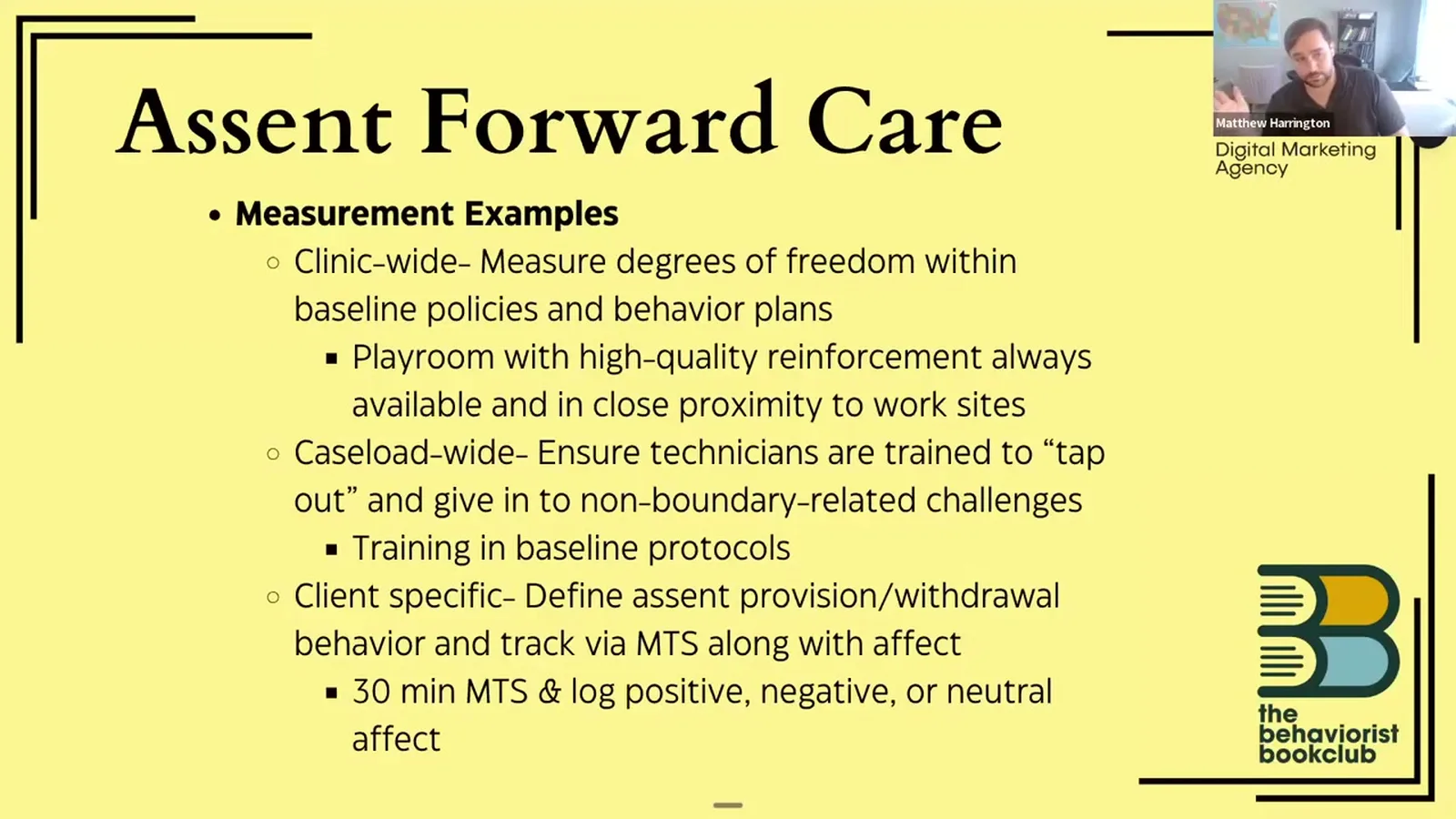
Want the underlying framework? The full one-hour CEU walks through the three ethical guardrails, assent tracking on a caseload, and the constructional approach end to end. Watch it free at the link below and use these tools on your next plan review.
Watch the full CEU: Ethical Guardrails in Behavior Reduction
Turn this topic into a CEU
You just studied this. Now get credit for it.
Watch Ethical Guardrails in Behavior Reduction with Matt Harrington and earn 1 free BCBA CEU. Detailed certificate, delivered the moment you finish.