When Parents Ask for the 'Wrong' Goal: A BCBA's Guide to Bias in Parent Training Conversations
How to handle stereotypy, normalcy, and spanking conversations without your bias (or theirs) driving the plan from a BCBA-led CEU.
Key takeaway
A parent sits down at the kitchen table and says, "I want you to stop the hand flapping." Or, "I want him to act normal so he doesn't get bullied." Or, "We spank in our house, and we'd like you to write that into the plan." If you are a Board Certified Behavior Analyst (BCBA), these moments are where parent training stops being a worksheet exercise and starts being the hardest part of the job.
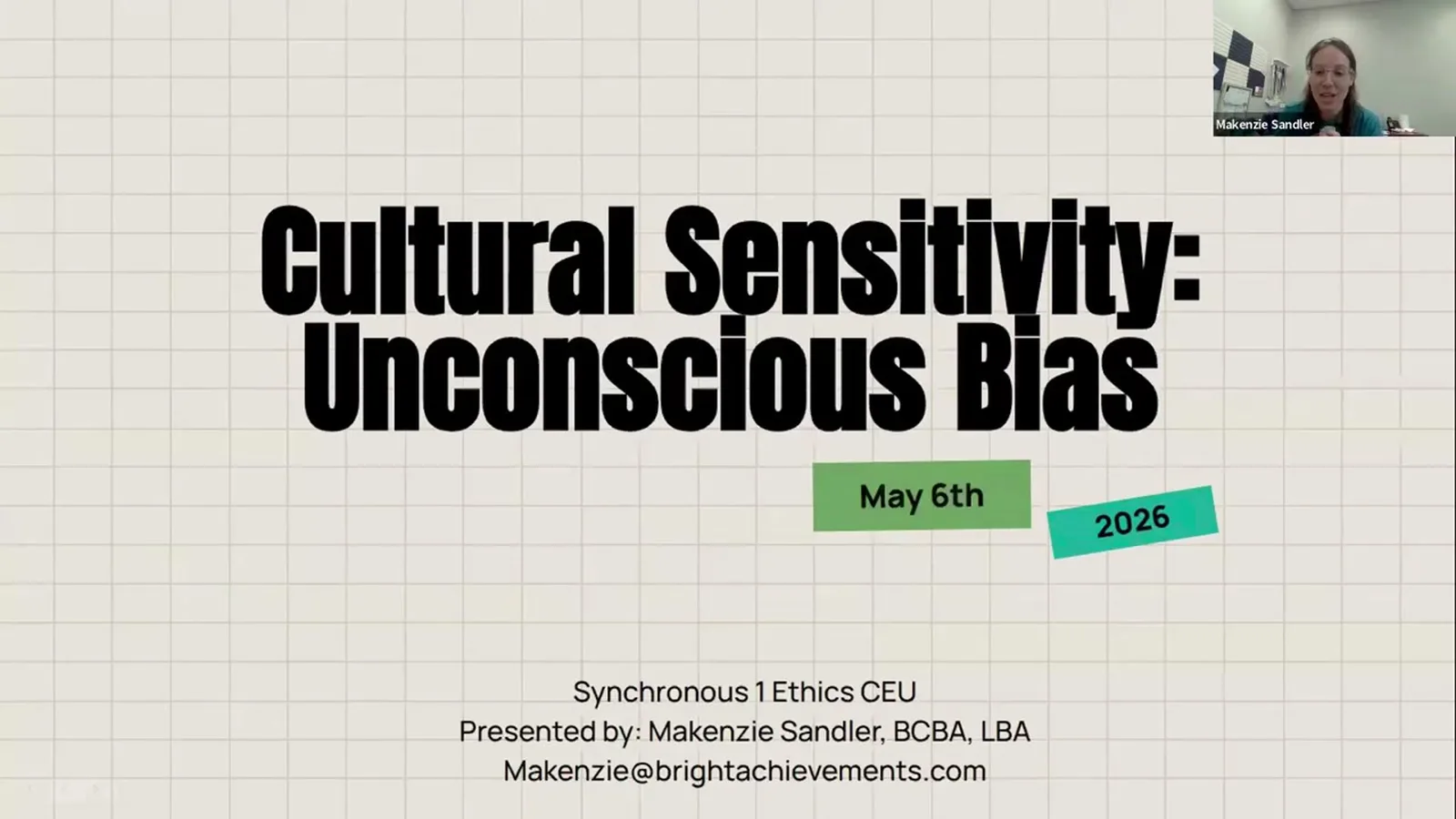
Cultural Sensitivity: Unconscious Bias
On this page · 8 sections▾
A parent sits down at the kitchen table and says, "I want you to stop the hand flapping." Or, "I want him to act normal so he doesn't get bullied." Or, "We spank in our house, and we'd like you to write that into the plan." If you are a Board Certified Behavior Analyst (BCBA), these moments are where parent training stops being a worksheet exercise and starts being the hardest part of the job. Most of the advice you have heard treats the parent as a partner to be aligned with. This page treats the parent as a person with their own values and biases, gives you the hidden-values reframe that Mackenzie Sandler teaches in her ethics CEU, and hands you the exact script she uses out loud: those all sound like safety goals to me.
The Conversation Every BCBA Dreads: "I Want You to Stop the Stimming"#
You know the meeting. You sit down to review goals. The parent looks at you and says they want the hand flapping gone. They want the rocking gone. They want their kid to look like the other kids in the class. Your stomach drops because you know the stereotypy is not hurting anyone. You know the research. You also know this parent is the one who has to live with their child every day, and you do not.
Mackenzie names this directly in the talk. She calls it parent bias when the family is asking you to erase the visible signs of autism from their child. She does not soften it. She does not call it a "values gap." She calls it what it is, then she shows you what to do with it.
The mistake most BCBAs make here is one of two things. Either you write the goal and feel bad about it for six months, or you tell the parent no and lose rapport in the first session. Neither one is the move. The move is to slow down, name what is happening, and figure out what the parent is actually asking for, because most of the time it is not what they said.
Why the Parent Isn't Asking What You Think They're Asking (Hidden Values)#
Here is the reframe that powers the rest of this page. Borrowed from Acceptance and Commitment Therapy (ACT), values are the long-term reinforcers that pull a person toward certain choices. They are not goals. You do not finish a value. You move toward it or away from it.
When a parent asks for "normalcy," normalcy is almost never the actual value. It is a stand-in. Sit with the parent for ten minutes and the real value almost always shows up underneath: safety, independence, belonging, protection from bullying, the chance for their kid to have friends. Mackenzie calls these hidden values or masked values.
Something that came up was a family who values quote unquote normalcy was their words for it. And they don't want their kid to get bullied. The concept of hidden values or like masked values where somebody was like, oh, well, I value my kid acting this way. But in reality, what they value is safety or independence. From the talk — Mackenzie Sandler
Once you can hear the hidden value, the conversation changes. You are no longer arguing about whether to suppress hand flapping. You are working on the same value the parent already cares about. You just get to pick a goal that actually moves toward it.
The Three-Question Stem That Surfaces What They Actually Want#
Mackenzie gives a simple set of questions that pulls the hidden value out into the open. You can use these in an intake, an assessment, or the moment a parent says something that makes you flinch.
The first is the magic wand question. If I could wave a magic wand and change one behavior right now, what would it be? Ask it three times. Patterns show up fast. Three "wand answers" about hitting and running and scratching are not three goals. They are one safety goal.
The second is the consult-the-source question. You ask the parent about their world before you bring your world into it.
How is motor stereotypy viewed in your family, in your community? What does that feel like for you? Ask those questions. I don't live on a farm. What does this behavior look like on a farm? From the talk — Mackenzie Sandler
The third is the assumption check. Out loud, you say: I am assuming you want the flapping gone because you do not want your son to look autistic. Tell me if I am wrong. Most of the time you are at least partly wrong, and the parent will tell you the real reason. Sometimes it is bullying. Sometimes it is a cousin who hurt themselves stimming and the family is scared. Sometimes the kid has already been hurt and you did not know.
When to Disagree Out Loud: Explicit Bias vs Unconscious Bias in the Parent Meeting#
The thing nobody told you in your supervision hours is that you are allowed to disagree with a parent. Not in a mean way. Not in a dismissive way. Out loud, professional, and on the record.
Unconscious bias is the stuff you do not know you carry. Explicit bias is the stuff you can name out loud and stand behind. When a parent says, "I want the stimming gone," that is not an unconscious bias. That is a position they have thought about and chosen. Mackenzie's point is that explicit bias gets a different conversation than unconscious bias. Explicit bias is something you can sit across the table from.
I think that sits down to have a conversation about explaining your personal biases. Probably the question is asked because you're against that. So I think that's okay to have that open value connection and conversation and have an open disagreement about it in a professional, ethical way of those are not unconscious biases. Those are explicit biases. From the talk — Mackenzie Sandler
What this looks like in practice: you say, "I want to be honest with you. I think suppressing all the hand flapping is going to take something away from your son that helps him stay regulated. Here is what I am worried about. Here is what I think we could do instead. Can we talk about it?" That is not a fight. That is consent and informed disagreement. The parent gets to keep their value. You get to bring yours into the room.
Spanking, Cluttered Homes, and Other Conversations Where Your Bias Will Show Up#
Stereotypy is the obvious one. The harder conversations are the ones where your bias is doing more of the work than the parent's. Mackenzie names two.
Spanking. It is legal in most Southern states. It is illegal-adjacent in New York. The family in front of you may have been raised on it, may believe in it, and may be asking you to write it into the plan. You do not have to agree. You do have to notice that "I am against this" is your bias, that the parent's bias is just as real, and that the conversation belongs in the open and not in passive aggression.
Cluttered homes. You walk into a session and the house is full. Toys, mail, laundry on the couch. The Facebook groups will tell you to refuse the case. Mackenzie's frame is gentler and more honest. Ask yourself what data you actually have. Is the kid safe? Is the session running? What is the parent's value here, and what is just your discomfort? Sometimes the right move is to flag a safety concern. Sometimes the right move is to admit you have a thing about clutter and run the session anyway.
The rule is the same in every one of these conversations. Name the value. Name yours. Find out if you can do good work together. If you cannot, that is also useful information.
Scripts You Can Use This Week (Stereotypy, Normalcy, Safety, Independence)#
This is the one Mackenzie does the work for you. When you do the magic wand question and you hear three answers, you reflect them back as one value. Out loud. To the parent. Like this.
What I'm hearing is you don't like how your brother is being aggressive toward the other brother and that your student is running out of the building from school. Those all sound like safety goals to me. Your value is to protect your child and make sure they're safe. From the talk — Mackenzie Sandler
That is the script. Print it. Use it Monday. The structure is: name two or three of the behaviors the parent flagged, package them under the value you heard, hand the value back to the parent. They almost always say yes. Now your goal selection is not "decrease stereotypy." It is "increase safe walking from the school building," or "decrease aggression toward sibling," and the parent is on the same page about why.
A few more swaps Mackenzie recommends you start using today. Stop writing "attention-seeking." Write "seeking connection." Stop writing "non-compliance." It does not pass the dead man's test and it creates bias in everyone who reads the chart. Stop writing "violent" when you mean physical aggression toward others in the form of hitting. The labels you pick become the lens the next clinician, teacher, and insurance reviewer uses to see the kid.
Frequently asked questions#
What if I think the parent's request is unethical, not just biased?
You are allowed to refuse. The BACB Ethics Code asks you to evaluate your own biases, and it also asks you to do no harm. If a parent is asking you to write a goal that would hurt the learner, the right move is to name it, explain why you cannot do it, and document the conversation. Refusing one goal is not refusing the case. Most parents will work with you if you tell them what you can and cannot do and why.
How do I bring up the family's culture without making them feel othered?
Ask the question early, before you have a problem to solve. In the first assessment, ask how the behavior in question is viewed in their family and community. Ask what it looks like at the grandparents' house, at church, at school. You are not interviewing them about their culture. You are gathering data on what is reinforced and punished in the rooms your goals have to live in.
Is it ever okay to refuse to write a goal the parent is asking for?
Yes. The clearest cases are safety and ethics. The grayer cases are values disagreements you cannot find common ground on. If you have done the hidden-values work, asked the consult-the-source questions, disagreed out loud, and you are still misaligned, it is okay to say this case may not be the right fit for me and refer them on. Mackenzie names this directly in the talk. Recognizing where your bias makes you a worse clinician is part of being a good one.
Watch the full CEU on openceu.com#
Mackenzie's full one-hour ethics CEU walks through the SCAD framework she uses to catch her own bias in real time, the ACT values worksheets she runs with families, and more examples of the parent training conversations she has actually had. It is free, on demand, and worth the hour the next time you have a hard parent meeting on the calendar.
Turn this topic into a CEU
You just studied this. Now get credit for it.
Watch Cultural Sensitivity: Unconscious Bias with Mackenzie Sandler and earn 1 free BCBA CEU. Detailed certificate, delivered the moment you finish.