When to Say No to Growing Your ABA Company (5 Honest Signals)
Same problems with your name on the window. No defined quality. No ops partner. Five signals to pause scaling, from a BCBA-led CEU.
Key takeaway
The keystone test for whether to grow your ABA company is simple: the name on the window is the same practice I left, and the family I serve still cannot walk into Walmart together.
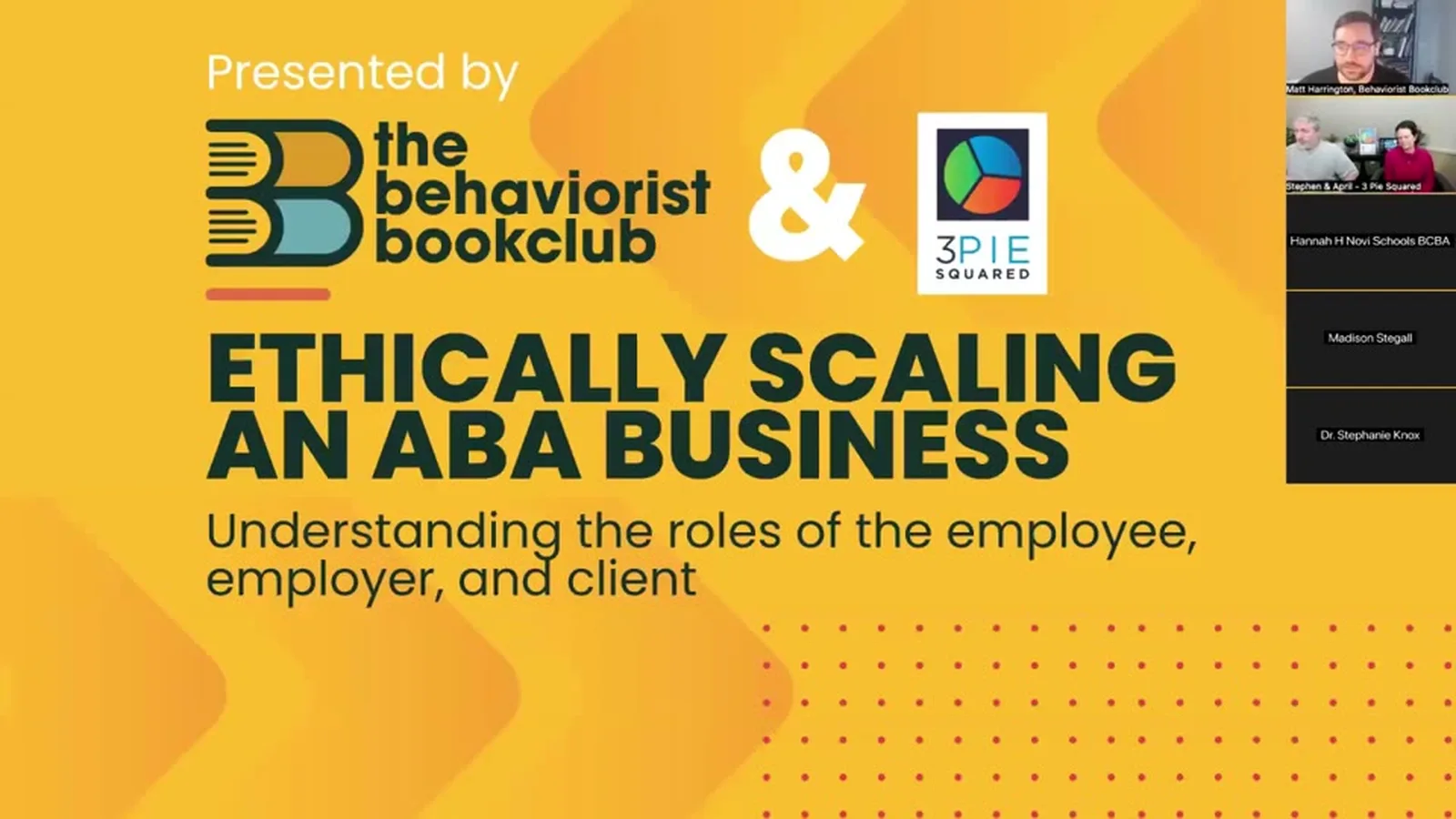
Ethically Scaling an ABA Company
Free learning path on this topic
Your 4 Ethics CEUs, Done
Four ethics CEUs in three courses, all free. Start with Matt Harrington's assent and data course, then ethical guardrails in behavior reduction, then cultural considerations in clinical practice. Every course carries ethics credit, so this path covers the BACB requirement with nothing to buy.
On this page · 9 sections▾
The keystone test for whether to grow your ABA company is simple: the name on the window is the same practice I left, and the family I serve still cannot walk into Walmart together. If either of those is true, you do not need a new BCBA, a new clinic, or a new contract. You need to stop and fix what you already have.
This page is for the BCBA owner who is staring at the next hire, the next location, or the next insurance contract and feeling that pull to say yes. Sometimes the right answer is no. Below are five honest signals that say pause. Each one comes from the CEU recording linked at the top.
Why "just keep growing" is the default and it is wrong#
Most ABA owners scale because the people around them are scaling. A neighbor opens a second clinic. A peer hires their fourth BCBA. The default story is that bigger is better and a slowdown is failure.
That story misses the cost. When you add a BCBA, you move one step farther from the family. When you add a tech, you add a person to supervise, train, and schedule. Each step is fine on its own. Stacked together, they pull the owner away from the work that made the practice good in the first place. Matt named this trap directly in the talk.
Sometimes when we think about, at least when I imagine scaling as a BCBA, it almost felt like the villain and anybody who engages with the villain is dancing with the devil. And so how do you not get hurt scaling? Well, you don't scale. From the talk — Matt Harrington
That is the gut reaction. The honest answer is that some growth is needed to keep up with costs and to keep the doors open. But growth without a stop rule is what turns a good practice into the practice you left.
The five signals below are your stop rules. If any one of them is true today, do not hire the next BCBA. Do not sign the next contract. Pause.
Signal 1: you cannot describe what quality means at your company#
If a parent asked you to define quality at your company in one sentence, could you do it? If a new BCBA asked what good looks like on her caseload, could you point to a number?
Matt and April pressed on this in the talk. At a recent ABA business conference, April asked owner after owner what quality means inside their company. Most struggled to answer. That is the problem. You cannot protect what you cannot describe. You cannot train staff into it, hire against it, or notice when it slips.
A workable definition has three parts. First, a clinical measure such as skill acquisition rate or progress on a baseline assessment. Second, a family measure such as a quality of life check or a satisfaction survey. Third, a staff measure such as turnover rate and cancellation rate. None of these are perfect. All of them are better than guessing.
Until you can write that down and show it to your team, do not hire. A new BCBA without a quality definition is a new BCBA who will guess. Six months later you will not be able to tell whether your scores dropped because of the hire or because of the system she stepped into.
Signal 2: your name is on the window but the practice feels like the one you left#
This is the keystone signal. It is the one line from the talk that hits hardest, and it is the reason this whole page exists.
I left my last practice because we were doing X, Y, and Z on ethical uncomfortable things and I wanted nothing to do with that. And now the only difference is a year later is it's my name on the window and I now have that same practice I left. From the talk — Matt Harrington
Most BCBA owners did not start a company because they wanted to run payroll. They started a company because the last place they worked did something they could not live with. Maybe RBTs were writing treatment plans because they were cheaper. Maybe one client had six different techs across twenty hours of services. Maybe families were promised a new location near home that was still a year away.
A year in, the owner looks up and sees the same patterns at her own practice. The villain she left is staring back from her own org chart.
If that is you, the answer is not another hire. Another hire makes the gap bigger. The answer is to stop, write down the two or three things you swore you would never do, and check whether your current company is doing any of them. If even one is true, you fix it before you grow. Growth on top of an ethical leak only spreads the leak.
Signal 3: you have no ops partner and you are the bottleneck#
April described the moment she had to tell Stephen she could not hold her full clinical caseload and also manage the staff. The conversation was hard. She had to be at burnout before she was willing to have it.
That moment is the bottleneck signal. The owner is in clinical sessions, billing calls, hiring interviews, HIPAA paperwork, and the website all in the same day. The week starts at forty five hours and ends at eighty. Stephen called this Mighty Mouse Syndrome, the trap of saving the day on small fires while the bigger work goes undone.
If you are the only person who can do the work, you cannot grow without dropping balls. Stephen and April put rough numbers on it. One BCBA with six or seven staff brings roughly fifteen to twenty hours of admin work per week. Billing alone can swallow a full day. Scheduling falls apart every time a family or a tech bumps a session.
Before you hire the next BCBA, write down who does each of these jobs at your company: clinical director, ops director, billing, scheduling, HIPAA officer, ethics officer, hiring. If your name is on more than three of those lines and there is no plan to move any of them off, pause. You do not need another BCBA. You need a partner, a fractional ops person, or a clear handoff for one of the lines you carry.
Signal 4: your current clients are not actually improving#
This is April's Walmart bar. It is the single best test of whether your services are working.
If you're not improving the family's quality of life, it doesn't matter if you're keeping your 10%, you know, supervision or 15% supervision or you're doing X amount of parent training. you know, if they can't go to Walmart together as a family, you're not meeting your expectations and this is not quality of services. From the talk — Matt Harrington
You can hit every BACB compliance line. You can run perfect supervision percentages. You can deliver parent training every week. None of it matters if the family still cannot do the things a family does. Walmart together. A birthday party. A car ride. Bedtime.
The check is honest and quick. Pick the last five clients you intake. For each one, write down what the family said they wanted from ABA at the start. Then write down whether that thing is happening today. If two or more of those five are no, you do not need more clients. You need to fix the cases you already have.
This signal is the easiest to skip because the company keeps running. Insurance still pays. Sessions still happen. The bank account looks fine. The only person who notices is the family, and most families will not tell you. They will quietly drop out and you will read it as a cancellation problem.
Signal 5: your KPIs are dipping and you are about to hire anyway#
The last signal is the one Matt named as his own pause rule. It is the most concrete.
I expanded to three new BCBAs. Now my qualities, now my scores, my progress, my acquisition rate, whatever the metric is, is now dipping. How can I pull that up before taking the next scaling step? From the talk — Matt Harrington
Pick three numbers and track them every month. The talk suggested these: turnover rate, cancellation rate, and a quick progress check from each BCBA. Add a satisfaction survey if you can. None of these need to be fancy. A monthly note from each BCBA on whether her clients are moving forward is enough to start.
The rule is simple. If your numbers dipped after the last hire, do not make the next hire. Pull the numbers back up first. If you grow on top of a dip, the next dip is steeper. Three hires in, you cannot tell which one broke the system, and you have three salaries to support while you figure it out.
This is the signal that protects the other four. The first four tell you the practice is not ready. This one tells you the last expansion already cost more than it gave.
What to do during the pause (not just wait)#
Pausing growth is not the same as standing still. The pause is the work.
Write your quality definition. Three sentences. Clinical, family, staff. Print it. Show it to your team next week and ask if it matches what they see on the ground.
Run the Walmart check on your last five intakes. If any family is not closer to the life they asked for, that case is your priority. Fix it before the next intake.
Pick one admin line you carry today and write the handoff. Billing, scheduling, or hiring. Find the person, the contractor, or the software that takes it off your plate in the next sixty days.
Pull your three KPIs for the last six months. Turnover, cancellation, and progress. Draw the line. If the line is dipping, your job for the next quarter is to pull it back up, not to add a BCBA who will tip it further.
When all three are stable for two quarters, you have earned the next step. That is the only honest green light.
Frequently asked questions#
Is it okay to stay a solo BCBA practice forever?
Yes. The talk made this point directly. Some owners want a national multi clinic practice. Others want two or three BCBAs and to know every family by name. Both are valid. The wrong move is to grow because the people around you are growing. If the small version of your company gives families the Walmart outcome and pays you what you need, that is a finished business, not a failed one.
How do I tell a prospective family I am not taking new clients right now?
Be honest and short. Tell the family your current caseload is full and that taking them on now would mean cancellations, tech turnover, or a delay in real progress. Offer a waitlist date and one or two other providers you trust. Families respect this. The families who pressure you to take them anyway are the ones most likely to leave in three months when the cracks show.
Will pausing growth hurt my contracts with insurance companies?
Usually no. Insurance funders care about credentialed clinicians delivering authorized services, not about your growth rate. Some contracts have minimum hour thresholds. Check the contract before you assume. In most cases you can hold steady, deliver clean documentation, and keep the contract. A small practice with strong outcomes and low turnover is a better partner for a funder than a fast growing practice with high cancellation and high tech churn.
Ready to grow when the signals turn green?#
If you ran the five checks and your practice passed each one, you are ready for the next step. If you are still working through one or two, that is the right place to be this quarter.
Watch the full CEU for Matt, Stephen, and April's complete walk through the framework, including the operations side of the pause.
Turn this topic into a CEU
You just studied this. Now get credit for it.
Watch Ethically Scaling an ABA Company with Matt Harrington and 3 Pie Squared and earn 1 free BCBA CEU. Detailed certificate, delivered the moment you finish.
Keep going with a free learning path
Your 4 Ethics CEUs, Done
Four ethics CEUs in three courses, all free. Start with Matt Harrington's assent and data course, then ethical guardrails in behavior reduction, then cultural considerations in clinical practice. Every course carries ethics credit, so this path covers the BACB requirement with nothing to buy.