BCBA Professional Development Plan for Grief and Loss Competence
A step by step competence plan for BCBAs who want to take grief cases. Coursework, mentorship, and reading list, from a BCBA-led CEU.
Key takeaway
Here is a six month plan you can copy: read the six or seven BCBA-authored grief papers out of the UK in month one, start ADEC thanatology coursework in month two, and watch the Irene Tuff Rewind interviews on repeat while you do both.
Increasing Competence and Confidence in Helping People with Disabilities through Grief
Free learning path on this topic
Culturally Responsive Practice
Makenzie Sandler's three-part series on culturally responsive practice, each worth an ethics CEU. Cultural competence in clinical work, unconscious bias and values, then culture across teams and systems using OBM.
On this page · 10 sections▾
Here is a six month plan you can copy: read the six or seven BCBA-authored grief papers out of the UK in month one, start ADEC thanatology coursework in month two, and watch the Irene Tuff Rewind interviews on repeat while you do both. That is the spine. Everything else in this guide hangs off it.
Why grief is a competence gap for most BCBAs#
Most BCBA programs do not teach grief. You learn verbal behavior, you learn assessment, you learn supervision. You do not learn what happens when a client's mom dies and the client starts eloping because nobody told them where mom went. That gap is not your fault. It is the field's. But once you know it is there, you own the fix.
Patricia Lund makes the case that grief sits inside our scope when we frame it as a behavior process. A death changes the environment. The environment changes behavior. We are trained to read that loop. We are not trained to read it through the lens of bereavement, and that is the piece we have to add.
The good news: the literature exists, the coursework exists, and the disabled self-advocates have already told us what they want. You do not have to invent any of it. You have to find it and study it.
Step one: read the six or seven BCBA-authored grief papers#
This is the smallest, cheapest, fastest move you can make. Start here.
"I found maybe six or seven papers written by BCBA, um, from the UK on this topic.". Patricia Lund
Karola Dillenberger and Mickey Keenan, both out of Ulster, have done most of the heavy lifting on behavior analytic accounts of grief. Their framing is that grief responses are a mix of private and public behaviors that follow the loss of a significant source of reinforcement. That is a sentence you can defend in any supervision meeting, on any case, in any state.
Read every paper they cite. Then read the papers those papers cite. The corpus is small enough that you can finish it in a long weekend. Take notes on three things in each paper: how the authors define grief, what setting events they name, and which interventions they describe. You will use those notes when you write your first treatment plan.
If you have never read outside the standard BCBA curriculum before, this will feel slow. Push through. The papers are short and the ideas repeat.
Step two: study thanatology basics through ADEC#
Once you have the BCBA-side literature in your head, you need the broader field. That field is called thanatology, which is the study of death, dying, and bereavement. The professional home is ADEC, the Association for Death Education and Counseling.
Patricia is finishing her ADEC certification right now. You do not have to go that deep on day one, but the coursework is open to anyone and you do not need a counseling license to take it.
"I'm currently finishing up some certification to be, uh, certified through the association. Uh, death education.". Patricia Lund
ADEC covers cultural differences in mourning, the history of death practices, how children understand permanence, and how adults with disabilities have been studied (and often ignored) in the bereavement literature. None of this is in your BCBA training. All of it shows up in real cases.
Plan for two ADEC webinars a month. Most run sixty to ninety minutes. Save the slide decks. Build a private folder of citations you can pull from when a teammate asks "where did you get that?"
Step three: follow disabled voices, not just researchers#
Research tells you what was studied. Self-advocates tell you what is actually happening. If you only read papers, you will write plans that look right on paper and miss the person in front of you.
"Listen to disabled voices that I would recommend going and researching Irene Tuff Rewind.". Patricia Lund
Irene Tuff Rewind is a series of conversations with adults with intellectual disabilities about end of life care. Watch them. Then go find more. Disability advocacy accounts on YouTube, podcasts hosted by autistic adults, and books written by people with IDD about their own losses all belong in your study plan.
When you read a research paper next to a first-person account, you will catch every place where the paper missed something. That habit is what separates a BCBA who can take a grief case from a BCBA who quotes a paper at a family.
Step four: shadow a grief support group#
Reading and watching only get you so far. At some point you have to sit in a room with people who are grieving and listen.
Many hospice agencies, religious organizations, and community mental health centers run open grief support groups. Some are facilitated by counselors, some are peer led. Email three local options and ask if you can attend as an observer for four to six weeks. Be clear about why you are there: you are a BCBA who wants to support clients with disabilities through bereavement and you want to learn how skilled facilitators hold space.
You will pick up language. You will pick up pacing. You will hear what families actually say, in real words, when the loss is fresh. None of that is in a paper.
A note on ethics: do not present yourself as a counselor. Do not give advice. You are there to listen and learn. If the group is closed to professionals, respect that and find another one.
Step five: get supervision on your first grief case#
You are not going to feel ready. Take the case anyway, with supervision.
Find a BCBA who has run grief cases before. If none of your contacts have done this work, look on LinkedIn for behavior analysts who have published on bereavement or who present on the topic at conferences. Most of them will take a one-off consult call. Pay them for their time.
Bring three things to that call: a written summary of the client's loss, a behavior intervention plan that names setting events and possible interventions, and a list of the secondary losses the client is facing (housing change, lost transportation, lost friend group, lost daily routine). Patricia is clear that the secondary losses are often more disruptive than the primary loss, and that is where most of your work will happen.
After the call, write up what you learned and what you changed in your plan. Keep that document. It will be the start of your own grief case notebook.
A six month competence checklist you can copy#
You can run this whole plan in six months without leaving your current caseload. Here is the cadence.
Month one. Read the six or seven BCBA-authored UK grief papers. Take notes on definitions, setting events, and interventions. Start the Irene Tuff Rewind videos in the background of your week.
Month two. Sign up for ADEC. Attend two webinars. Read Maureen Oswin's Am I Allowed to Cry, the book that broke open the assumption that people with disabilities did not grieve.
Month three. Reach out to local grief support groups and ask to observe. Pick one and commit to four to six sessions. Keep attending ADEC webinars.
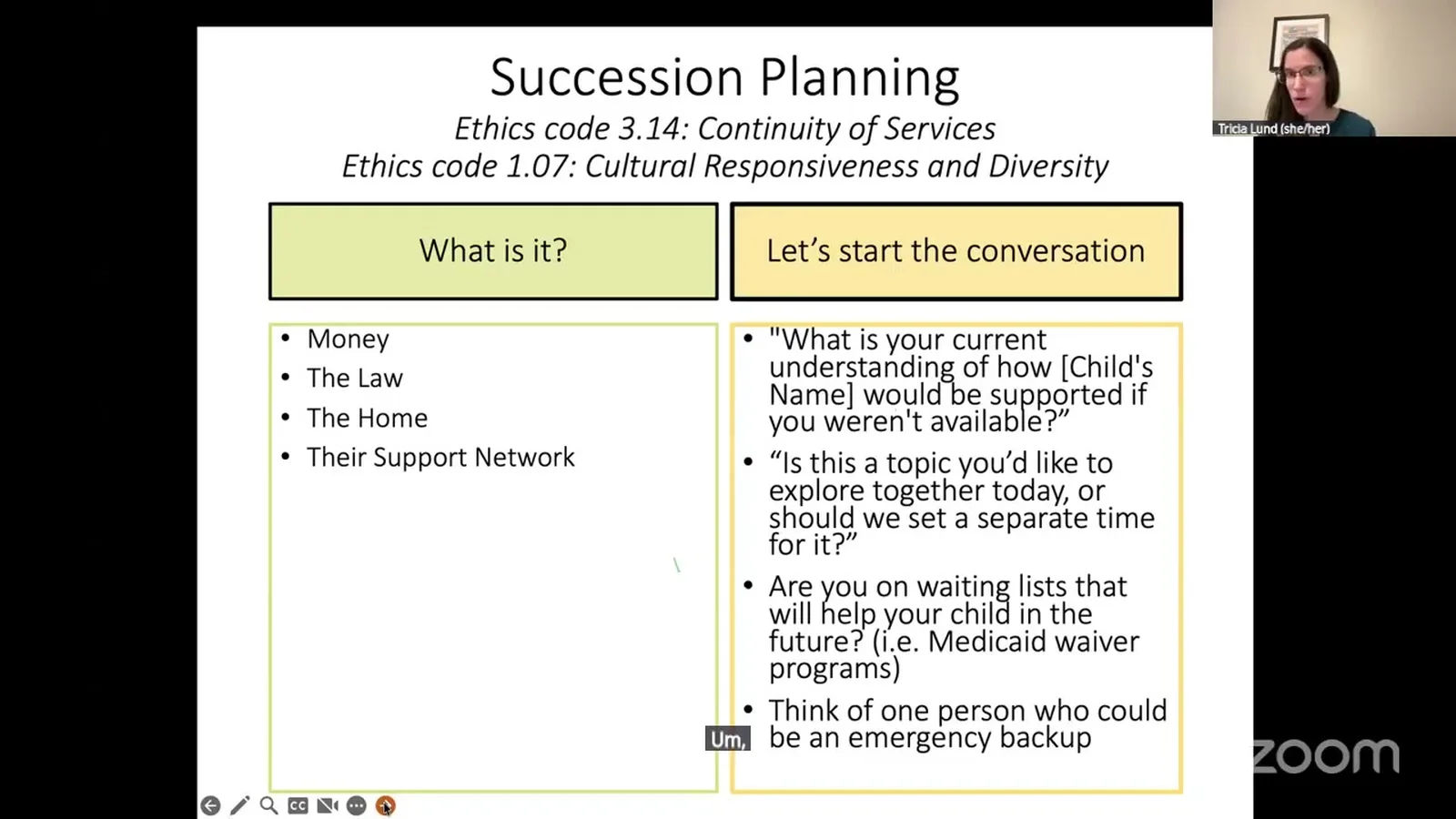
Month four. Identify a senior BCBA you can pay for a one-off supervision consult. Begin drafting succession planning conversations into your initial parent interviews, even on non-grief cases. This is how you spot the gap before the loss happens.
Month five. Take your first grief case with supervision. Write up everything. Bring the case to your consult.
Month six. Audit your last six months. What surprised you? What would you do differently? Update your client interview template, your behavior plan template, and your staff training materials.
That is the plan. It is not glamorous. It works because every step builds on the one before it.
How to know you are ready to take a grief case#
You are ready when you can do four things without thinking.
One: define grief in behavior analytic terms in a single sentence that a parent could follow. Patricia's framing of grief as a behavior change following the loss of a significant reinforcer is a fine starting point. Make it your own.
Two: name three to five setting events that change how a person grieves. Relationship to the person who died. How the death happened. History of trauma. Cultural context. Degree of dependence on the person who died. If you can rattle those off in a team meeting, you have the literature in your bones.
Three: explain the difference between primary loss and secondary loss to a group home staff member in two minutes. If you can do that, you can write a plan that protects the client's support network when the family network shrinks.
Four: name the limits of your scope without flinching. You are not a therapist. You do not diagnose prolonged grief disorder. You do not run grief therapy. You build behavior plans that reduce challenging behaviors, you advocate for the client, you collaborate with the LPC or social worker who is doing the therapy work, and you train staff and family on what grief responses look like so they stop getting punished as "behaviors."
When all four of those feel automatic, take the case.
FAQ#
How does a BCBA build competence for grief cases? Read the six or seven BCBA-authored UK grief papers, take ADEC coursework in thanatology, follow disabled self-advocates such as the Irene Tuff Rewind interviews, observe a community grief support group, and take your first case under supervision from a BCBA who has done grief work before.
What is ADEC and is it worth it for BCBAs? ADEC is the Association for Death Education and Counseling, the professional home for thanatology. The coursework covers cultural mourning practices, child and adult bereavement, and clinical applications. You do not need to be a counselor to attend, and a BCBA can absolutely benefit from the webinars and certificate tracks. It is worth it if you plan to take grief cases regularly.
Are there ABA-specific grief research papers I should read? Yes. There are roughly six or seven peer-reviewed papers, mostly out of UK BCBA researchers including Karola Dillenberger and Mickey Keenan, that frame grief in behavior analytic terms. Start there, then expand to Maureen Oswin's foundational book Am I Allowed to Cry on disability and mourning.
Do I need a separate certification to support grieving clients? No separate certification is required to support grieving clients within your BCBA scope, which means behavior support, family training, advocacy, and collaboration. You do need additional training (ADEC, supervised cases, support group observation) to be competent. If you want to provide grief therapy itself, you need a counseling license, which a BCBA does not have.
How long does it take to feel competent in grief work? Six months of focused study (papers, ADEC, support group observation, one supervised case) will get you to your first independent case. Real fluency takes years of repeated case experience plus ongoing reading. Plan to stay a student of the topic for as long as you take the cases.
Take the source CEU#
This entire plan grew out of one free CEU from Patricia Lund. If you have not watched it yet, start there before you start the reading list.
Turn this topic into a CEU
You just studied this. Now get credit for it.
Watch Increasing Competence and Confidence in Helping People with Disabilities through Grief with Patricia Lund and earn 1 free BCBA CEU. Detailed certificate, delivered the moment you finish.
Keep going with a free learning path
Culturally Responsive Practice
Makenzie Sandler's three-part series on culturally responsive practice, each worth an ethics CEU. Cultural competence in clinical work, unconscious bias and values, then culture across teams and systems using OBM.