BACB Code 1.08: Non-Discrimination and Cultural Responsiveness in ABA
Code 1.08 examples on bias in BCBA practice, cultural humility scripts, and how to adapt goals to family values from a BCBA-led CEU.
Key takeaway
BACB Code 1.08 is the rule that Dwight Schrute breaks the second he says "no one would ever believe that she would be a boss" in his sales role-play, and this guide turns that scene into a pre-intake bias checklist, scripts for asking about family values, and a manager response when a coworker says something biased so your team handles culture with BST, not slides.
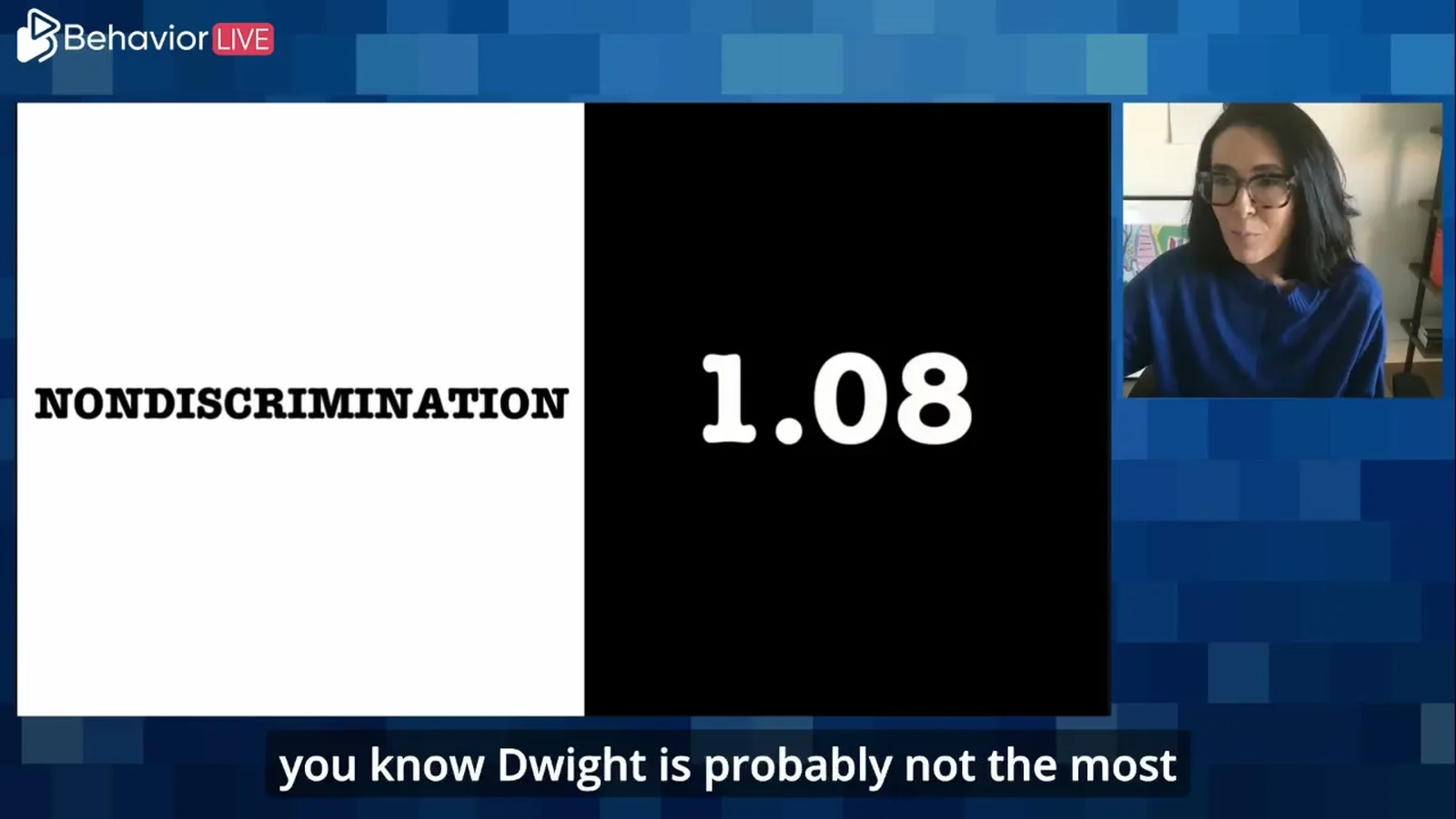
Dunder Mifflin’s Guide to BCBA Ethics: Lessons from The Office
Free learning path on this topic
Your 4 Ethics CEUs, Done
Four ethics CEUs in three courses, all free. Start with Matt Harrington's assent and data course, then ethical guardrails in behavior reduction, then cultural considerations in clinical practice. Every course carries ethics credit, so this path covers the BACB requirement with nothing to buy.
On this page · 9 sections▾
BACB Code 1.08 is the rule that Dwight Schrute breaks the second he says "no one would ever believe that she would be a boss" in his sales role-play, and this guide turns that scene into a pre-intake bias checklist, scripts for asking about family values, and a manager response when a coworker says something biased so your team handles culture with BST, not slides.
What 1.08 says and why it covers more than race#
Code 1.08 tells behavior analysts not to discriminate against clients, families, or coworkers based on age, race, ethnicity, national origin, religion, gender, gender identity, sexual orientation, disability, language, or socioeconomic status. Most BCBAs read that list and think "race." The list is much wider than that.
Picture a family that speaks Tagalog at home, a dad who works third shift, a mom who wears a hijab, a teen client who uses they/them pronouns, or a household on Medicaid in a rural county. Each of those is a 1.08 surface. The code applies to all of them. It also applies to your team. A tech who jokes about an accent or a supervisor who skips a Sunday session because "they should just come to clinic" can both put you out of compliance.
The rule has two halves. The first half says "do not discriminate." The second half is bigger and harder. It says you should be culturally responsive. That means you change how you assess, write goals, run sessions, and train staff so the work fits the family's culture, not yours.
The Dwight mistake: assuming you know what the family needs#
In the recording, Dwight role-plays a sales call with a female buyer. He says, "I will tell her what her needs are and then fill them." Mellanie Page uses it as the punchline of the whole code.
BCBAs do the same thing all the time, just with nicer words. We walk into a home, run a VB-MAPP, score the deficits, and write a goal bank. We pick targets because the assessment said so. We never stop to ask if the family even cares about those targets.
The fix is to remember what "socially significant" really means. Page calls it out cleanly: socially significant means significant to the family, not significant to us. If the family does not care that their kid can label 50 community helpers, that is not a socially significant goal. It is a goal you picked because the protocol said to.
"I will tell her what her needs are and then fill them." That line is the whole 1.08 violation in one sentence.
Bias check questions to run before every intake#
Run this list before you walk into the first session. Five minutes. Pen and paper or a note in your phone.
- What do I already think about this family based on the referral form alone? Write it down.
- Where did that thought come from? A past client? A stereotype? A guess?
- What language do they speak at home, and have I asked or assumed?
- What does a "good outcome" look like to me right now, before I have met them?
- Whose values is that outcome based on?
- What am I going to do if their values do not match mine?
- Is there a person on my team who shares part of this family's background who could mentor me on this case?
That last one matters. Cultural humility is not a slide deck. It is asking a coworker for a real conversation before you make a treatment plan that ignores half the family's life.
How to ask about family values without being awkward#
A lot of BCBAs skip the values conversation because they do not know how to start it without sounding like a survey. Use these scripts during the intake or the first parent meeting. Pick one, rehearse it once out loud, then use it.
Script 1, the warm open: "Before we write any goals, I want to learn what matters most in your home. What does a good day look like for your family?"
Script 2, the traditions question: "Are there family routines, holidays, or traditions you want us to know about so we can plan around them and include them?"
Script 3, the language and identity question: "What language do you speak at home? Is there a name or pronoun your child prefers that we should use from day one?"
Script 4, the dealbreaker question: "Is there anything in ABA you have heard about that worries you, or anything you do not want us to do? I would rather hear it now than find out later."
Script 5, the religion and morals question: "Are there beliefs or practices in your family that should shape how we set goals, like food rules, prayer times, or how kids are expected to greet adults?"
You do not need all five. Pick two. The point is to ask, write the answer down, and bring it into the treatment plan.
Adapting goals to honor traditions, religion, and identity#
Once you have answers, the goals have to change. Here is what that looks like in practice.
A family that prays five times a day does not need a goal that says "remain seated during all instructional time." They need a goal that builds tolerance for transitions in and out of prayer. Same skill. Different wrapper.
A Deaf parent does not need a goal that says "responds to vocal mand." They need a goal that says "responds to mand in the family's primary modality," which may be ASL.
A family that values respect for elders may not want their child to be taught to "advocate by saying no to adults" in the way a Western parenting book frames it. You can still teach assent and refusal. You just teach it in a way that fits how the family talks to grandparents.
A trans teen client does not need a social skills goal that uses the wrong name. Update the program. Update the data sheet. Update the way the team talks in session.
The skill underneath the goal usually stays the same. The topography and the context change to match the family. That is the whole job.
"We don't know everything about everyone or their differences. Accept those and ask with curiosity, not judgment."
Training your team using BST, not just slide decks#
Most agencies handle 1.08 with a 20 minute video and a sign-off sheet. That is not training. That is documentation. Page is direct about it. Recorded training is the floor. BST is what actually changes behavior.
A real BST loop for non-discrimination looks like this:
- Instructions. Walk the team through the code, with examples from your actual caseload, not stock scenarios.
- Model. You, the BCBA, role-play the right way to ask a family about their religion or how to respond when a tech says something off.
- Rehearsal. Each team member practices the script out loud with you or a peer.
- Feedback. You score them on tone, word choice, and follow-up question. Specific feedback, not "good job."
- Repeat until fluent. One pass is not fluent. Three passes with feedback might be.
Document the BST in the same file where you store the slide-deck completion. Now you have a record that the training was experiential, not just watched.
What to do when a coworker says something biased#
This is the moment most supervisors freeze. A tech says something about a family's religion, weight, accent, or income. You hear it. Now what.
Step one, do not wait. Address it in the moment if it is safe to, or pull them aside within the hour. Waiting a week tells the team it was not a big deal.
Step two, use a one-line script. Try: "I want to flag something you said about that family. It landed in a way that does not fit how we practice here. Can we talk about it?"
Step three, listen first. Most biased comments come from a place the person has never examined. Ask what they meant. Do not lecture.
Step four, name the code. Bring up 1.08 by number. Show them the language. This is not your opinion. This is the BACB.
Step five, plan the repair. If it affected a client or family, decide what you owe them. If it was a one-time comment, plan how the tech will catch it next time. If it is a pattern, that is a documentation and supervision issue, not just a chat.
Step six, write it down. Date, what was said, what you said back, what the plan is. This is how you protect the family, the tech, and yourself.
FAQ#
What does Code 1.08 prohibit? Code 1.08 prohibits discrimination against clients, families, supervisees, and coworkers based on protected categories, and it also requires culturally responsive practice. That second part is what most people miss. You can violate 1.08 by being passive, not just by being hostile.
Is it discrimination if I refuse a case outside my competence? No. Code 1.06 says you stay inside your scope of competence. If you refuse a case because you genuinely cannot serve them well, that is not discrimination. The 1.08 question is what you do next. Do you do the reading, find a mentor, and grow into it, or do you just keep passing every case like it?
How do I write a goal that respects a family's culture? Start with the skill the child needs. Then ask the family how they want it taught and what context it should show up in. Rewrite the operational definition so the target behavior fits their home. Keep the underlying skill. Change the wrapper.
What is cultural humility in ABA? Cultural humility is the practice of admitting you do not know everything about a family's background, asking with curiosity instead of assuming, and letting the family teach you how to serve them. It is the opposite of cultural competence as a checkbox.
How do I document non-discrimination training for my team? Document both pieces. Log the didactic training, the video, the slide deck, with date and signature. Then log the BST piece separately, with role-play scenarios, who rehearsed, who scored them, and what feedback was given. If you only have the first piece, you have a paper trail. If you have both, you have actual training.
Keep going#
If this opened anything up for you, the full CEU pairs 1.08 with four other codes and adds the chat-driven examples you cannot get from a written guide.
Turn this topic into a CEU
You just studied this. Now get credit for it.
Watch Dunder Mifflin’s Guide to BCBA Ethics: Lessons from The Office with Mellanie Page and earn 1 free BCBA CEU. Detailed certificate, delivered the moment you finish.
Keep going with a free learning path
Your 4 Ethics CEUs, Done
Four ethics CEUs in three courses, all free. Start with Matt Harrington's assent and data course, then ethical guardrails in behavior reduction, then cultural considerations in clinical practice. Every course carries ethics credit, so this path covers the BACB requirement with nothing to buy.