When Is Punishment Actually Ethical in ABA?
Honest answers on when punishment procedures are defensible, when they are not, and the questions to ask first, from a BCBA-led CEU.
Key takeaway
If you want to know when a punishment procedure can be ethical in ABA, you need a four-question test before you write a single line of the plan, and you need to be honest that even Non-Contingent Reinforcement (NCR) and extinction can be "the hammer" when you use them to just whack a behavior down.
Ethical Guardrails in Behavior Reduction
On this page · 8 sections▾
If you want to know when a punishment procedure can be ethical in ABA, you need a four-question test before you write a single line of the plan, and you need to be honest that even Non-Contingent Reinforcement (NCR) and extinction can be "the hammer" when you use them to just whack a behavior down. This page is about the gray zone, not a checklist. Compassionate intent does not equal compassionate behavior, and "safety" gets used to justify a lot of procedures that would not pass a careful read. The four questions below come from the same guardrails that Matt Harrington uses to evaluate any reduction procedure, including punishment.
Why "is punishment ethical" is the wrong question#
The question most people are really asking is "is this specific punishment procedure, for this specific learner, in this specific context, defensible right now?" That is a much harder question, and it is the only one worth answering. The Behavior Analyst Certification Board (BACB) does not ban positive punishment. The ethics code asks you to use the least restrictive procedure that is likely to work, to get informed consent, and to keep the client safe. None of that tells you what to do on a Tuesday with a learner who is hitting staff six times an hour.
Here is the harder truth. A lot of procedures we call "kind" can do harm if you use them without thinking. NCR can flood a learner with reinforcement and stall skill building. Extinction can produce hours of crying for a learner who already has a trauma history. And a clean response cost can be lower harm than either, in the right case. The label on the procedure does not decide the ethics. The application does.
Procedures and interventions are not inherently trauma informed or trauma causing. The application of the procedures is what matters. A single function functional analysis is not automatically more traumatic than a practical functional assessment with synthesized reinforcers. Similarly, extinction and escape extinction are not automatically trauma providing while NCR isn't. From the talk — Matt Harrington
So stop asking if punishment is ethical. Start asking if this plan, for this learner, clears the four-question test.
The four-question test before any aversive procedure#
Before you write a punishment procedure, run these four questions in order. If you cannot answer "yes" to all four, the plan is not ready.
1. Have you ruled out a skill-building path that would work in the same time window? This is the building resistant repertoires guardrail. If a teaching plan, a replacement skill, or a tolerance shaping plan could reasonably reduce the behavior in the same timeframe, that is the path. Punishment is not a shortcut for a teaching gap.
2. Is the behavior dangerous enough, or impairing enough, to justify the cost? The cost includes the learner's trust in you, the risk that the procedure generalizes to staff fear, and the risk of side effects. A behavior that puts the learner or others in real danger may meet this bar. A behavior that annoys staff does not.
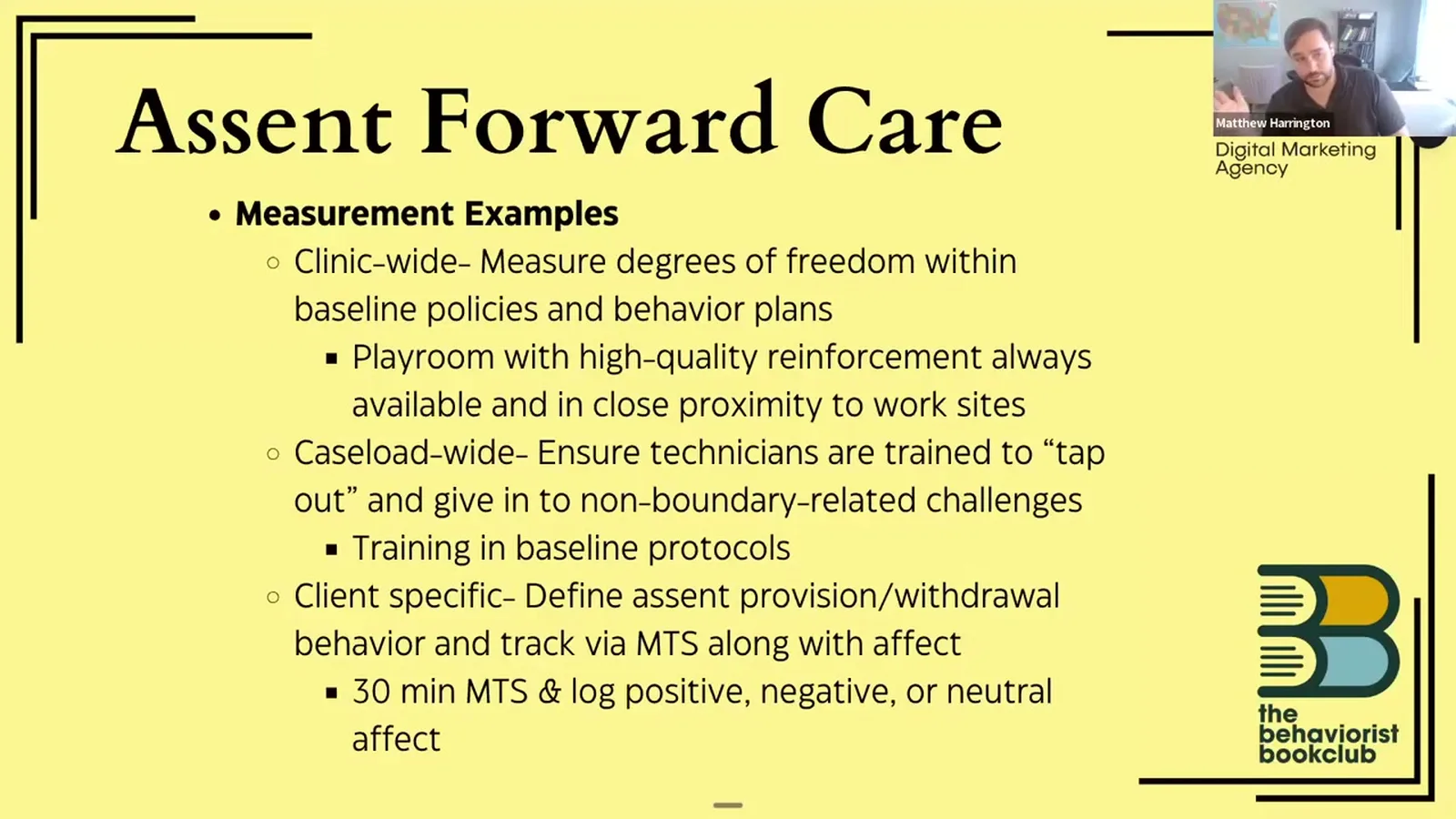
3. Do you have continuous assent, not just one-time consent? Caregivers need to understand what the procedure is, what the side effects could be, and what their stop signal is. The learner, even one who cannot speak, gives you assent and withdrawal signals all day. If you do not have a way to track those signals, you are not ready.
4. Can you defend this plan in writing, in front of a clinician you respect, in a year? If the answer is "I would not put my name on this in a public record," stop. The ethics code does not protect a plan you would not defend out loud.
That fourth question is the one most people skip. It is also the one that, in Matt's experience running severe behavior cases, sorts the defensible plans from the ones that just felt urgent at the time.
Where extinction stops being learning and starts being harm#
This section is in a page about punishment because extinction is, in practice, where most "is this still okay" calls land. Extinction is everywhere in ABA. Every shaping plan uses small extinctions. You reinforce 10 seconds of tolerance, then 15, then 20, and you stop reinforcing the shorter intervals. That is learning. That is fine.
Blatant, full-on extinction is different. Holding a demand through a 90-minute escalation, refusing all access to the reinforcer, riding out an extinction burst that includes self-injury, that is the line. The procedure itself is not the problem. The risk profile is. Extinction is, as Matt puts it, an "assent possible" procedure. It can be done with assent. But it usually is not, because the burst phase is where assent breaks down.
How do you know you have crossed from learning into harm? Three signals.
- The learner is losing skills they had before, like coming to the table, greeting you, or asking for help.
- Second order effects are showing up at home or at school. The caregiver tells you the learner does not want to come in anymore.
- You are running the procedure because the data point is moving, not because the whole client is moving.
That last one is the trap. Matt described a potty training case where the targeted data looked great, transitions were happening, the goal looked like a win, and the caregiver came in and said the learner was refusing to come to sessions. The intervention was working on its narrow target and pulling the rest of the relationship apart at the same time. That is when extinction has stopped being learning.
Building resistant repertoires means approaching challenges constructionally and building on current skills and adding new ones versus just focusing on whacking the behavior down with a hammer. Whether that hammer be NCR or extinction, teaching replacement skills. From the talk — Matt Harrington
If a punishment procedure is on the table, you should be asking the same questions about your current extinction plan. The two procedures sit in the same gray zone.
Compassionate intent does not retroactively justify the procedure#
This part is uncomfortable. Most of us in ABA have run a procedure in the past that we would not run today. The honest response is not "I did not mean to cause harm." The honest response is "I caused harm, and I am going to do this differently now."
There's a difference between compassionate intent and a compassionate behavior. When I talk about causing no further harm or acknowledging past and potential trauma by you and others, oftentimes one of the responses to that is, well, I didn't mean to cause harm. I just didn't know any better. From the talk — Matt Harrington
What this means for your current plan. If a parent or a previous BCBA tells you that a punishment procedure was used and the learner has a trauma history with it, you do not get to run a similar procedure now because your intent is good. The learner's nervous system does not read your intent. It reads the procedure. Choose differently.
It also cuts the other way. Assent forward care does not mean you back off the second the learner gets uncomfortable. Learners have, as Matt put it, the right to be uncomfortable in service of a larger goal. Weightlifting is uncomfortable. Saving for retirement is uncomfortable. Hard tolerance work is uncomfortable. The question is whether the learner is choosing to be in the position they are in, not whether they are smiling through it.
The right to be uncomfortable in service of a larger goal. Which is why ascent forward care is not just backing off as soon as anybody gets uncomfortable. From the talk — Matt Harrington
So a defensible punishment procedure can include discomfort. What it cannot include is harm to a learner who has not given you the means to know whether they are choosing it.
Documenting the analysis: what a defensible punishment rationale looks like#
If you are going to include a punishment procedure, the written rationale needs to cover six things. Not three. Six.
- The function. What does the behavior get the learner, and what skill gap is making this function dominant?
- The skill-building plan you tried first, or are running in parallel. If there is no parallel teaching plan, the punishment plan is not defensible.
- The behaviors you ruled out as less restrictive, and why. Differential reinforcement, response interruption and redirection, NCR, antecedent change. List them. Say why each one is not enough on its own.
- The risk of the behavior if you do nothing more. Be specific. "Self-injury producing hospitalization three times in the last six months" is specific. "Aggression" is not.
- The continuous assent plan. How you are going to know, every 15 or 30 minutes, whether the learner is still assenting to the procedure. Momentary time sampling on a defined assent indicator is one way. There are others.
- The stop conditions. What data, what side effect, what caregiver report ends this procedure. Write it down before you start.
If your behavior plan has 20 reduction targets, you cannot do this level of analysis for all of them. That is also a sign. As Matt puts it, you probably need two reduction goals that really matter, not seven that fill out a plan. Pick the ones that move quality of life. Track the rest. Do not pretend you are analyzing 20 things at this depth.
When the answer is just no#
Some procedures do not pass the test no matter how you frame them. Procedures that produce tissue damage. Procedures that require physical restraint as the main mechanism. Procedures that the learner has a documented trauma history with. Procedures that are running because staff are burnt out, not because the learner needs them.
The hardest "no" is the one you say to yourself when the plan is already written, the team is trained, and the caregiver is asking why progress is slow. Saying no there costs you something. Saying yes there costs the learner more.
Frequently asked questions#
Does the BACB Ethics Code prohibit positive punishment? No. The code requires you to use the least restrictive procedure likely to work, to get informed consent, and to keep the client safe. Positive punishment is allowed when those conditions are met and documented. The code does not give you a blanket permission either. The defense lives in your written rationale, not in the procedure category.
Is response cost considered punishment under the ethics code? Yes. Response cost is a punishment procedure, technically negative punishment, because it removes a stimulus to reduce a behavior. It is often lower harm than positive punishment, but it is not exempt from the four-question test. The same rules apply: skill-building path ruled out, risk of behavior justifies the cost, continuous assent, defensible in writing.
Can I include a punishment procedure if the parent specifically requests it? Parent request alone is not enough. You still need to run the four-question test. If the procedure is not the least restrictive option likely to work, the answer is no, even if the parent is asking for it. Your job there is to walk the parent through the alternatives you considered and why you chose the path you chose. Informed consent is a conversation, not a signature.
Keep going#
If you found this useful, the source CEU walks through the full guardrails framework that powers this decision tree, including the constructional approach and how to use degrees of freedom to evaluate any reduction plan. You can watch it here:
Turn this topic into a CEU
You just studied this. Now get credit for it.
Watch Ethical Guardrails in Behavior Reduction with Matt Harrington and earn 1 free BCBA CEU. Detailed certificate, delivered the moment you finish.