The Ethics of Behavior Reduction in ABA: A Working Framework
How to evaluate behavior reduction plans against three ethical guardrails, with caseload-level tools and case examples from a BCBA-led CEU.
Key takeaway
The ethics of behavior reduction in ABA come down to three guardrails (cause no further harm, continuously informed and assented to, and build resistant repertoires) and one hard rule most plans break: a Board Certified Behavior Analyst (BCBA) cannot ethically analyze a Behavior Intervention Plan (BIP) that lists twenty separate behavior reduction targets, so most plans are ethically over-extended on day one and need to be cut down to the two goals that actually move quality of life.
Ethical Guardrails in Behavior Reduction
On this page · 7 sections▾
The ethics of behavior reduction in ABA come down to three guardrails (cause no further harm, continuously informed and assented to, and build resistant repertoires) and one hard rule most plans break: a Board Certified Behavior Analyst (BCBA) cannot ethically analyze a Behavior Intervention Plan (BIP) that lists twenty separate behavior reduction targets, so most plans are ethically over-extended on day one and need to be cut down to the two goals that actually move quality of life.
Why a checklist of rules will not protect your clients#
If you came up in ABA the way most of us did, ethics was taught as a list. Get consent. Use the least restrictive procedure. Do not cause harm. Check, check, check. The problem is that the list does not tell you what to do on a Tuesday at 2:14 p.m. when your tech is leaning on escape extinction harder than the plan says to and the kid has stopped looking at her.
A checklist treats ethics as a one-time event. You did the thing. You filed the form. You are done. But the actual work changes every session. Treatment fidelity drifts. Staff try something new and keep doing it. A goal gets met and three new ones quietly get added. None of that shows up on the checklist, and none of it triggers a re-review.
ethics not as a set of rules, but rather as guardrails. And I think as BCBAs who like our step one, step two, step three type thinking, ethical guardrails has been a really good way of modifying, becoming more flexible, and thinking about things less as a to-do list or a don't-do list. From the talk — Matt Harrington
Guardrails are values, not procedures. They are the lines you keep the intervention between. The intervention bounces off one, you correct. It drifts toward the other, you correct again. The job is not "did I check the boxes." The job is "is the work still between the lines today."
The three guardrails: harm, assent, building repertoires#
These are the three I use. They are not the only three you could pick. The point is to have a set and apply them on top of every behavior reduction plan you write.
1. Cause no further harm. This means three things at once. You acknowledge that past ABA, including yours, may have caused harm even when the intent was good. You listen to the whole client, not just the target graph. And you look for second and third order effects (the things that change because of your intervention even though they were not the target).
The gut-punch example here is a potty training case. The graph said success. Peeing on schedule. Transitions back and forth. Clean data. Then the parent said the kid stopped jumping out of the car for ABA, stopped talking as much, did not want to come in. The potty training had eaten the natural reinforcers that made ABA the place the kid wanted to be. The target moved. Everything else moved with it. The graph never showed that.
Compassionate intent is not the same as compassionate behavior. You can mean well and still cause harm. What the field needs is the behavior, not the feeling about the behavior.
2. Continuously informed and assented to. Consent is the legal version (the caregiver signature on the BIP). Assent is the behavioral version (the client is currently choosing to participate). Both have to be continuous, not one-time.
Every time you change the intervention under a 5-5 code review, the caregiver should get fresh information so they can keep choosing in. You do not need a new signature on every tweak. You do need a real conversation. And on the client side, you need a way to actually measure whether they are still in. A five-year-old changes their mind thirty times in thirty minutes. Your client gets eight-hour sessions. The math on "they signed in at 8 a.m. so we are good until 4 p.m." does not work.
3. Build resistant repertoires. This is the skill acquisition guardrail. Behavior reduction without skill building is whacking behavior down with a hammer (extinction, non-contingent reinforcement, blocking). Building resistant repertoires means you are also teaching the skills that make the behavior unnecessary, and you are designing the discharge plan from day one. This is the constructional approach: where do you want this client to go, what skills do they need to get there, and what will keep them going once they arrive.
Said another way: the three guardrails line up with assent-forward care, trauma-informed care, and the constructional approach. They are not new frameworks. They are the frameworks the field is already converging on, treated as the floor of a behavior reduction plan instead of optional add-ons.
How to run a monthly ethical audit on every behavior plan#
Once a month, pull every BIP on your caseload and ask three questions per plan.
- Has this intervention bounced off a guardrail since last review? Look for staff variability, fidelity errors, anything you tried mid-month and kept doing without thinking through long-term effects, anything the parent flagged. Write down what bounced and what you did about it.
- Is the assent data still telling you yes? If you are running momentary time sampling on assent (more on that below) and the plan is sitting at 60% assent provision, the plan is outside the guardrail. Modify it before next month.
- Are second and third order effects still acceptable? The target is moving. What else is moving? Communication, mood at drop-off, sleep, sibling behavior, parent reports. If any of those got worse while the target got better, the plan needs work.
Those guardrails that you need to keep your intervention between, it's not as simple as just one time thinking about it and then staying within that the rest of the time. Rather, what happens is as your intervention changes and modifies, you go from one guardrail and bounce and have to redirect. From the talk — Matt Harrington
Treat this audit like you treat Interobserver Agreement (IOA) and fidelity. It is not optional. It is part of the cadence.
The two-goal rule: why most behavior plans are ethically over-extended#
This is the one that will get pushback from insurance reviewers, but it is the right answer.
I can tell you. From experience. You cannot provide. The necessary level. Of analysis. And care. To a client. Across. 20 different. Behavior reduction interventions. That operate separately. You have to. Specifically. Focus. On the ones. That are really going to move. The needle. From the talk — Matt Harrington
Pick two behavior reduction goals per client that genuinely move quality of life. Those are your primary goals. They get the analysis, the assent tracking, the trauma-informed modifications, the constructional alternatives. The rest are secondary. You still track them. You still report on them. But you are not pretending you can ethically design and supervise twenty separate behavior reduction protocols at the level each one would need.
The honest version of this is that a BIP with twenty targets is a BIP where eighteen of them are getting box-checked instead of analyzed. The guardrails cannot hold on a plan that big. Cut it down. Tell the parent why. Document the rationale. The Behavior Analyst Certification Board (BACB) Ethics Code does not require you to overreach.
This is the gray zone the field does not love to name. Insurance pays per goal. Cutting goals can feel like leaving authorization on the table. Do it anyway. The alternative is ethical drift you can predict from the paperwork.
Common drift patterns that push interventions outside the guardrails#
Three patterns account for most of it.
Fidelity drift. A tech is running the plan, but not the way it is written. The deviation is small at first. Then it compounds. You catch it on a session observation and the plan has effectively been a different plan for two weeks.
Improvisation drift. You tried something new on Tuesday. It worked. You kept doing it. You never wrote it into the plan. You never thought through long-term effects. The plan on paper and the plan in practice are now two different documents.
Reinforcer drift. The intervention is technically working, but it ate the natural reinforcers that made the setting work. Potty training that kills the kid's love of coming to ABA. A demand fading procedure that quietly makes the table the worst place in the clinic. The target graph still looks fine.
Things that can throw guardrails off course are anything from treatment fidelity errors, a staff member not applying the intervention as expected, to you trying something new one day and then sticking to it without thinking about the long-term effects. From the talk — Matt Harrington
The monthly audit catches all three if you actually run it. None of them get caught by a one-time consent signature.
Writing your own guardrails (and why mine should not be yours)#
The three guardrails above are mine. They are not the only set. The exercise that matters is writing your own and then sticking to them.
Start by looking at the plans on your caseload and asking what made you uncomfortable in the last six months. The discomfort is data. It usually points at a value you have but have not named yet. Name it. Make it a guardrail. Apply it the next time you write a BIP.
A few practical commitments that tend to show up in clinician-written guardrails:
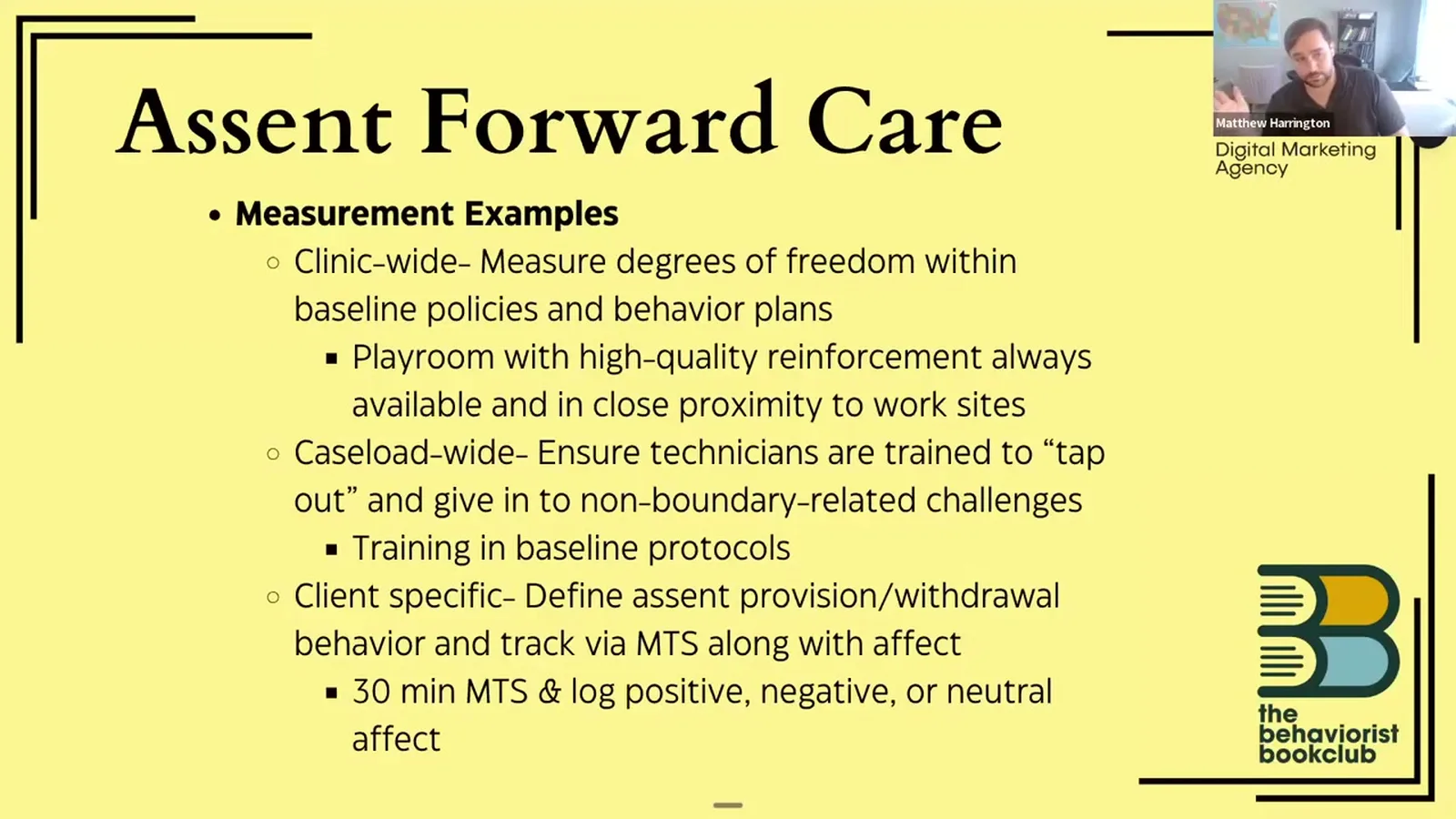
- A baseline momentary time sampling cadence (every 15 or 30 minutes) for assent provision on every client, written into the plan, not optional.
- A "tap out" rule for techs: a list of behaviors that are not boundary violations and should be let go rather than enforced. This is a staff training artifact, not a BIP line.
- A degrees of freedom check on every reinforcer: the client must have more than one path to a reinforcer of equivalent value. If there is only one path, the assent on that path is coerced even when it looks compliant.
- A discharge plan written at intake, not at the 90-day review.
Your set will be different from mine because your blind spots are different. The point is to have them written down so a tech, a Registered Behavior Technician (RBT), or a supervisor can hold you to them.
Frequently asked questions#
Does the BACB Ethics Code require continuous ethical review of behavior plans?
The Code requires you to monitor and modify interventions based on data and to keep consent informed as conditions change. It does not specify a monthly audit cadence. That is a clinical decision. Most clinicians who take the guardrail approach land on monthly, because that is roughly the rate at which fidelity, improvisation, and reinforcer drift compound enough to show up.
How is an ethical guardrail different from a clinical decision tree?
A decision tree tells you what to do next. A guardrail tells you what to stay between while you decide. The tree is a procedure. The guardrail is a value. You can run any decision tree inside the guardrails, but the guardrails are what tell you when the tree itself has stopped serving the client.
What is the difference between compassionate intent and a compassionate behavior?
Intent is what you meant. Behavior is what the client experienced. You can intend kindness and still run a procedure that the client encodes as harm. The field needs the behavior, not the intent. That is also the honest answer to clinicians who feel guilty about older work: feel the guilt, let some of it go, and change the behavior going forward.
The full talk goes deeper on assent measurement, the constructional approach, and degrees of freedom. If you are about to do a caseload audit, watch it first.
Turn this topic into a CEU
You just studied this. Now get credit for it.
Watch Ethical Guardrails in Behavior Reduction with Matt Harrington and earn 1 free BCBA CEU. Detailed certificate, delivered the moment you finish.