PDA in Toddlers: What It Looks Like Before They Can Tell You
PDA in toddlers: subtle precursors, pretend-play micromanaging, and threshold drops you can spot in early intervention, from a BCBA-led CEU.
Key takeaway
In a 2- or 3-year-old, PDA almost never looks like the school-age version. The signs are quieter. You see a child who micromanages pretend play.
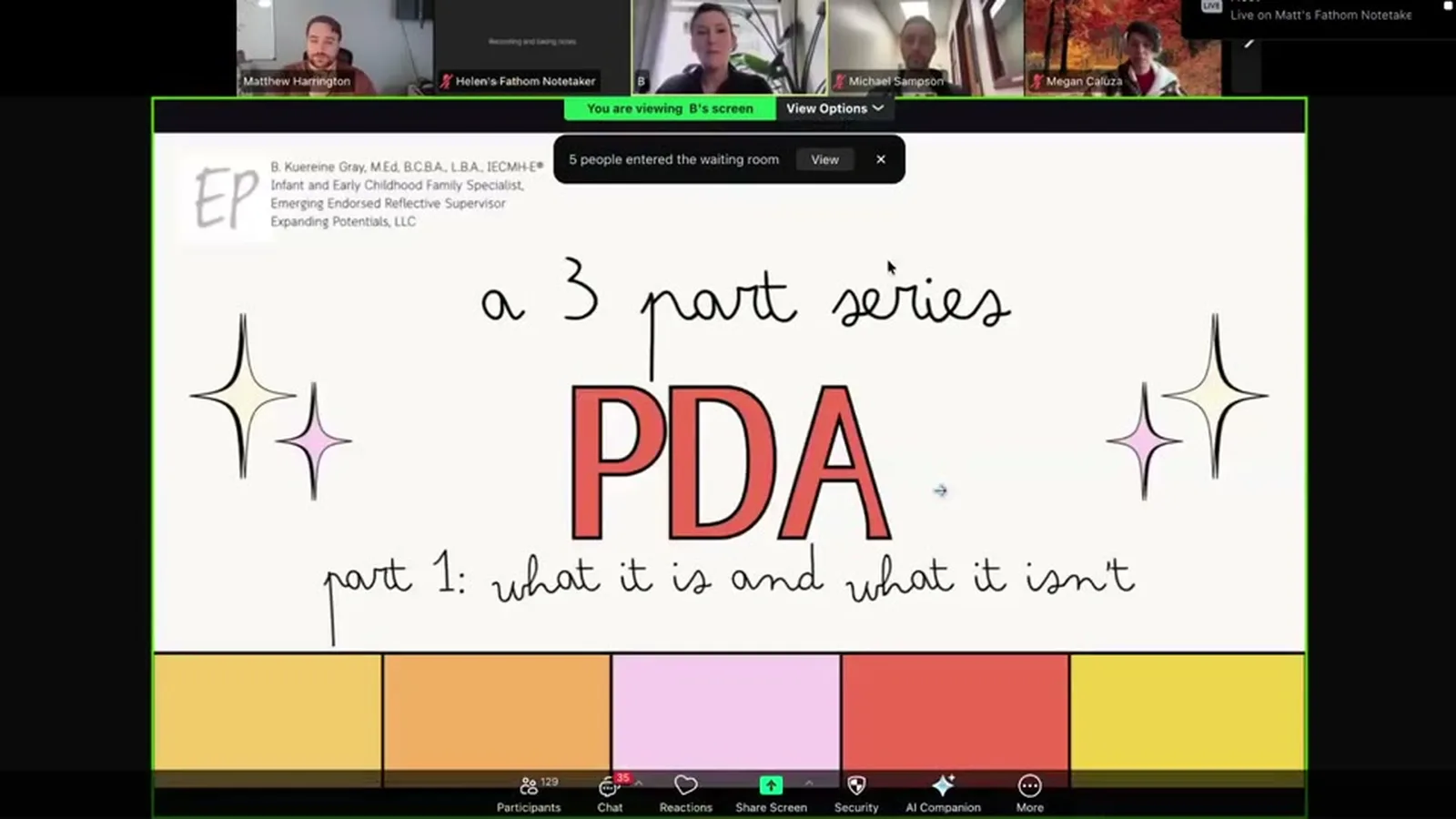
PDA: What it is and What it isn't
On this page · 8 sections▾
In a 2- or 3-year-old, PDA almost never looks like the school-age version. The signs are quieter. You see a child who micromanages pretend play. You see a child who comes home from daycare and falls apart faster each week. You see a child with some words, but the words mostly point one way: telling you how to play, where to sit, what to say. These pre-verbal and early-verbal signs are the ones an EI clinician (Early Intervention, the birth-to-3 system) has to catch, because the child cannot yet describe what is happening inside.
Why PDA in toddlers gets missed in early intervention#
Most PDA write-ups describe a verbal, school-age child. That child can say "I can't." That child melts down at the door before school. A 2-year-old in EI does not present that way. You see the child once a week. You coach the parent. You do not run discrete trials.
So the pattern hides. The child looks social. The child smiles. The child has language, even a lot of it. Many EI providers note the language and stop looking. PDA gets ruled out before it ever gets considered.
There is a second problem. Some toddlers in EI have a language delay or a mixed receptive expressive language disorder (a delay in both understanding and using words). When language is limited, the PDA pattern is muted. The behavioral signs are still there, but they are softer. Bea (Brandy Kuereine Gray, BCBA) said this directly in the talk.
I had an individual who had decreased vocal language expression and they did have a diagnosis of mixed receptive expressive language disorder, and what I noticed is they did not present with as many PDA characteristics. They were still there, but it was not as pronounced until some of their language started to develop. From the talk — B. Kuereine Gray
The takeaway for EI work is small but important. Limited language does not rule PDA out. It only makes it harder to see.
Bella, age 3: what the pattern actually looked like#
Bea ran an EI case in Colorado with a 3-year-old named Bella. The model was parent training, not direct service. Bea saw the family weekly. Bella had a lot of words, but she used them in a narrow way. She was warm. She had dimples. She looked, on the surface, like a typically developing child with some quirks.
The first sign showed up in pretend play.
When it came to cooperative play, we played the same way every time. And if mom tried to move the cars in a different way, then we would direct mom how to play. That doesn't go there. You need to move this here. You need to say this. It was the micromanaging of play that became really difficult. From the talk — B. Kuereine Gray
That is the early signal. Not refusal. Not aggression. Not screaming. Just a quiet, steady takeover of pretend play, every session, with the same scripts.
Micromanaging pretend play as an early signal#
Most PDA write-ups list "obsessive role play" as a feature, but they aim it at older kids. In EI you see a softer version. The child sets the scene. The child casts the parent. The child corrects any move that breaks the script.
This is not a stim. It is not the lining-up behavior you might flag for autism. It is closer to a director's chair. The child needs the play to go a certain way because that way feels safe. When the parent moves a car the wrong way, the child's nervous system reads it as a demand, even though no one made a demand.
For an EI clinician, the question to ask is simple. Does the child let the parent change one thing in play without redirecting? Try moving one car. Try one new line in the script. If every change gets corrected, every time, across sessions, that is a pattern worth tracking.
Threshold drops after school or daycare#
The second sign in Bella's case came from outside the EI session. When the school year started, Bella began attending a preschool program. The afternoons changed. Bea saw it on the next visit.
I started seeing as the school year started, she would go into school, and if I saw her and her caregivers after school, our threshold was significantly decreased. She started saying I want to play my way right away. And then it became I just want to show you things and I'm going to talk at you. From the talk — B. Kuereine Gray
That phrase, "I want to play my way right away," is the signature. It is what threshold collapse sounds like in a 3-year-old. The child has used up her tolerance for outside demands at school. By the afternoon, she has none left for the parent or the EI provider.
The bucket analogy from the talk is useful here. Think of each child as starting the day with a bucket of capacity. A typical child does a demand, takes a short break, refills a little, and is ready for the next one. A PDA child does not refill the same way. Demands stack. By 3 p.m., the bucket is empty. Anything that looks like a demand, even a hello or a question, tips it over.
In a toddler this looks like a fast slide. Bea described what came next with Bella. The directing started. Then the language dropped off. Then ignoring. Then toy lining. Then turning away. Then a screech and running out of the room. That whole sequence might take 4 minutes.
When language is delayed: spotting PDA without words#
If a toddler does not have many words, you cannot rely on "I want to play my way right away" as your signal. You have to read behavior instead.
A few patterns to watch, drawn from Bea's clinical experience with both verbal and pre-verbal kids:
- The child redoes the same play sequence over and over and corrects anyone who departs from it.
- The child uses gesture, body block, or grabbing to control where adults sit, what they touch, what they say.
- The child shuts down (not tantrums, shuts down) when a familiar routine is interrupted, even a preferred one.
- The afternoon presentation is different from the morning presentation, and the gap is widening.
- Cooperative play does not progress, even when receptive language does.
None of these alone is PDA. The pattern is the data. Bea was explicit on this point.
Just because they can't tell you, and it's not as pronounced, there are behavioral indicators. And as providers we want to be aware so that we can tailor interventions so they can be more successful. From the talk — B. Kuereine Gray
If you see three or four of these patterns hold across three or four weeks, that is signal. Document it. Bring it to your supervisor or consult.
What to document before you refer for re-evaluation#
EI clinicians do not diagnose. You should not write "PDA" in a parent-facing report. What you can do is document the pattern carefully and ask the evaluating psychologist to consider it.
A short list of what to capture:
- A sequence, not a snapshot. Note what comes before the behavior, what comes during, and what comes after. Do this across at least 3 sessions. PDA shows up as a chain, not a single event.
- The pretend-play script. Describe the play that the child runs. Note what happens when the parent changes one element. Note the recovery time.
- The threshold map. Compare morning sessions to after-school sessions. Note how fast the slide happens and what triggers it.
- What does not work. If the parent uses a visual schedule, a token board, or first-then language, and it works some days and not others, write that down. Inconsistent response to standard antecedent supports is itself a clue.
- A neutral referral note. Write something the psychologist can use. "I am seeing a reliable pattern of subtle precursors that look more like demand avoidance than oppositional behavior. I would like to refer for re-evaluation with an eye to a PDA-type profile." That is the language Bea used.
Bea's referral with Bella worked because she did this homework first. The pattern did not come out of nowhere. There were subtle precursors that were sequential. Once Bea saw the pattern hold across visits, she made the referral. The evaluator agreed. The team kept the SBT framework (Skill-Based Treatment, an FTF-aligned protocol) but tuned it to give Bella more perceived autonomy. Her threshold for demands rose. The plan worked.
Frequently asked questions#
Can you diagnose a PDA profile in a kid under 4?
You cannot diagnose PDA in EI work. EI clinicians do not diagnose, and in the US there is no formal PDA diagnosis on its own. What you can do is flag the pattern, document precursors, and refer for re-evaluation by a psychologist who knows PDA. Bea's path with Bella is a clean model: spot the pattern, document the sequence, write a neutral referral, let the evaluator decide.
If a toddler has a language disorder, can you still flag PDA characteristics?
Yes. Bea was clear that PDA features can be muted in kids with limited expressive language. They are not absent. They are softer. Watch the behavior, not the words. Look for the script-takeover in play, the threshold drops, the slide from regulated to dysregulated through a chain of small precursors. If those patterns hold over weeks, flag them, even if the child cannot yet tell you "I can't."
What do I tell parents in EI who don't want another evaluation?
Lead with what you see, not with a label. Walk the parent through 2 or 3 specific moments from recent sessions. Show them the chain. Say something like, "I am seeing a pattern that does not respond well to the strategies we usually try. Another evaluator can help us understand what would work better." Avoid promising a diagnosis. Frame the evaluation as a tool to tailor intervention, not as a verdict on the child.
Watch the full talk#
Bea's first session in this 3-part PDA series walks through the Bella case in her own words, plus the Taryn (age 6) and Poppy (age 20) cases that round out the developmental picture. If you are an EI clinician, this is the case that will sharpen your eye for the toddler version of the profile.
Watch "PDA: What it is and What it isn't" on openceu.com
Turn this topic into a CEU
You just studied this. Now get credit for it.
Watch PDA: What it is and What it isn't with B. Kuereine Gray and earn 1 free BCBA CEU. Detailed certificate, delivered the moment you finish.