PDA vs ODD: How to Tell Them Apart in Practice
PDA vs ODD: the four behavior patterns that separate pathological demand avoidance from oppositional defiant disorder, from a BCBA-led CEU.
Key takeaway
The fastest way to tell PDA (a demand-avoidance profile linked to autism) apart from ODD (oppositional defiant disorder) is to ask whether the child is saying "I can't" or "I won't." ODD looks like won't.
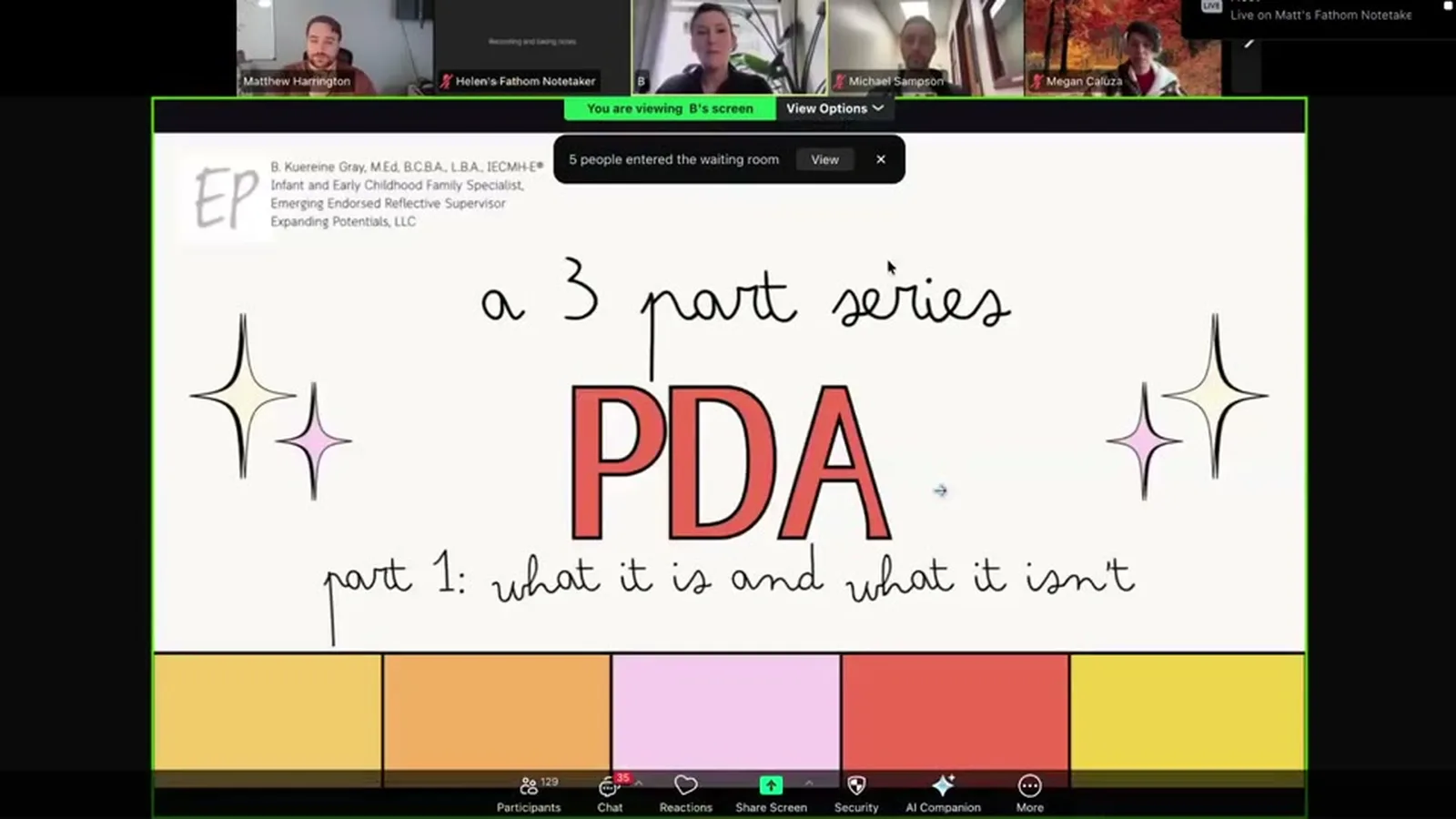
PDA: What it is and What it isn't
On this page · 7 sections▾
The fastest way to tell PDA (a demand-avoidance profile linked to autism) apart from ODD (oppositional defiant disorder) is to ask whether the child is saying "I can't" or "I won't." ODD looks like won't. PDA looks like can't, even when the task is routine and the skills are already there. The behavior on the surface can look the same, but the antecedent, the function, and the treatment plan are not.
PDA vs ODD in one sentence: "I can't" vs "I won't"#
This is the line that flips your case formulation. With ODD, a child has the skills and is choosing not to use them. The refusal is goal-directed. It often pairs with arguing, blame, and a steady push against authority.
With PDA, the child also has the skills. But in the moment of the demand, they cannot access them. The body and brain treat a normal request as a threat. The refusal is not a choice. It is a stress response.
Bea Gray puts the distinction this way in the talk.
It is I can't do this, not I won't do this. And that is consistent in people who have PDA, who discuss it in the PDA Society. Resisting and avoiding ordinary demands. When I talked about having the difficulty with engaging in those routine tasks or routine chains of behaviors, it's not that they're not part of our baseline competencies. It's not that they're novel. It's not that they're low-probability behaviors. It is I can't engage in this. From the talk — B. Kuereine Gray
If your working hypothesis is "won't," your plan probably leans on contingencies, rules, and follow-through. If your working hypothesis is "can't," that same plan will make the refusals worse.
Why ODD was the wrong label (Newsome's 1980s observation)#
PDA did not start as a marketing term. It started because a clinical researcher kept seeing kids who did not fit the ODD picture. Elizabeth Newsome was working with children whose refusals had a different shape, a different trigger, and a different course. ODD framing was leading clinicians to the wrong plan.
Elizabeth Newsome actually started working and publishing identifying characteristics in the 1980s. She started noticing that individuals that she was working with all demonstrated these certain consistencies, these certain patterns of behavior that didn't quite fit in with oppositional defiance. And so she wanted to start looking at, hey, is this something that we can all kind of classify into one group and they can have more tailored interventions. From the talk — B. Kuereine Gray
That history matters at the clinical level. PDA is not a softer way to say ODD. It is a separate pattern that was named because ODD did not explain what the kids were doing. If you have a case where the ODD label feels close but the interventions are not landing, that is the same gap Newsome was looking at.
ODD also tends to load on conduct features. Blame-shifting, vindictiveness, and pushing limits with peers and adults are part of the DSM picture. PDA does not load there. The PDA child often wants connection and is upset that the demand has broken it.
The four behavior patterns that point to PDA, not ODD#
When you are sorting between the two profiles, four patterns from the talk do most of the work. Look for them across more than one setting and more than one demand type.
First, the refusal targets ordinary, mastered tasks. Brushing teeth. Getting dressed. Eating a familiar food. With ODD, refusal often clusters around tasks the child finds boring or unfair. With PDA, the task can be neutral or even preferred and still trigger refusal.
Second, the avoidance comes in layers. The child does not jump straight to a "no." You see soft delays, excuses, distraction, then negotiation, then a sharp escalation. ODD refusals tend to be more steady. PDA refusals look like a ladder.
Third, surface sociability with thin social understanding. The child smiles, mirrors, and seems to track the room. But under that, they miss the rules of give-and-take. ODD does not predict this mask. PDA often does.
Fourth, rapid mood shifts that do not match the size of the event. A bumped knee turns into a meltdown. A small redirect turns into screaming. With ODD, the emotional arc is usually slower and more goal-directed. Bea names the pattern directly.
Then there's the mood lability the inappropriate level of response quick escalation sometimes rapid cycling. From the talk — B. Kuereine Gray
If three of these four show up across home and school, ODD alone is probably not the right frame.
Anxiety as antecedent (PDA) vs defiance as antecedent (ODD)#
This is the antecedent question, and it is the one that should drive your plan. With ODD, the antecedent to refusal is usually a demand the child does not want to meet, paired with a power dynamic they want to push on. The function is access or escape, with control as a side effect.
With PDA, the antecedent is the demand itself, regardless of what the demand is. The nervous system reads "you have to" as a loss of agency, and the body reacts before the child can plan a response. The function looks like escape, but the driver underneath is anxiety about lost autonomy.
The PDA profile individuals tend to demonstrate increased observable behaviors that would align with anxiety-related response classes. It's not an anxiety disorder or social anxiety. From the talk — B. Kuereine Gray
That last line matters. You are not diagnosing an anxiety disorder. You are noting that the response class looks anxious. Heart-rate jumps, freezing, dissociation, and shutdown all show up. ODD does not usually carry that profile.
For your FBA (functional behavior assessment, the formal "why does the behavior happen" workup), this changes the antecedent column. With ODD, you write the demand and the social context. With PDA, you write the demand, the social context, and the cumulative load on the child that day. The same request at 8 a.m. and 3 p.m. can produce very different responses.
When refusal is driven by familiar baseline-competency tasks#
This is the single strongest tell for PDA over ODD. The child is refusing things they can already do, and have done many times, in a calm setting, with the right tools in reach.
With ODD, refusal of mastered tasks happens, but it usually has a reason the child will give you. "It's not fair." "She did it last time." "I don't have to." With PDA, the child often cannot explain the refusal. They may say they are tired, or that something feels wrong, or that they just can't. The story changes from minute to minute because the story is not the driver.
Look at your data. If the same task is completed on Monday, refused on Tuesday, completed on Wednesday, and triggers a meltdown on Thursday, with no clear setting-event pattern in the ODD direction, you are probably looking at PDA threshold load. The demand did not change. The capacity to meet it did.
This is also where token boards, visual schedules, and first-then boards stop being neutral. For an ODD profile, those tools can hold a frame. For a PDA profile, every visible demand on the board adds to the load. The tool meant to help becomes part of the antecedent.
What to do when your assessment is split between the two#
You will have cases where the data points in both directions. The child argues like ODD and shuts down like PDA. Or the child meets ODD criteria on paper and still does not respond to ODD-shaped interventions.
Start by separating the two questions. Question one is descriptive. What does the behavior look like, and across what settings. Question two is functional. What is the antecedent, and what is the response class. ODD is largely a descriptive label. PDA is more about pattern and function. You can hold both at once without contradicting yourself.
Next, run a short intervention probe. For two weeks, treat the case as PDA. Reduce direct demands. Offer choice. Lower the visible demand count. Use indirect language. If the behavior softens, you have a useful signal even without a formal PDA assessment.
If the behavior does not change, you have also learned something. The case is more likely to be ODD or another escape-maintained profile, and your original plan probably needs more contingency strength, not less.
Document both runs in your notes, and tell the family what you saw. You are not over-diagnosing. You are testing two hypotheses against the same child, in order, with data.
Frequently asked questions#
Can a kid have both PDA and ODD on paper?
Yes. A formal ODD diagnosis and PDA characteristics can sit in the same chart, and often do when the child has been in services for years. Treat the ODD diagnosis as the historical record and the PDA characteristics as the working clinical picture. Your plan should follow the picture that responds to intervention, not the older label.
Does the same FBA process work for ODD and a PDA profile?
The structure of the FBA stays the same. You still observe, take ABC data, and look for patterns. What changes is the antecedent column. With a PDA profile, you add cumulative demand load, perceived agency, and threshold state to your antecedent notes. A standard FBA that only logs the immediate trigger will under-call the function.
If the family already has an ODD diagnosis, can I still document PDA characteristics?
Yes, and you should. You are not diagnosing PDA. You are noting a behavioral profile that affects treatment planning. Use language like "characteristics consistent with a pathological demand avoidance profile" in your notes, and tie each one to observed behavior. That keeps you in scope and gives the next clinician a real starting point.
Watch the full talk →. The recording walks through the EDA-8 scoring pattern, three case examples (Bella at 3, Taryn at 6, Poppy at 20), and the spoon-theory framing for threshold load that is hard to capture in writing.
Turn this topic into a CEU
You just studied this. Now get credit for it.
Watch PDA: What it is and What it isn't with B. Kuereine Gray and earn 1 free BCBA CEU. Detailed certificate, delivered the moment you finish.